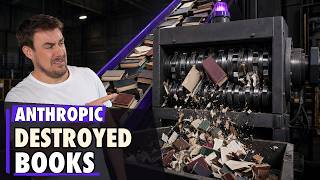
AI lab that ran 'Project Panama,' buying millions of print books, cutting bindings with hydraulic cutters, scanning pages at high speed, and discarding originals to build a private training library; publicly denies buying from Zoom Books or destroying rare or antiquarian books; separately paid $1.5B to settle piracy claims.
Canadian company describing itself as a book recycler; identified by booksellers in the Netherlands, Germany, Australia, and New Zealand as the source of unusually large, oddly timed bulk orders; denies digitizing or destroying books for AI purposes and will not name its customers.
Book metadata and data broker that publicly pitched bulk book acquisition of 1,000 to 1,000,000 books as a compliant path to AI training data, then later claimed to Fortune the service was never launched or used to supply AI companies.
JU
Judge William Alsup (N.D. Cal.)
Presided over Bartz v. Anthropic; ruled in June 2025 that training on legally acquired, digitized books is fair use, but that retaining pirated books was not; approved the $1.5B settlement in July 2026.
Publicly criticized the destructive-scanning practice and directed his SpaceXAI team to preserve rare books by scanning them non-destructively instead of cutting spines.
SE
Secondhand and antiquarian booksellers (Netherlands, Germany, Australia, New Zealand)
Report receiving suspicious bulk orders at odd hours, high prices, for obscure or local titles that they suspect are tied to AI training data sourcing, though they cannot definitively trace the books to AI scanning operations.
AU
Authors Guild and plaintiff authors (Andrea Bartz, Charles Graeber, Kirk Wallace Johnson)
Filed the copyright lawsuit against Anthropic over pirated books and secured the $1.5 billion settlement, roughly $3,000 per registered work.