NotebookLM upgraded to Gemini 3.5 with agentic research
TECH

NotebookLM upgraded to Gemini 3.5 with agentic research

26+
Signals

Strategic Overview

  • 01.
    Google upgraded NotebookLM to run on Gemini 3.5 and Antigravity, equipping each notebook with a secure cloud computer that can write and run code for agentic, multi-step research.
  • 02.
    Users can now start a project from loose ideas or questions and let NotebookLM use Google Search to discover and add high-quality sources, instead of uploading documents first.
  • 03.
    Notebooks can generate and download outputs in many formats including PDF, DOCX, Markdown, XLSX, PPTX, charts, images, and structured CSV/JSON data.
  • 04.
    The update rolls out globally on the web starting June 8, 2026, first to Google AI Ultra subscribers and Workspace business customers with AI Ultra or AI Expanded access.

The Notebook Got a Computer: How Antigravity Turns Reading Into Doing

The core mechanical change in this release is that NotebookLM stopped being a place where you read documents and became a place where work happens. Google equipped each notebook with a secure cloud computer that lets NotebookLM write and run code [1], and wired in its Antigravity IDE to drive that execution [4]. On top of that compute layer sits a library of more than 100 curated software skills [1], which is what lets a single chat request fan out into a real multi-step task instead of a one-shot answer.

That architecture is why the output list is so unusually broad for a research tool. Because the model can actually run code, it can hand you finished artifacts rather than just prose: PDF, DOCX, Markdown, XLSX, PPTX, charts, and structured CSV or JSON data, with images generated through Nano Banana [2]. The practical effect, as Android Authority put it, is that Google is collapsing 'research, analyze, create, and package' into one surface instead of forcing users to bounce between half a dozen tools [3]. The notebook is no longer the destination for your sources — it is the workspace where reasoning, computation, and delivery all converge.
Source Discovery Is the Real Inversion of the Product

The quieter but more consequential shift is where a project now starts. Previously the user supplied the corpus; the entire premise of NotebookLM was 'bring your own documents.' With Gemini 3.5, you can start from loose ideas or questions and let NotebookLM guide you through building a source repository [1], reaching out through Google Search to find relevant, high-quality sources and add them to the notebook automatically [2]. New web integration also lets full research reports be imported directly into notebooks. This is the move that takes the product from retrieval over a fixed set of files to open-ended, agentic research across the live web.

It is also where the most credible risk lives. TechBuzz frames the upgrade as evolving NotebookLM from a document reader into an agentic assistant by pairing Gemini 3.5 reasoning with Google Search's reach [5]— but it flags the obvious failure mode: web results are hit or miss, and an AI layer does not automatically fix signal-to-noise [5]. The thing that makes the feature powerful, letting the model choose its own sources, is the same thing that hands it the ability to choose badly. Source discovery moves the burden of judgment from the user's document-selection step into the model's search step, where it is much harder to audit.

By The Numbers: A 65% Win Rate That Skews Toward Research, Not Reading

By The Numbers: A 65% Win Rate That Skews Toward Research, Not Reading
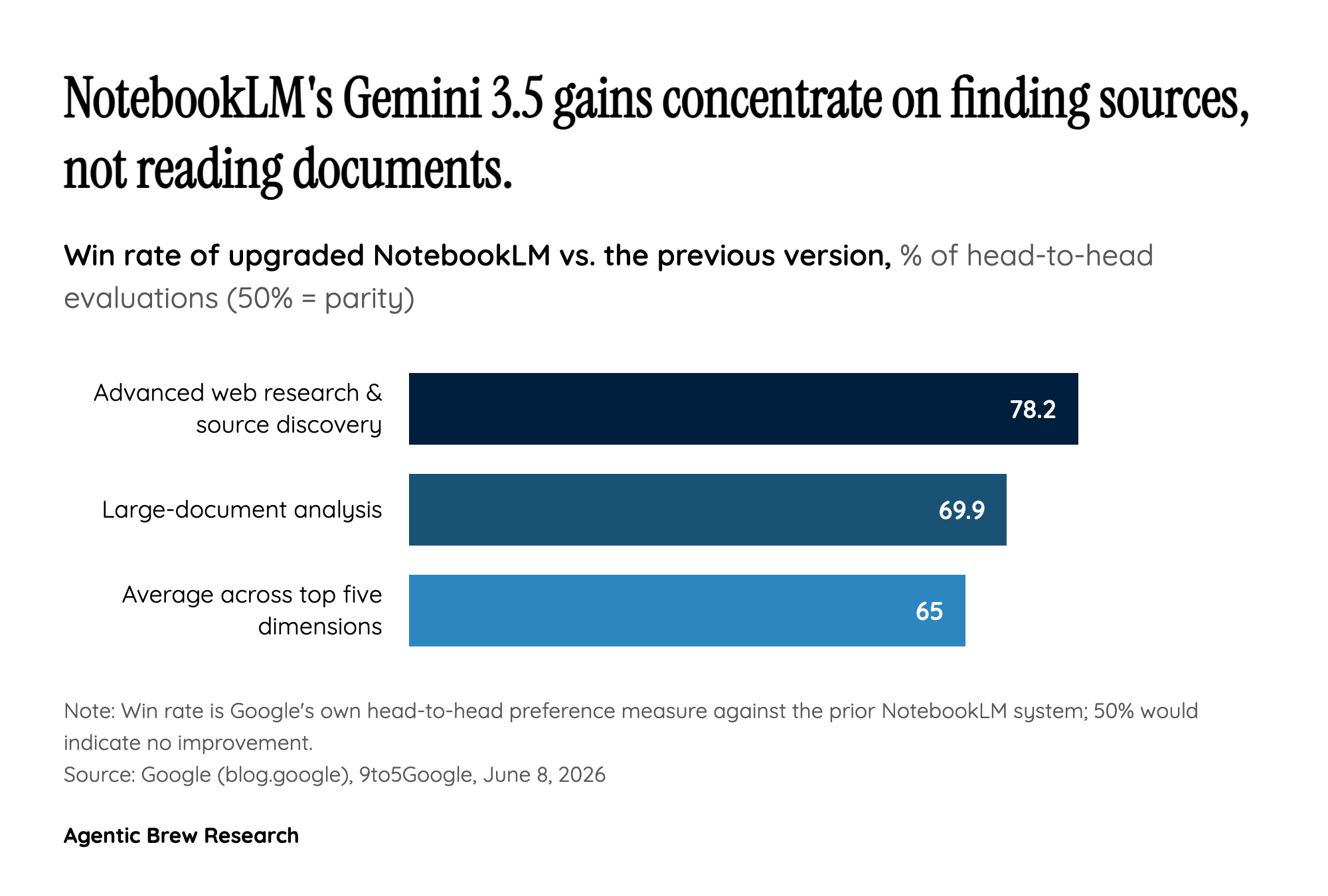
The upgraded NotebookLM's largest win rate over its predecessor lands on web research and source discovery (78.2%), the release's headline new capability.

Google's own evaluation is where the upgrade's case is strongest on paper. The new system posts an average win rate above 65% across the top five core evaluation dimensions versus the prior version — roughly 15 points above parity [1]. Two of those dimensions are reported individually, and they reveal where the gains actually concentrate: 69.9% in large-document analysis and 78.2% in advanced web research and source discovery, both measured against the prior baseline [2].

That distribution matters more than the headline average. The single biggest jump, nearly 78%, lands precisely on the new agentic capability — finding and discovering sources — which is consistent with a release built around Google Search integration rather than a uniform model swap. It also tells you what Google is optimizing for: the win-rate story is a research story, not a writing or summarization story. The numbers are self-reported and benchmark-style, so they describe head-to-head preference against Google's own previous system rather than independent accuracy, which is exactly the gap the skeptics seize on.

The Skeptics' Ledger: Speed, Cost, and Hallucinations That Didn't Leave

Against Google's reliability framing — Gemini 3.5 promising 'more accurate and reliable information' and better visibility into the model's thinking [1], with one outlet attributing fewer hallucinations and better synthesis to the reasoning upgrade [5]— sits a markedly more cautious community read. On r/notebooklm the dominant posture is wait-and-see rather than celebration, and the discussion is partly anticipatory: some users were still asking whether NotebookLM even runs the new 3.5 model yet, so this is as much pre-launch skepticism as direct reaction to the rollout.

The contrarian thread is specific. Practitioners there argue 3.5-flash is comparable or only slightly better than the prior Pro tier and that its real advantage is speed, not quality; others flag that it is reportedly several times more expensive than the previous flash model, and that audio overviews run on a separate text-to-speech model a chat upgrade doesn't touch. Most pointedly, users report that hallucinations persist even with a notebook attached — directly contradicting the launch's reliability pitch. Creator-side YouTube and X sentiment runs the other way, with hands-on voices framing the launch as a 'research-to-creation' workflow shift and pointing to Discover Sources as the automation unlock. The tension between those two camps — workflow excitement versus lived reliability doubts — is the most honest summary of how this landed.

Why Now: A Six-Month March From Gemini 3 to an Agentic Operating Layer

This release reads less like a standalone feature and more like the next beat in a deliberate sequence. In December 2025 Google moved NotebookLM onto Gemini 3 and shipped Data Tables exportable to Sheets [6]— the first sign the product was being pushed toward structured, exportable output rather than just summaries. At Google I/O in May 2026, Google unveiled Gemini 3.5 Flash alongside Antigravity 2.0 [7], assembling the exact two components this NotebookLM upgrade now fuses.

Seen against that timeline, June 8 is the moment the model and the agent IDE finally land in a consumer-facing research product together [1]. The gating choices reinforce the strategy: launching first to AI Ultra subscribers and AI Expanded Workspace customers [2]turns NotebookLM into a premium showcase for agentic Gemini and a reason to hold the top subscription tier. The cost objection raised by skeptics and the Ultra-only availability are two sides of the same coin — Google is positioning agentic research as a high-end capability, which is precisely why early adopters are scrutinizing whether the quality justifies the price.

Historical Context

2025-12-19
Google announced NotebookLM was officially built on Gemini 3 and added a Data Table Studio output exportable to Google Sheets.
2026-05-19
At Google I/O 2026, Google introduced Gemini 3.5 Flash, Gemini Omni Flash, Gemini Spark, and Antigravity 2.0.
2026-06-08
Google rolled out NotebookLM running on Gemini 3.5 plus Antigravity with agentic research capabilities.

Power Map

Key Players
Subject

NotebookLM upgraded to Gemini 3.5 with agentic research

GO

Google

Owner and developer pairing Gemini 3.5 with its Antigravity IDE to reposition NotebookLM from a document reader into an agentic research assistant.

GO

Google AI Ultra subscribers

First consumer tier to receive the upgrade, making the premium subscription the gate for early access to agentic NotebookLM.

WO

Workspace business customers (AI Ultra / AI Expanded)

Enterprise group included at launch, signaling Google's intent to embed agentic research inside organizational workflows.

AN

Antigravity

Google's agent-first AI-powered IDE integrated into NotebookLM to enable in-notebook code execution and multi-step agentic research.

Fact Check

7 cited
  1. [1] Do better research with NotebookLM
  2. [2] NotebookLM now runs on Gemini 3.5 and Antigravity
  3. [3] Google's NotebookLM gets a major upgrade
  4. [4] Google upgrades NotebookLM with Gemini 3.5 and agentic research tools
  5. [5] Google's NotebookLM gets Gemini 3.5 and AI-powered research
  6. [6] NotebookLM is officially built on Gemini 3 with Data Tables
  7. [7] Google AI timeline: biggest moments

Source Articles

Top 5

THE SIGNAL.

Analysts

"Reads the upgrade as evolving NotebookLM from a document reader into an agentic assistant by pairing Gemini 3.5 reasoning with Google Search's reach, while cautioning that web results are hit or miss and an AI layer does not automatically fix signal-to-noise."

TechBuzz
Technology publication

"Frames the upgrade as turning NotebookLM into a unified workspace 'that lets you research, analyze, create, and package information without having to bounce between half a dozen tools.'"

Android Authority
Technology publication
The Crowd

"Checking your holiday wishlists, there's one request that's coming up 3x more than anything else... 🥁 NotebookLM is OFFICIALLY built on Gemini 3! Google's most intelligent model, this brings significant improvements to NotebookLM's reasoning and multimodal understanding."

@@NotebookLM3102

"NotebookLM is now powered by Gemini 3 as well! This moment probably marks the time when the full lineup of Google AI products got upgraded. Gemini 3 everywhere 👀 https://t.co/TU07gwwOD6"

@@testingcatalog571

"NotebookLM + Gemini 3.1 is the most insane AI workflow right now. No more manual research for hours. No more generic AI fluff or tab switching. Here's the Research-to-Build play 👇 → Use "Discover Sources" to automate your research in seconds. → Convert raw insights into https://t.co/Png2X3w6MR"

@@JulianGoldieSEO176

"Will NotebookLM get better with the new Gemini 3.5 flash model? And will video overviews become more cinematic with the new omni video model?"

@u/Beginning-Willow-8010
Broadcast
NotebookLM Just Got a Major Upgrade (Gemini Integration Explained)

NotebookLM Just Got a Major Upgrade (Gemini Integration Explained)

NotebookLM + Google Antigravity Is INSANE!

NotebookLM + Google Antigravity Is INSANE!

NoteBookLM + Gemini 3 Update is CRAZY!

NoteBookLM + Gemini 3 Update is CRAZY!