Alibaba's 75% profit drop as AI infrastructure capex surges 75% year-over-year
TECH

Alibaba's 75% profit drop as AI infrastructure capex surges 75% year-over-year

24+
Signals

Strategic Overview

  • 01.
    Alibaba's net income for the quarter ended June 30, 2026 fell 75% year-over-year to RMB10,444 million (US$1,539 million), even as total revenue rose 9% to RMB268,953 million (US$39,639 million).
  • 02.
    Capital expenditure jumped 75% year-over-year to RMB67,678 million (US$9,975 million), the main driver of the profit compression.
  • 03.
    AI Cloud and Compute Services revenue grew 45% year-over-year to RMB48,437 million, its fastest growth pace in 22 quarters, while AI-related product revenue posted its 12th consecutive quarter of triple-digit growth.
  • 04.
    Alibaba's US-listed shares fell around 5% after the results were released.

Deep Analysis

The Vanishing Payback Period

A claim attributed to Alibaba began circulating widely on X in the hours after Alibaba's June-quarter results landed: that the company can recoup its entire AI infrastructure investment within three years, with the payback window continuing to shorten toward roughly two and a half years. That specific figure does not appear in Alibaba's own earnings release, its SEC filing, or the wire coverage of the quarter - it surfaced through social-media discussion paraphrasing what the company reportedly said, and it drew heavy engagement precisely because of how it lands against the quarter's headline numbers: net income collapsed 75% year-over-year to RMB10,444 million even as revenue climbed 9% to RMB268,953 million [1]. What CEO Eddie Wu did say on the record, in the earnings release itself, was more measured: he called the quarter strong, attributing the results to "the improving commercialization of our full-stack AI capabilities" [1], and CFO Toby Xu pointed to accelerating cloud segment growth and rising operating leverage as evidence the investment thesis was already working [1].

The unverified payback-period figure isn't emerging from nowhere, though - Alibaba's CFO made a directionally similar case the prior quarter, telling investors that "very significant investments" in AI explained the negative free cash flow while insisting the technology bets were beginning to pay off commercially [9]. And it arrives just as capital expenditure reached RMB67,678 million for the quarter, up 75% year-over-year, pushing cumulative AI/cloud spending to roughly RMB190 billion - about half of the RMB380 billion three-year commitment Alibaba made in February 2025 [2]. Whether or not "two and a half years" is a figure Alibaba's leadership actually used, the speed at which it spread suggests investors are hungry for a concrete payback timeline: if the ramp is real, it should show up in margin expansion over the next few quarters; if it's aspirational or misattributed, the market is pricing in a story that hasn't yet been confirmed in writing.

Two AI Businesses, One Balance Sheet

Two AI Businesses, One Balance Sheet
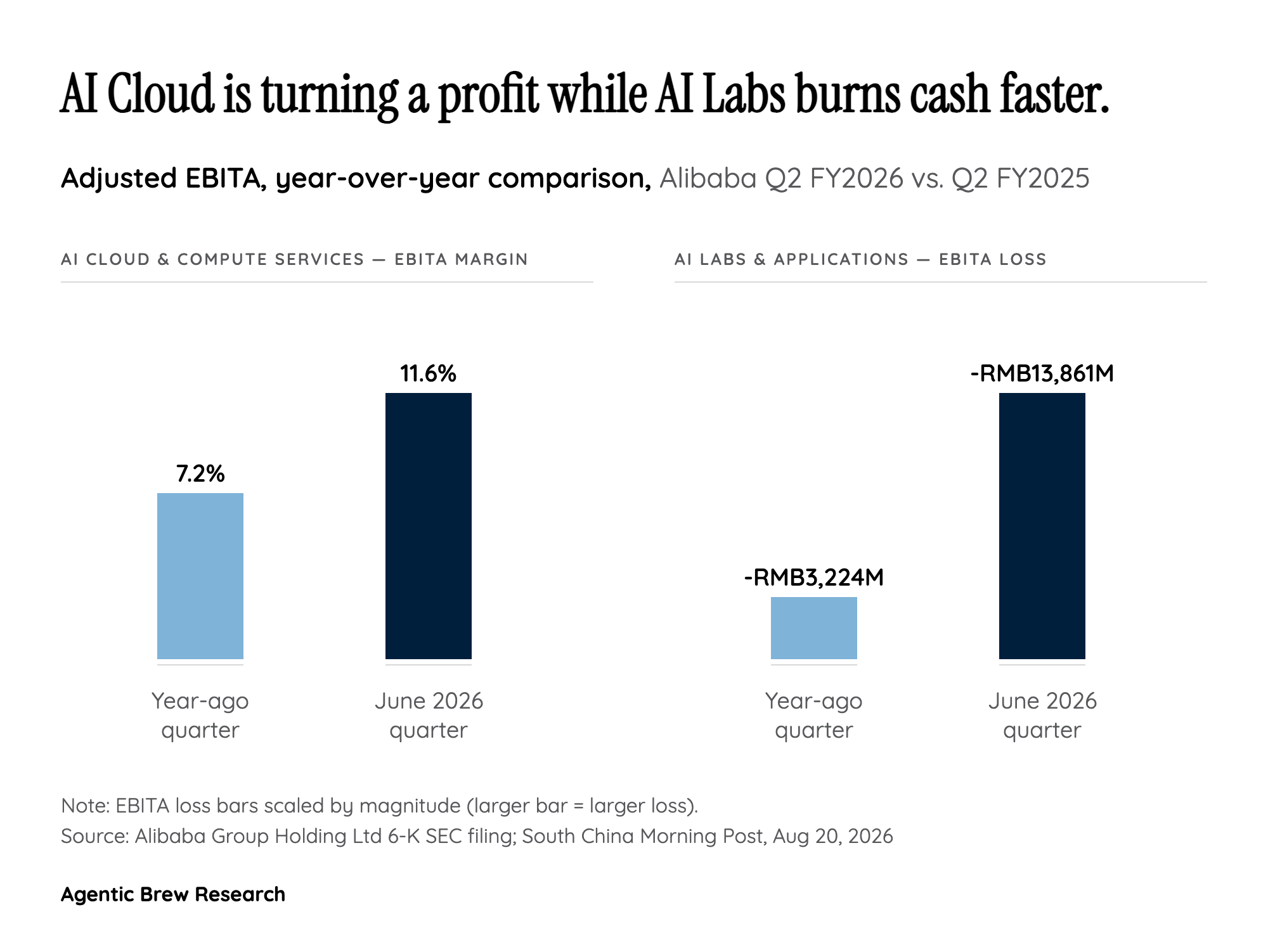
AI Cloud EBITA margin expanded to 11.6% from 7.2% while AI Labs & Applications EBITA losses widened to RMB13,861 million from RMB3,224 million, year-over-year.

The word "AI" is doing a lot of work across Alibaba's earnings, and it is masking two businesses moving in opposite directions. AI Cloud and Compute Services - the unit that sells compute, storage, and infrastructure to other companies - grew revenue 45% year-over-year to RMB48,437 million, its fastest pace in 22 quarters, while adjusted EBITA for the segment jumped 133% and margin expanded to 11.6% from 7.2% a year earlier [3]. That is a business with genuinely improving unit economics: selling AI infrastructure at scale is starting to look like a real profit center rather than a subsidized loss leader.

AI Labs & Applications - home to Alibaba's Qwen model family and consumer-facing AI products - tells the opposite story. Revenue there grew a comparatively modest 16% to RMB3,338 million, even as the Qwen app crossed 250 million users, but adjusted EBITA losses widened to -RMB13,861 million from -RMB3,224 million a year earlier [2]. In other words, the further Alibaba's AI push moves from selling raw compute toward selling AI products people actually use, the more expensive - and less profitable - it currently gets. That divergence matters for reading the payback-period claim above: the infrastructure side is closer to breakeven than the group headline suggests, but it is being dragged down by an applications business burning cash at an accelerating rate, with no visible margin inflection yet.

The Capex Arms Race Nobody Can Afford to Lose

One analyst framing that circulated widely described the entire Chinese AI infrastructure race as a prisoner's dilemma: no single cloud provider can afford to pull back on capex relative to its rivals, even though the sector-wide result of everyone spending at once is compressed near-term profitability for all of them [4]. Alibaba's capex jump wasn't driven by a single cause - reporting pointed to uneven timing of customer purchases, growing CPU-compute procurement tied to AI agent demand, and rising prices across chip components, layered on top of the strategic infrastructure buildout [5].

The scale of the commitment is what makes the dilemma bite. Alibaba pledged in February 2025 to spend at least RMB380 billion (about $53 billion) over three years on AI and cloud infrastructure, a sum the company said exceeded its total AI/cloud spending over the entire prior decade [6][7]. Eighteen months in, roughly half of that budget - RMB190 billion - has already been deployed [2], leaving Alibaba committed to a similar amount of AI infrastructure spending over the next stretch regardless of whether near-term margins cooperate. Having made the multi-year pledge publicly, backing away now would read as a concession that a domestic rival - or a hyperscaler abroad - was better positioned to win the compute race; the sunk commitment itself has become part of the incentive to keep spending.

Why the Market Shrugged at a 75% Profit Collapse

Given a 75% collapse in net income, the market's reaction was notably restrained: Alibaba's US-listed shares fell only around 5% after the results, according to CNBC [8]- though Investing.com put the move closer to 2.9%, a reminder that even the size of the selloff isn't fully agreed on [2]. Free cash flow swung to -RMB44,670 million from -RMB18,815 million a year earlier [2]- more than double the prior year's cash outflow - yet adjusted profit of roughly RMB27.3 billion actually beat expectations [3].

The muted reaction suggests investors had already priced in the AI-investment narrative before the print landed, treating the profit collapse as the expected cost of the capex cycle rather than a surprise. That is effectively a bet that the payback story holds up in some form, and that the Cloud segment's margin expansion continues even as the AI Labs division keeps burning cash. If either assumption breaks - if capex doesn't taper as the RMB380 billion plan nears completion, or if Cloud segment margins stall - the calm the market showed this quarter is unlikely to survive a second consecutive year of the same trade-off.

How China's AI Bet Compares

Two threads of community and media discussion around this earnings release add outside context that doesn't appear in Alibaba's own filing. In an on-air segment on Bloomberg Tech, reporter Peter Elstrom framed Alibaba's AI investment challenge as structurally harder than what US hyperscalers face: Alibaba's spending has to compete not just against global rivals but against domestic open-source competitors like DeepSeek and Moonshot, which undercut the pricing power Alibaba needs to make its own AI products profitable - a path Bloomberg's analysis called "quite difficult" compared to the US, where hyperscalers don't face the same open-source pressure at home.

A widely discussed Reddit breakdown circulating in r/China put Alibaba's spending in a different kind of context: combined capex from China's four largest AI spenders - Alibaba, Tencent, ByteDance, and Baidu - totals roughly $102 billion this year, about one-eighth the scale of the largest US hyperscalers, even though Chinese capex is growing faster in percentage terms, up more than 80% year-over-year versus roughly 77% for the American cohort. Neither figure comes from a primary filing, so treat them as directional community estimates rather than verified numbers - but read together, the two threads sketch a harder version of the prisoner's dilemma described elsewhere in this analysis: Alibaba isn't just spending to keep pace with foreign hyperscalers on infrastructure, it's spending into a domestic market where its own AI products face free, open-source substitutes, which may be part of why the AI Labs segment's losses are widening even as Cloud's economics improve.

Historical Context

2025-02-24
Alibaba announced a plan to invest at least RMB380 billion (about $53 billion) over three years in cloud computing and AI infrastructure, exceeding its total AI/cloud spending of the prior decade.
2026-05
In the prior quarter's earnings call, CFO Toby Xu attributed negative free cash flow to "very significant investments" in AI, while CEO Eddie Wu said the company's technology investments were beginning to pay off commercially.
2026-08-20
By the June 2026 quarter, cumulative spending under the RMB380 billion plan reached roughly RMB190 billion, about half of the three-year commitment.

Power Map

Key Players
Subject

Alibaba's 75% profit drop as AI infrastructure capex surges 75% year-over-year

AL

Alibaba Group

Reporting company that raised capex 75% to fund AI infrastructure and GPU clusters, absorbing the resulting profit hit while its cloud business accelerates.

ED

Eddie Wu

Alibaba Group CEO; sets the multi-year AI capex strategy. Company executives have told investors AI capex could break even within two to three years, a claim central to how the market is interpreting the earnings.

TO

Toby Xu

Alibaba Group CFO; manages the capex/free-cash-flow trade-off and communicates margin trends in the AI Cloud segment to investors.

AL

Alibaba Cloud (AI Cloud and Compute Services segment)

Business unit posting 45% revenue growth and 133% adjusted EBITA growth - the segment offsetting group-level profit compression and the strongest evidence for the payback narrative.

QW

Qwen / AI Labs & Applications segment

Consumer and enterprise AI app arm; grew revenue 16% and crossed 250 million Qwen app users but widened adjusted EBITA losses to -RMB13,861 million, dragging on group profitability.

Fact Check

9 cited
  1. [1] Alibaba Group Holding Ltd 6-K SEC Filing
  2. [2] Alibaba Q2 2026 slides: AI surge drives revenue up 9%, profit down 75%
  3. [3] Alibaba's AI cloud growth surge drives earnings despite soaring tech spending
  4. [4] Alibaba profit plunges 75% as AI spending spree hits bottom line
  5. [5] Alibaba quarterly profit drops 75% as AI investment spending grows
  6. [6] Alibaba to spend $53 billion on AI infrastructure in big pivot
  7. [7] Alibaba to invest RMB380 billion in AI and cloud infrastructure over next three years
  8. [8] Alibaba Cloud Revenue
  9. [9] Alibaba Group Holding Limited (NYSE:BABA) Q4 2026 Earnings Call Transcript

Source Articles

Top 5

THE SIGNAL.

Analysts

Calls the quarter strong on the back of improving AI commercialization.

Eddie Wu
CEO, Alibaba Group

Points to accelerating cloud segment revenue growth and improving earnings quality as evidence the AI investment is translating into margin gains.

Toby Xu
CFO, Alibaba Group

Frame the region's cloud AI spending race as a structural trap where no single company can afford to underspend relative to rivals, even though the collective overspending compresses sector-wide profitability.

Unnamed analysts (via TechBuzz.ai)
Industry/market analysts
The Crowd

Alibaba: WE CAN RECOUP OUR AI INVESTMENTS WITHIN THREE YEARS, AND THE PAYBACK PERIOD CONTINUES TO SHORTEN—TOWARD 2.5 YEARS, FOR EXAMPLE. - AI compute resources continue to generate cash flow for a considerable period even after paying back their investment within three years.

@@jukan05682

$BABA reported an hour ago. Cloud revenue up 45%. Total revenue up 4%. But the sentence that matters is buried in a footnote to the cash flow statement, and it is not about Alibaba. Capital expenditure came in at RMB67.68bn, US$9.98bn, against RMB38.68bn a year earlier. Up 75%.

@@Schulz_Research38

JUST IN: Alibaba quarterly profit plunges 75% as the company ramps up spending on AI infrastructure & computing capacity.

@@Polymarket23

Alibaba shares fall 3% as AI spending drives 75% drop in net income

@u/ControlCAD34
Broadcast
Alibaba's AI Spending Spree, Concerns of Circular AI Financing | Bloomberg Tech 8/20/2026

Alibaba's AI Spending Spree, Concerns of Circular AI Financing | Bloomberg Tech 8/20/2026

Kuaishou Slides After Weak 3Q Guidance | The China Show | 8/20/2026

Kuaishou Slides After Weak 3Q Guidance | The China Show | 8/20/2026

Walmart Drops, Alibaba ADRs, Coty Sinks After Fourth Quarter Results | Stock Movers

Walmart Drops, Alibaba ADRs, Coty Sinks After Fourth Quarter Results | Stock Movers

Alibaba's 75% profit drop as AI infrastructure capex surges 75% year-over-year — AI News | Agentic Brew