TypeSafe AI's Jev funding round
TECH

TypeSafe AI's Jev funding round

35+
Signals

Strategic Overview

  • 01.
    TypeSafe AI announced on October 9, 2026 that it raised approximately $870 million in a Series A round at a $7.5 billion valuation.
  • 02.
    Andreessen Horowitz led the round, with Sequoia Capital and existing investor DCVC also participating.
  • 03.
    Jev is a transformer-based 'System One model' that returns typed, probabilistic decisions instead of generating text, explicitly described by TypeSafe as not an LLM.
  • 04.
    TypeSafe's funding announcement came three days after OpenAI launched a competing 'Decisions API' on GPT-6 Luna, which itself arrived roughly three weeks after Jev's own launch.

Deep Analysis

Jev Isn't a Faster Chatbot - It's a New Model Category

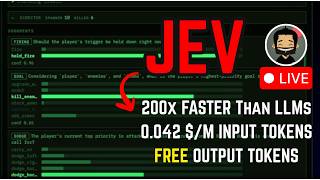
TypeSafe is explicit about what Jev is not: "Jev does not generate text. It returns typed, probabilistic decisions that software can act on directly." [1]Its three output modes - Choice, Score, and Noul (yes/no) - are evaluated in a single parallel pass with a calibrated confidence value, rather than produced token by token the way a chat model would write a sentence [2]. That architectural choice is what underpins the headline performance numbers: an end-to-end response time of 70-500 milliseconds versus 3-329 seconds for frontier chat models, at $0.042 per million input tokens with output tokens free [2]. TypeSafe's own workflow evaluations claim Jev is up to 193.6x faster and 444.6x cheaper than frontier models GPT-6 Astra and Fable 5.1 [3].

From a $200 Million Seed to a $7.5 Billion Valuation in Under a Month

From a $200 Million Seed to a $7.5 Billion Valuation in Under a Month
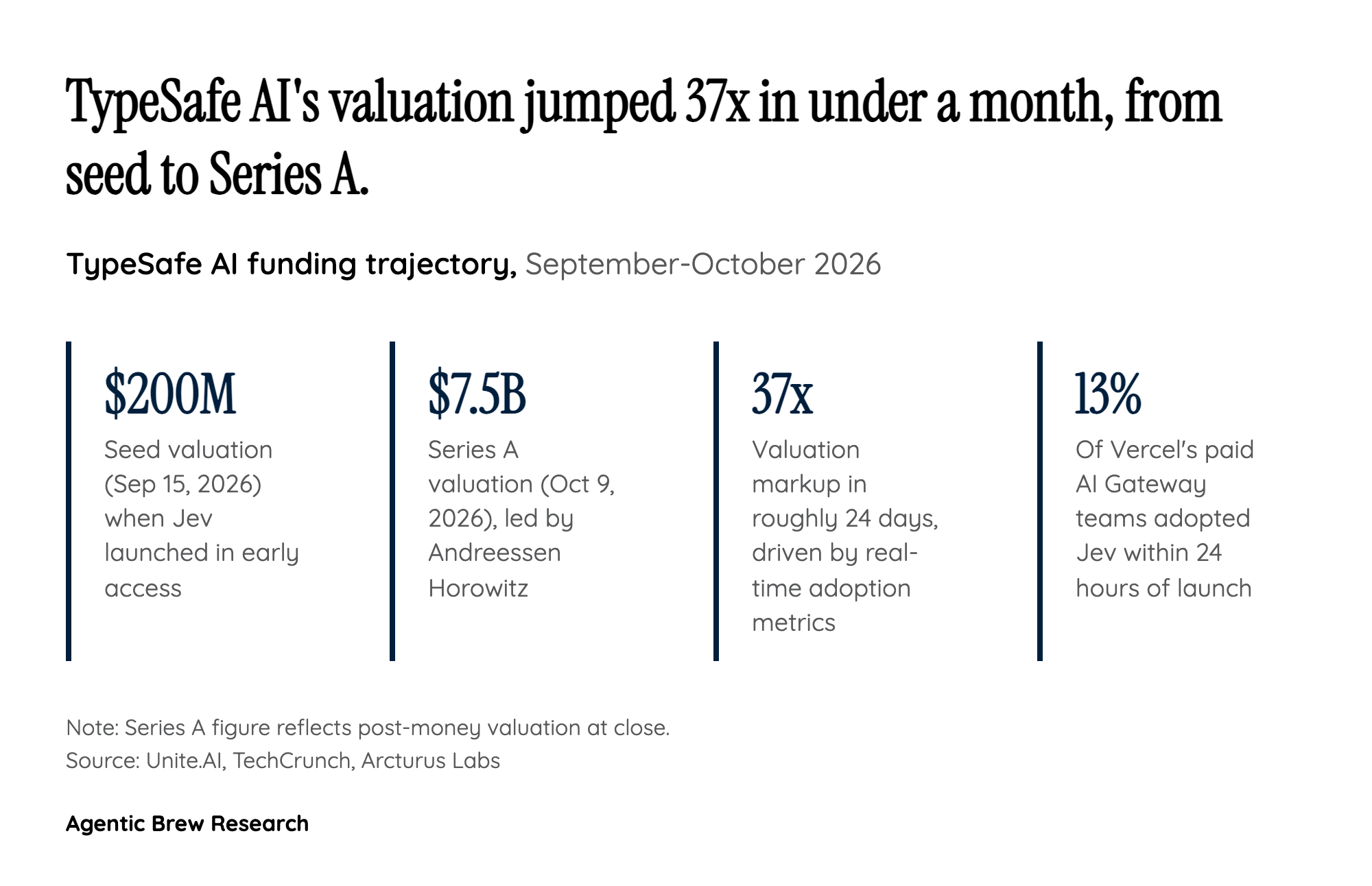
TypeSafe AI's valuation jumped 37x in under a month, from a $200M seed to a $7.5B Series A.

TypeSafe spent two years in stealth before emerging on September 15, 2026, when it launched Jev in early access alongside a comparatively modest $40 million seed round led by DCVC at roughly a $200 million valuation [4]. Less than four weeks later, on October 9, the company closed an $870 million Series A led by Andreessen Horowitz, with Sequoia Capital and DCVC also participating, taking the valuation to $7.5 billion [5][6]. That is close to a 37x markup on the seed valuation inside a single month - a trajectory built less on revenue history than on real-time adoption metrics investors could watch accumulate during the weeks the company was raising.

OpenAI's Three-Week Counterpunch and the Moat Question

OpenAI launched its own 'Decisions API' on October 6, 2026 - three weeks after Jev's debut - built on its existing GPT-6 Luna model rather than a purpose-built architecture [7]. OpenAI's Nikunj Handa credited Jev with 'inspiring this whole thing' [7], an implicit admission that TypeSafe, not OpenAI, set the agenda for this category. DCVC's James Hardiman counters that TypeSafe's two years of stealth R&D on reliability - not just speed - separates it from 'fast follow clones' [7]. But an Arcturus Labs analysis is blunter about the risk: 'TypeSafe's survival comes down to the moat: how hard it really is to replicate their training data and reinforcement learning process.' [8]

Reliability Was the Hard Problem - and Hallucination Doesn't Disappear, It Moves

Almeida frames TypeSafe's whole premise around a mismatch between language models and machine automation: 'We have been super good at human language for four years, but it's not useful for automation because computers speak a different language.' [5]He has also said reliability, not raw speed, was the hardest part of building Jev: 'Making the models reliable was so much harder than expected.' [7]Yet type-safety does not eliminate hallucination outright. Earendil CTO Armin Ronacher notes the design 'delegates the hallucination problem a little bit to the user' [8]- a validly-typed answer can still be confidently wrong. TypeSafe's own documentation lists known weak points including unreliable counting, arithmetic, and date comparison, plus accuracy loss on large, noisy state [8].

Fast Adoption, Mixed Verdict

Within 24 hours of launch, Jev reached roughly 13% of Vercel's paid AI Gateway teams - the fastest adoption of any model in the Gateway's history - with Netlify and LangChain integrating within days [8]. TypeSafe says the model has already reached about a third of Fortune 500 companies [9]. Community reaction splits along platform lines: the company itself leaned into launch-moment enthusiasm, trade press tracked the funding conversation shift from informal talk of a much larger raise to the $870 million round that actually closed, and some developers report using Jev as a cost-saving pre-filter in production pipelines, screening cases before escalating harder ones to frontier models. Others describe the launch hype as astroturfed. Independent testing complicates that picture further: one head-to-head categorization test against a frontier model found Jev agreed roughly 60% of the time, ran at about one-fifth the cost, and was judged correct in about 70% of the cases where the two disagreed on manual review - a real edge for narrow pre-filtering use cases, but a more modest one than the funding round's optics imply.

Historical Context

2024
Founded by Diogo Almeida, Sasha Sheng, and Erik Gafni, and operated in stealth for roughly two years before emerging publicly.
2026-09-15
Emerged from stealth, launched Jev in early access, and simultaneously announced a $40 million seed round led by DCVC at roughly a $200 million valuation.
2026-09-21
Jev reached about 13% of Vercel's paid AI Gateway teams within 24 hours, the fastest adoption of any model in the Gateway's history.
2026-10-06
Launched a competing 'Decisions API' built on GPT-6 Luna, roughly three weeks after Jev's launch.
2026-10-09
Announced an $870 million Series A at a $7.5 billion valuation led by Andreessen Horowitz, with Sequoia Capital and DCVC also participating, about 24 days after Jev's launch.

Power Map

Key Players
Subject

TypeSafe AI's Jev funding round

DI

Diogo Almeida

TypeSafe AI co-founder and CEO, a former OpenAI researcher on RLHF/InstructGPT/ChatGPT who sets the company's public framing of Jev as an automation tool rather than a chatbot.

AN

Andreessen Horowitz (a16z)

Lead investor of the $870M Series A; partner Martin Casado is joining TypeSafe's board, giving a16z direct governance influence over the company's roadmap.

DC

DCVC (Data Collective)

Led TypeSafe's $40M seed round and returned as a Series A participant; General Partner James Hardiman publicly credits the firm's confidence to two years of reliability-focused R&D.

SE

Sequoia Capital

New participating investor in the Series A, adding further validation to the round.

OP

OpenAI

Launched a rival 'Decisions API' on GPT-6 Luna three weeks after Jev's debut, positioning itself as the direct competitive threat to TypeSafe's new category.

VE

Vercel

Early enterprise adopter; integrated Jev into its AI Gateway and reported adoption by about 13% of paid teams within 24 hours, the fastest uptake of any model in the Gateway's history.

Fact Check

9 cited
  1. [1] TypeSafe AI Jev Released
  2. [2] Introducing System One Models and Jev
  3. [3] TypeSafe AI's Jev Offers an Alternative to LLMs That Claims to Be 193x Faster and 445x Cheaper
  4. [4] TypeSafe AI Raises $870M Series A at $7.5B Valuation to Ship More AI Models
  5. [5] The Maker of Non-Text AI Model Jev Valued at $7.5B Just Weeks After Launch
  6. [6] Andreessen Horowitz Leads $870M Round for AI Startup TypeSafe at $7.5B Valuation
  7. [7] Jev, an AI for Making Quick Decisions, Has Been a Viral Hit in Silicon Valley - But OpenAI Is Hot on Its Heels
  8. [8] Will OpenAI Eat Jev's Lunch?
  9. [9] Jev Creator TypeSafe Closes $870M Round at $7.5B Valuation

Source Articles

Top 5

THE SIGNAL.

Analysts

“Argues LLMs excel at human language but are poorly suited to automation, and that making Jev reliable - not just fast - was the hardest engineering problem the team faced.”

Diogo Almeida
Co-founder and CEO, TypeSafe AI

“Credited Jev with inspiring OpenAI's own Decisions API, an implicit acknowledgment that TypeSafe set the agenda for the non-text decision model category.”

Nikunj Handa
OpenAI

“Argues TypeSafe's two years of stealth development, particularly its focus on reliability over raw speed, gives it an edge over 'fast follow clones' like OpenAI's new offering.”

James Hardiman
General Partner, DCVC

“Notes Jev's design pushes the hallucination problem onto the developer rather than eliminating it, since a response can still be confidently wrong within its typed schema.”

Armin Ronacher
CTO, Earendil

“Found Gemini slightly more accurate than Jev but 10-20x more expensive, valuing Jev primarily for its calibrated, real probability outputs rather than raw accuracy.”

Nikhil Mudholkar
CTO, Bryo AI
The Crowd

“Ladies and gentlemen, agents and assistants, we are psyched to announce Jev is back. Capacity has increased and signups are open!”

@@typesafeai1075

“TypeSafe AI just launched Jev today. Here's what you need to know. Jev is TypeSafe AI's first public model, built by Diogo Almeida, a researcher behind the instruction-following work that led to ChatGPT. Unlike a chatbot, Jev doesn't generate text token by token. It answers [thread continues]”

@@AGTPinsights86

“TypeSafe AI is talking with investors about raising $1 billion or more as enthusiasm builds around its Jev model and potential valuations above $10 billion.”

@@theinformation27

“Jev / TypesafeAI is revolutionary as LLM's”

@u/Babayaga1664190
Broadcast
Jev by TypeSafe AI | What is a System-1 Decision Model

Jev by TypeSafe AI | What is a System-1 Decision Model

Jev From TypeSafe is a New Class of AI Model that is FAST and CHEAP - But There is a Caveat!

Jev From TypeSafe is a New Class of AI Model that is FAST and CHEAP - But There is a Caveat!

Livestream Coding with the new TypeSafe AI JEV Model | Parallel Constrained Decoding

Livestream Coding with the new TypeSafe AI JEV Model | Parallel Constrained Decoding

TypeSafe AI's Jev funding round — AI News | Agentic Brew