The Mechanism: One Line, Not a Rewrite
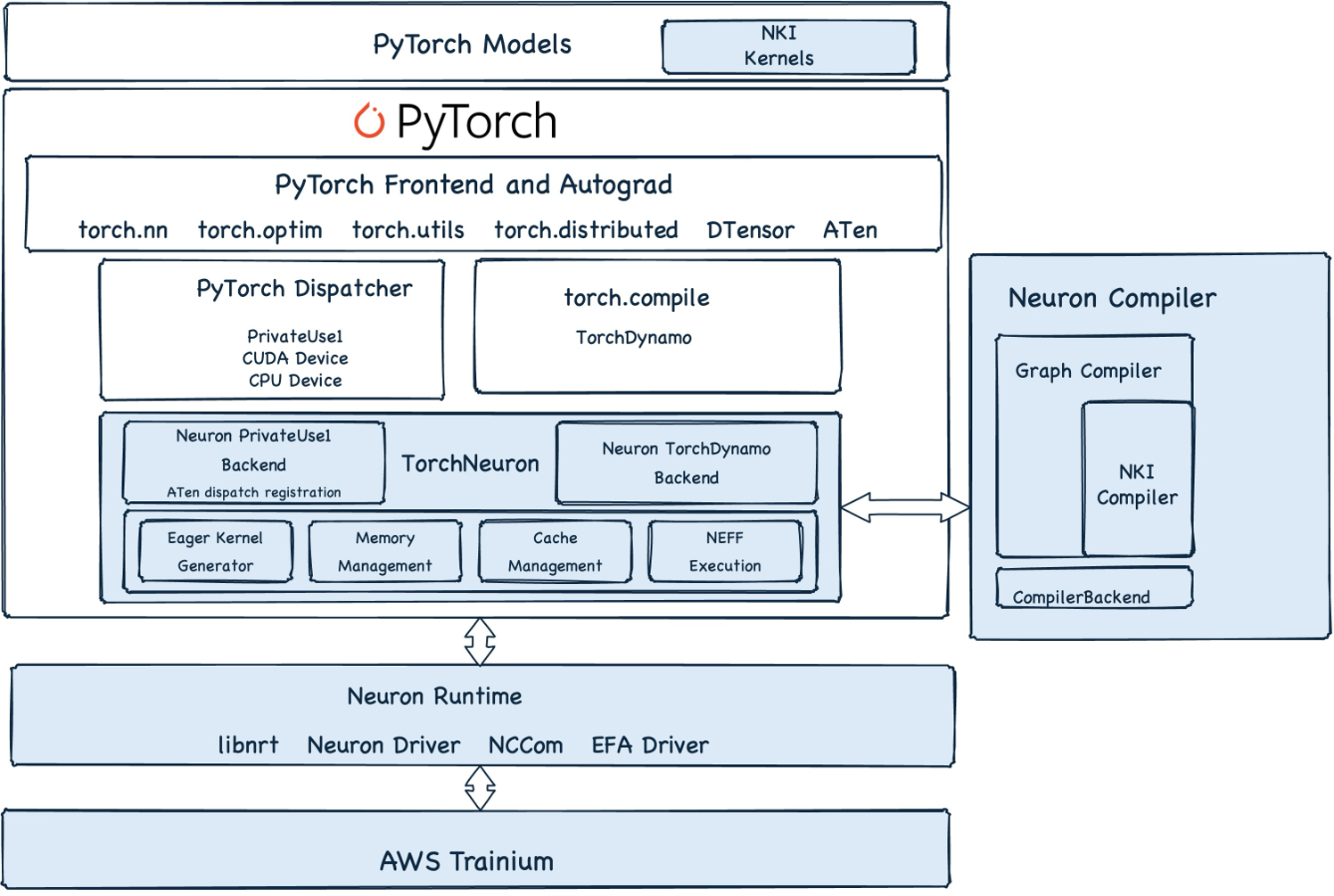
For years, moving a PyTorch workload off Nvidia GPUs meant weeks of rewriting kernels, revalidating numerics, and hoping the new chip actually fit the workload - a cost so high most teams never tried. TorchNeuron collapses that migration to a single line: calling .to('neuron') on a model, or pointing torch.compile at the neuron backend, changes nothing else in the code [1]. That works because AWS built TorchNeuron on top of PrivateUse1, PyTorch's own official extension point for third-party hardware, rather than a proprietary Neuron-specific layer - so torch.nn, torch.tensor, torch.autocast, torch.distributed, and torch.profiler all operate on Trainium2 and Trainium3 as if they were native CUDA calls [1]. The same plumbing covers distributed training out of the box: DDP, FSDP2, SimpleFSDP, tensor parallelism, pipeline parallelism, DTensor, and DeviceMesh all compose with existing model code, with collectives routed over Trainium's dedicated collective cores and AWS's Elastic Fabric Adapter network [1]. Inside Amazon, the Prime Video engineering team already used TorchNeuron on Trainium to ship 'Prime 360,' a system that reconstructs NBA plays in 3D from multi-camera footage for broadcast replay angles standard cameras can't capture [8]- a sign AWS is dogfooding the same migration path it's selling to outside developers. But 'minimal code changes' is not 'zero code changes' for every workload: the first release explicitly does not support dynamic or symbolic shapes, sparse tensors, NestedTensor, or forward-mode autograd, and an August 2026 upstream test run against the PyTorch test suite logged roughly 22,000 deliberate skips for operators that simply don't have a native Neuron lowering yet [1].