FCC Bans Chinese Humanoid Robots and Power Inverters
TECH

FCC Bans Chinese Humanoid Robots and Power Inverters

33+
Signals

Strategic Overview

  • 01.
    The FCC added foreign-made humanoid robots, quadruped 'robot dog' robots, and connected power inverters to its Covered List on July 28-29, 2026, immediately blocking new equipment authorization for models not yet approved for US sale.
  • 02.
    The restriction is prospective only - it covers new device models seeking approval, while already-authorized robots and inverters already deployed in the US remain unaffected, though the FCC retains authority to revoke existing approvals in some cases.
  • 03.
    FCC Chairman Brendan Carr said the action follows President Trump's direction to secure US supply chains, after a White House-convened interagency task force determined the covered devices pose unacceptable national security risks.
  • 04.
    The Department of War will review case-by-case waiver requests for robots and the Department of Homeland Security will do the same for power inverters, leaving a narrow path for specific models to still gain approval.

Deep Analysis

The Inverter Ban Is the Bigger Story Nobody's Leading With

Most headlines led with humanoid robots, but the same Covered List action also bars new imports of foreign-made power inverters used in solar arrays, battery storage, and data-center grid connections [2]. Grid-connected inverters constantly phone home to manufacturer servers for monitoring, over-the-air firmware updates, and remote control of power output - the same dual-use capability that makes a robot's cameras a surveillance risk also makes an inverter vulnerable to remote manipulation [2]. Huawei and Sungrow, two of the leading suppliers into that market, are now shut out of new US authorization [1]. Community discussion among solar-industry followers has pointed to how small a share of US inverter supply is domestically made today.
Confirmed Backdoors Are Doing the Rhetorical Heavy Lifting

The FCC's national-security case rests on documented incidents, not hypotheticals. Security researchers catalogued CVE-2025-2894, a backdoor embedded in the firmware of Unitree's Go1 quadruped that auto-started on boot and tunneled to a China-based cloud service, giving remote operators camera access without the owner's knowledge [3]. By May 2025, a US congressional committee was already urging an investigation and sanctions after finding the same class of backdoor in Unitree units deployed at US prisons, police departments, and military installations [4]. The FCC's own justification echoes that history almost verbatim: covered robots 'collect data that could be leveraged by malign actors to surveil Americans, enhance the capabilities of foreign intelligence services, or to remotely commandeer the robots' [5]. Tech Times reported that grid-connected inverters carry the same dual-use remote-manipulation capability - constant contact with manufacturer servers for monitoring, firmware updates, and remote control of power output [2].

Beijing's Response Adds to a Drumbeat Ahead of the Trump-Xi Summit

Beijing's response was immediate and pointed. The Chinese Foreign Ministry called the measure protectionism that would 'hurt the interests of U.S. companies and consumers' rather than lift American competitiveness [6], while the Chinese Embassy in Washington urged the US business community to push back and signaled Beijing would respond in kind [7]. For Unitree specifically, social and video commentary has noted the ban arrives while the company is separately pursuing a multi-billion-dollar Shanghai IPO and a newly announced Nvidia reference-platform partnership - a second front of scrutiny even as its commercial momentum builds. More broadly, the ban adds to what one outlet called a steady drumbeat of potential flashpoints ahead of a planned September 2026 Trump-Xi summit, with China vowing to take all measures necessary in response [7].

A Ban With Its Own Escape Hatches - and a Template Behind It

A Ban With Its Own Escape Hatches - and a Template Behind It
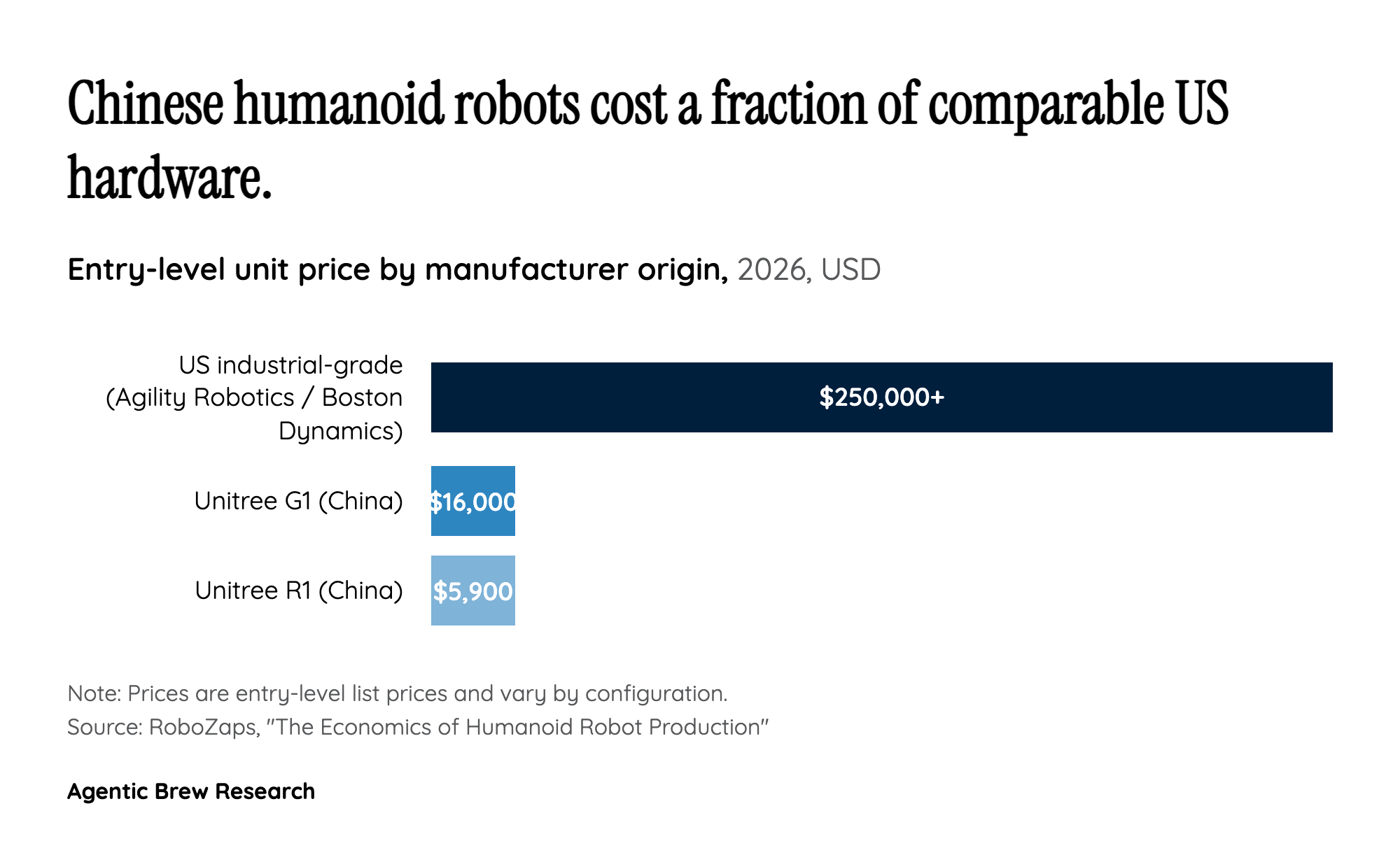
Chinese humanoid robots cost a fraction of comparable US hardware.

The restriction is not an absolute wall. The Department of War will evaluate case-by-case waiver requests for robots and DHS will do the same for power inverters, so specific models that can demonstrate they pose no unacceptable risk can still reach the US market [5]. That flexibility cuts both ways: because robotics hardware advances so quickly, limiting US buyers to older, mostly domestic FCC-approved models risks slowing adoption and ceding ground on cutting-edge, low-cost hardware rather than protecting it [8]. The legal mechanism itself is not new. The FCC first used an entire-product-category approach, rather than banning a single named company, in December 2025, when it added foreign-made drones and components, including DJI and Autel products, to the same Covered List [9]. That drone precedent is the direct template for this week's robot and inverter action. The economic stakes for reshoring are real: Goldman Sachs projects the global humanoid robot market could reach $38 billion by 2035 [10], even as entry-level Chinese models remain priced from roughly $5,900 to $16,000 versus over $250,000 for comparable US industrial-grade units [11]- a cost gap the ban does nothing to close on its own.

Historical Context

2025-03
Security researchers cataloged a backdoor embedded in the firmware of Unitree's Go1 quadruped robot, auto-starting on boot and connecting to a China-based cloud tunnel, allowing remote control and camera access without owner knowledge.
2025-05-05
A US congressional committee urged investigation and sanctions against Unitree over backdoors in quadruped robots deployed at US prisons, police departments, and military installations, warning of remote exfiltration and espionage risk.
2025-12-22
The FCC added new models of foreign-made drones and their critical components, including DJI and Autel products, to its Covered List - the first time an entire product category rather than a single named entity was covered, establishing the template later used for the humanoid robot and inverter ban.
2026-07-28
FCC announces the ban on new imports of Chinese-made humanoid robots, quadrupeds, and power inverters, timed ahead of a planned September 2026 Trump-Xi summit.

Power Map

Key Players
Subject

FCC Bans Chinese Humanoid Robots and Power Inverters

FC

FCC (Chairman Brendan Carr)

Issued the Covered List addition banning new imports and publicly framed the action as securing US supply chains under Trump administration direction

UN

Unitree Robotics

Chinese humanoid/quadruped maker (4,200+ units shipped in 2025) and the company most directly targeted; recently also named on a list of alleged China-military-linked firms

AG

AGIBOT and UBTech

China's second-largest humanoid maker (5,000+ units shipped in 2025) and another Chinese humanoid maker (roughly 1,000 units shipped in 2025), collectively locked out of new US sales alongside Unitree

HU

Huawei and Sungrow

Leading Chinese power-inverter suppliers whose grid-connected products are now barred from new US authorization under the same Covered List action

US

US robot makers (Tesla, Figure AI, Agility Robotics, Boston Dynamics, 1X, Apptronik)

Domestic developers positioned to gain a protected home market as new Chinese models are locked out of US authorization

CH

China's Ministry of Foreign Affairs and Chinese Embassy in Washington

Publicly condemned the ban as protectionism harming US companies and consumers, and warned of reciprocal measures

Fact Check

11 cited
  1. [1] US Bans Imports of New Chinese Robots Over Security Concerns
  2. [2] FCC Bans Chinese Humanoid Robots and Power Inverters Linked to Confirmed Backdoors
  3. [3] The Hidden Doggy Door: Backdoor Found in Robot Dogs
  4. [4] US Congress Urges Investigation into Unitree Robot Backdoors
  5. [5] United States Bans Chinese Humanoid and Quadruped Robots, Citing National Security
  6. [6] US Bans Imports of Humanoid Robots Amid China National Security Concerns
  7. [7] US Bans Foreign-Made Humanoid Robots, Targeting China Over National Security
  8. [8] US Humanoid Robot Ban Raises Questions About Slowing Innovation
  9. [9] FCC Adds Foreign-Made Drones and Components to Covered List, Citing National Security Risks
  10. [10] The Global Market for Robots Could Reach $38 Billion by 2035
  11. [11] The Economics of Humanoid Robot Production

Source Articles

Top 5

THE SIGNAL.

Analysts

Argues the restriction will backfire on the US itself rather than boosting American competitiveness.

Mao Ning, Chinese Foreign Ministry spokesperson
Critical of the ban as protectionist

Calls on the US business community to resist the restriction and signals China will respond in kind.

Chinese Embassy in Washington
Frames the ban as economic coercion targeting Chinese firms
The Crowd

BREAKING: Trump administration to reportedly ban new Chinese humanoid & quadruped robots from entering the United States.

@@Polymarket3919

NEW The FCC has now added two new categories of devices to our Covered List, which bans new versions from import or sale in America. 1. Advanced robotic devices, such as humanoids and quadrupeds produced in foreign countries. 2. Power inverters produced in foreign countries.

@@BrendanCarrFCC1637

China responds to US's ban on advanced Chinese humanoid & quadruped robots: "Protectionism won't make the US more competitive. Instead, it will only hurt American companies and consumers." Again, just like EVs, can't win, so ban. Again, national security excuse.

@@XH_Lee23987

Trump is banning chinese robots/ai models

@u/Puzzleheaded_Week_52616
Broadcast
Why is the FCC banning new human-like robots from China?

Why is the FCC banning new human-like robots from China?

川普出手!美國禁中國機器人進口 防堵網攻、資料竊取

川普出手!美國禁中國機器人進口 防堵網攻、資料竊取

The US Wants Unitree Robotics BANNED! Can Washington Slow China's Humanoid Robot Revolution?

The US Wants Unitree Robotics BANNED! Can Washington Slow China's Humanoid Robot Revolution?