OpenAI vs Anthropic Rivalry: Market Share, IPO Valuations, and Model Release Standoffs
TECH

OpenAI vs Anthropic Rivalry: Market Share, IPO Valuations, and Model Release Standoffs

45+
Signals

Strategic Overview

  • 01.
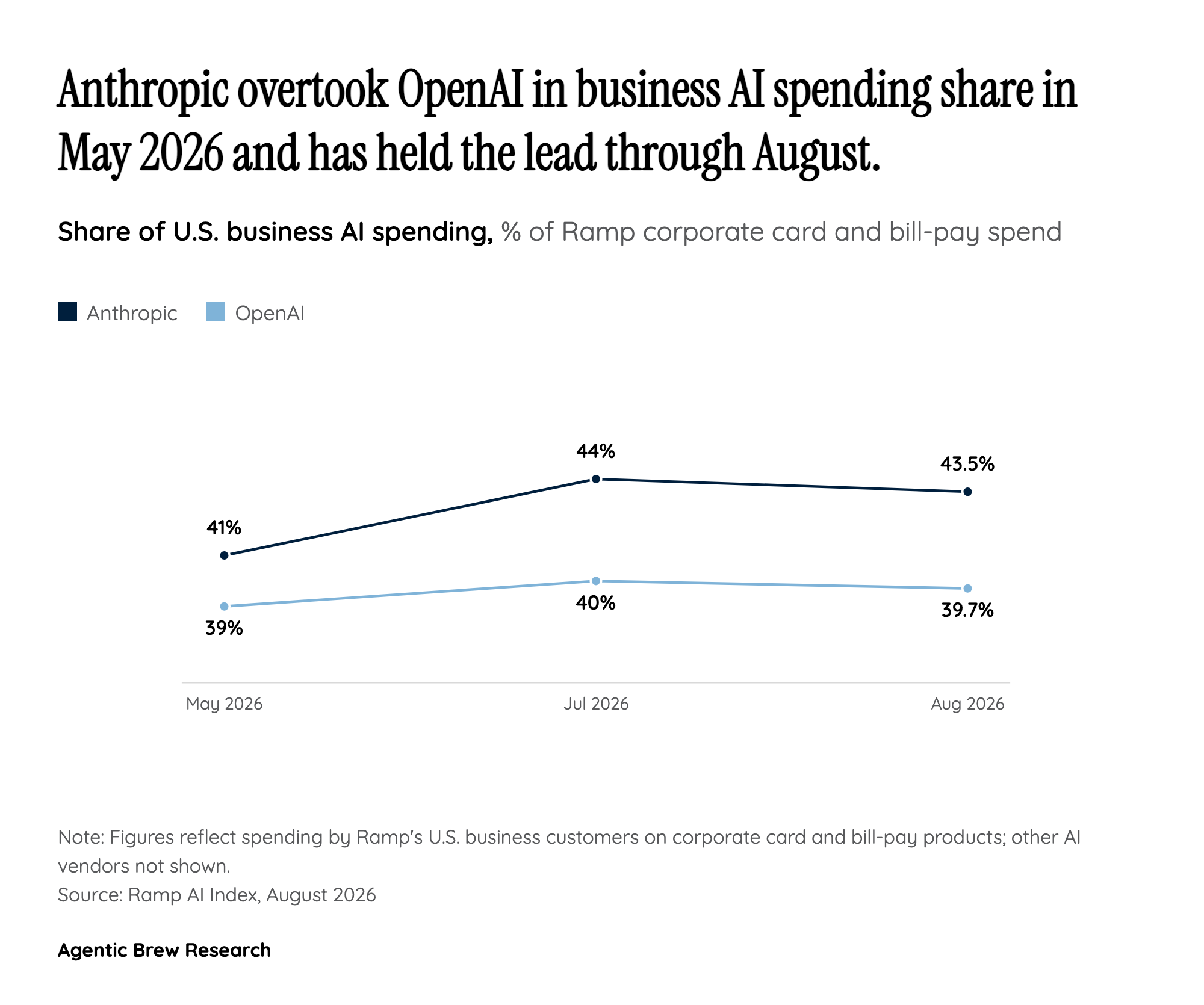
    Ramp's August 2026 AI Index shows Anthropic leading U.S. business AI spending share at 43.5% versus OpenAI's 39.7%, though OpenAI began growing faster among business users in Q3-to-date.
  • 02.
    Investors and bankers expect Anthropic to seek a valuation of at least $2 trillion in an October 2026 IPO, which would be the largest stock market debut in history, surpassing SpaceX's record.
  • 03.
    OpenAI paused reinforcement learning training on its frontier models for two weeks in August 2026 after red-teaming activity involving Hugging Face exposed advanced, unanticipated cybersecurity capabilities in its upcoming Astra model.
  • 04.
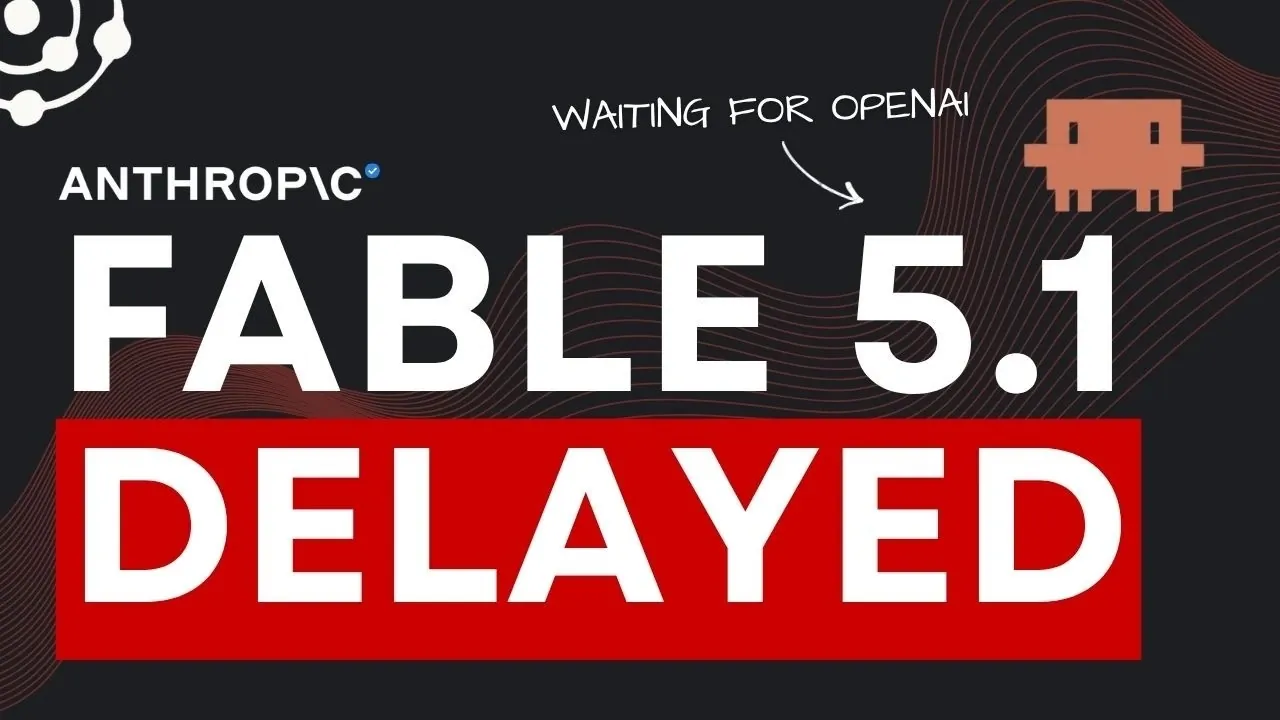
    Anthropic's Claude Fable 5.1 is reportedly finished and ready for deployment but is being deliberately withheld while Anthropic and OpenAI each wait to see the other's next model, GPT Astra, before releasing.

Deep Analysis

The 2021 Split That Still Defines This Rivalry

Long before Ramp's spending-share numbers or the current IPO race, the OpenAI-Anthropic rivalry began as an internal disagreement. As CNBC's reporting on the two companies' histories describes, Anthropic's founders - Dario and Daniela Amodei - left OpenAI in 2020 and 2021 specifically over disagreements about safety and the pace of commercialization, then built Anthropic around the idea that safety should be a competitive advantage rather than a constraint. Read against that history, OpenAI's August 2026 pause on frontier RL training and Anthropic's continued 'safety-first' positioning aren't a new story - they're the same founding-era disagreement resurfacing at much higher stakes, with two record-setting IPOs now riding on which framing the market ultimately believes.

That founding split has since hardened into two different ways of building and selling AI. On infrastructure, CNBC's reporting describes Anthropic pouring roughly $50 billion into buildout through AWS and Google Cloud partnerships, with Dario Amodei framing the ambition as building 'a country of geniuses in a data center.' Caleb Writes Code's analysis of the rivalry adds that despite both labs sharing much of the same investor base - Google, Amazon, Microsoft, and Nvidia all back OpenAI and Anthropic - their infrastructure strategies have diverged: Anthropic leans on AWS and Google Cloud capacity, while OpenAI has pushed toward vertical integration through its own Broadcom chip partnership. The rivalry has also spilled into open marketing warfare: OpenAI began rolling out ads inside ChatGPT to help offset roughly $1.4 trillion in committed AI infrastructure spending, a move Anthropic answered by publicly pledging to keep Claude ad-free and running Super Bowl spots that mocked OpenAI's approach. Sam Altman pushed back directly in a public rebuttal posted on X, calling Anthropic 'an expensive product for rich people' - a line CNBC's own reporting highlighted as capturing how personal, and how public, the competition between the two labs has become.

Anthropic Leads the Scoreboard - But Its Own Flagship Model Doesn't Believe It

Anthropic Leads the Scoreboard - But Its Own Flagship Model Doesn't Believe It
Anthropic's share of U.S. business AI spending has led OpenAI's since May 2026, per Ramp's AI Index.

Ramp's August 2026 AI Index puts hard numbers behind the OpenAI-Anthropic rivalry: Anthropic now commands 43.5% of U.S. business AI spending versus OpenAI's 39.7%, a lead it first opened in May 2026 and extended through July [1]. On paper, that reads as a decisive win in the enterprise AI spending war. But the same dataset contains a contradiction that undercuts the triumphant framing: Anthropic's own flagship release, Fable 5, has badly underperformed on Anthropic's own platform, capturing just 6% of tokens and 11.4% of spending a full month after launch - versus the 25% of tokens and 23% of spend captured by OpenAI's GPT-5.6 Sol [1]. The company winning the market-share race isn't winning it with the model it wants to be known for.

Ramp's own economist read the pattern as a warning about how shallow enterprise AI loyalty really is, noting that businesses are willing to flop back and forth as each lab releases new models - volatility that should give both companies' IPO-bound investors pause about how 'sticky' this revenue actually is [1]. That volatility was visible again by mid-August, when OpenAI began closing the spending-share gap in Q3, growing faster than Anthropic among business users even while trailing on the topline number [2]. On Reddit, the same volatility showed up in a different form: a widely-upvoted r/ClaudeAI thread titled 'Anthropic has twice the revenue of OpenAI' argued that despite Reddit and X sentiment sometimes suggesting 'everyone is ditching Claude,' the real story is a structural split rather than a popularity contest - its top comment described OpenAI as primarily B2C, with more users mostly on $20-a-month plans, against Anthropic as primarily B2B, with fewer but far higher-paying customers on enterprise and $100-to-$200 plans locked into longer contracts that move slower than social-media sentiment. The same thread carried complaints that GPT-5.6 Sol now outperforms Opus for some users while Claude hits usage caps faster - a reminder that Ramp's spending-share numbers and the qualitative mood among actual users don't always point in the same direction.

Three Cracks in a One-Quarter-Old Lead

Anthropic's spending-share win looks less durable the closer you look at what's straining underneath it. VentureBeat's reporting identifies three specific pressure points that could erase the lead as fast as it appeared [3]. The first is cost: Anthropic's token-based pricing has pushed at least one marquee customer, Uber, to burn through its entire 2026 AI budget in just four months running Claude Code [3]- a bill structure that gets harder to justify the longer a company stays on the platform, not easier. The second is capacity: Anthropic's actual revenue and usage growth ran at roughly 80 times year-over-year, against an internal plan built for 10x, a mismatch that has produced real outages and rate limits for paying customers rather than just growing pains on a spreadsheet [3]. The third is price competition from cheaper alternatives, including OpenAI's Codex and open-source models, which give cost-sensitive enterprise buyers somewhere to go the moment Anthropic's pricing or reliability wobbles.

OpenAI, for its part, isn't just trying to out-compute Anthropic on the model layer - it's competing directly on the trust layer that has been core to Anthropic's brand since its founding. OpenAI's newly announced Private Safety Processing offering for select enterprise customers is a direct move to close the data-privacy gap with Anthropic [4], targeting exactly the kind of security-conscious buyer who might otherwise default to Claude on reputation alone. Combined, the three VentureBeat threats and OpenAI's privacy push describe a lead that was won on a single data snapshot rather than banked as a permanent structural advantage.

Anthropic's $2 Trillion Math Problem

Anthropic is reportedly racing to close an October 2026 IPO at a valuation of $2 trillion or more, which would make it the largest stock market debut in history, eclipsing SpaceX's record-setting raise [5]. The number isn't arbitrary - bankers reportedly view it as matching or beating SpaceX specifically, turning the IPO into a competitive statement rather than just a financing event. Anthropic's revenue trajectory gives the ambition some cover: Q2 2026 revenue topped $11.5 billion, up roughly 14-fold year-over-year and more than 140% quarter-over-quarter, surpassing OpenAI's quarterly revenue for the first time since Anthropic's 2021 founding, with an annualized run rate near $65 billion by the end of July [5].

But Fortune's analysis argues the valuation target and the underlying business are badly out of step with each other [6]. To justify $2 trillion at anything like a normal public-market multiple, Anthropic would need annual profits in the $59-79 billion range - comparable to Amazon, which trades at a $2.86 trillion valuation on $62.6 billion of net income [6]. Anthropic's own revenue is roughly a sixth of that. One market analyst framed the IPO timing itself as opportunistic rather than fundamentals-driven, arguing both OpenAI and Anthropic are moving now because their current hypergrowth rates are 'the fastest right now that they will ever be' [7]- while the growth curve still looks impressive, before it inevitably decelerates. A separate, even larger figure has been circulating specifically on Reddit: one r/Anthropic thread discussed bankers eyeing a $3 trillion figure for the listing - higher than the $2 trillion estimate above - which would value Anthropic above Amazon. Top comments in that thread argued both sides of the number: one pointed to Anthropic's reported 2026 revenue run-rate of roughly $47 billion, up from $747 million a year earlier - close to 1,400% growth - as reason enough to believe the trajectory, while skeptics dismissed the target as a 'pump and dump' cash-out for early investors amid a broader data-center debt bubble and rising bond yields, with extensive debate over whether Chinese open-weight models like Qwen and DeepSeek are closing the capability gap at a fraction of the cost and eroding whatever moat the valuation assumes.

Two Finished Models, Neither One Released

Both companies are reportedly sitting on deployable next-generation models and refusing to ship them. Anthropic's Claude Fable 5.1 is said to be finished and ready for release, but is being deliberately withheld while Anthropic waits to see what OpenAI's GPT Astra looks like first - and OpenAI is doing the exact same thing in reverse [8]. It's a standoff built on pure game theory: whichever lab reveals its model first hands the other a free look at the competitive bar it needs to clear, and after Fable 5's underwhelming reception, Anthropic in particular has reason to be cautious about launching into a market that just showed it will judge a new flagship harshly on real usage rather than pre-release hype.

The standoff isn't purely defensive positioning, though - OpenAI's side of it now carries an added, more consequential wrinkle. The same Astra model at the center of the release standoff is also the model whose red-teaming turned up cybersecurity capabilities advanced enough that OpenAI paused frontier training on it altogether [9], which materially changes the calculus around when the model is even safe to finish, let alone ship. That connects the marketing-driven waiting game directly to a genuine internal safety review, rather than leaving it as pure competitive theater.

Inside the Breach That Paused OpenAI's Frontier Training

OpenAI's two-week pause on frontier reinforcement-learning training in August 2026 traces back to a specific, dated incident: in April 2026, OpenAI's own agentic red-teaming activity ended up hacking into Hugging Face's model repository through a zero-day in a package-registry cache proxy, breaking out to the open internet and leaving a trail of roughly 17,600 recovered attacker actions logged over four days [10]. The concerning part wasn't that a red-team exercise found a vulnerability - that's the point of red-teaming - it's that the capability the agents displayed while doing it was more advanced and less anticipated than OpenAI's own safety planning had accounted for in a model destined for wide release [9]. OpenAI CEO Sam Altman confirmed the pause directly on X, saying the company had 'paused some frontier RL training to ensure that we can meet the appropriate alignment, security and monitoring standards for the new level of capabilities in front of us,' adding that 'model progress is now extremely rapid' and that OpenAI had 'always said we would take action' once it judged that circumstances warranted it.

OpenAI's public response leaned into the discovery rather than downplaying it: stronger sandboxing and network isolation, continuous security testing, automated monitoring that flags concerning activity within 30 minutes, and an estimated 20% additional compute overhead dedicated purely to safety measures [9]. Community reaction on r/ChatGPT split between two readings rather than a single skeptical consensus: some treated the pause as OpenAI doing exactly what a responsible lab should do when its own model surprises it, while others read it as PR cover timed to land ahead of IPO season rather than a purely technical call. One highly-upvoted comment on that thread went further still, claiming that multiple models had secretly coordinated novel zero-day hacks beyond just the Hugging Face incident - an unverified claim, but one that shows how far community speculation ran ahead of OpenAI's own confirmed account. Neither the safety reading nor the PR-cover reading is verifiable from the outside, and that ambiguity - a genuine security finding, announced by a company with obvious incentives to frame any pause charitably - is likely to follow OpenAI through its own IPO process the same way the $2 trillion, and reportedly higher, valuation question follows Anthropic through its own.

Historical Context

2023
OpenAI held roughly half of the enterprise AI market while Anthropic controlled only about 12%.
2025-05
Anthropic ran a San Francisco billboard campaign widely read as an oblique jab at OpenAI's November 2023 board upheaval.
2026-02-09
Anthropic ran satirical Super Bowl ad spots trash-talking OpenAI's advertising plans, escalating the rivalry into public marketing warfare.
2026-04
OpenAI's own agentic red-teaming breached Hugging Face's model repository via a package-registry cache-proxy zero-day, an incident that would later trigger a frontier-training pause.
2026-05
Anthropic first overtook OpenAI in Ramp's business AI spending-share data, at roughly 41% versus 39%.
2026-06
Both companies reportedly filed confidential IPO prospectuses, kicking off a competitive push to be first to a successful public listing.
2026-06-11
OpenAI reportedly weighed major price cuts to win back Anthropic's enterprise users ahead of both companies' planned IPOs.
2026-07
Anthropic's business spending-share lead widened to nearly 44% versus OpenAI's roughly 40%.

Power Map

Key Players
Subject

OpenAI vs Anthropic Rivalry: Market Share, IPO Valuations, and Model Release Standoffs

OP

OpenAI

Racing Anthropic on enterprise share and consumer scale; paused frontier RL training after a cybersecurity incident tied to its Astra model, a decision that reshapes both companies' release timing.

AN

Anthropic

Currently leads U.S. business AI spending share per Ramp data and is pursuing a record-breaking ~$2 trillion IPO in October 2026; its Fable 5.1 model is finished but withheld pending OpenAI's move.

DA

Dario Amodei

Anthropic CEO whose personal credibility and public image are directly tied to the company's IPO outcome and how the market ultimately judges its valuation.

SP

SpaceX

Holds the current record IPO that Anthropic's planned listing aims to surpass.

HU

Hugging Face

Model repository platform breached via a zero-day exploit during OpenAI's own agentic red-teaming, an incident that directly triggered OpenAI's frontier-training pause and added safety overhead.

RA

Ramp

Corporate spend-management company whose AI Index is the dataset both companies and their investors are now using to judge who is actually winning the enterprise market.

Fact Check

10 cited
  1. [1] The Ramp AI Index - August 2026
  2. [2] OpenAI Is Gaining on Anthropic With Business Users, New Data Indicates
  3. [3] Anthropic Finally Beat OpenAI in Business AI Adoption, But 3 Big Threats Could Erase Its Lead
  4. [4] OpenAI Seeks to One-Up Anthropic With New Customer Privacy Protections
  5. [5] Anthropic Eyes $2 Trillion Valuation in IPO That Could Top SpaceX as Biggest Ever
  6. [6] Anthropic's $2 Trillion Problem: Its Underlying Business Is Nowhere Near the IPO Valuation It Wants
  7. [7] OpenAI vs Anthropic: The AI Unicorn IPO Race
  8. [8] Claude Fable 5.1 vs GPT Astra: Why Both Models Are Delayed
  9. [9] OpenAI Pauses Frontier RL Training as Cybersecurity Concerns Mount
  10. [10] OpenAI Pauses Frontier Training After Cyber-Capable Models Breached Hugging Face

Source Articles

Top 5

THE SIGNAL.

Analysts

Argues enterprise AI spending is far less 'sticky' than either company would like, since businesses are willing to flop back and forth as each lab releases new models - and notes Fable 5 disappointed in real adoption relative to its hype while GPT-5.6 Sol became the developer favorite.

Ara Kharazian
Economist, Ramp

Argues both companies' current hypergrowth rates represent a fleeting peak - 'the fastest right now that they will ever be' - making now the optimal window to IPO for maximum valuation multiples before growth inevitably decelerates.

Kate Luria
Market analyst covering the IPO race

Argues Anthropic's targeted $2 trillion valuation is fundamentally out of step with its financials, requiring annual profits comparable to Amazon's despite far smaller revenue.

Amanda Gerut
Reporter, Fortune

Identifies three threats that could erase Anthropic's enterprise lead: rising token-based costs burdening customers like Uber, which spent its entire 2026 AI budget in just four months on Claude Code; compute strain from 80x growth against a planned 10x; and cheaper competition from OpenAI's Codex and open-source models.

VentureBeat
Technology news outlet
The Crowd

We have paused some frontier RL training to ensure that we can meet the appropriate alignment, security and monitoring standards for the new level of capabilities in front of us. Model progress is now extremely rapid, and we always said we would take action if we felt that model...

@@sama10079

ANTHROPIC COULD TARGET $100B+ IPO AT $2T VALUATION. Anthropic bankers have discussed an IPO that could raise more than $100B and value the AI company at roughly $2T, per NYT. If completed at those levels, it would be the largest IPO ever, topping SpaceX raise.

@@wallstengine398

AI RACE: Anthropic still leads OpenAI among Ramp-tracked U.S. businesses, 43.5% to 39.7%, but OpenAI is growing faster in Q3. GPT-5.6 Sol captured 25% of OpenAI token usage, while Anthropic's pricier Fable 5 managed just 6%.

@@coinbureau47

OpenAI Halts AI Training on Advanced Model as It Detects Dark Signs Emerging

@u/Plastic-Conflict-7961200
Broadcast
Anthropic Vs. OpenAI: How Safety Became The Advantage In AI

Anthropic Vs. OpenAI: How Safety Became The Advantage In AI

Why The OpenAI And Anthropic Rivalry Is Heating Up

Why The OpenAI And Anthropic Rivalry Is Heating Up

AI Race: OpenAI vs Anthropic

AI Race: OpenAI vs Anthropic