Meta launches Muse Code AI coding agent
TECH

Meta launches Muse Code AI coding agent

55+
Signals

Strategic Overview

  • 01.
    Meta released Muse Code (beta), its first terminal-based AI coding agent, on August 5, 2026, powered by the new Muse Spark 1.2 model.
  • 02.
    Muse Code is available in beta for macOS and Linux, installed via a single terminal command.
  • 03.
    For large jobs, Muse Code fans work out to separate persistent sub-agents running in parallel, each in an isolated git worktree, to avoid mid-run file collisions.
  • 04.
    Every model call, tool run, approval, and edit is written to a local append-only event log before execution, making the runtime replay-exact and restart-safe after crashes.
  • 05.
    Muse Code ships with built-in skills: /plan converts tasks into approval-gated plans, /grill stress-tests those plans, and /goal works the agent toward completing a broader objective.
  • 06.
    Muse Spark 1.2 scores 82.9% on Terminal-Bench 2.1 and 59.3% on DeepSWE v1.1, up from 76.2% and 53.0% for Muse Spark 1.1.
  • 07.
    Muse Code's standard pricing is $1.25/M input tokens and $4.25/M output tokens; a discounted contributor tier at $0.10/M input and $0.20/M output (about 20x cheaper) requires letting Meta train future models on prompts and completions.
  • 08.
    The standard tier allows 3,000 requests/min and 4,000,000 tokens/min, while the contributor tier is capped much lower, at 60 requests/min and 2,100,000 tokens/min.
  • 09.
    Meta says it required thousands of internal engineers to use Muse Code weekly, and that 7,000 active internal users generated over 800 fixes that improved the model.

A Deliberate Price War, With Your Code as Currency

Muse Code's standard pricing lands at $1.25 per million input tokens and $4.25 per million output tokens, but Meta also offers a steeply discounted contributor tier at $0.10 per million input and $0.20 per million output tokens, roughly 20 times cheaper [1]. The catch is that the contributor tier requires developers to let Meta use their prompts and completions to train future models, and Meta backs the discount with much tighter throughput limits: 60 requests per minute and 2.1 million tokens per minute, versus 3,000 requests per minute and 4 million tokens per minute on the standard tier [1].

The tradeoff has not gone unnoticed. A MacRumors forum thread dedicated to the pricing split shows mostly skeptical sentiment, with a number of commenters arguing the discount is not steep enough to justify handing Meta training rights over their code, alongside a smaller group willing to accept the exchange [2]. That data-hungry posture is not new for Meta: the company has said it required thousands of internal engineers to use Muse Code weekly, with roughly 7,000 active internal users producing more than 800 fixes that fed back into the model, according to Meta's own account [3]- a precedent that suggests the contributor tier is less an experiment than an extension of a data flywheel Meta already runs in-house.

Meta Publishes Its Own Reality Check

Meta Publishes Its Own Reality Check
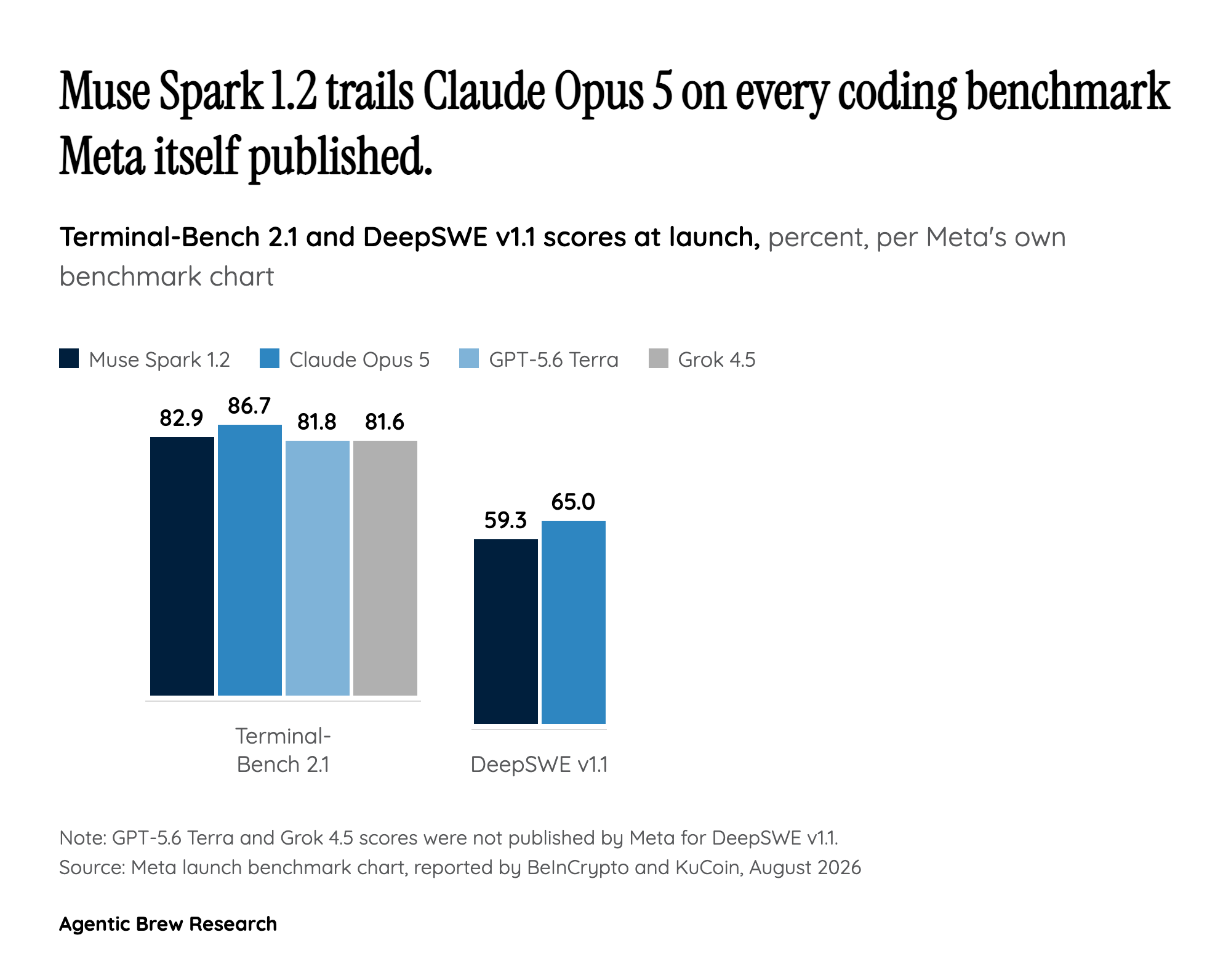
Muse Spark 1.2 vs. rival models on Meta's own Terminal-Bench 2.1 and DeepSWE v1.1 launch benchmarks.

On Meta's chosen benchmarks, Muse Spark 1.2 posts real gains over its predecessor: 82.9% on Terminal-Bench 2.1 and 59.3% on DeepSWE v1.1, up from 76.2% and 53.0% for Muse Spark 1.1 [4]. That edges out OpenAI's GPT-5.6 Terra in Codex (81.8% on Terminal-Bench 2.1) and xAI's Grok 4.5 in Grok Build (81.6%) [4].

But the same chart undercuts Meta's positioning against the actual category leader: Claude Opus 5 running Claude Code scores 86.7% on Terminal-Bench 2.1 and 65.0% on DeepSWE v1.1, beating Muse Spark 1.2 on both, and Meta's own internal 440-pull-request test reportedly shows Claude Opus 5 roughly nine points ahead there too [5][6]. In other words, Meta picked its own scoreboard and still ended up publishing evidence that its flagship rival is ahead on every metric it chose to show.

The DeepSeek Comparison: A Favorable Frame in a Crowded Price War

Meta's launch also invites comparison to DeepSeek's V4 Flash 0731, a similarly low-cost model, and here Muse Spark 1.2 comes out narrowly ahead: Artificial Analysis's Intelligence Index scores it 54 versus DeepSeek's 50, and its GDPval-AA v2 Elo rating of 1631 tops DeepSeek's 1559 [7][8]. On the specific benchmarks Meta highlighted at launch, its self-reported 82.9% on Terminal-Bench 2.1 and 59.3% on DeepSWE 1.1 both edge out the figures DeepSeek published for V4 Flash 0731 on its own engineering blog: 82.7% and 54.4% respectively [9].

Those numbers deserve a caveat: they come from separate measurement setups rather than one unified table. The Intelligence Index and Elo figures are Artificial Analysis's own independent evaluations, while the Terminal-Bench and DeepSWE numbers pair Meta's self-reported chart against DeepSeek's self-reported figures. Artificial Analysis's own narrative writeup on Muse Spark 1.2 separately lists a lower, independently run Terminal-Bench v2.1 score of 80% for the model, distinct from the 82.9% Meta reported itself [8]. Put together, the DeepSeek comparison is real but curated: Meta highlighted the one head-to-head where it wins narrowly, while its own chart elsewhere shows it trailing Claude Code on every metric that matters most.

Analysts Doubt the Co-Training Edge Will Last

Independent analysts are skeptical that Meta's approach of co-training the model and the agent harness together gives it a durable advantage. Omdia chief analyst Lian Jye Su noted that rivals are already doing similar integration work, observing that other vendors, such as OpenAI and Anthropic, have been treating harness engineering as part of the training process, and flagged the security and governance requirements enterprises will demand as a likely brake on adoption [10].

Pareekh Jain of Pareekh Consulting argued that Muse Code's real test will be enterprise project outcomes and how much human intervention it actually removes, expecting companies to start it on narrowly scoped, lower-risk tasks before trusting it with production code [10]. Counterpoint Research's Neil Shah went further, arguing that vendor-published benchmark charts, like the Terminal-Bench and DeepSWE comparisons Meta itself chose to publish, matter less than real-world results, since the key metric for CIOs is the pass rate against an enterprise's own pipeline [10].

Historical Context

2026-04
Meta released the first Muse Spark model roughly four months before Muse Spark 1.2 and Muse Code.
2026-08-05
Muse Code (beta) and Muse Spark 1.2 launched together for macOS and Linux, marking Meta's first entry into the terminal-based autonomous coding agent category already occupied by OpenAI's Codex and Anthropic's Claude Code.
2026-07-10
Meta shares had their best week since early 2024, up 15% for the week, roughly a month before the Muse Code launch.

Power Map

Key Players
Subject

Meta launches Muse Code AI coding agent

ME

Meta Platforms / Meta Superintelligence Labs

Developer and publisher of Muse Code and Muse Spark 1.2; positions the product as a lower-cost alternative to rivals to gain developer adoption, using the contributor tier's data-training rights as an extension of the internal data flywheel Meta already runs.

OP

OpenAI (Codex)

Competing terminal/agentic coding product; Muse Spark 1.2 edges out GPT-5.6 Terra in Codex on Terminal-Bench 2.1 (82.9% vs 81.8%) but trails on DeepSWE v1.1 long-horizon tasks.

AN

Anthropic (Claude Code)

Market leader Muse Code is explicitly built to challenge; Claude Opus 5 (max effort) leads Terminal-Bench 2.1 at 86.7%, ahead of Muse Code, and Meta's own launch benchmarks show Claude Opus 5 beating Muse Code on every comparison Meta itself published.

XA

xAI (Grok Build / Grok 4.5) and Google (Gemini 3.6 Flash)

Secondary competitors also benchmarked at launch; Grok Build scored 81.6% on Terminal-Bench 2.1, behind Muse Spark 1.2, which also exceeds Grok and Gemini 3.6 Flash on DeepSWE 1.1.

DE

DeepSeek

Competing lower-cost model provider (V4 Flash 0731); Meta's launch positions Muse Spark 1.2 as narrowly ahead of DeepSeek V4 Flash on several benchmarks, situating this launch within a broader agentic-coding price war beyond just the Meta/OpenAI/Anthropic rivalry.

MA

Mark Zuckerberg

Meta CEO; publicly announced Muse Code's beta launch.

AL

Alexandr Wang

Meta Superintelligence Labs AI chief; publicly framed Muse Code's value proposition around cost-effectiveness, saying the tool 'can be an incredibly good option, especially from a cost perspective' for many workflows.

Fact Check

12 cited
  1. [1] Meta's Muse Code for Mac
  2. [2] Meta's New Mac Coding Agent Costs Up to 20x Less if You Let Meta Train on Your Data
  3. [3] Meta Launches Muse Code AI
  4. [4] Meta Launches Muse Code, a New AI Coding Agent Powered by Spark 1.2
  5. [5] Zuckerberg's Muse Code vs Anthropic Benchmarks
  6. [6] Meta's Muse Code Loses to Anthropic's Claude Opus 5 in AI Coding Benchmark
  7. [7] Muse Spark 1.2 vs DeepSeek V4 Flash - Model Comparison
  8. [8] Muse Spark 1.2
  9. [9] DeepSeek V4 Flash 0731 GA: Agent Benchmarks
  10. [10] Meta Launches Muse Code for Complex Software Work With Persistent AI Agents
  11. [11] Introducing Muse Code and Muse Spark 1.2
  12. [12] Meta Launches Muse Code, an AI Agent for Large Code Bases

Source Articles

Top 5

THE SIGNAL.

Analysts

Skeptical that Meta's approach of co-training the model and agent harness together gives Meta a durable edge, since rivals are doing similar integration work; also flagged security and governance requirements as a likely brake on enterprise adoption.

Lian Jye Su
Chief Analyst, Omdia

Believes Muse Code's competitive advantage must be proven through real enterprise project outcomes and a reduced need for human intervention; expects adoption to start with narrowly scoped, lower-risk tasks before agents are trusted with production code.

Pareekh Jain
CEO, Pareekh Consulting

Argues vendor-published benchmark comparisons, like Meta's own Terminal-Bench and DeepSWE chart, are less meaningful than third-party or same-harness evaluations, since enterprise buyers care more about pass rates on their own pipelines than headline benchmark scores.

Neil Shah
Vice President of Research, Counterpoint Research
The Crowd

Releasing Muse Code in beta today. It's a terminal coding agent that takes on complete software engineering tasks across large repos: planning changes, writing code, validating the results. Powered by Muse Spark 1.2, a coding-focused model update.

@@finkd13523

Introducing Muse Code (beta), a terminal coding agent built for long-horizon software engineering, powered by our new Muse Spark 1.2 model. Muse Code plans, implements, and validates complex, multi-file changes across large repositories with persistent sub-agents that solve

@@AIatMeta3348

Meta just launched a coding agent that costs 21x less than Claude Code and Codex. But there's a catch. It's called Muse Code. The contributor tier charges $0.20 per million output tokens. For context, Claude Code and Codex both start at $20 a month and go up to $200 depending

@@VaibhavSisinty60

Meta releases Muse Code in beta

@u/troll_khan227
Broadcast
Meta Muse Code Is HERE – Spark 1.2 & Meta's NEW Coding Agent!

Meta Muse Code Is HERE – Spark 1.2 & Meta's NEW Coding Agent!

Muse Code with Muse Spark 1.2: Fan-Out Coding Agent with Vision

Muse Code with Muse Spark 1.2: Fan-Out Coding Agent with Vision

How to Install Meta AI Muse Code Coding Tool on Mac OS

How to Install Meta AI Muse Code Coding Tool on Mac OS

Meta launches Muse Code AI coding agent — AI News | Agentic Brew