
OpenAI unveils Jalapeño custom inference chip
TECH

OpenAI unveils Jalapeño custom inference chip

30+
Signals

Strategic Overview

  • 01.
    OpenAI and Broadcom unveiled Jalapeño on June 24, 2026, OpenAI's first custom AI chip - an ASIC the company calls an 'Intelligence Processor' that is architected specifically for running large language models in response to user prompts.
  • 02.
    The chip was co-developed from initial design to manufacturing tape-out in just nine months, an unusually fast cycle that OpenAI says was sped up partly by using its own AI models to accelerate parts of the chip design.
  • 03.
    Jalapeño is built for inference only, not training; OpenAI is expected to keep using Nvidia GPUs for pre-training its largest models for the foreseeable future, making this a selective shift rather than a clean break.
  • 04.
    The chip is still in testing with final performance numbers being measured, and the official announcement disclosed no concrete architecture specifications; initial data-center deployment is planned for late 2026.

Deep Analysis

Why OpenAI Built a Chip That Can't Train Anything

The most important thing to understand about Jalapeño is what it deliberately does not do. It is an inference-only ASIC, an application-specific integrated circuit purpose-built for one job: running already-trained models when a user types a prompt into ChatGPT, Codex, or the API [1]. It does not train models. OpenAI is expected to keep buying Nvidia GPUs for pre-training its largest models for the foreseeable future, because the most performance-intensive work still lives there [2]. That makes Jalapeño a selective carve-out rather than a clean break from Nvidia.

The logic is economic. Inference now represents roughly two-thirds of all AI compute, because a model is trained once but answered billions of times [3]. When the recurring cost of your business is serving tokens, shaving the cost of each token compounds. A general-purpose GPU is built to do many things well; a fixed-function ASIC built around your own kernels and serving systems can be co-optimized for latency, throughput, and cost on exactly the workloads you run. OpenAI President Greg Brockman framed the bet as hunting for 'specific workloads that are underserved' by general-purpose hardware [2]. The strategic prize, repeatedly described as an 'Apple-like' move, is vertical integration: by owning the chip, the memory, the networking, the scheduling, and the deployment, OpenAI can tune the whole stack together instead of renting someone else's silicon and accepting their tradeoffs [4].

By The Numbers

By The Numbers
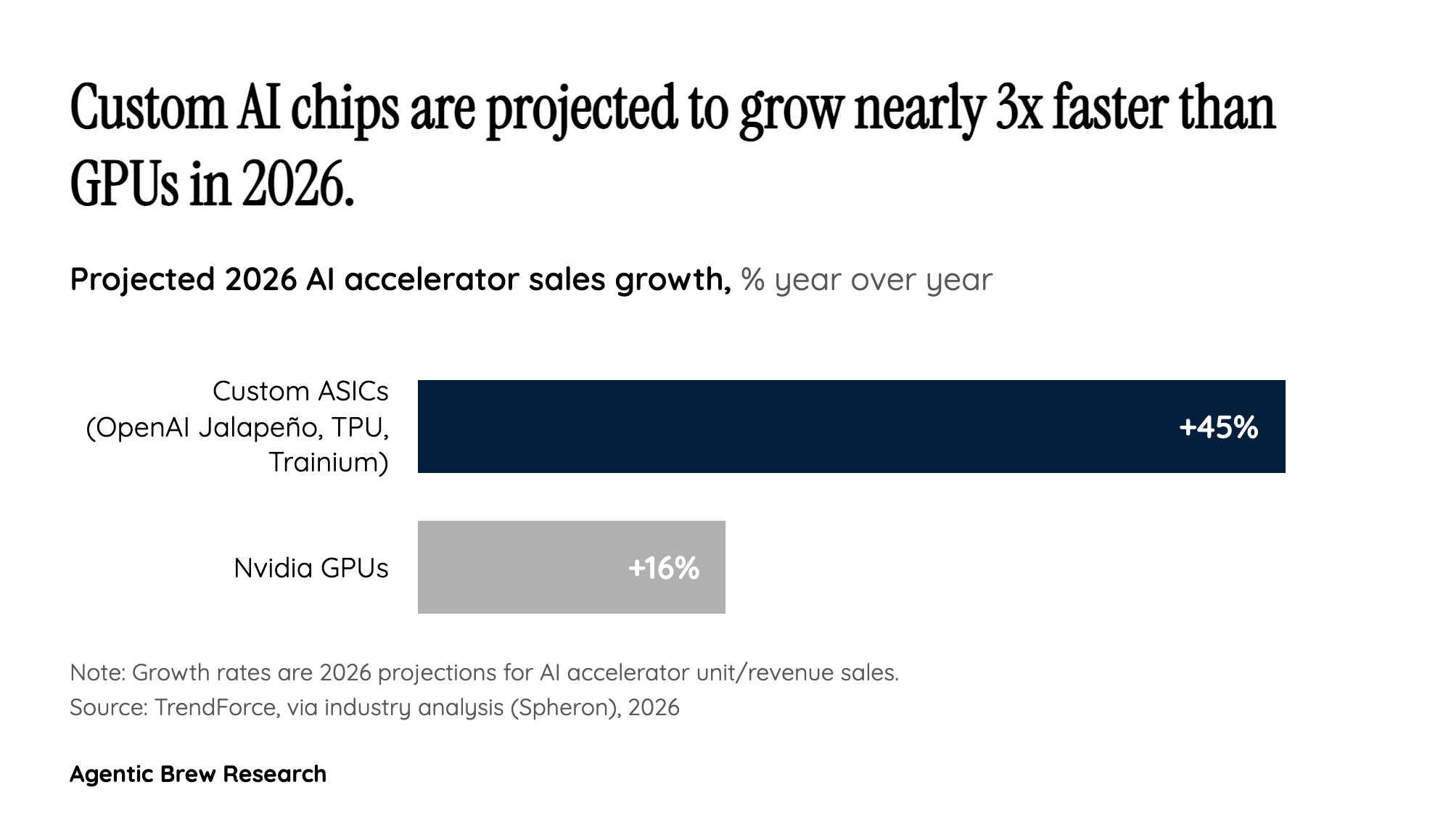
Custom AI chips (ASICs) are projected to grow about 45% in 2026 versus roughly 16% for GPUs - nearly 3x faster.

A few figures define the stakes. The chip went from initial design to manufacturing tape-out in just nine months, an unusually fast cycle that OpenAI says was accelerated partly by using its own AI models in the design work [5]. It is the first chip in a 10-gigawatt OpenAI-designed accelerator deployment that Broadcom and OpenAI announced in October 2025, with the first data centers slated to come online late in 2026 [6]. The headline economic claim - that the chip could cut inference cost per token by roughly 50 percent versus current Nvidia GPUs - is attributed to reporting from Bloomberg and Broadcom's CEO, not confirmed by OpenAI, which in its own statement emphasizes superior performance-per-watt rather than a specific cost figure [7]. The broader market backdrop is steep: custom ASIC sales are projected to grow about 45 percent in 2026 against roughly 16 percent for GPUs, and Broadcom is targeting $100 billion in annual AI chip revenue by 2027 on the back of a roughly $73 billion AI backlog [3].

Follow the Broadcom Money

Jalapeño is OpenAI's chip, but it is Broadcom's franchise. A point that practitioners were quick to clarify online is that Broadcom is the custom-ASIC designer here - the same firm behind Google's TPU - while TSMC is the fabricator, so 'built by Broadcom' describes design and integration, not a foundry [3]. That distinction matters because it places Jalapeño inside a fast-growing custom-silicon business rather than treating it as a one-off. Analysts read the announcement as a likely tailwind for Broadcom's custom-silicon arm, even while warning that early shipment volumes may be modest [8].

It also confirms a trend. Jalapeño slots OpenAI alongside Google's TPU, Amazon's Trainium, Microsoft's Maia, and Meta's MTIA in the club of large AI players building proprietary silicon [3]. Crucially, like all of those, Jalapeño is captive: it is an internal chip meant to power OpenAI's own services, not a product you can rent or buy. The investor enthusiasm visible in finance-leaning communities centered on exactly this - Broadcom's position arming hyperscaler after hyperscaler with bespoke accelerators - rather than on any consumer angle.

What the Skeptics See That the Bulls Don't

The loudest counter-signal is the absence of detail. OpenAI disclosed no concrete architecture specifications, and final performance is still being measured, which means the most-cited numbers are projections rather than benchmarks [9]. Wedbush's Matt Bryson, even while calling the news a 'probable positive' for Broadcom, cautioned that successful compute chips usually need multiple design iterations and that initial shipment volumes may prove modest [10]. First-generation custom silicon rarely arrives finished.

The sharpest skepticism, though, came from practitioner communities rather than analysts. Where finance-leaning forums were bullish, the local-inference crowd was dismissive to wary: the recurring point was that Jalapeño is an internal chip that will not be sold, will not help anyone running models on their own hardware, and mirrors the closed in-house silicon of Google, Amazon, and Microsoft. Some voiced an anti-monopoly worry that a dominant player optimizing the market around its own chip could squeeze open and local inference, a fear others in the same threads pushed back on. The gap between investor excitement and builder ambivalence is the tension worth watching: the same vertical-integration story that thrills shareholders reads, to people who run their own models, as one more wall going up around the best hardware.

Historical Context

2024-07
Early reports of an OpenAI-Broadcom custom chip collaboration first surfaced.
2025-10-13
OpenAI and Broadcom announced a strategic collaboration to deploy 10 gigawatts of OpenAI-designed AI accelerators.
2026-06-24
OpenAI unveiled Jalapeño, its first custom inference chip, with first samples received and in testing.

Power Map

Key Players
Subject

OpenAI unveils Jalapeño custom inference chip

OP

OpenAI

Designed the chip from scratch around its own understanding of LLM workloads, kernels, and serving systems, seeking to own more of the full stack to cut inference cost and reduce its dependence on Nvidia.

BR

Broadcom

Co-development and silicon partner that supplies the Ethernet connectivity for the racks; part of a strategic collaboration announced in October 2025 to deploy 10 gigawatts of OpenAI-designed accelerators.

NV

Nvidia

The incumbent whose GPU pricing power and inference dominance Jalapeño aims to chip away at; the threat is real but bounded, since OpenAI keeps Nvidia for training.

MI

Microsoft

Largest shareholder of operational OpenAI and named partner for gigawatt-scale data center deployment beginning in 2026, giving it a direct stake in whether Jalapeño lowers serving costs.

TS

TSMC

Manufactures the ASIC and fabricates essentially all advanced hyperscaler AI chips, making it the quiet chokepoint behind every custom-silicon program in this race.

Fact Check

10 cited
  1. [1] OpenAI and Broadcom reveal Jalapeño, first AI chip in partnership
  2. [2] OpenAI unveils its first custom chip, built by Broadcom
  3. [3] Hyperscaler Custom AI Chips 2026: Trainium, TPU, Maia, MTIA vs Nvidia GPU
  4. [4] Broadcom and OpenAI debut Jalapeño intelligence processor, plot an Apple-like move to build the full stack
  5. [5] OpenAI unveils first custom AI inference chip Jalapeño with Broadcom, and its development was sped up with OpenAI's own models
  6. [6] OpenAI and Broadcom announce strategic collaboration
  7. [7] OpenAI's First Custom AI Chip Targets 50% Cheaper Inference as Jalapeño Unveiled
  8. [8] Broadcom Gets a Major OpenAI Boost
  9. [9] OpenAI and Broadcom announce new AI chip Jalapeño
  10. [10] OpenAI Jalapeño Chip: Big Tech's Bold Move Toward an Nvidia Alternative

Source Articles

Top 3

THE SIGNAL.

Analysts

"By designing more of the stack ourselves, we can serve more intelligence with greater efficiency and keep pushing advanced AI toward broader access."

Greg Brockman
President and Co-founder, OpenAI

"We have a deep understanding of the workload. We've really been looking for specific workloads that are underserved."

Greg Brockman
President and Co-founder, OpenAI

"This is just the beginning of a multi-generation roadmap. By co-developing our industry-leading silicon directly with OpenAI, we are enabling the deployment of gigawatt scale data centers with Microsoft and other partners beginning in 2026."

Hock Tan
President and CEO, Broadcom

"Characterized the announcement as a 'probable positive' for Broadcom, though cautioned that initial shipment volumes may prove relatively modest and that successful compute chips usually need multiple design iterations."

Matt Bryson
Analyst, Wedbush Securities
The Crowd

"We've designed and built our first AI chip: Jalapeño. Designed from the ground up by OpenAI and brought to production with @Broadcom, Jalapeño is purpose-built for the LLM workloads powering ChatGPT, Codex, the API, and future agentic products. Chips are foundational to the AI"

@@OpenAI22624

"OpenAI just unveiled Jalapeño, its first custom AI chip designed from scratch for LLM inference- It is OpenAI moving deeper into the full stack: chips, kernels, memory, networking, racks, scheduling, deployment and product experience. OpenAI has learned from Cerebras-deal what"

@@kimmonismus561

"OpenAI and Broadcom $AVGO unveiled Jalapeño, a custom AI accelerator built for LLM inference. The chip is expected to deploy with Microsoft and other data center partners starting in 2026, with Celestica handling board, rack, and system integration work."

@@wallstengine228

"OpenAI on X: "We've designed and built our first AI chip: Jalapeño. Designed from the ground up by OpenAI and brought to production with @Broadcom...""

@u/SidelineStory81641
Broadcast
OpenAI's Jalapeño Chip Could Change LLMS Forever

OpenAI's Jalapeño Chip Could Change LLMS Forever

OpenAI Unveils First Custom AI Chip With Broadcom | Bloomberg Tech 6/24/2026

OpenAI Unveils First Custom AI Chip With Broadcom | Bloomberg Tech 6/24/2026

OpenAI's Jalapeño: The Chip That Ends the GPU Hype?

OpenAI's Jalapeño: The Chip That Ends the GPU Hype?