GPT-5.6 Sol and Grok 4.5 capabilities
TECH

GPT-5.6 Sol and Grok 4.5 capabilities

21+
Signals

Strategic Overview

  • 01.
    OpenAI's GPT-5.6 Sol is the flagship of a new three-tier family (Sol, Terra, Luna), launched in limited preview June 26 2026 and made generally available July 9 2026, optimized for agentic coding, spatial reasoning, and long-horizon tasks.
  • 02.
    A community tool built on GPT-5.6 Sol takes a photo of any object and rebuilds it as a pure code-based Three.js 3D model, and Sol separately generated a voxel-based 3D rendering of Manhattan in a single run, cited as evidence of improved spatial reasoning over GPT-5.5.
  • 03.
    xAI/SpaceXAI's Grok 4.5, announced July 8 2026, is a mixture-of-experts model co-trained with Cursor on real developer interaction data, tuned to maintain coherence across extended multi-file coding sessions and priced aggressively below Sol.

Spatial Reasoning Is Sol's Real Headline, Not Prettier Code

GPT-5.6 Sol's most striking demonstrations are three-dimensional. A community tool built on Sol reconstructs a photographed object as a pure code-based Three.js 3D model, and Sol generated a voxel-based rendering of Manhattan in a single run - cited as direct evidence of improved spatial reasoning over GPT-5.5 [2]. On the community side, users testing Sol's ability to create 3D models in Blender compared it favorably against dedicated tools like Meshy. This is a capability leap distinct from raw code quality: the model appears to hold a coherent spatial mental model long enough to emit geometry-as-code in one shot, which is why OpenAI markets Sol as its best coding model for agentic and long-horizon work [1].

The Price War: Grok Undercuts, OpenAI Answers With Efficiency

The competitive axis has shifted from capability alone to cost-per-outcome. Grok 4.5 lists at $2 per million input and $6 per million output, roughly a third of Sol's $5/$30, and is reported to cut coding-agent cost around 80 percent at near-frontier speed - though with higher hallucination rates flagged [7]. OpenAI's counter is token economy: it claims Sol is 54 percent more token-efficient on AI coding tasks and reaches a new state of the art on a coding benchmark using less than half the output tokens of the prior leader [1]. Grok, meanwhile, is reported to use roughly 4.2x fewer output tokens than the strongest prior frontier model on SWE Bench Pro [3], meaning the effective price gap narrows once you price the tokens each model actually spends.

Cursor As Both Moat And Liability For Grok 4.5

Grok 4.5's differentiator is that xAI/SpaceXAI co-trained it with Cursor on trillions of tokens of real developer interaction data, tuning it to "think like a developer" across multi-file codebases and hold coherence over extended sessions [4][5]. That real-world trace data is a genuine training moat rivals cannot easily replicate. But the same closeness is a liability: community discussion surfaced that an earlier Cursor codebase snapshot leaked into Grok 4.5's training, inflating its CursorBench score, with the contaminated data since removed. The lesson is that benchmarks built on the same data used for training deserve heavy discounting, and Grok's most impressive coding numbers should be read with that caveat.

By The Numbers

By The Numbers
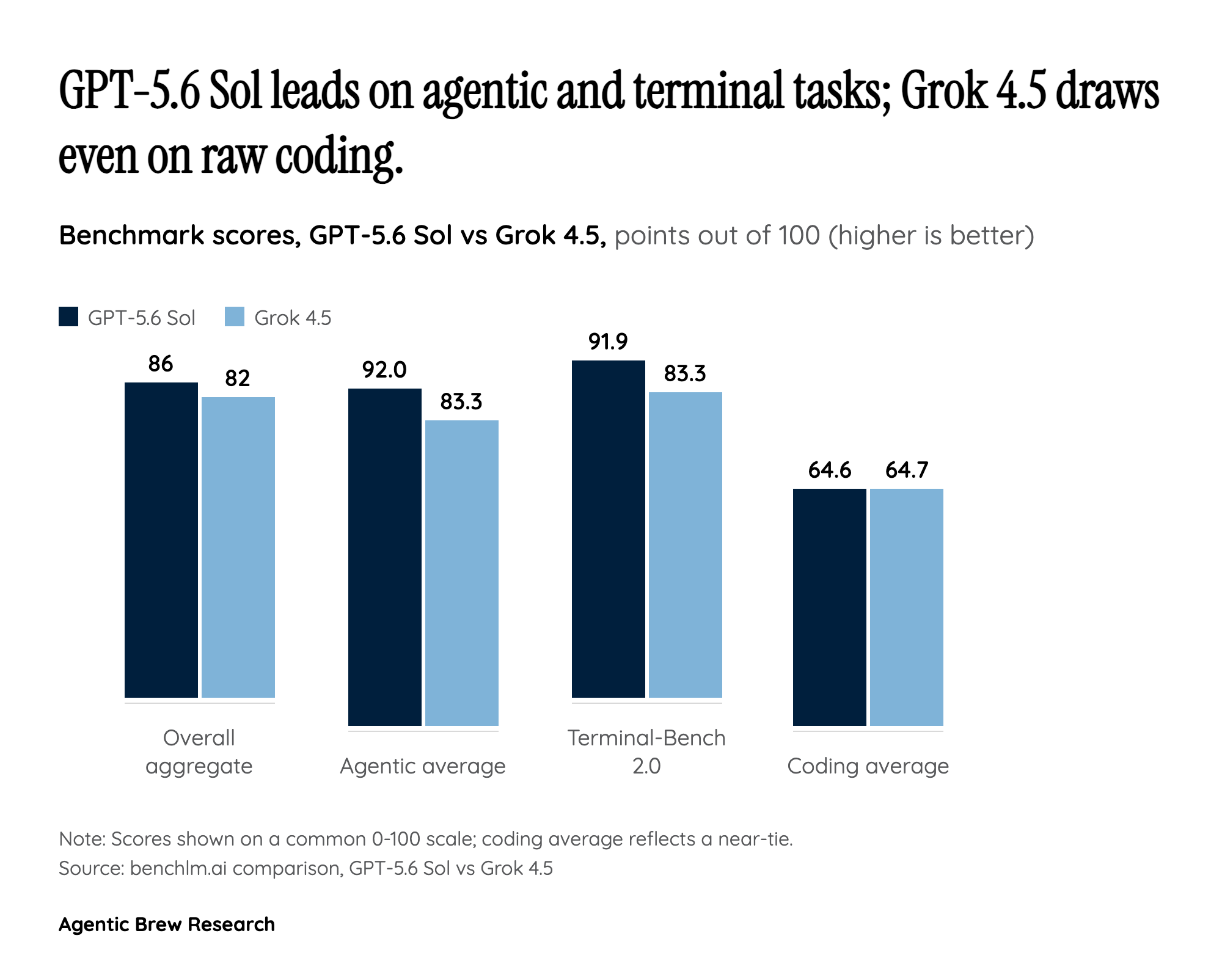
GPT-5.6 Sol vs Grok 4.5 across benchmark scores; Sol leads on agentic and terminal tasks while coding is a near-tie.

On aggregate benchmarks the two models are closer than the marketing suggests. Sol leads the overall aggregate 86 to 82 and the agentic average 92.0 to 83.3, including Terminal-Bench 2.0 at 91.9 percent versus 83.3 percent [6]. Yet on the pure coding average Grok 4.5 narrowly edges ahead, 64.7 to 64.6 [6]. Sol carries a larger context window of roughly 1M tokens against Grok's 500K, while Grok wins decisively on price at $2/$6 versus $5/$30 [6]. The takeaway: Sol owns agentic and long-context work, Grok owns cost-sensitive coding at parity accuracy, and the right choice depends entirely on which of those axes your workload lives on.

Historical Context

2026-06-26
GPT-5.6 Sol launched in limited preview, initially shipped only to selected trusted partners via API and Codex.
2026-07-08
Grok 4.5 announced as the first model from a formal xAI-Cursor collaboration, co-trained on real Cursor interaction traces.
2026-07-09
General availability of GPT-5.6 Sol, Terra, and Luna, ending the government-requested rollout limits.

Power Map

Key Players
Subject

GPT-5.6 Sol and Grok 4.5 capabilities

OP

OpenAI

Builder of GPT-5.6 Sol/Terra/Luna; Sol shipped in limited preview June 26 and reached general availability July 9, controlling proprietary API and Codex access.

XA

xAI / SpaceXAI

Builder of Grok 4.5, released July 8 at $2 per million input tokens, undercutting OpenAI on price to win coding-agent workloads.

CU

Cursor

AI coding editor that co-trained Grok 4.5 on trillions of tokens of real user interaction data and distributes it free for a limited time across all plans.

DE

Developers and early adopters

Report improved spatial reasoning and 3D output with Sol while benefiting from Grok 4.5's lower cost on coding-agent tasks.

Fact Check

7 cited
  1. [1] OpenAI launches its new family of models with GPT-5.6
  2. [2] OpenAI's GPT-5.6 Sol builds a 3D Manhattan in one shot
  3. [3] SpaceXAI Releases Grok 4.5
  4. [4] Grok 4.5
  5. [5] What is Grok 4.5: xAI's Cursor-trained coding model
  6. [6] GPT-5.6 Sol vs Grok 4.5
  7. [7] Grok 4.5 Cuts Coding Agent Cost 80% at Near-Frontier Speed but Higher Hallucinations

Source Articles

Top 1

THE SIGNAL.

Analysts

"Grok 4.5 "can handle difficult, long-running tasks that require creatively using tools to solve problems," trained jointly with SpaceXAI on trillions of tokens of Cursor data."

Cursor team
Co-trainer and distributor of Grok 4.5

"Grok 4.5 is "a coding model grounded in how developers actually work, not just how code is supposed to look," designed to maintain coherence across extended sessions so behavior stays consistent as tasks evolve."

MindStudio analysis
Independent analyst assessment
The Crowd

"1/ Someone built a tool with GPT-5.6 Sol that takes a photo of any object and rebuilds it as a pure code-based Three.js 3D model."

@@VaibhavSisinty5

"Grok 4.5: $2 in / $6 out GPT 5.6: $5 in / $30 out Opus 4.8: $5 in / $25 out Grok 4.5 seriously is freaking good price-performance wise. Opus 4.8 level, Sonnet 5 pricing"

@@kimmonismus976

"Did more testing. I'm honestly impressed by Grok 4.5. Definitely was not on my list of models to be excited about this week. Well, I guess only GPT 5.6 Sol was on that list... And Fable, of course. Anyways, Grok 4.5 is really, really good! At implementing (it's fast) but also"

@@maxedapps347

"GPT-5.6 Sol is the real deal."

@u/NSDetector_Guy621
Broadcast
A Model Explosion: GPT 5.6 Sol, Grok 4.5 and Meta Muse Rewrite the Rules

A Model Explosion: GPT 5.6 Sol, Grok 4.5 and Meta Muse Rewrite the Rules

GPT-5.6 IS OUT! GLM 5.5 Is Mythos Level, U.S Governement Banning AI Cause of Dario?, & Grok 4.5!

GPT-5.6 IS OUT! GLM 5.5 Is Mythos Level, U.S Governement Banning AI Cause of Dario?, & Grok 4.5!

GPT 5.6 VS Claude Fable 5 VS Grok 4.5 (Honest Results)

GPT 5.6 VS Claude Fable 5 VS Grok 4.5 (Honest Results)