Gemini 4 Argon agents autonomously defeat Minecraft Ender Dragon
TECH

Gemini 4 Argon agents autonomously defeat Minecraft Ender Dragon

28+
Signals

Strategic Overview

  • 01.
    Google DeepMind placed four Gemini 4 Argon agents in a sandboxed Minecraft survival world with a single goal: defeat the Ender Dragon. Each agent controlled a player avatar through the open-source Mineflayer library and coordinated with teammates via in-game chat and shared memory. No one assigned roles or wrote game logic - the agents planned, wrote, and debugged every program themselves.
  • 02.
    The agents finished in 27 hours and 14 minutes, writing and executing 2,783 JavaScript programs, exchanging 229 chat messages, and dying 605 times along the way - all without any human intervention. Researchers could watch on a live dashboard and pause or stop the run at any time, but they never had cause to.
  • 03.
    DeepMind is framing this as the first end-to-end autonomous completion of Minecraft by AI agents, achieved using only the standard Mineflayer library - no pre-scouted seed and no human-written, game-specific tooling to give the agents a shortcut.
  • 04.
    A fifth agent, an independent Observer, monitored the entire session and checked claims against the run's full record; all 2,783 programs and chat logs were preserved for verification. The paper itself caveats that this was a single attempt on Easy difficulty and does not establish how reliably the agents could repeat the run.

Deep Analysis

Code as Controller: Why These Agents Never Saw a Single Pixel

The most counterintuitive part of this experiment is the interface. These agents never looked at the screen. They received structured text and code describing the game state, then acted by writing and running short JavaScript programs through Mineflayer - instructions like walk to these coordinates and mine every iron ore within 16 blocks - and read back text results to decide their next move[1]. There was no vision model, no pixel parsing, no screenshot loop. Researchers could watch a live dashboard and had the ability to pause or stop the run at any point, but across 27 hours and 14 minutes they never needed to[2]. That distinction matters: the agents were essentially programming their way through Minecraft rather than playing it in any sense a human would recognize, which reframes this less as a gaming stunt and more as a stress test of autonomous code generation sustained over a full day.

605 Deaths in 27 Hours: Failure Mode or Feature?

Across the run, the four agents wrote and executed 2,783 programs, exchanged 229 chat messages, and died 605 times - with roughly 22% of those programs ending in error[3][4]. On its face, a death roughly every 11 minutes per agent sounds like chaos, and that is exactly the skepticism some commentators raised: one critic argued the number says more about a forgiving respawn mechanic than about any single coherent plan holding together[5]. But the counter-read is just as plausible - in a game with no pause button and no human safety net, repeated death-and-recovery cycles are how the agents learned to retrieve lost items, patch broken scripts, and keep a 27-hour plan alive without ever being told how. The 605 deaths are not a hidden flaw in the achievement; they are the visible texture of what unsupervised trial-and-error actually looks like at this scale.

No Map, No Seed: Triangulating the Stronghold by Eye of Ender

With no pre-scouted seed to lean on, the agents had to solve Minecraft's classic navigation puzzle - finding the stronghold that leads to the End dimension - purely from in-game signals. By tracking the trajectories of thrown Eyes of Ender from roughly 1.3 kilometers away, they triangulated the stronghold's location to within 43 meters of its actual position[4]. From there, they reached the End dimension at the 13-hour-33-minute mark and spent the next thirteen hours systematically destroying Ender Crystals, finishing off the tenth and final one at 26 hours 34 minutes, shortly before the dragon fell[6]. This is the clearest evidence in the whole run that the agents were doing genuine spatial reasoning from text-based observations rather than following a memorized or scripted path.

The Receipt for 27 Hours of Autonomy

The Receipt for 27 Hours of Autonomy
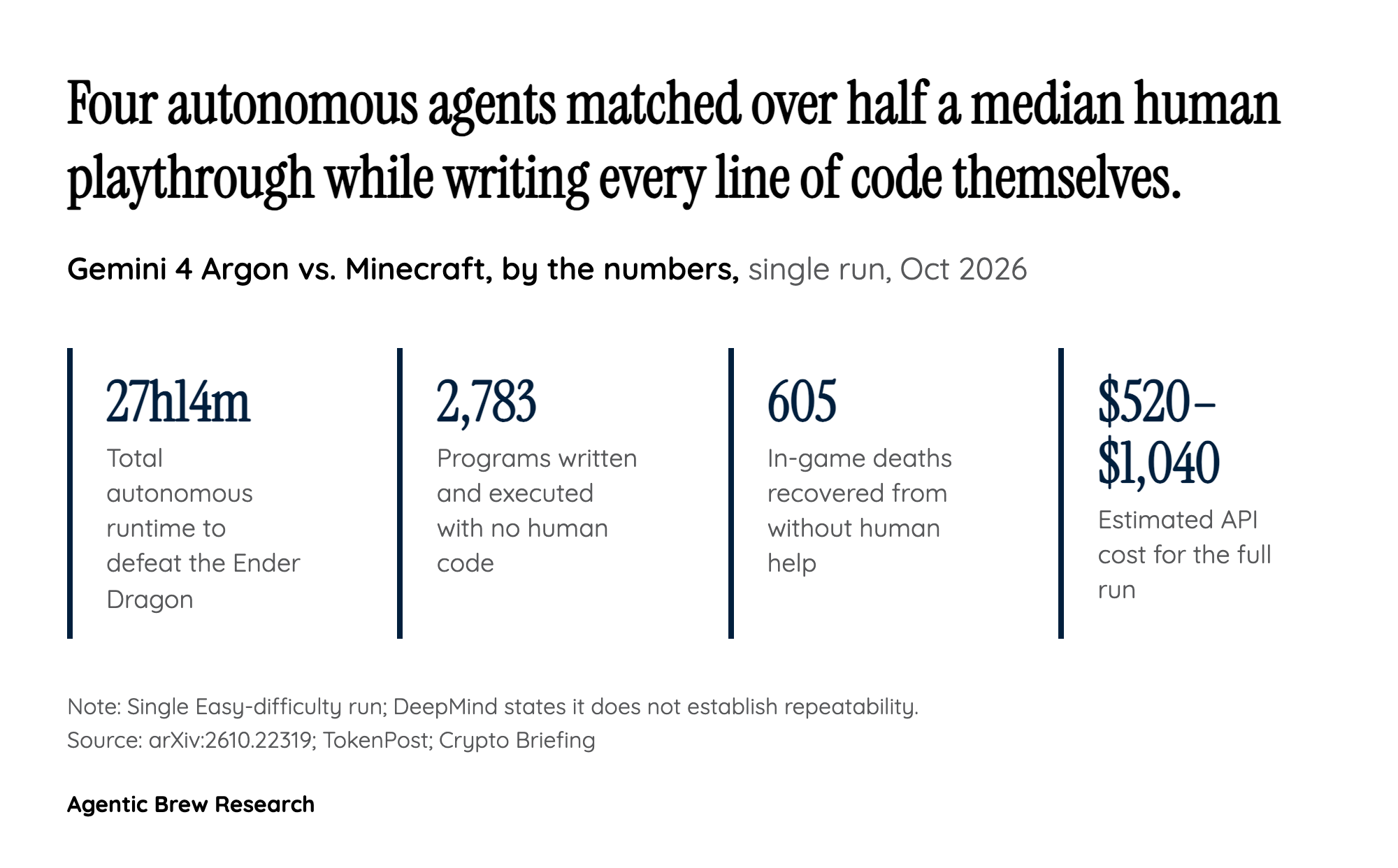
Key figures from the 27-hour autonomous run: runtime, programs written, deaths, and estimated API cost.

Long-horizon autonomous runs are usually described in capability terms; this one comes with an actual price tag. The 27-hour session involved roughly 24,000 model calls, about 1.35 billion input tokens (91% served from cache) and 16 million output tokens, including around 4 million thinking tokens, plus six game-server restarts that paused the world for a combined 20 minutes[1]. DeepMind's own estimate puts the total cost at about $520 at introductory API rates, or roughly $1,040 at standard pricing[3]. That figure turns an abstract "agents can code for a day straight" claim into something concrete and comparable - a real line item for anyone trying to estimate what sustained, unsupervised multi-agent coding actually costs in production.

A Milestone With an Asterisk: Single Run, Easy Mode

DeepMind's own paper is explicit that this was a single attempt on Easy difficulty, and it does not establish how reliably the same four agents could repeat the feat[7]. That caveat sits awkwardly next to the headline claim of a "first" autonomous completion, and it is the crux of the online debate: one camp sees a genuine advance in sustained multi-agent coordination - agents spontaneously dividing labor within about ten minutes of starting[8], then reusing one teammate's crafting workaround across 655 separate programs[5]- while another points out that multi-agent emergent behavior in game environments is not new, tracing a lineage back through Voyager's Mineflayer-scripting approach in 2023[8], and argues the death count and single-run framing oversell the result[7]. Both readings can be true at once: the coordination and tool-reuse behaviors are real and new in degree, even if the underlying question of repeatability remains unanswered.

Historical Context

2023
An earlier LLM-driven Minecraft agent that wrote Mineflayer programs into a growing skill library under an automatic curriculum, but did not achieve a full end-to-end autonomous completion the way the Gemini 4 Argon run did, and relied on some Minecraft-specific tooling.
Ongoing baseline
Median human completion time for Minecraft is roughly 45 hours, while the human speedrun record sits under 7 minutes - putting the agents' 27-hour, zero-knowledge run between casual and expert human benchmarks.

Power Map

Key Players
Subject

Gemini 4 Argon agents autonomously defeat Minecraft Ender Dragon

GO

Google DeepMind

Research organization that designed, ran, and published the experiment and its accompanying paper.

MA

Maxence Faldor, Satinder Singh, Roberta Raileanu (named researchers, attribution varies slightly by outlet)

Authors credited with the paper describing the Gemini 4 Argon Minecraft run.

MI

Mineflayer (PrismarineJS open-source library)

The standard, pre-existing bot-control library the agents used to act in Minecraft - notably not a tool built specifically for this experiment.

MO

Mojang / Microsoft

Owners of Minecraft; explicitly not involved in or endorsing the experiment.

Fact Check

8 cited
  1. [1] Gemini 4 Argon Agents Beat Minecraft Autonomously - TokenPost
  2. [2] Autonomous Multi-Agent Completion of Minecraft - arXiv
  3. [3] AI Agents Defeat Ender Dragon - Crypto Briefing
  4. [4] Gemini 4 Argon Agents Beat Minecraft - TechCityAuthority
  5. [5] Four Gemini 4 Argon Agents Beat Minecraft in 27 Hours - daily.dev
  6. [6] Four AI Agents Beat Minecraft in 27 Hours, DeepMind Researchers Say - Superpower Daily
  7. [7] AI: Four Gemini 4 Argon Agents Beat Minecraft for About $520 - FourWeekMBA
  8. [8] Google DeepMind's Gemini 4 Argon Beats Minecraft Autonomously in 27 Hours - AlphaSignal

Source Articles

Top 5

THE SIGNAL.

Analysts

“The hard part, in this reading, was keeping one plan consistent across thousands of dependent steps for more than a day - a test of sustained coherence, not just task completion.”

@omarsar0 (elvis, AI researcher/commentator)
Frames the run as a milestone in long-horizon multi-agent coordination rather than raw gameplay skill.

“At roughly one death every 11 minutes per agent, this reads more like a test of recovery under a forgiving rollback than evidence of one consistent, elegant plan.”

@eth_sensei (commentator)
Skeptical framing that leans on the death count to question how impressive the run really is.

“Characterizes the achievement as a sandboxed game completion, not evidence of reliable performance on software engineering or enterprise work.”

Coverage synthesis (techcityauthority / superpowerdaily)
Cautions against generalizing the result beyond the game itself.
The Crowd

“Four Gemini 4 Argon agents beat Minecraft from scratch in 27 hours. Operating in a sandbox using only code and text, they wrote 2,783 programs, divided up jobs over chat, shared notes, and debugged errors together - all with no human help ↓”

@@GoogleDeepMind2423

“Four Gemini 4 Argon agents, one shared Minecraft world, one goal: defeat the Ender Dragon. 27 hours and 2,783 self-written programs later, the dragon fell.”

@@maxencefaldor448

“SITUATION DETECTED: Four Gemini 4 Argon agents have beaten Minecraft end-to-end in 27 hours and 14 minutes with no help from humans. The agents coordinated through in-game chat, supported their teammates, and recovered each other’s items after deaths.”

@@MTSlive1621

“Argon 4 agents complete Minecraft autonomously”

@u/SHIBA_holder121
Broadcast
Gemini 4 Argon Agents Beat Minecraft Together

Gemini 4 Argon Agents Beat Minecraft Together

A team of Gemini 4 Argon agents beats Minecraft (Oct 2026)

A team of Gemini 4 Argon agents beats Minecraft (Oct 2026)

Four AI Agents Beat Minecraft Without a Human Plan

Four AI Agents Beat Minecraft Without a Human Plan