Alphabet's $85B equity raise for AI infrastructure
TECH

Alphabet's $85B equity raise for AI infrastructure

33+
Signals

Strategic Overview

  • 01.
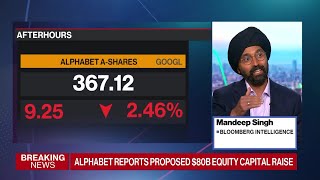
    Alphabet priced an upsized ~$84.75 billion equity offering on June 3, 2026 — the largest single equity offering in history, surpassing Petrobras's 2010 $70B record.
  • 02.
    The structure stacks ~$18B in Class A/C common shares, a $16.75B depositary-share mandatory convertible preferred, a $10B Berkshire Hathaway private placement, and a $40B at-the-market program starting Q3 2026.
  • 03.
    Proceeds fund Alphabet's 2026 AI and cloud capex of $180-190B — roughly six times its 2022 capex of about $31B — after Cloud backlog doubled to ~$460B in Q1.
  • 04.
    It is Alphabet's first public equity issuance in more than two decades, and the first tranche was upsized from $40B to $45B after the book oversubscribed.

Deep Analysis

Under the hood: a four-layer capital stack, not just a stock sale

The headline number obscures what's actually a four-layer instrument: ~$18B in Class A/C common shares priced at $355.20 and $351.80, a $16.75B depositary-share mandatory convertible preferred, a $10B Berkshire private placement, and a $40B at-the-market program that drips into Q3 2026 onward [1]. The convertible is the most interesting piece — it forcibly converts to common around May 15, 2029 at a 2.2520-2.8160 share ratio per Series A share, which lets Alphabet book equity-like balance-sheet treatment today while deferring dilution by roughly three years [2]. The ATM tranche means Alphabet keeps optionality: it can lean into issuance when shares rally and pull back when they don't. Stacking four formats also distributes the dilution shock across instruments with different buyer bases — index-tracking common, yield-seeking preferred, anchor strategic, and continuous market participants — which is why the book oversubscribed enough to push the first tranche from $40B to $45B [3].

Follow the money: why $174B of operating cash flow still wasn't enough

Alphabet generated roughly $174B in TTM operating cash flow and just posted Q1 2026 revenue of $109.9B (+22% YoY) with net income of $62.6B (+81%) [4]. So why issue equity? The 2026 capex envelope of $180-190B is, on its own, larger than the entire annual operating cash flow — and that's before dividends, buybacks, and the steeper 2027 capex CFO Ashkenazi has already flagged [5]. The equity raise funds roughly 46% of the $185B midpoint capex plan, leaving cash flow to absorb the rest plus shareholder returns. Industry-wide AI capex is projected above $700B in 2026, with Goldman estimating $4-8T over the next five years, so even hyperscaler-grade cash generation is now sub-scale relative to the buildout [1]. The trigger was visible in Q1: Google Cloud revenue of $20B grew 63% YoY and backlog doubled quarter-over-quarter to ~$460B, with Pichai stating demand is 'meaningfully exceeding our available supply' [6]. When backlog is the bottleneck, every quarter of under-investment is revenue Alphabet can't ship — and equity funding closes that gap faster than waiting for cash to compound.

Who wins, who loses: Berkshire's anchor and the precedent risk for peers

Buffett's Berkshire took 14.2M Class A shares at $351.81 and 14.4M Class C at $348.20, bringing total Alphabet exposure above $26B and making it Berkshire's 7th-largest US holding [7]. Berkshire's involvement is hard to overstate as validation — a famously capex-averse, AI-skeptical investor anchoring an AI infrastructure raise is the strongest possible signal that the buildout has crossed from speculative to balance-sheet defensible. The losers are Alphabet's hyperscaler peers. As EBC put it, if a company with $174B of operating cash flow concludes outside equity is an efficient way to fund AI, 'investors are entitled to ask whether peers eventually arrive at the same point' [8]. Microsoft, Meta, Amazon, and Oracle now face an implicit benchmark: either match Alphabet's capex pace from internal cash (compressing buybacks and earnings) or follow with their own raises (compressing multiples via supply). Either path ends the low-capex, high-earnings template that defined Big Tech for a decade [9].

The contrarian read: dilution math, sell-at-ATH, and the IPO liquidity squeeze

Not everyone is buying the buy-side narrative. The skeptical community framing on r/wallstreetbets and r/technology runs sharper than the analyst takes: issuing equity into an all-time-high tape looks like a textbook 'sell at ATH' by management who already know what 2027 capex looks like, and there is a real liquidity-absorption problem when this raise drops alongside other expected mega-IPOs. EBC made the supply-side concern explicit, warning the market has to digest a large block of new stock 'at the same time it is digesting IPOs, convertibles, and steady passive inflows' [8]. The unit-economics doubts are the deeper bear case — if LLM serving costs scale linearly with users rather than amortizing like classic software, the $180-190B is a recurring obligation, not a one-time buildout. Even the bullish read concedes Mitchell's point that markets may be underpricing the regime shift from capital-light platforms to capital-intensive infrastructure operators [3]. The bear case isn't that Alphabet is wrong about demand — it's that the equity is funding a step-function shift in cost structure that the market has not finished repricing yet [9].

Historical Context

2010-09-23
Set the previous world-record equity offering at $70B to fund offshore oil fields — the benchmark Alphabet just broke.
2022
Capex sat at roughly $31B — a baseline that the 2026 plan now multiplies by six.
2025-Q3
Began accumulating Alphabet shares, foreshadowing the $10B anchor commitment to the 2026 raise.
2026-02
Issued initial 2026 capex guidance of $175-185B, signaling the largest infrastructure step-up in company history.
2026-04
Raised capex guidance by $5B to $180-190B after Google Cloud backlog hit ~$460B, doubling quarter over quarter.
2026-06-01
Originally announced plans to raise $80 billion in equity to fund AI buildout, anchored by Berkshire Hathaway.
2026-06-03
Priced and upsized the offering to ~$84.75B, setting a new global record for a single equity offering.

Power Map

Key Players
Subject

Alphabet's $85B equity raise for AI infrastructure

AL

Alphabet

Issuer running its first public equity raise in 20+ years to fund AI/cloud capex

SU

Sundar Pichai

Alphabet CEO framing the raise as funding a generational platform shift

AN

Anat Ashkenazi

Alphabet SVP & CFO positioning the deal as proactive flexibility ahead of higher 2027 capex

BE

Berkshire Hathaway

$10B anchor investor, lifting total Alphabet exposure above $26B (7th-largest US holding)

IN

Institutional investors

Drove oversubscription that pushed the first tranche from $40B to $45B

OT

Other hyperscalers (Microsoft, Meta, Amazon, Oracle)

Peer issuers now facing pressure to consider similar equity funding for AI infrastructure

Fact Check

9 cited
  1. [1] Alphabet's $85B equity offering for AI
  2. [2] Alphabet free writing prospectus for mandatory convertible offering
  3. [3] Alphabet's record-breaking $85B raise for Google's AI business is a helluva good signal
  4. [4] Alphabet Q1 2026 earnings reaction
  5. [5] June 2026 investor presentation
  6. [6] Alphabet raises $80B in the largest equity offering in US corporate history to fund AI infrastructure
  7. [7] Alphabet Prices $84.75 Billion Equity Raise, Berkshire Hathaway Doubles Down On AI Infrastructure
  8. [8] Alphabet $80 billion equity raise: AI share supply
  9. [9] Alphabet's capital raise signals end of low capex, high earnings business model

Source Articles

Top 5

THE SIGNAL.

Analysts

"We are experiencing strong demand for our AI solutions and services from enterprises and consumers, at levels that are meaningfully exceeding our available supply; we are compute constrained in the near term."

Sundar Pichai
Alphabet CEO

"The transaction we are announcing today represents a strategic proactive move to optimize our financial flexibility and maximize long-term shareholder value creation."

Anat Ashkenazi
Alphabet SVP & CFO

"If a company with this level of cash generation concludes that outside equity is an efficient way to fund AI infrastructure, investors are entitled to ask whether peers eventually arrive at the same point — the market now has to absorb a very large block of new stock while digesting IPOs, convertibles, and steady passive inflows."

EBC Financial Group
Markets research

"Investors may be underestimating a key transition underway when Big Tech moves to capital-intensive AI infrastructure operations, which could reshape the market dynamics that helped fuel U.S. equity outperformance over the past decade."

Rupert Mitchell
Blind Squirrel Macro

"Alphabet's capital raise signals the end of low capex, high earnings business model."

CNBC market contributor
Television segment commentary
The Crowd

"Alphabet's $80 billion stock sale leaves Wall Street in 'unprecedented territory,' says Goldman's Gutman"

@u/Logical_Welder34674900

"Google owner Alphabet to sell $80bn in stock to fund AI spending spree"

@u/ArgentineBeauty1900

"Alphabet Inc. (NASDAQ: GOOG, GOOGL) announced plans to raise $80 billion through equity offerings."

@u/HyugeErectus1300
Broadcast
How Alphabet Slipped Ahead In The AI Race

How Alphabet Slipped Ahead In The AI Race

'Fast Money' traders react to Alphabet's proposed $80 billion equity capital raise for AI

'Fast Money' traders react to Alphabet's proposed $80 billion equity capital raise for AI

Alphabet Will Raise $80 Billion to Fund AI Spending

Alphabet Will Raise $80 Billion to Fund AI Spending