Graph Engineering: The Next Layer of AI Agent Design
TECH

Graph Engineering: The Next Layer of AI Agent Design

49+
Signals

Strategic Overview

  • 01.
    Graph engineering is presented as the fifth layer in a stack running prompt engineering -> context engineering -> harness engineering -> loop engineering -> graph engineering, coordinating multiple agents, loops, functions, validators, tools, and humans rather than programming a single agent's behavior.
  • 02.
    A graph-engineered system is defined by three primitives: nodes (an agent, model call, deterministic function, tool, or human approval), edges (sequential, parallel, or conditional routing rules for what runs next), and state (a shared object every node reads from and writes to).
  • 03.
    Vanja Petreski frames the shift as moving from similarity-based retrieval (vector search) to relationship-based navigation (graphs), arguing flat context windows are running out of road.
  • 04.
    Claude Code's subagent architecture is offered as a working example of graph engineering without a separate framework - subagents act as nodes, orchestrator routing decisions act as edges, and returned results form the shared state.
  • 05.
    A recurring criticism is that graph engineering repackages decades-old orchestration and state-machine concepts under a new name rather than introducing something genuinely novel.

Deep Analysis

The Three Primitives: What Graph Engineering Actually Describes

Strip away the branding and graph engineering describes a specific, fairly narrow idea: systems built from nodes (an agent, a plain model call, a deterministic function, a tool, or a human approval step), edges (sequential, parallel, or conditional rules for what runs next), and a shared state object every node reads from and writes to [2]. Proponents insist it is not a replacement for the layers underneath it but the layer that coordinates them [1]- a graph is made of loops, each loop needs a good harness, each harness call is a context problem, and every context contains prompts [3]. Crucially, several writers argue no new framework is required to do this: Claude Code's subagent system already provides the primitives, with subagents standing in for nodes, orchestrator routing decisions standing in for edges, and returned results forming the shared state [5]. That framing is what lets the term travel so easily - anyone already running subagents, parallel tool calls, or orchestrator-worker patterns can retroactively describe their system as 'graph engineered' without changing a line of code.
From One Tweet to a Framework: The Anatomy of a Viral Term

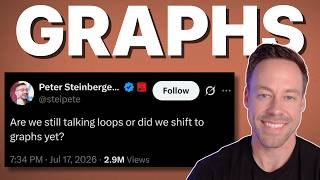
The speed of this trend is arguably more newsworthy than its content. Peter Steinberger's July 18, 2026 post asking whether the field had shifted from loops to graphs reached 2.6 million views within two days, building on an earlier post from the day before, July 17, that had already logged 8.4 million views on its own [8]. The ladder it capped was itself recent: Addy Osmani's June 2026 popularization of 'loop engineering,' followed by The Pragmatic Engineer's mid-July explainer of the same term, meant graph engineering arrived as the newest rung on a framework that was barely a month old [9]. Within 48 hours, the term had splintered into three competing definitions and spawned copycat posts, including a fabricated claim of a $3.1 million Stanford research grant that does not exist [8]. Independent writers moved fast to stake out interpretations - one Substack piece published just three days after Steinberger's post proposed a specific three-agent worker/invigilator/evaluator model as 'the' graph-engineering pattern [13]- illustrating how quickly a vague framing calcifies into competing prescriptive claims once it starts trending.

Rebrand or Breakthrough? The LangGraph and State-Machine Pushback

The most substantive pushback isn't about whether graphs are useful - it's about whether 'graph engineering' names anything new. LangChain creator Harrison Chase said publicly he still doesn't fully understand what the term adds beyond LangGraph, which shipped the same nodes/edges/shared-state execution model in January 2024, well over two years before the 2026 framing emerged [11]. XState creator David K went further, framing the loop-to-graph shift as one more cycle in a recurring pattern of rebranding established software-engineering concepts under new names [10]. Gao Dalie's rebuttal takes a middle position: the underlying problem graphs address - that agents fail not from lack of intelligence but from unclear organizational structure - is real, but 'most of the hard problems are not' new, since orchestration and state-machine design have been solved territory for decades [6]. That the model has already shipped in three separate mainstream frameworks (LangGraph, Microsoft's AutoGen GraphFlow, and Google's ADK 2.0) before the term existed undercuts the idea that graph engineering is a technical breakthrough rather than a naming exercise [11].

The Debunking: Why the Headline Stats Don't Hold Up

The statistic doing the most work to legitimize graph engineering as trending elsewhere - an '18% accuracy improvement and 85% cost reduction' - does not survive scrutiny. Turing Post traced it back to a single narrow GraphRAG industrial case study, not a general finding about multi-agent graphs, and found that the supposed evidence for a broader consensus actually conflates three unrelated technologies: a GraphRAG industrial-diagram case study, Stanford's DSPy program-optimization research, and Anthropic's coded multi-agent orchestration work [7]. That does not mean every number in circulation is fabricated - a separate claim in circulation holds that Anthropic's own internal research eval showed a multi-agent setup beating a single-agent Claude Opus 4 baseline by 90.2%, though that figure too traces back to a single third-party blog post rather than an Anthropic-published number [5]- but it shows how a real number from one context gets laundered into a universal claim about graphs versus loops in another. Turing Post's proposed filter is a useful discipline for any viral engineering claim: ask what kind of graph, compared to what baseline, and where the number actually came from [7].

When a Graph Earns Its Keep - and When It's Just Overhead

Even sympathetic voices warn that graphs carry real costs that get glossed over in trend pieces. Avi Chawla argues a node only justifies its existence if it represents genuine specialization, parallel fan-out, or failure isolation - otherwise a graph is just a more expensive way to run one loop [3]. The math backs up the caution: Vanja Petreski points out that at 85% accuracy per hop, a five-hop graph traversal degrades to roughly 44% end-to-end reliability, a compounding-error problem that gets worse, not better, as graphs grow more elaborate [4]. Carlos Perez pushes the critique further, arguing that a graph of loops needs 'anchors' - measurements no node can argue with - or the whole network inherits the same metric-gaming failure modes as a single loop chasing one signal [12]. Together these views sketch a practical filter: reach for a graph only when work genuinely splits into separable parts needing different models, parallel execution, or isolated failure domains, not because the term is trending.

Historical Context

2024-01
Shipped the nodes/edges/shared-state graph execution model for agents well before the 2026 'graph engineering' framing emerged.
2025
Huntley's 'Ralph Wiggum' technique established the foundational iterative-loop pattern for running coding agents until goals are achieved, later cited as the origin of loop engineering.
2026-05-12
Shipped a '/goal' command ('keep working until this outcome is true'), part of a wave of harnesses standardizing loop-engineering features that graph engineering later builds on.
2026-06-07
Popularized 'loop engineering' as the dominant framing for agent design before the shift to graph engineering.
2026-07-14
Published 'What is loop engineering?' documenting the loop-engineering trend days before the graph-engineering pivot took off.
2026-07-17
An earlier post, 'Designing Cycles to Prompt Agents,' had already reached 8.4 million views, setting up the graph-engineering post days later.
2026-07-18
Posted 'Are we still talking loops or did we shift to graphs yet?', credited with popularizing 'graph engineering' and reaching 2.6 million views within two days.
2026-07-21
Published 'Graph Engineering: The Next Step After Prompts and Loops,' proposing a three-agent worker/invigilator/evaluator graph model, referencing Steinberger's post.
2026-07-24
Published 'Graph Engineering with Claude Code,' showing subagents as graph nodes and citing Anthropic's multi-agent research eval beating a single-agent baseline by 90.2%.
2026-07-26
Published 'Forget Loop Engineering, Graph Engineering is about THIS,' arguing the term rebrands existing orchestration challenges.
2026-07-27
Published 'Graph Engineering Clearly Explained!' laying out the five-layer engineering stack (prompt, context, harness, loop, graph).

Power Map

Key Players
Subject

Graph Engineering: The Next Layer of AI Agent Design

PE

Peter Steinberger

Independent developer whose July 18, 2026 post asking whether the field had shifted from loops to graphs is widely credited with popularizing the term and triggering the viral debate.

HA

Hamel Husain

Published a widely shared follow-on post declaring loop engineering superseded, amplifying the framing shift.

AD

Addy Osmani

Popularized the preceding term 'loop engineering' in June 2026, the framing that graph engineering positions itself as superseding.

BO

Boris Cherny (Anthropic, Claude Code creator)

Cited as an early influence on loop engineering, the layer graph engineering claims to build on top of.

AN

Anthropic

Its 'Building Effective Agents' guide and Claude Cookbook, with five composable patterns (prompt chaining, routing, parallelization, orchestrator-workers, evaluator-optimizer), are the underlying source material being reinterpreted by commentators as graph structures.

HA

Harrison Chase (LangChain/LangGraph creator)

Publicly questioned whether the term names anything beyond what LangGraph already does, reflecting developer-community skepticism.

DA

David K (XState creator)

Argued the graph/loop terminology repackages decades-old state-machine concepts.

LA

LangGraph, Microsoft AutoGen (GraphFlow), Google ADK 2.0

Existing frameworks already implementing the nodes/edges/shared-state model the term describes; LangGraph shipped this model in January 2024.

Fact Check

13 cited
  1. [1] Graph Engineering: AI Agents & Multi-Agent Organizations
  2. [2] Graph Engineering for AI Agents
  3. [3] Graph Engineering Clearly Explained!
  4. [4] Graph Engineering
  5. [5] Graph Engineering with Claude Code
  6. [6] Forget Loop Engineering, Graph Engineering Is About THIS
  7. [7] Is Graph Engineering Real? Why Everyone Is Talking About It
  8. [8] Peter Steinberger Announces End of Loop Engineering Era, Shift to Graph Engineering
  9. [9] What Is Loop Engineering?
  10. [10] Graphs vs Loops: The Agentic AI Debate
  11. [11] Graph Engineering
  12. [12] From Loop Engineering to Graph Engineering
  13. [13] Graph Engineering: The Next Step After Prompts and Loops

Source Articles

Top 5

THE SIGNAL.

Analysts

Frames graph engineering as the coordination layer above loop engineering, defining what runs when and who checks whom, and lists node justification, state cleanliness, trusted routing, and agent agreement as the four hard problems worth solving before adding a graph.

Avi Chawla
Writer, Daily Dose of Data Science

Dismisses graph engineering as unnecessary complexity and hype around simple agent usage.

Max Weinbach
Analyst, Creative Strategies

Views the loop-to-graph terminology churn as a repeated cycle of rebranding established software engineering patterns.

David K
Creator, XState

Skeptical that 'graph engineering' names anything beyond what LangGraph already provides.

Harrison Chase
Creator, LangChain/LangGraph

Argues the real shift is organizational rather than technical: agents fail from unclear structure, not lack of intelligence, and graphs constrain agents to a pre-designed map rather than free-roaming loops.

Gao Dalie
Independent AI writer, Substack

Argues the deeper axis isn't loops-versus-graphs but grounded-versus-ungrounded; a graph of loops needs incontestable 'anchor' measurements or it inherits the same metric-gaming failure modes as a single loop.

Carlos E. Perez
Writer, Intuition Machine

Advocates typed edges over generic graph links so relationships explain causality, and hybrid vector-plus-graph-plus-SQL retrieval over pure vector search.

Vanja Petreski
Independent engineer/blogger

Cautions readers to interrogate viral graph-engineering claims by asking what kind of graph, compared to what baseline, and where cited statistics originate, since much circulating evidence conflates unrelated case studies.

Turing Post editorial team
Publication, Turing Post
The Crowd

from prompt → context → harness → loop → graph engineering. the list keeps growing, and every new term gets treated as a replacement for the last one. each layer wraps the one before it, and the cleanest way to tell them apart is to ask what a single unit of work looks like.

@@akshay_pachaar2727

GRAPH ENGINEERING IS THE REASON AI AGENTS SUDDENLY STARTED LOOKING INTELLIGENT Instead of a single prompt, modern systems execute 50-300 graph nodes that plan, retrieve, validate, and self-correct before producing a final answer. Parallel branches eliminate idle model time,

@@MPxbt40

A senior engineer showed me the graph structure behind a multi-agent system companies are spending six figures to build the visual looked almost too simple nodes on one side a matrix on the other but that matrix decides which agent can talk to which, what information moves

@@Gyome1_9

LangGraph was right about agents all along, we just needed 3 years to catch up

@u/ialijr84
Broadcast
Graph Engineering, Without the Hype

Graph Engineering, Without the Hype

Move Over Loop Engineering, Graph Engineering Is Now Here

Move Over Loop Engineering, Graph Engineering Is Now Here

A Practitioner's Guide to Graphs - Tim Ainge, Good Collective

A Practitioner's Guide to Graphs - Tim Ainge, Good Collective