NVIDIA's Automated Driving Push With Volvo And Mercedes-Benz
TECH

NVIDIA's Automated Driving Push With Volvo And Mercedes-Benz

27+
Signals

Strategic Overview

  • 01.
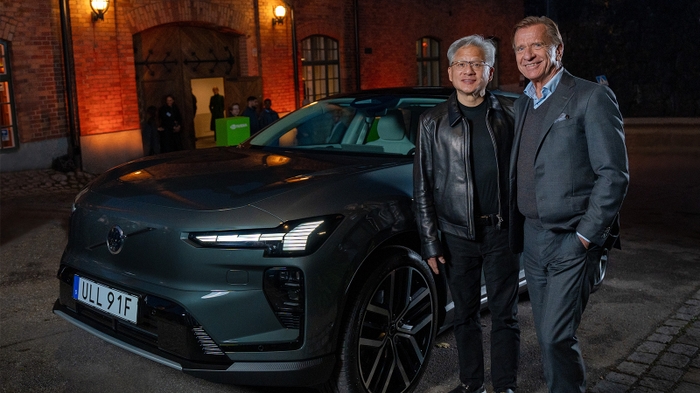
    Volvo Cars announced an expanded automated-driving partnership with NVIDIA, building on a collaboration that began in 2017, combining Volvo's safety systems with NVIDIA's Hyperion sensor/compute architecture, Halos safety OS, and Alpamayo Stack driving software.
  • 02.
    Mercedes-Benz announced its own expanded NVIDIA partnership the day after Volvo's announcement, targeting SAE Level 4 applications including 'robolimousines' and urban point-to-point navigation in selected German cities by the end of 2026.
  • 03.
    Volvo's rollout will begin with supervised driving features before gradually introducing hands-free, eyes-off and mind-off driving in urban areas and on highways, targeted before 2030, launched in multiple regions simultaneously but excluding China at launch.
  • 04.
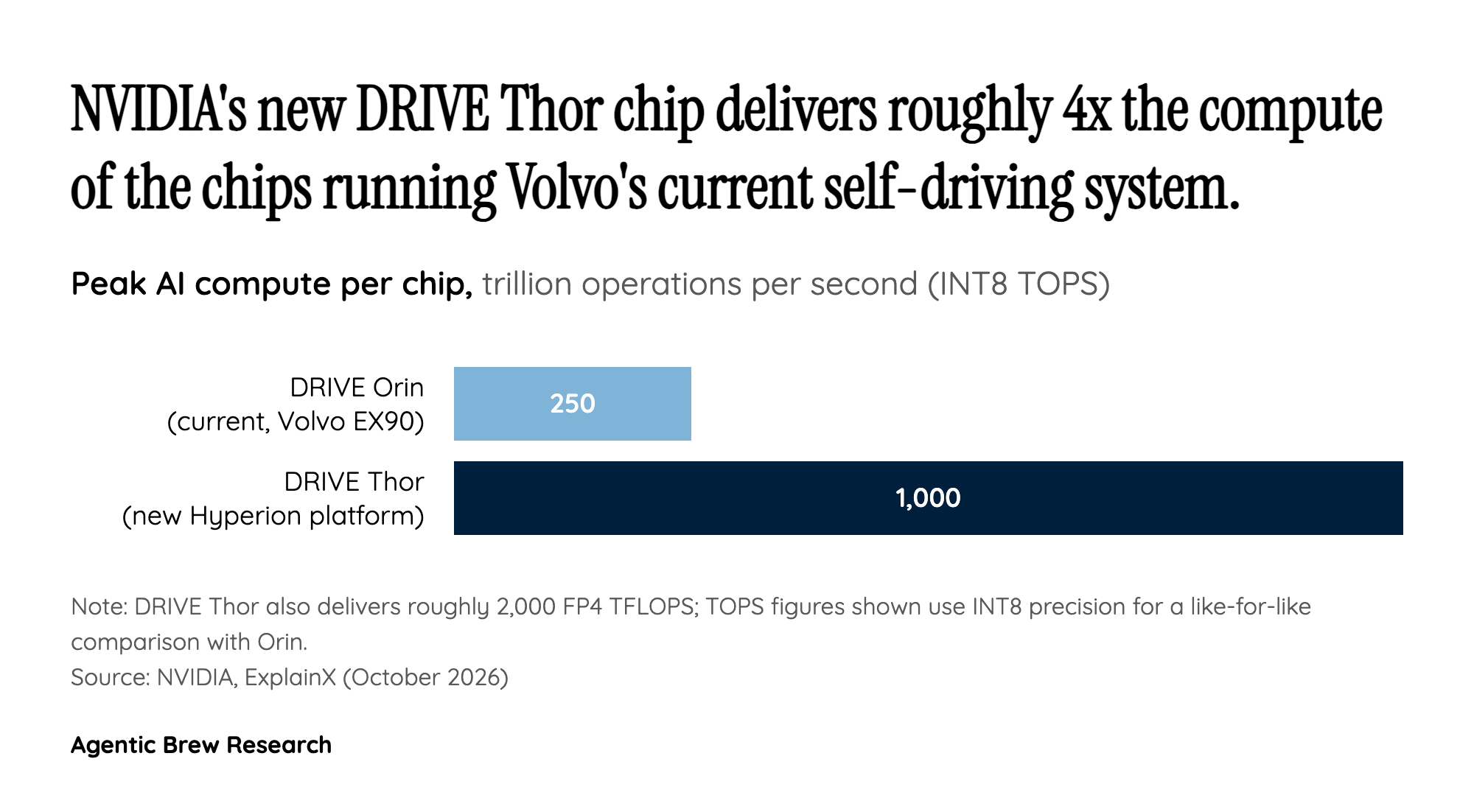
    NVIDIA's Hyperion platform pairs dual DRIVE AGX Thor SoCs (roughly 2,000 FP4 TFLOPS / ~1,000 INT8 TOPS) with a standardized sensor suite for 360-degree real-time fusion, succeeding the current DRIVE Orin-based setup (over 250 trillion operations per second) used in Volvo's EX90.

Deep Analysis

The Compute Leap Behind 'Eyes-Off, Mind-Off' Driving
The Compute Leap Behind 'Eyes-Off, Mind-Off' Driving
NVIDIA's DRIVE Thor delivers roughly 4x the compute of the DRIVE Orin chips running Volvo's current EX90.

The jump from NVIDIA's current-generation DRIVE Orin to DRIVE Thor is the technical engine behind the leap from today's assisted-driving Volvos to tomorrow's hands-free, eyes-off, mind-off cars. Volvo's EX90 runs on Orin, rated at over 250 trillion operations per second; the Thor chips at the heart of the new Hyperion platform deliver roughly 2,000 FP4 TFLOPS, or about 1,000 INT8 TOPS [2], something like a fourfold increase in raw AI compute. NVIDIA pairs that silicon with a standardized Hyperion 10 sensor suite: two DRIVE AGX Thor chips, 14 cameras, 9 radars, a single lidar, 12 ultrasonic sensors, four interior cameras, and an exterior microphone array, all fused in real time [1]. That sensor density is what lets the system read lane-less construction zones and double-parked vehicles instead of relying on cameras alone - the compute jump isn't a spec-sheet flex, it's the prerequisite for removing the driver from the loop at all.
One Stack, Every Automaker: NVIDIA's Platform Lock-In Play

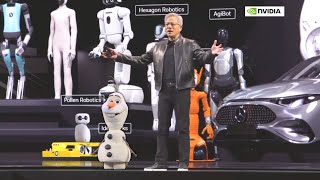
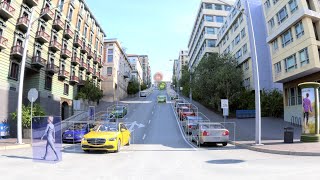
What makes this announcement bigger than two car companies is that it is the same stack. Hyperion, the Halos safety OS, and the Alpamayo driving software are the exact same building blocks NVIDIA is simultaneously rolling out to BYD, Geely, Isuzu, Nissan, Jaguar Land Rover, Hyundai, and robotaxi partners like Uber [1]. Mercedes-Benz's CTO Jörg Burzer put it plainly, calling NVIDIA 'our most important strategic partner in automated driving' [3], and the dependency doesn't stop at the windshield. NVIDIA silicon is also woven into Mercedes' MO360 factory network and its engineering simulation infrastructure, so the relationship spans the entire product lifecycle, from the factory floor to the dashboard [4]. For NVIDIA, that is the point: becoming the common substrate underneath competing automakers gives it more leverage than any single car deal could. At NVIDIA's GTC 2026 keynote, Jensen Huang underscored the scale of that ambition, announcing four more robo-taxi-ready partners - BYD, Hyundai, Nissan, and Geely, representing roughly 18 million cars sold per year - joining existing partners Mercedes, Toyota, and GM. For the automakers, the arrangement raises the same question critics have long asked about Mobileye - how much of their 'self-driving' identity is actually their own, versus a licensed layer on someone else's silicon and software.

The Geely Question: Who Else Sees Volvo's Sensor Data?

The most overlooked wrinkle in this week's announcements has nothing to do with chips. Volvo Cars is majority-owned by China's Geely Holding, and the new Hyperion-based cars will generate a torrent of sensor data - 14 camera streams, 9 radar streams, a lidar point cloud, and 12 ultrasonic streams per vehicle. China's National Intelligence Law requires organizations and citizens to 'support, assist, and cooperate with national intelligence work,' and no independent audit of how Volvo's sensor data flows back to its Chinese parent has been published [5]. Adding to the ambiguity, Volvo reportedly reached an unpublished data-restriction agreement with the U.S. Commerce Department back in May 2026, the terms of which remain undisclosed even as the NVIDIA partnership goes public [5]. None of this appeared in Volvo's or NVIDIA's announcement - the safety-heritage framing was front and center, the ownership structure wasn't mentioned at all.

Two Timelines, Two Bets: Robolimousines vs. a Careful Rollout

Volvo and Mercedes-Benz are running the same playbook at very different speeds. Mercedes is pushing toward SAE Level 4 'robolimousines' and urban point-to-point navigation in selected German cities by the end of 2026 [3], a genuinely aggressive timeline. Volvo, by contrast, is starting with supervised features where the driver remains responsible, before gradually introducing hands-free, eyes-off, and mind-off driving in urban areas and on highways, targeted for before 2030, and launching everywhere except China [2][3]. Volvo also plans 13 new cars by the end of 2030 as part of the broader push [6]. NVIDIA's own CEO Jensen Huang explicitly endorsed the slower path: 'As the car earns its trust and as Volvo becomes comfortable with the capabilities of the cars, they'll continue to expand the services that are available. There's no hurry, safety first' [7]. That two automakers running the identical underlying stack chose such different public timelines suggests the technology's ceiling is less certain than either company's marketing implies.

Hype vs. Hands-On: Does the Stack Actually Work Yet?

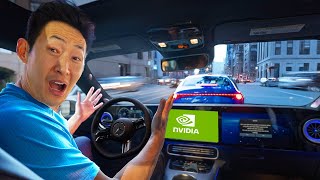
Enthusiasm for the deal is running ahead of proof it fully works. In the self-driving community's own discussion of the announcement, skeptics argue NVIDIA has hardware but not yet a demonstrated working driving model. A related worry raised separately in that same discussion is vendor lock-in - the same critique long leveled at Mobileye - versus hardware-agnostic players like Wayve. The believers' counter is that the stack has already been road-tested for months across multiple OEMs, including rides given to journalists in a production-intent Mercedes CLA. A hands-on ride-along in that CLA found the system running both an end-to-end model and a classical stack simultaneously, explicitly contrasted with Tesla FSD's camera-only approach, and it handled double-parked vehicles, lane-less construction zones, and ambiguous intersections correctly, but it was still described as an 'early beta' that could not yet exit a parking spot on its own. That gap between a geofenced beta ride and a shipped, door-to-door, mind-off product is exactly where this week's announcements are placing their bets. At the same GTC keynote, NVIDIA offered its clearest public counter-evidence: Alpamayo, the reasoning layer underpinning Hyperion, narrating its own driving decisions in real time - explaining a lane change, calling out a double-parked vehicle it was steering around, and responding to a spoken request to speed up. Even so, a skeptical read circulated on X in the days after the Mercedes announcement, framing the expanded deal as essentially the whole NVIDIA stack bolted onto Mercedes' own MB.OS and invoking a prior on-camera Jensen Huang comment about what the hard part of self-driving actually is - a more guarded read than the official announcements, echoing the same wait-and-see posture playing out in the self-driving community on Reddit.

Historical Context

2017
Volvo and NVIDIA began their decade-long collaboration that the October 2026 announcement builds upon.
2020-06-23
Mercedes-Benz and NVIDIA first announced a software-defined computing architecture partnership built on NVIDIA's Orin chip, supporting SAE Level 2/3 automated driving and Level 4 automated parking, rolling out starting 2024.
2026-05
Volvo reportedly reached an unpublished data-restriction agreement with the U.S. Commerce Department concerning vehicle data, a term that remains undisclosed as of the October 2026 partnership announcement.
2026-10-14
Volvo Cars announced its expanded automated-driving partnership with NVIDIA one day before Mercedes-Benz's announcement.
2026-10-15
Mercedes-Benz announced its expanded NVIDIA partnership, a day after Volvo's announcement, targeting Level 4 robolimousines.

Power Map

Key Players
Subject

NVIDIA's Automated Driving Push With Volvo And Mercedes-Benz

NV

NVIDIA

Supplies the Hyperion compute/sensor architecture, Halos safety OS, and Alpamayo Stack driving software (including DRIVE Thor chips) underlying both automakers' systems; simultaneously extends the same platform to BYD, Geely, Isuzu, Nissan, Jaguar Land Rover, Hyundai and robotaxi partners like Uber.

VO

Volvo Cars

Contributes nearly a century of vehicle-safety engineering; majority-owned by China's Geely Holding; announced the expanded partnership in October 2026, targeting hands-free door-to-door driving before 2030, excluding China at launch.

ME

Mercedes-Benz

Integrates NVIDIA's stack with its MB.OS vehicle software platform to pursue SAE Level 4 'robolimousines' and urban point-to-point navigation, also extending NVIDIA compute into its MO360 manufacturing network.

GE

Geely Holding

Majority owner of Volvo Cars; raises data-governance questions because China's National Intelligence Law requires organizations and citizens to 'support, assist, and cooperate with national intelligence work,' and no independent audit of Volvo-to-Geely sensor data flows has been published.

Fact Check

7 cited
  1. [1] NVIDIA DRIVE Hyperion Level 4 ecosystem announcement
  2. [2] Volvo, NVIDIA Hyperion, Halos, Alpamayo: Door-to-Door Driving Before 2030 - What's Confirmed in 2026
  3. [3] NVIDIA Expands Automated Driving Partnerships With Mercedes-Benz, Volvo Cars
  4. [4] Mercedes-Benz Accelerates Future Robotaxi Ecosystem and Collaborates With Industry-Leading Partners
  5. [5] Volvo Adopts NVIDIA's Sensor-Dense Platform While Owner Geely Faces Chinese Intelligence Laws
  6. [6] Mercedes-Benz, Volvo Bet on NVIDIA for Self-Driving
  7. [7] Claims Journal: Jensen Huang Remarks on Volvo-NVIDIA Partnership

Source Articles

Top 5

THE SIGNAL.

Analysts

“Framed the Volvo deal as combining Volvo's safety systems with NVIDIA Hyperion/Halos, and counseled a gradual, trust-building rollout pace rather than rushing capability expansion.”

Jensen Huang
Founder and CEO, NVIDIA

“Positioned the partnership as uniting Volvo's safety heritage with NVIDIA's AI/compute strength.”

Håkan Samuelsson
President and CEO, Volvo Cars

“Described NVIDIA as Mercedes-Benz's single most important strategic partner for automated driving, signaling deep platform dependence across vehicles and factories.”

Jörg Burzer
Board Member and CTO, Mercedes-Benz
The Crowd

“The next decade of driving, built together. We're expanding our strategic partnership with @MercedesBenz AG to develop the next generation of driver assistance and automated driving systems. All while upholding the high safety standards expected from a Mercedes-Benz. Learn https://t.co/M5b3Z8Cnlx”

@@nvidia1639

“Volvo Cars just expanded its nearly decade-long partnership with $NVDA on self-driving Future Volvos will use Nvidia Hyperion sensors and compute, the Alpamayo driving software stack, and the Halos safety layer for hands-free, door-to-door driving on highways, city streets, and parking.”

@@_Investinq4

“Mercedes just bet its "next decade of driving" on NVIDIA. Jensen already told us on camera what the hard part is. Today they expanded the deal, and it's basically the whole NVIDIA stack bolted onto Mercedes' own MB.OS: the Hyperion platform, the Alpamayo driving model and the Halos safety layer.”

@@hussinn11354

“Volvo will use Nvidia's tech for hands-free, point-to-point driving”

@u/Finnegan_Faux76
Broadcast
NVIDIA DRIVE Partners Showcase Cutting-Edge Innovations in Automated and Autonomous Driving

NVIDIA DRIVE Partners Showcase Cutting-Edge Innovations in Automated and Autonomous Driving

I Tested Nvidia's Self Driving Car… should Tesla be worried?

I Tested Nvidia's Self Driving Car… should Tesla be worried?

Jensen Huang Reveals the Future of Self Driving Cars and Robots at NVIDIA GTC 2026

Jensen Huang Reveals the Future of Self Driving Cars and Robots at NVIDIA GTC 2026

NVIDIA's Automated Driving Push With Volvo And Mercedes-Benz — AI News | Agentic Brew