Groq raises $650M after Nvidia talent deal
TECH

Groq raises $650M after Nvidia talent deal

32+
Signals

Strategic Overview

  • 01.
    Groq confirmed a $650M growth round on June 22, 2026, led by existing backers Disruptive and Infinitum, to expand its AI inference cloud.
  • 02.
    The raise follows Nvidia's roughly $20B December 2025 deal that licensed Groq's LPU IP and hired away founder/CEO Jonathan Ross, president Sunny Madra, and other employees.
  • 03.
    Groq re-staffed with a new executive bench (COO Alan Rice, CTO Sinclair Schuller, CPO Rakesh Malhotra) under interim CEO Adam Winter and interim CFO Matt Eng, targeting 200 MW of inference capacity by end of 2027.
  • 04.
    Senators Elizabeth Warren and Richard Blumenthal opened a March 2026 antitrust inquiry questioning whether the Nvidia-Groq deal is a 'reverse acquihire' structured to evade merger review.

Deep Analysis

What's Left to Fund After Nvidia Took the Crown Jewels?

The headline reads like a contradiction: Groq raised $650M on June 22, 2026 to run inference datacenters seven months after Nvidia paid roughly $20B to license its core LPU IP and hire away founder/CEO Jonathan Ross, president Sunny Madra, and other engineers [1]. If the chip architecture and the people who designed it are gone, what exactly are investors buying?

The answer is that Groq is no longer selling a chip — it is selling capacity. The company already operates 13 data centers across North America, Europe, the Middle East and APAC, serving over five million developers and processing trillions of AI tokens each week [2]. That installed base, the customer relationships, and the physical infrastructure are the real asset that survived the Nvidia deal. The licensing agreement Nvidia signed was non-exclusive [3], so Groq retained the right to keep deploying and operating its technology even as Nvidia absorbed the IP and the founders.

What makes the financing unusual is that it is effectively guaranteed. Existing investors Disruptive and Infinitum committed to backstop the entire round if other existing investors decline their pro-rata shares — as one report put it, 'in some ways, the $650 million in funding is guaranteed' [4]. That structure tells you the raise is less a competitive market test of Groq's standalone value than a decision by its largest backers to keep the operating business alive.
The Absorber Becomes the Supplier

The most striking irony of Groq's second act is hardware. The company that designed the Language Processing Unit to compete with Nvidia GPUs is now building its inference cloud on Nvidia silicon. Groq's new LPX system is a liquid-cooled appliance that houses Nvidia's LPU 3 chips, and the $650M will fund fitting out existing data centers with that hardware [5]. The firm that absorbed Groq's IP is now also a hardware vendor to Groq's pivot.

The technical stakes here are about memory architecture, which is where developer YouTube concentrated its attention. The dominant framing in those breakdowns is SRAM versus HBM: Groq's original LPU leaned on large on-chip SRAM for low-latency, deterministic inference, while Nvidia's GPUs rely on high-bandwidth memory (HBM) that can become a bottleneck for latency-sensitive serving. Those creator analyses read the Nvidia move less as a simple licensing transaction and more as a capability transfer — vertical integration across memory, inference, and frontier talent — which is also how the broader trade press has framed Groq's reorientation toward an inference 'neocloud' business [6]. The LPU 3 spec circulating in coverage — 92 lanes at 112 Gbps per lane (2.5 Tbps bidirectional) and 500 MB of onboard SRAM, debuted in March 2026 — shows the SRAM-heavy design philosophy lives on, just now inside Nvidia's product line [5].

For Groq, dependence on a supplier that is also the entity that hollowed out its team is the defining execution risk of the pivot.

The 'Reverse Acquihire' That Has Washington Watching

The deal's structure is now a policy test case. In March 2026, Senators Elizabeth Warren and Richard Blumenthal opened an inquiry arguing the Nvidia-Groq arrangement is the latest example of 'reverse acquihiring' — a strategy that, in their words, 'involves acquiring control of a company's key assets without acquiring the company itself' [7]. The concern is that by licensing the IP and hiring the leadership rather than buying the company outright, Nvidia may have sidestepped the premerger notification that a conventional ~$20B acquisition would trigger.

Not everyone reads it as anticompetitive overreach. Industry analysts argue the move is strategically rational: by absorbing Groq's technology and talent, Nvidia secures its ecosystem and widens its 'competitive moat' in AI inference, keeping the next wave of inference innovation inside its own stack and out of reach of rivals [8]. Both readings agree on the underlying mechanic — Nvidia bought the parts of Groq that mattered to it — and disagree only on whether that should be legal without review. Either way, the inquiry could set precedent for how Big Tech consolidates AI talent and IP without ever filing a merger.

Follow the Money: Who Actually Gets Paid

The most charged conversation about this deal is not about megawatts — it is about who collects. The center of gravity for that anxiety is secondary-market investors, where the dominant question is how the roughly $20B from the Nvidia deal is split and whether common shareholders see any of it. Holders worry the distribution favors taxes, retained staff, and preferred investors, leaving early common holders effectively wiped out, while contrarian voices counter that vested holders receive pro-rata payouts and that the $20B is small relative to projected AI infrastructure spend. There is even debate over whether the remaining 'Groq 2.0' cloud shell carries real value, with reports of the cloud business being explored for sale at around $1B.

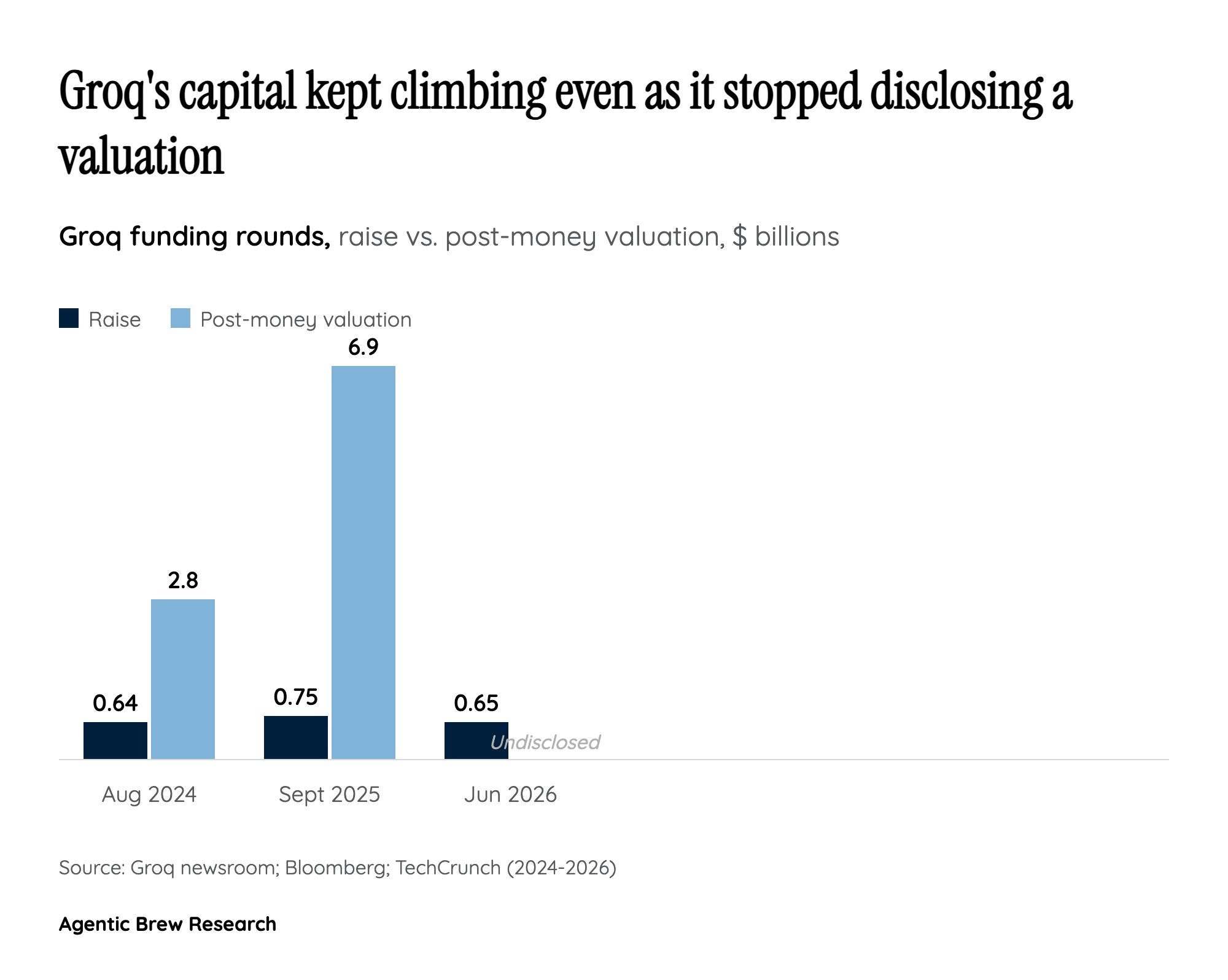
The new $650M round sharpens that tension rather than resolving it. Because Disruptive and Infinitum are backstopping the entire raise [4], fresh capital flows in on terms set by the largest existing investors — and any holder who can't or won't follow their pro-rata risks dilution as 'Groq 2.0' is recapitalized. The funding trajectory frames the stakes: Groq raised $640M at a $2.8B valuation in August 2024, then $750M at a $6.9B post-money valuation in September 2025, and has now raised over $3B in total [9]. Tellingly, the valuation on the new $650M round was not disclosed [1]— an omission that, against two prior up-rounds, reads loudly to the investors trying to figure out what their shares are now worth.

By The Numbers: A Funding Trajectory That Stopped Quoting a Valuation

By The Numbers: A Funding Trajectory That Stopped Quoting a Valuation
Groq's three growth rounds: raise amount vs. post-money valuation (Aug 2024 - Jun 2026). The June 2026 round disclosed no valuation.

Groq's three growth rounds tell the story of a company whose capital kept climbing even as its strategic position inverted. In August 2024 it raised $640M at a $2.8B valuation; in September 2025 it raised $750M at a $6.9B post-money valuation, led by Disruptive with BlackRock, Neuberger Berman, DTCP, Samsung, Cisco and Infinitum participating; and in June 2026 it raised $650M with no valuation disclosed [9]. Across these rounds the company has now raised over $3B total [9].

The inflection point sits between the second and third rounds: Nvidia's ~$20B December 2025 deal — its largest on record — that took the IP and the founders [10]. The earlier rounds funded a chip company climbing toward a $6.9B mark; the latest funds an inference-cloud operator whose valuation its backers chose not to publish [1]. Read alongside the operating targets — 200 MW of capacity by end of 2027, up from 13 existing data centers [2]— the trajectory shows capital being redeployed from designing silicon to renting it.

Historical Context

2016
Groq founded by Jonathan Ross, creating the LPU and later GroqCloud.
2024-08
Groq raised $640M at a $2.8B valuation.
2025-09-17
Groq raised $750M at a $6.9B post-money valuation, led by Disruptive with BlackRock, Neuberger Berman, DTCP, Samsung, Cisco and Infinitum participating.
2025-12
Nvidia struck a ~$20B non-exclusive license for Groq's LPU IP and hired CEO Jonathan Ross and president Sunny Madra; Groq investors received cash payouts.
2026-03-20
Warren and Blumenthal opened an antitrust inquiry into the Nvidia-Groq deal.
2026-05-28
Axios and TechCrunch reported Groq was raising up to $650M from existing investors for its 'second act.'
2026-06-22
Groq officially confirmed the $650M raise led by Disruptive and Infinitum and announced its new executive team.

Power Map

Key Players
Subject

Groq raises $650M after Nvidia talent deal

DI

Disruptive

Dallas-based late-stage growth firm that co-led and backstops the $650M round and led Groq's prior $750M round; its founder Alex Davis is Groq's chairman, giving it outsized control over the company's second act.

IN

Infinitum

Fort Lauderdale hedge fund and existing 2025 backer that co-led and backstops the $650M round, effectively guaranteeing the raise closes regardless of other investors' participation.

NV

Nvidia

Licensed Groq's LPU IP and hired its leadership in the ~$20B not-acqui-hire, and now supplies the LPU 3 chips inside Groq's new LPX system — making it simultaneously the cause of Groq's pivot and a hardware vendor to it.

SE

Sen. Elizabeth Warren & Sen. Richard Blumenthal

Opened the antitrust inquiry into the deal; their 'reverse acquihire' framing could set precedent on whether acquiring key assets and talent without buying the company triggers merger review.

JO

Jonathan Ross

Groq's founder/CEO (and creator of Google's TPU) who departed to Nvidia in the December 2025 deal; his exit is the central reason for the re-staffing and the strategic pivot.

Fact Check

10 cited
  1. [1] AI chipmaker Groq confirms $650M raise, re-staffs after Nvidia's $20B not-acqui-hire deal
  2. [2] Groq Raises $650M to Scale Its AI Inference Cloud Business
  3. [3] Nvidia to license tech from AI inference chip company Groq, hire its leadership
  4. [4] After Nvidia's $20B not-acqui-hire, AI chip startup Groq reportedly raising $650M
  5. [5] Inference chip startup Groq raises $650M to grow cloud platform
  6. [6] Groq Seeks $650 Million Amid Shift to AI Inference Neocloud Business
  7. [7] Warren, Blumenthal Question Whether Nvidia's $20 Billion Groq Deal Is Attempt to Avoid Antitrust Laws
  8. [8] Is Nvidia's Groq Deal a Masterstroke or an Antitrust Minefield?
  9. [9] Groq Raises $750 Million as Inference Demand Surges
  10. [10] Nvidia buying AI chip startup Groq for about $20 billion in biggest deal

Source Articles

Top 5

THE SIGNAL.

Analysts

"They characterize the deal as 'reverse acquihiring,' a strategy that involves acquiring control of a company's key assets without acquiring the company itself, designed to skirt antitrust premerger notification."

Sens. Elizabeth Warren & Richard Blumenthal
U.S. Senators (D-Mass., D-Conn.)

"Analysts argue that by acquiring Groq's technology and talent, Nvidia secures its ecosystem and widens its 'competitive moat,' preserving full-stack leadership in AI inference."

Kavout (industry analysts)
Market analysis firm
The Crowd

"Groq raised $650 million in a new funding round aimed at expanding its data center capacity and helping the onetime chip startup become a provider of artificial intelligence computing https://t.co/2lSMoxnafe"

@@business80

"groq actually closed $650M of funding just to run inference datacenters, despite their core tech getting sold to nvidia how? well, i wrote a post about it a couple weeks ago ⬇️ https://t.co/Dg95a7QSP7"

@@blip_tm11

"Groq raised $650 million in growth funding led by Disruptive and Infinitum, roughly six months after Nvidia signed a reported $20 billion licensing agreement for Groq's technology and hired away founder Jonathan Ross and several key executives. The company has since refocused its"

@@TradedVC0

"GROQ after Nvidia deal"

@u/drivenkey16
Broadcast
The Nvidia-Groq Deal Is WAY Bigger Than Reported (3 Things the Headlines Missed)

The Nvidia-Groq Deal Is WAY Bigger Than Reported (3 Things the Headlines Missed)

NVIDIA "Acquires" Groq

NVIDIA "Acquires" Groq

Nvidia's deal with Groq and what it means for the chipmaker and AI

Nvidia's deal with Groq and what it means for the chipmaker and AI