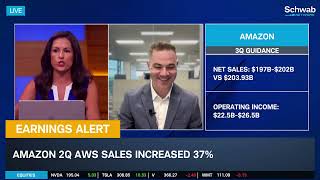
Amazon Q2 2026 Earnings: AWS Growth and AI Capex Surge
TECH

Amazon Q2 2026 Earnings: AWS Growth and AI Capex Surge

39+
Signals

Strategic Overview

  • 01.
    AWS revenue reached $42.2 billion in Q2 2026, up 37% year over year - the fastest growth in 18 quarters - beating analyst expectations of roughly $40.5 billion.
  • 02.
    Total net sales rose 20% to $200.6 billion, topping the $196.47 billion consensus, and net income more than tripled to $62.6 billion - though $53.4 billion of that pre-tax profit came from a non-operating gain tied to Amazon's Anthropic investment rather than core operations.
  • 03.
    Amazon raised its full-year 2026 AI capex guidance from $200 billion to $220 billion, citing higher memory chip costs, even as trailing-12-month free cash flow swung to a $7.6 billion outflow from an $18.2 billion inflow a year earlier.
  • 04.
    Shares climbed roughly 7-10% in after-hours trading as investors rewarded the growth story despite the negative free cash flow, with AWS's AI and custom chip businesses each surpassing $25 billion in annualized revenue run rate.

Deep Analysis

The $53.4 Billion Asterisk Behind Amazon's Profit Triple

The headline number was impossible to miss: net income more than tripled to $62.6 billion. But roughly $53.4 billion of that pre-tax profit came from a single non-operating line - a markup on Amazon's investment in Anthropic - not from selling more cloud capacity or ads [1]. That distinction matters because it changes what the quarter actually says about Amazon's core business versus its balance sheet. It is also exactly what a widely-upvoted community read flagged before the market's excitement had fully settled: the composition of the profit beat, not just its size, deserves scrutiny, and once the Anthropic markup is set aside, the underlying cash picture looks considerably weaker - trailing-12-month free cash flow swung to a $7.6 billion outflow from an $18.2 billion inflow a year earlier, as trailing-12-month capex hit $169 billion, up 64% year over year [3]. A counter-argument in that same discussion held that Amazon's adjusted results, stripped of one-time gains, would still have beaten estimates on their own, and that near-term cash burn is a reasonable price for demand growth of this magnitude. Both readings are defensible - which is itself the point: a single quarter's headline number is doing a lot of interpretive work here, and investors cheering the 7-10% after-hours pop were reacting to the top-line growth story more than the accounting behind the profit figure [3].
Why Wall Street Rewards Cloud Hosts and Punishes AI Labs

Amazon's stock jumped after the report, but the more telling comparison is what happened to companies making similar bets without Amazon's business model. Meta Platforms spent heavily on AI infrastructure too, yet its shares fell about 8% after its own report because investors could not draw as direct a line from that spending to revenue [2]. Amazon, by contrast, gets to point at AWS's 37% revenue growth and a 36.8% operating margin - ahead of Google Cloud's 35.6% [3]- as concrete proof the capex is converting into paying customers [2]. As one industry commentator put it bluntly, Amazon's hosting revenue is someone else's AI bill: AWS profits regardless of which company's model wins, because it is renting out the infrastructure underneath the race rather than betting on a single outcome [2].

Betting AWS's Future on Being Model-Agnostic, Not Model-Best

Andy Jassy used the earnings call to make an explicit strategic argument: AWS does not need to own a frontier model to win the AI infrastructure race. "AWS and Amazon Bedrock can have a wildly successful business without its own frontier model, and the reason is that there's not going to be a single model to rule them all," he said [2]. The numbers back the bet so far - AWS's AI business and its custom chips business each exceeded $25 billion in annualized revenue run rate, more than doubling year over year, up from an AI run rate of just over $15 billion as recently as Q1 2026 [5][6][9]. Jassy went further, suggesting the AI opportunity could eventually become a trillion-dollar annual revenue business for AWS with strong free cash flow and return on invested capital [7]. It is a deliberately different wager than the one frontier-model labs are making - Amazon is betting on being the neutral pipes and chips underneath whichever models win, rather than fielding the winning model itself, and this quarter's growth numbers are the first hard evidence that customers are actually buying into that pitch at scale.

The Capacity Shortfall That Justifies $220 Billion - and Still Isn't Enough

The Capacity Shortfall That Justifies $220 Billion - and Still Isn't Enough
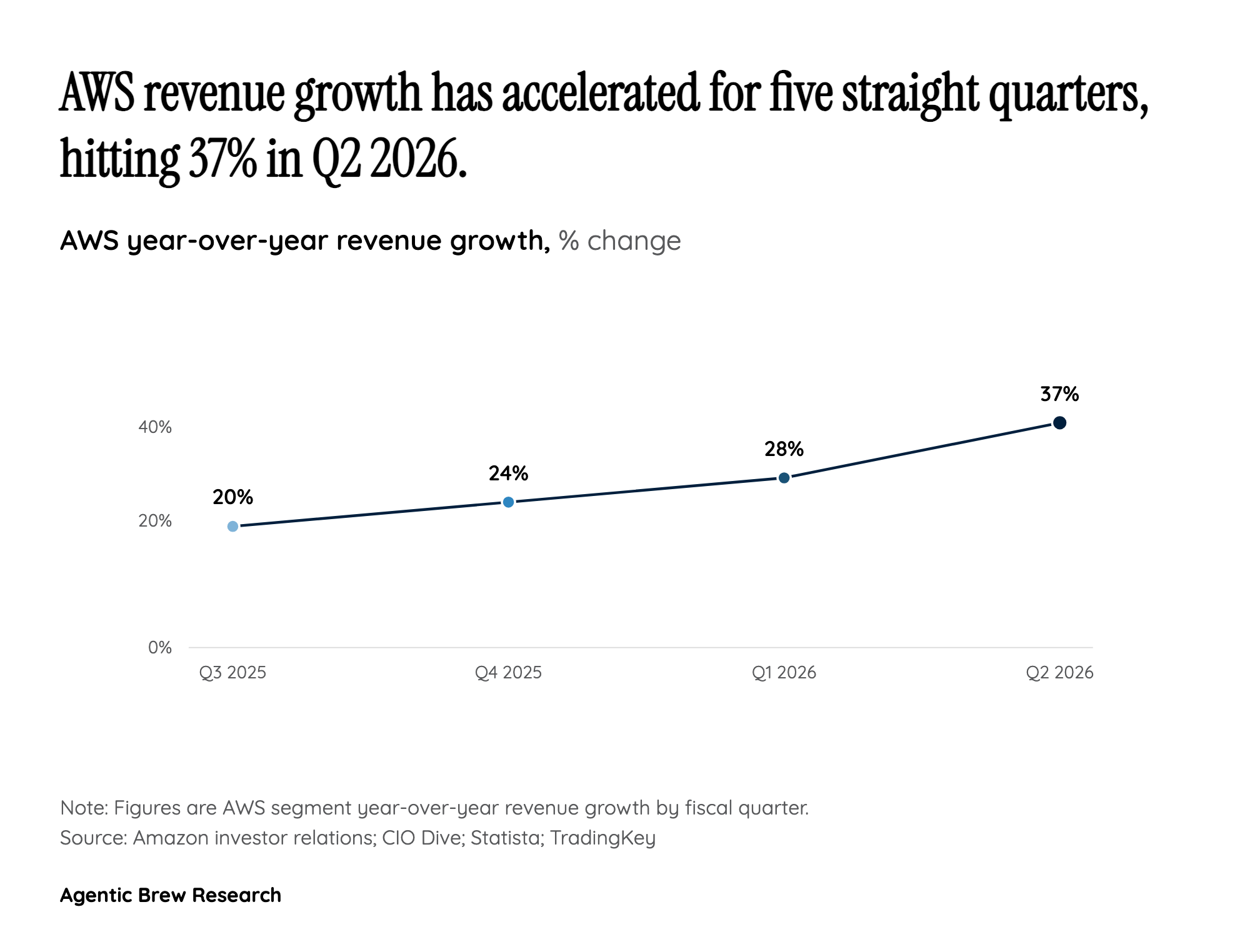
AWS revenue growth has accelerated for five straight quarters, from 20% in Q3 2025 to 37% in Q2 2026.

Amazon raised its 2026 capex guidance from $200 billion to $220 billion, explicitly citing higher memory chip costs [4]. That number was not a surprise in direction - Alphabet had already lifted its own 2026 guidance from $180-190 billion to $195-205 billion before Amazon reported, and BofA's Justin Post had predicted Amazon would land near $210 billion on rising memory prices, just under the actual figure [3][8]. What stands out is Jassy's own admission about what that spending buys: even at $220 billion, "we will still not have enough capacity to meet all the demand we have in 2026, and I believe this dynamic will also be true in 2027 too" [3]. That statement reframes the entire capex story - this is not discretionary growth spending Amazon could dial back if demand softened, but a company openly rationing infrastructure against a demand curve it cannot fully satisfy. It also lines up with the growth trajectory that got AWS here: 20% growth in Q3 2025, 24% in Q4 2025, 28% in Q1 2026, and now 37% in Q2 2026 - the fastest pace since the quarter ending December 2021 [9][10][11][12]. Five straight quarters of acceleration is the evidence Jassy is using to justify spending Amazon cannot yet turn into positive free cash flow, and Cowen's Derrick Wood had warned before the print that another capex raise, following Google's precedent, could still spook the market regardless of the growth numbers behind it [3].

Historical Context

2021-12-31
The quarter ending December 2021 was the last time AWS posted faster year-over-year growth than the 37% recorded in Q2 2026.
2025-Q3
AWS revenue grew 20% year over year to about $33 billion, before the recent acceleration began.
2025-Q4
AWS revenue hit $35.6 billion, up 24% year over year - then the segment's largest growth rate in 13 quarters, marking the start of the current acceleration.
2026-Q1
AWS sales grew 28% year over year to $37.6 billion, with AI revenue run rate over $15 billion.
2026-07-27
Ahead of earnings, analysts predicted Amazon would raise its 2026 capex guidance from $200 billion, pointing to Alphabet's prior capex hike from $180-190B to $195-205B as precedent.
2026-07-30
Amazon reported its fifth straight quarter of accelerating cloud sales growth, easing investor concern that heavy AI infrastructure spending would not generate returns.

Power Map

Key Players
Subject

Amazon Q2 2026 Earnings: AWS Growth and AI Capex Surge

AN

Andy Jassy (Amazon President and CEO)

Set the raised AI capex guidance, publicly framed AWS/Bedrock as a platform-agnostic AI hosting layer rather than a frontier-model competitor, and acknowledged capacity will remain short of demand into 2027.

AN

Anthropic

Amazon's AI-lab investment target; a markup on this stake generated $53.4 billion of non-operating pre-tax income, the primary driver of Amazon's reported net income more than tripling.

GO

Google Cloud / Alphabet

Direct hyperscaler competitor; had already raised its own 2026 capex guidance before Amazon's report, setting the precedent investors expected Amazon to follow, and posted a slightly lower cloud operating margin than AWS.

ME

Meta Platforms

Cautionary contrast case - despite comparably heavy AI capex, Meta's stock fell about 8% after its report because investors saw less direct revenue attribution than for cloud hosts like Amazon.

DE

Derrick Wood (Cowen analyst)

Warned ahead of the report that a further capex raise, following the market's negative reaction to Google's own hike, could pressure Amazon's stock.

JU

Justin Post (BofA analyst)

Projected Amazon's capex guidance would land near $210 billion given rising memory chip costs, just under the actual $220 billion figure Amazon announced.

Fact Check

12 cited
  1. [1] Amazon Q2 2026 Earnings
  2. [2] Investors Love AI, As Long As You're a Cloud Host
  3. [3] Amazon Q2 2026 Earnings: AWS
  4. [4] Amazon (AMZN) Q2 Earnings Report 2026
  5. [5] Amazon (AMZN) Q2 Earnings: AWS +37%, Record Advertising, Stock Up 9%
  6. [6] Amazon Puts AI Agents to Work as Sales Top $200 Billion
  7. [7] Amazon Reports Fifth Straight Quarter of Cloud Sales Growth
  8. [8] Prediction: CEO Andy Jassy Will Raise Amazon's Full-Year Capex Guidance
  9. [9] Amazon CEO Andy Jassy on AWS AI, Q1 2026 Earnings
  10. [10] Amazon (AMZN) AWS Q2 2026 Revenue
  11. [11] AWS Revenue Jumps to $33B
  12. [12] Year-over-Year Quarterly Growth of AWS Revenues

Source Articles

Top 5

THE SIGNAL.

Analysts

Warned that another capex guidance raise, following Google's precedent, risked triggering stock selling pressure.

Derrick Wood
Analyst, Cowen

Argued Amazon's cloud-hosting revenue is structurally dependent on other companies' AI spending, raising sustainability questions across the AI economy even as investors currently reward hosts over model-builders.

Russell Brandom
Tech journalist/analyst, TechCrunch

Positioned AWS's long-term AI opportunity as potentially reaching trillion-dollar annual revenue with strong returns, framing the current capex surge as an investment period rather than a red flag.

Andy Jassy
President and CEO, Amazon
The Crowd

Amazon's Q2 2026 earnings are in. More here. 👇

@@amazon47

JUST IN: Amazon $AMZN has surged more than 7% after reporting stronger-than-expected Q2 2026 earnings. Amazon reported revenue of $200.6 billion (+20% YoY) and EPS of $5.75, both beating Wall Street expectations. The biggest driver was AWS, which grew 37% YoY to $42.2 billion,

@@CryptoTweets98

Amazon raises its 2026 capex to $220 billion due to higher memory costs. "Even at that amount, we will still not have enough capacity to meet all the demand we have in 2026. And I believe this dynamic will also be true in 2027, too."

@@YahooFinance21

AMZN Quarterly Revenue $200.6 billion (up 20% YoY)

@u/Not69Batman445
Broadcast
AMZN Beats & COIN, MSTR, RDDT, RIVN Earnings

AMZN Beats & COIN, MSTR, RDDT, RIVN Earnings

Amazon & Apple Both Report Earnings | The Close 7/30/2026

Amazon & Apple Both Report Earnings | The Close 7/30/2026

Amazon Earnings BEAT: AWS Explodes 37% & AMZN Stock Jumps

Amazon Earnings BEAT: AWS Explodes 37% & AMZN Stock Jumps