WRC 2026: Embodied AI Robots Move From Demo to Deployment
TECH

WRC 2026: Embodied AI Robots Move From Demo to Deployment

39+
Signals

Strategic Overview

  • 01.
    WRC 2026 ran Aug 19-23 in Beijing under the theme 'Human-Robot Symbiosis, Production-Demand Convergence,' drawing 300+ exhibitors (up 36% year over year per Xinhua) and more than 2,000-3,000 exhibits, with 150+ debut products, alongside a first-ever 'Procurement Day' aimed at buyer-driven deployment rather than spectacle.
  • 02.
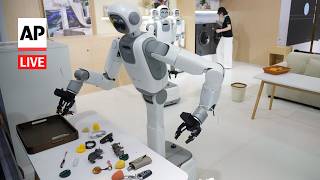
    Embodied-intelligence exhibitors roughly doubled to 200+ from about 80 last year, with 300+ machines actually operating on the show floor rather than staged for cameras, marking what 36kr called the end of the 'performance period' and the start of the 'formal working period.'
  • 03.
    Real deployments were on display alongside demos: Zoomlion's 'Robot Ops' embodied-intelligence OS runs across roughly 20 manufacturing scenarios, and Wujie Dongli operated an untethered human-robot coffee space with a Korean chain, handling drink delivery, table clearing, and cleanup with no preset paths or remote control.
  • 04.
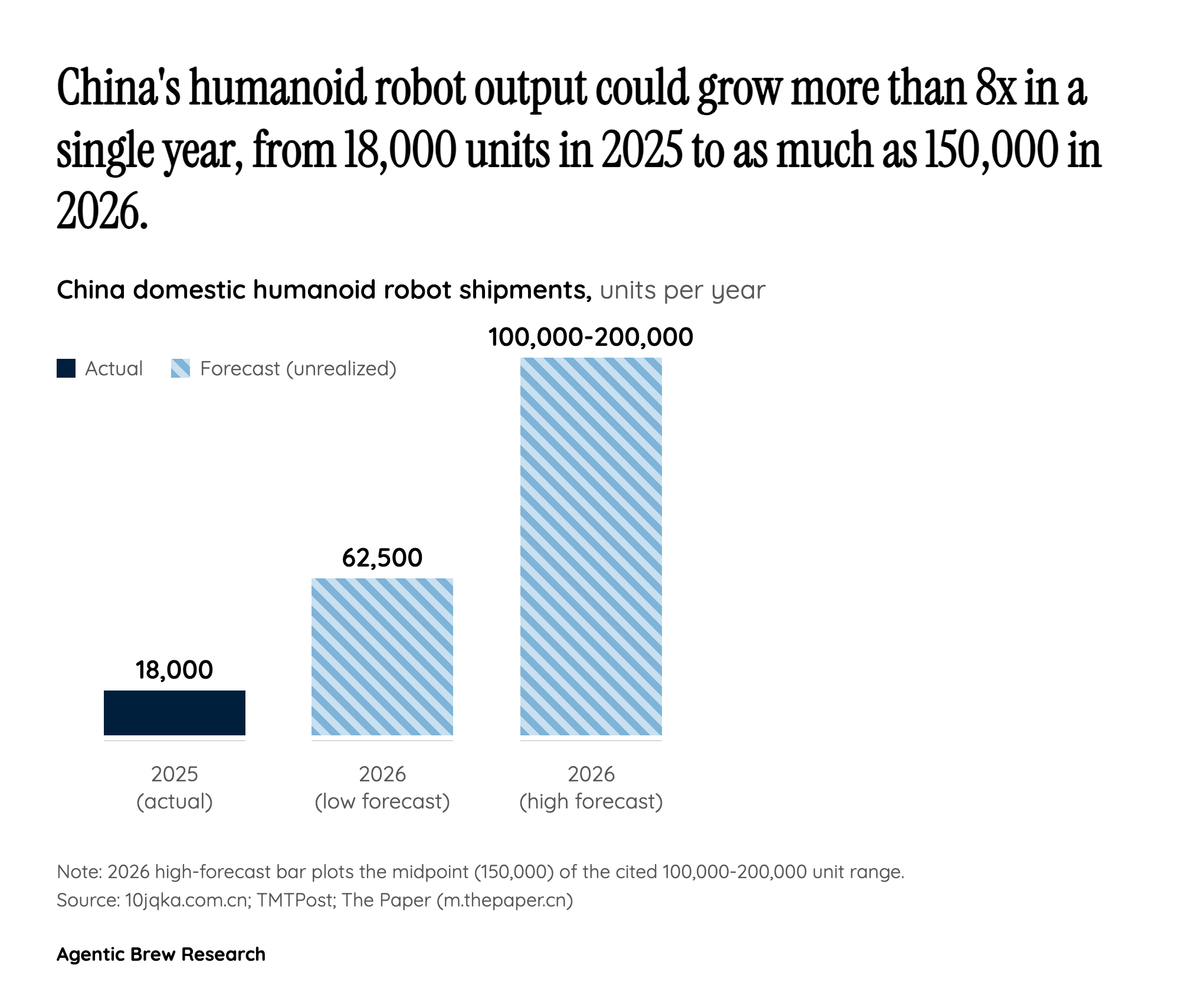
    China's humanoid output is scaling fast: domestic shipments hit about 18,000 units in 2025 (+650% year over year), and 2026 forecasts range from 62,500 up to 100,000-200,000 units, positioning 2026 as the 'scaled mass-production year' following 2025's '0-to-1' validation phase.

Deep Analysis

The Demo Trap Is the Real Throughline of WRC 2026

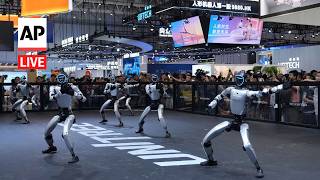
The most consequential tension at WRC 2026 wasn't between companies, it was inside the industry's own leadership. Xiong Rong, chief scientist at the Zhejiang Humanoid Robot Innovation Center, publicly warned the sector to avoid falling into a 'Demo trap,' building robots that genuinely work rather than perform for cameras [1]. Xiong Youjun, CEO of the Beijing Humanoid Robot Innovation Center, went further, declaring that humanoid robots are 'bidding farewell to showing off skills' as brain-body coordination matures [1]. 36kr's on-the-ground coverage echoed the same verdict, reporting that 'the performance period of embodied intelligence has ended, and the formal working period has officially begun,' pointing to 300-plus machines actually operating on-site [2]. Yet the same conference produced a wave of viral spectacle content: dancing robots, a robot-horse claiming 40 km/h top speed and all-terrain capability that onlookers said only ever moved slowly on flat floors, and an agile humanoid whose visible balance micro-adjustments led at least one self-identified industry observer to suspect teleoperation rather than autonomy. Eastmoney's own analysis undercuts the optimistic framing further, noting that most humanoid robots today still flow to research institutes, trade shows, or export markets rather than settling into stable, unsupervised production-line work [1].
Real Deployment Case Studies vs. the Spectacle Track

Look past the highlight reels and WRC 2026 did contain genuine deployment evidence. Zoomlion ran its 'Robot Ops' operating system across roughly 20 real manufacturing scenarios, including wire-harness handling, material picking, and rearview-mirror pre-assembly, using bipedal Z01, wheeled Z03, and quadrupeds D15/D40 [3]. Wujie Dongli went further into daily-life deployment: at a live coffee space run with Korean chain HOLLYS, its robots handled drink delivery, table clearing, trash collection, and seat repositioning with, in the company's words, no preset trajectory and no backend remote control, all perception, decision-making, and execution driven by its self-developed general brain MWA [4]. The company says it has already booked about 700 million yuan in cumulative orders and begun its first global deliveries [5]. AVIC's Fengxing-001 pointed toward an even more specialized niche, completing simulated trials for aircraft maintenance and missile-loading tasks that normally require four to six workers [6]. Social commentary around the show added a further data point in the same direction, with posts highlighting UBTech's Walker S already running on an EV maker's production line rather than a stage. These cases sit in sharp contrast with the conference's other headline acts, a robot-horse whose demonstrated 'all-terrain' movement never left slow, flat-floor walking, and dancing humanoids built for livestream spectacle rather than task completion. Reddit discussion around a package-sorting robotic-arm demo added a related, more grounded framing: commenters converged on the idea that such systems win on 24-hour throughput, error rate, and operating cost rather than raw per-action speed, a more modest but arguably more realistic case for automation than the marquee humanoid demos.

Why This Matters Now: Labor Shortages and a US-China Flashpoint

Why This Matters Now: Labor Shortages and a US-China Flashpoint
China domestic humanoid robot shipments: ~18,000 units in 2025, forecast to reach 62,500-200,000 units in 2026.

WRC 2026's deployment push is not happening in a vacuum. AgiBot alone reported 15,000 cumulative humanoid units by June 2026 at a run rate of 5,000 per month [1], while national production forecasts for 2026 run as high as 100,000-200,000 units [7]. Reporting from Al Jazeera's coverage of the show tied that scale-up to an official campaign to put more than 10,000 humanoids to work in Chinese factories by the end of 2026, framed as a response to labor shortfalls tied to the country's declining birth rate. The same week as WRC 2026, per that same coverage, Fourier Intelligence became mainland China's first publicly traded humanoid robot maker, with shares closing far above its offer price after reportedly shipping around 6,000 humanoids in the first half of the year. That reporting also positioned humanoid manufacturing as a US-China rivalry flashpoint: the United States had banned new imports of foreign-made humanoid robots roughly a month earlier citing supply-chain, national-security, and cybersecurity concerns, a move Chinese officials criticized as pressuring other countries to pick sides. Analysts cited in that coverage project the industry could be worth trillions of dollars by 2050.

The Pricing Gap and the Homogenization Risk

The scaling numbers mask a pricing problem. UBTech's U1 series lists between 119,800 and 990,000 yuan, positioned around premium social and emotional interaction features [8], and has already racked up 13,361 orders [1]. But Unitree founder Wang Xingxing has put a different number on what genuine household-market maturity requires: a robot that can independently complete roughly 80% of household tasks, a bar he thinks is two to three years away at best [8]. A separate industry executive at the same event put the price point needed for real household adoption at roughly 20,000-30,000 yuan [8]. As traditional industrial-equipment makers like Zoomlion pivot into humanoid and quadruped hardware [3], the field of vendors competing on similar joints, reducers, and motors is widening, pushing the sector toward commodity-style price and feature competition. 36kr's reporting frames this directly: full-stack self-research on components and world models, not surface-level demos, is becoming the real competitive battleground [2].

Historical Context

2025
Dubbed the 'mass-production year'; domestic shipments reached about 18,000 units (+650% YoY).
2025 WRC
Prior edition mainly answered whether humanoid robots CAN work; embodied-intelligence exhibitors then numbered only about 80, versus 200+ in 2026.
2026
Framed as the 'scaled mass-production year,' forecasts of 62,500 to 100,000-200,000 units.

Power Map

Key Players
Subject

WRC 2026: Embodied AI Robots Move From Demo to Deployment

UB

UBTech (优必选)

Humanoid maker; showcased U1 series with emotional AI plus Walker C1 and a super-bionic humanoid

MA

MagicLab (魔法原子)

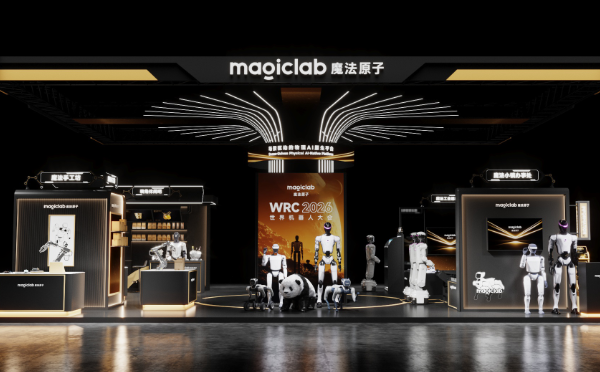
Full-stack embodied-intelligence company; exhibited 7 products at booth C323 for factory, broadcasting, and hospitality use cases

VI

Vita Dynamics (维他动力/Vbot)

Consumer embodied-AI startup; ships quadruped 'Da Tou,' developing humanoid ATOM, closed ~500M yuan Pre-A round in May 2026

WU

Wujie Dongli (无界动力)

Deployed a live, autonomous human-robot coffee space with Korean chain HOLLYS using its self-developed 'general brain' MWA; ~700M yuan cumulative orders and first global deliveries underway

ZO

Zoomlion

Heavy-machinery maker turned industrial embodied-intelligence player; showed bipedal Z01, wheeled Z03, quadrupeds D15/D40, running 'Robot Ops' OS across roughly 20 real manufacturing scenarios

AG

AgiBot / Zhiyuan (智元机器人)

Reached 15,000 cumulative humanoid units by June 2026 at a 5,000/month run rate

Fact Check

8 cited
  1. [1] Eastmoney: WRC 2026 industry analysis on humanoid robot deployment and the demo trap
  2. [2] 36Kr: Embodied intelligence's performance period has ended at WRC 2026
  3. [3] PR Newswire: Zoomlion showcases Robot Ops embodied-intelligence OS at WRC 2026
  4. [4] Economic Observer: Wujie Dongli's autonomous coffee space with HOLLYS at WRC 2026
  5. [5] Sina Finance: Wujie Dongli order backlog and global deliveries
  6. [6] Interesting Engineering: WRC 2026 humanoid robots including AVIC Fengxing-001
  7. [7] TMTPost: 2026 China humanoid robot production forecasts
  8. [8] 163.com: UBTech U1 pricing and Wang Xingxing's household robot tipping-point remarks

Source Articles

Top 5

THE SIGNAL.

Analysts

Argues the industry must avoid building robots that merely perform for cameras and instead build ones that genuinely work.

Xiong Rong (熊蓉), Chief Scientist, Zhejiang Humanoid Robot Innovation Center
Warns against the 'demo trap'

As brain-body coordination matures, frames WRC 2026 as an inflection point where flashy skill demonstrations give way to functional deployment.

Xiong Youjun (熊友军), CEO, Beijing Humanoid Robot Innovation Center
Humanoids are 'bidding farewell to showing off skills'

A robot only reaches genuine household-market maturity once it can independently complete about 80% of tasks in any home scenario; estimates 2-3 years optimistic, 5-10 years pessimistic, citing unresolved alignment/precision/cost tradeoffs.

Wang Xingxing, founder, Unitree
Sets a concrete bar for the real 'tipping point'

Notes most humanoid robots today still flow to research institutes, trade shows, or export markets rather than stable production-line work.

Eastmoney editorial analysis
Scale claims outrun deployment reality
The Crowd

Chinese robots have learned to dance the waltz At the World Robot Conference, UBTECH's humanoid robot Walker S replicated a person's movements in real time and adjusted its balance using tactile sensors. The company's robots are already being used on the production lines of NIO...

@@nexta_tv136

Running from Aug. 19 to 23, the 2026 World Robot Conference (WRC) in Beijing has brought together more than 300 exhibitors from 26 countries and showcased over 3,000 products, including more than 300 debuts. Take a look inside the WRC, where robots are moving from the demo floor...

@@ZuoZhangChina30

China showed off ultra-realistic bionic robots at the World Robot Conference in Beijing. Price tag: about $17,000 each. It's so over Writer: Sol

@@MarioNawfal1215

DaxAI's all terrain robot-horse debuts at WRC'26: 100Km/10h autonomy, 300Kg max load, 40Km/h max speed

@u/Distinct-Question-161200
Broadcast
LIVE: Humanoid robots dance and fight at 2026 World Robot Conference in China

LIVE: Humanoid robots dance and fight at 2026 World Robot Conference in China

China showcases growing robotics industry at the 2026 World Robot conference

China showcases growing robotics industry at the 2026 World Robot conference

LIVE: Humanoid robots perform tasks at 2026 World Robot Conference in China

LIVE: Humanoid robots perform tasks at 2026 World Robot Conference in China