Cloudflare OS Launch
TECH

Cloudflare OS Launch

26+
Signals

Strategic Overview

  • 01.
    Cloudflare open-sourced Cloudflare OS on August 5, 2026 as part of its 'Agents Week' event - an Apache 2.0-licensed platform for building AI agents, apps, and workflows inside isolated, governed environments built on company-curated data and tools.
  • 02.
    The platform combines three parts: an agent workspace grounded in a company's own context and skills with an isolated code-execution runtime, a security and governance framework for safe access to internal data, and a platform for personal, modifiable apps called 'Gadgets.'
  • 03.
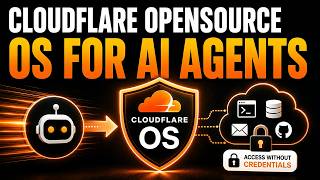
    Access control runs through 'Gatekeeper' Workers - per-service intermediaries that grant scoped, policy-governed access instead of raw credentials - and agents start with zero permissions by default.
  • 04.
    Model choice runs through Cloudflare AI Gateway, letting organizations bring their own model provider while administrators track and control token spend broken down by person, team, and app.
  • 05.
    Cloudflare OS is available now as an open-source repository; a fully managed dashboard product, development-workflow containers, and Slack/chat integrations are planned next.

A Decade-Old Idea, Rebuilt on Workers

Kenton Varda, the Cloudflare engineer behind Cloudflare OS's sandboxing model, has been direct about where the idea comes from: a decade ago he founded Sandstorm.io around the principle that every document or app instance should get its own fully isolated sandbox - a 'Grain' - rather than a slot in a shared multi-tenant server. Cloudflare OS's 'Gadget,' its term for one instance of an app, is explicitly that same idea, now rebuilt on Cloudflare's own infrastructure: each Gadget loads client-side UI and server-side logic on demand as a Dynamic Worker, instantiated inside a Durable Object Facet - a new Workers-runtime primitive Cloudflare built specifically for this project [1]. Cloudflare frames the broader workspace the same way internally: an agent and workspace built around how a specific company works, what it knows, and the systems it depends on [2].

Gatekeeper Workers Flip the Default From 'Trusted' to 'Zero'

The security design at Cloudflare OS's core inverts how most internal AI tools handle access. Rather than handing an agent a standalone API key it can use to reach a CRM, ticketing system, or internal codebase, every internal system is fronted by a per-service 'Gatekeeper' Worker that grants scoped, policy-governed access - and agents start with zero permissions by default until a Gatekeeper explicitly grants them [3]. Cloudflare's CIO, Sam Rhea, has framed this as a response to a scaling problem: handing raw credentials to autonomous agents is dangerous and doesn't hold up as agent use multiplies, so the security had to live inside the platform itself rather than depend on every individual developer implementing it correctly [4]. The approach echoes a related Cloudflare proposal, the Agent Access Model, under which an agent can only do what the human operating it is already permitted to do - never more, and never through a standing account of its own [5].

Open Source, But Still Cloudflare's Runtime

Cloudflare OS's code is Apache 2.0 licensed and free to self-host, but that openness comes with a catch reviewers have been quick to flag: the platform is built around Cloudflare Workers and Durable Objects, so running it still means running on Cloudflare's edge infrastructure rather than a fully neutral stack [4]. Security researchers reviewing the release have separately warned that once agents can generate and share their own apps and dashboards, restricted data can leak sideways - through an export, a shared workspace, or an agent-built tool nobody audited [3]. Early technical audiences have generally been impressed by the Gatekeeper credential-broker design and its Sandstorm.io lineage, while more skeptical corners of the developer community have pushed back on the 'operating system' framing itself and questioned how much independence the open-source license really buys an adopter tied to Cloudflare's runtime. By shipping the whole stack - workspace, governance, and app layer - under a permissive license, Cloudflare is also positioning it as a free alternative to proprietary enterprise agent platforms, raising the bar for vendors selling comparable governance layers [6].

Built for Internal Use First, Then Opened Up

Cloudflare OS wasn't built for outside customers first. CEO Matthew Prince says the company built it because nothing on the market did what Cloudflare itself needed, and only after running it internally did the company decide any organization could 'start from where it took us years to get' [6]. Cloudflare gave every employee - thousands of people across every function - access to the first internal version back in May 2026, months before the public open-source release on August 5 during the company's 'Agents Week' [7]. The stated goal is removing the 'developer bottleneck': letting non-engineers build, modify, and share working internal apps themselves instead of filing a feature request and waiting on an engineering team [2]. Launch partners Presidio [8]and Happy Cog [9]are already helping enterprises customize deployments, and on GitHub the core repository had already picked up roughly 4.8k stars, 360 forks, and 627 commits within its first stretch as a public project [10]. Cloudflare says a fully managed dashboard version, development-workflow containers, and Slack/chat integrations are next [6].

Historical Context

2014
Kenton Varda founded Sandstorm.io roughly a decade before Cloudflare OS, pioneering the per-instance sandboxed application ('Grain') model that Cloudflare OS's 'Gadget' concept directly revives.
2026-05
Cloudflare gave every employee access to the first version of Cloudflare OS in May 2026; thousands across every function began using it daily.
2026-08-05
Cloudflare publicly open-sourced Cloudflare OS under Apache 2.0 during its 'Agents Week' event, making the platform available for any organization to self-host.

Power Map

Key Players
Subject

Cloudflare OS Launch

CL

Cloudflare

Creator and publisher of Cloudflare OS; built it first to run its own global workforce, then open-sourced it as a self-hostable enterprise product to expand its platform/edge-compute business beyond CDN and security.

MA

Matthew Prince (Co-founder and CEO, Cloudflare)

Public face of the launch; frames Cloudflare OS as removing the 'developer bottleneck' for enterprise AI adoption and as a multi-year internal project now offered externally.

KE

Kenton Varda (Cloudflare engineer, ex-founder of Sandstorm.io)

Architect connecting Cloudflare OS's sandboxing model directly to his earlier startup Sandstorm.io, positioning the launch as a technical continuation of that decade-old thesis, now rebuilt on Cloudflare Workers.

SA

Sam Rhea (CIO, Cloudflare)

Articulates the internal security rationale (avoiding raw API-key exposure to agents) that shaped the Gatekeeper access-control design.

HA

Happy Cog (implementation partner)

Launch implementation partner helping organizations deploy/customize Cloudflare OS; co-founder publicly frames governance as a first-class requirement.

PR

Presidio (implementation partner)

Global systems integrator named alongside Happy Cog as a launch partner for tailoring Cloudflare OS deployments to enterprise environments.

Fact Check

10 cited
  1. [1] Cloudflare OS: Open-Source Agent Platform Explained
  2. [2] Cloudflare OS: an open platform for agents, apps, and work
  3. [3] Cloudflare Launches Open-Source OS to Secure AI Agents
  4. [4] Cloudflare OS: Inside the Open-Source AI Agent Platform
  5. [5] The Agent Access Model
  6. [6] Cloudflare Open-Sources Cloudflare OS
  7. [7] Cloudflare OS Open-Sources Its Agent Workspace
  8. [8] Cloudflare Launches Cloudflare OS, an Open-Source AI Agentic Workspace for the Enterprise
  9. [9] Cloudflare OS Is the First AI Workspace Built Around How Companies Actually Work
  10. [10] cloudflare/cloudflare-os (GitHub repository)

Source Articles

Top 5

THE SIGNAL.

Analysts

Positions Cloudflare OS as solving a problem no existing tool solved, built from years of internal necessity and now made generally available. Quote: "We built this because nothing else did what we needed. Now any company can start from where it took us years to get."

Matthew Prince
Co-founder and CEO, Cloudflare

Frames enterprise AI agent security/governance as a mandatory upfront design requirement rather than a bolt-on. Quote: "Security and governance can no longer be an afterthought when deploying autonomous agents and internal AI tools."

Matt Weinberg
Co-founder and President, Happy Cog

Explicitly identifies Cloudflare OS as a deliberate remake of his prior startup Sandstorm.io's sandboxing philosophy, rebuilt on Cloudflare Workers infrastructure, distinguishing it from generic 'chatbot with connectors' competitors. Quote: "Today we are releasing Cloudflare OS, a chatbot with connectors, just like every other tech company is doing. Except actually, it's different. This is a remake of Sandstorm.io, my startup from 10 years ago, except this time built on Cloudflare Workers"

Kenton Varda
Cloudflare engineer; founder, Sandstorm.io (2014)

Argues that handing raw API keys to autonomous agents is inherently dangerous and doesn't scale, justifying the Gatekeeper mediation model where credentials never touch agent code. Quote: "The security had to be part of the platform, not something every person building an app or using an agent has to implement correctly"

Sam Rhea
CIO, Cloudflare
The Crowd

Today we are releasing Cloudflare OS, a chatbot with connectors, just like every other tech company is doing. Except actually, it's different. This is a remake of Sandstorm[.]io, my startup from 10 years ago, except this time built on Cloudflare Workers (the platform I've spent the last 9 years building) and deeply leveraging AI. This is more or less the culmination of my secret 10-year master plan. This is a full-on personal app vibe coding platform, in which the sandbox is so secure that you can pretty much go wild -- the AI cannot introduce a significant security bug. We believe a company's security team can feel comfortable giving non-technical users permission to vibe code and then sleep soundly at night. How is that possible? It's the Sandstorm security model, revisited. A "Gadget" is the same thing as a Sandstorm "Grain": a fine-grained app instance. For example, if you have a document editor app, each document runs as a separate instance of the app, in a separate sandbox (one "Gadget"). This means two things, both of which I think are Big Deals: 1. The platform can manage all access control, by controlling who can access the Gadget at all. There is no way the Gadget can accidentally leak itself to an attacker -- even an attacker who has access to other Gadgets based on the same app. 2. Since everyone is running their own copy of the code, everyone can freely *modify* their copy of the code. Think about #2 a bit more. What if, when you wanted a new feature in the software you are using, you could just prompt your agent to add it? This doesn't work in the cloud Software-as-a-Service model, because you are not running your own copy of the app. Sandstorm tried to change that 10 years ago, but the world wasn't ready, because not enough people had the skills or patience to actually modify their software. AI has changed that. Now you just ask the agent -- the same agent that you are using to help you interact with the Gadget can also modify the code of the Gadget. And it is so fun.

@@KentonVarda5428

Cloudflare OS is an open-source platform that lets everyone in your company build apps, automate work, and safely access internal systems, shaped around what your organization knows and how it operates.

@@Cloudflare1142

I paired Cloudflare OS with self hosted deepseek-v4-flash and the result is freakin amazing Imagine running this setup inside DGX spark, you get fully private work companion solving all your work stuff The thing about this type of software is it already have a good harness and it probably can work out of the box with every open weight model Cant wait for the future

@@farhanhelmycode331

Cloudflare OS: an open platform for agents, apps, and work

@u/Cloudflare113
Broadcast
Cloudflare OS: 4,000 Apps in 1 Month [Now Open Source]

Cloudflare OS: 4,000 Apps in 1 Month [Now Open Source]

Cloudflare Just Open-Sourced Its AI Agent Operating System

Cloudflare Just Open-Sourced Its AI Agent Operating System

How to Download and Install Cloudflare AI Operating System

How to Download and Install Cloudflare AI Operating System