Bezos's Prometheus raises $12B at $41B valuation for 'artificial general engineer'
TECH

Bezos's Prometheus raises $12B at $41B valuation for 'artificial general engineer'

26+
Signals

Strategic Overview

  • 01.
    Prometheus, co-founded and co-led by Jeff Bezos and Vik Bajaj, raised $12 billion at a $41 billion valuation to build an 'artificial general engineer' for the physical world.
  • 02.
    The artificial general engineer is software designed to automate the design and manufacturing of complex physical systems, ranging from jet engines to drug compounds.
  • 03.
    The $12B round follows an initial $6.2B raise at the company's late-2025 launch, bringing total funding to over $18 billion, with a large share earmarked for compute.
  • 04.
    Prometheus operates with roughly 150 employees across San Francisco, London, and Zurich, structured as an independent company with no corporate ties to Amazon or Blue Origin.

Deep Analysis

The Bet: Atoms Are a Bigger Prize Than Bits
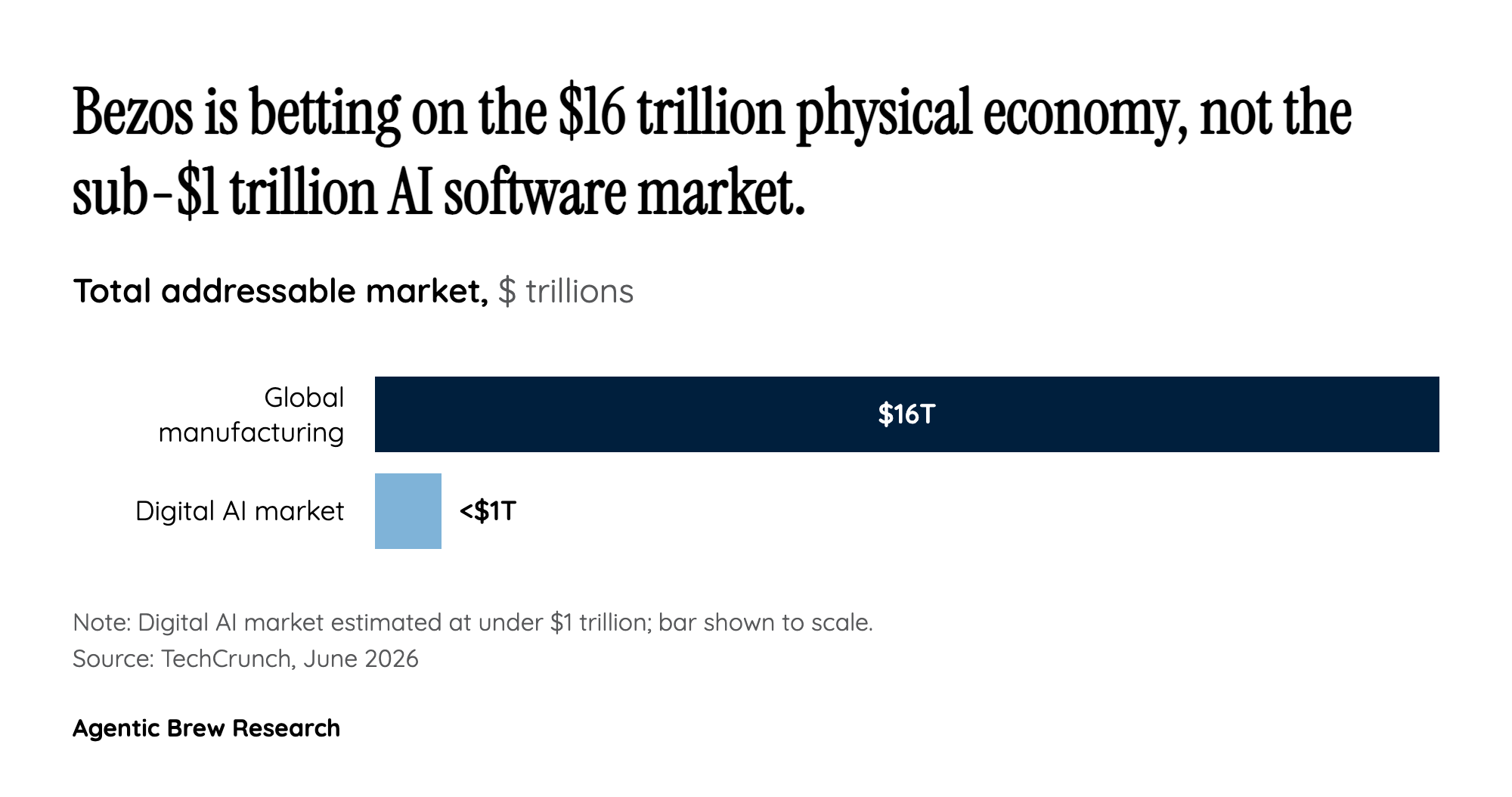
The Bet: Atoms Are a Bigger Prize Than Bits
Bezos's physical-AI thesis in one comparison: global manufacturing dwarfs the digital AI software market by more than 16x.

Strip away the celebrity founder and the eye-watering numbers, and Prometheus is a single thesis: the next frontier for AI is the physical world, not the screen. The company is building what it calls an 'artificial general engineer' — software designed to automate the design and manufacturing of complex physical systems, ranging from jet engines to drug compounds [1]. The pitch to investors rests on a simple size comparison. Global manufacturing is roughly a $16 trillion industry, against a digital AI market still under $1 trillion [1]. If chatbots are fighting over the smaller pie, the argument goes, then whoever cracks engineering and manufacturing is playing for an order of magnitude more.

There is also a defensibility argument baked in. The reasoning circulating among the founders and backers is that the physical world creates moats that code alone cannot [1]— a manufacturing capability is harder to copy than a model checkpoint. Concretely, the product would not write your emails; it would simulate, design, and iterate on real hardware, with Bezos describing the goal as compressing projects that once needed 100 engineers for a decade into roughly 10 engineers for a single year [3]. That is the difference between 'physical AI' and the assistant on your phone: one targets the design loop for things you can drop on your foot.


Follow the Money: A $41B Price Tag on a Company With Nothing to Ship

The financing is the part that makes even AI-saturated observers blink. The $12 billion round lands at a $41 billion valuation [1], on top of an initial $6.2 billion raised at launch in late 2025, pushing total funding past $18 billion [2]. At $41 billion, Prometheus is one of the most richly valued AI startups ever funded and one of the largest single bets on the physical-AI sector [1]— and it has reached that price with no shipped prototype publicly disclosed [1].

What is unusual is who is writing the checks. This is not just venture froth: JPMorgan Chase, Goldman Sachs, and BlackRock are in the round alongside Bezos himself [4], the kind of balance-sheet institutions that normally show up later and more cautiously. A large portion of the capital is earmarked for compute [4], because world models that simulate physical environments and learn from real-world trial-and-error are far more expensive to train than a text model. The bet is therefore doubly concentrated — a single unproven thesis, funded at a size that leaves little room for a slow start.

Wall Street Cheers, Reddit Calls the Bluff

The reaction split cleanly along audience lines, and the gap is the most revealing signal here. On X and in finance circles the round was received as a landmark moment for physical AI — the dominant framing treated it as the largest single bet yet on AI moving from screens to factories, with some operators noting the obvious compute implications and that Prometheus could itself become a major cloud customer. Mainstream and business YouTube coverage, including a direct Bezos and Bajaj interview, leaned into the optimistic case that AI will raise standards of living.

Reddit told a sharply different story. Sentiment ran cynical, fixated on billionaire motives and even debating whether a $41 billion company can honestly be called a 'startup' at all. The most pointed critique was technical rather than political: a top-voted r/singularity comment argued that Prometheus is chasing the same AGI as everyone else, and that the 'physical AI' and 'artificial general engineer' labels are mostly investor positioning — a way to differentiate precisely because the team is behind, not ahead. That is the tension worth holding onto. The capital markets are pricing Prometheus as a category-defining bet; a vocal slice of the technical community reads the category itself as marketing. Both can be partly right, and only shipped product will settle it.

The Quiet Claim Buried in the Optimism

The most socially combustible part of the launch was not the valuation but Bezos's labor economics. He argues that AI will create a labor shortage even as it displaces specific tasks [3], expanding overall opportunity the way Amazon's growth did rather than producing mass unemployment. He extended this to household economics, suggesting the productivity gains could make single-income households viable again — a striking claim given decades of trend in the opposite direction.

That framing is exactly where the community pushback concentrated. The two-earner-to-one-earner line was read with heavy sarcasm on Reddit, where the highest-voted retort essentially asked whether doubled productivity would actually mean doubled pay, or simply doubled output captured by owners. It is a fair question to sit with: the entire investment case for Prometheus rests on the same productivity multiplier — roughly 10x faster product development [2]— that Bezos frames as a gift to workers. Whether that surplus flows to the 10 remaining engineers, to consumers through cheaper physical goods, or to the cap table is the unresolved second-order question that no funding round can answer.

Historical Context

2025-11
Founded by Jeff Bezos and Vik Bajaj, launching with $6.2B in funding and acquiring agentic AI startup General Agents.
2025-12
Grew past 120 employees and recruited researchers from Meta, OpenAI, and DeepMind, while facing a trademark dispute.
2026-06-11
Announced a $12B raise at a $41B valuation, with Bezos and Bajaj publicly explaining the venture in a CNBC interview.

Power Map

Key Players
Subject

Bezos's Prometheus raises $12B at $41B valuation for 'artificial general engineer'

JE

Jeff Bezos

Co-founder and co-CEO; founding investor and largest backer of the $6.2B Series A. This is his first formal operational role since stepping down as Amazon CEO in 2021, giving the venture outsized visibility and capital access.

VI

Vik Bajaj

Co-founder and co-CEO; chemist/physicist formerly of Google X, co-founder and former CSO of Alphabet's Verily, co-founder of Xaira Therapeutics, and CEO of Foresite Labs. Brings the scientific credibility behind the physical-engineering thesis.

JP

JPMorgan Chase, Goldman Sachs, BlackRock

Major institutional investors in the $12B round. Their participation signals serious Wall Street appetite for large-scale physical-AI bets rather than purely venture-stage risk capital.

AS

Ashish Vaswani & Jakob Uszkoreit

Advisors; former Google researchers and co-authors of the Transformer paper 'Attention Is All You Need'. Their involvement lends technical authority to the team's AI ambitions.

Fact Check

4 cited
  1. [1] Jeff Bezos's Prometheus raises $12B to build an 'artificial general engineer' for the physical world
  2. [2] Bezos's Prometheus hits $41B valuation with $12B raise
  3. [3] Jeff Bezos' venture just raised $12 billion
  4. [4] Jeff Bezos's physical AI startup Prometheus raises $12B at $41B valuation

Source Articles

Top 5

THE SIGNAL.

Analysts

"Argues AI productivity gains will create a labor shortage rather than mass unemployment, expanding overall opportunity even as it displaces specific tasks. He framed the goal as software that 'will create a labor shortage even as it displaces specific tasks'."

Jeff Bezos
Co-founder & Co-CEO, Prometheus

"The aim is to 'empower engineers and make innovation easier and faster so smaller teams can do much bigger things on much shorter time cycles' — compressing projects that once needed 100 engineers for a decade into 10 engineers for a year."

Jeff Bezos
Co-founder & Co-CEO, Prometheus
The Crowd

"Jeff Bezos on CNBC explains revealed what Prometheus is building. Today his new company Prometheus announced a $12B funding round at a valuation of $41B . Prometheus trying to build an artificial general engineer that can help design and manufacture physical products like"

@@rohanpaul_ai936

"Jeff Bezos AI startup Prometheus is reportedly worth $41B and aims to bring AI to engineering and manufacturing. Bezos says the company has raised significant funding because the work is “very compute-intensive” and said Prometheus could eventually become an $AMZN AWS customer."

@@StockSavvyShay517

"Jeff Bezos's AI startup Prometheus raises $12 billion at $41 billion valuation: The industrial AI company, which Bezos co-leads with Vik Bajaj, has hired about 150 people and is building AI systems for engineering and manufacturing"

@@qz1

"Jeff Bezos Reveals His New Startup Prometheus Is Building an “Artificial General Engineer”"

@u/BuildwithVignesh665
Broadcast
Jeff Bezos reportedly creating AI startup 'Project Prometheus'

Jeff Bezos reportedly creating AI startup 'Project Prometheus'

Prometheus CO-CEO Jeff Bezos: AI will result in labor scarcity, will raise standard of living

Prometheus CO-CEO Jeff Bezos: AI will result in labor scarcity, will raise standard of living

Jeff Bezos has a secretive new AI project & worries over world's first suspected AI cyberattack

Jeff Bezos has a secretive new AI project & worries over world's first suspected AI cyberattack