Google I/O 2026 AI Search overhaul sparks open-web backlash
TECH

Google I/O 2026 AI Search overhaul sparks open-web backlash

41+
Signals

Strategic Overview

  • 01.
    At Google I/O 2026 (May 19-20), Sundar Pichai and Liz Reid unveiled what Google called the biggest Search overhaul in 25 years: AI Mode powered by Gemini 3.5 Flash becomes the default, with 1B+ monthly users, and AI Overviews now reach 2.5B+ users globally.
  • 02.
    Two AI-native ad formats — Conversational Discovery ads (creative built in real time by Gemini for the user's specific query) and Highlighted Answers (sponsored recommendation lists) — were announced at Google Marketing Live alongside Universal Cart and the Agent Payments Protocol (AP2), which let Gemini complete purchases without users visiting merchant sites.
  • 03.
    Ahrefs' 300,000-keyword study finds AI Overviews now correlate with a 58% lower CTR on top-ranked pages — nearly double the 34.5% decline measured in April 2025 — as publisher case studies show HubSpot down 70-80%, Chegg down 49%, and DMG Media down up to 89% on some queries.
  • 04.
    Parallel antitrust complaints from Penske Media in the U.S. and the European Publishers Council in the EU (both filed Feb 2026) accuse Google of cannibalizing publisher traffic, while users are migrating to Kagi, DuckDuckGo, Brave, and Startpage.

What actually shipped at I/O 2026 — and why it's a clean break, not an upgrade

Google framed the I/O 2026 keynote as the biggest Search box upgrade in 25 years, and for once the marketing line matched the mechanics [1]. AI Mode — powered by the new Gemini 3.5 Flash default — became the centerpiece, crossing 1 billion monthly users roughly one year after launch [2]. AI Overviews, the lighter-weight summary layer that sits above traditional results, now reach 2.5 billion+ users globally [3]. TechCrunch's verdict was blunt: 'The era of the ten blue links is officially over' [3].

What changed isn't just a UI swap. The pipeline that historically pushed users toward external sites was inverted into one that resolves the query in-place. Conversational follow-ups inside AI Mode keep users on Google's surface; Universal Cart and the Agent Payments Protocol (AP2) extend that surface all the way through checkout, letting Gemini complete purchases across Search, the Gemini app, YouTube and Gmail without the user ever visiting the merchant site [4][5]. As Google's Vidhya Srinivasan put it, 'UCP makes checkout from your cart super smooth. You can check out with Google Pay in just a few taps with many of your favorite brands' [4].

The nuance Google reps keep emphasizing — quoted by moderators in r/localseo — is that AI Mode is technically opt-in: 'If someone chooses to ask a follow-up from an AI Overview, or selects the AI Mode button in the Search box, then that takes them to AI Mode. It doesn't happen automatically.' At 1B MAU and a redesigned search box that surfaces AI Mode as the primary CTA, that distinction is doing a lot of work.
The traffic collapse: from 34.5% to 58% CTR loss in ten months

The traffic collapse: from 34.5% to 58% CTR loss in ten months
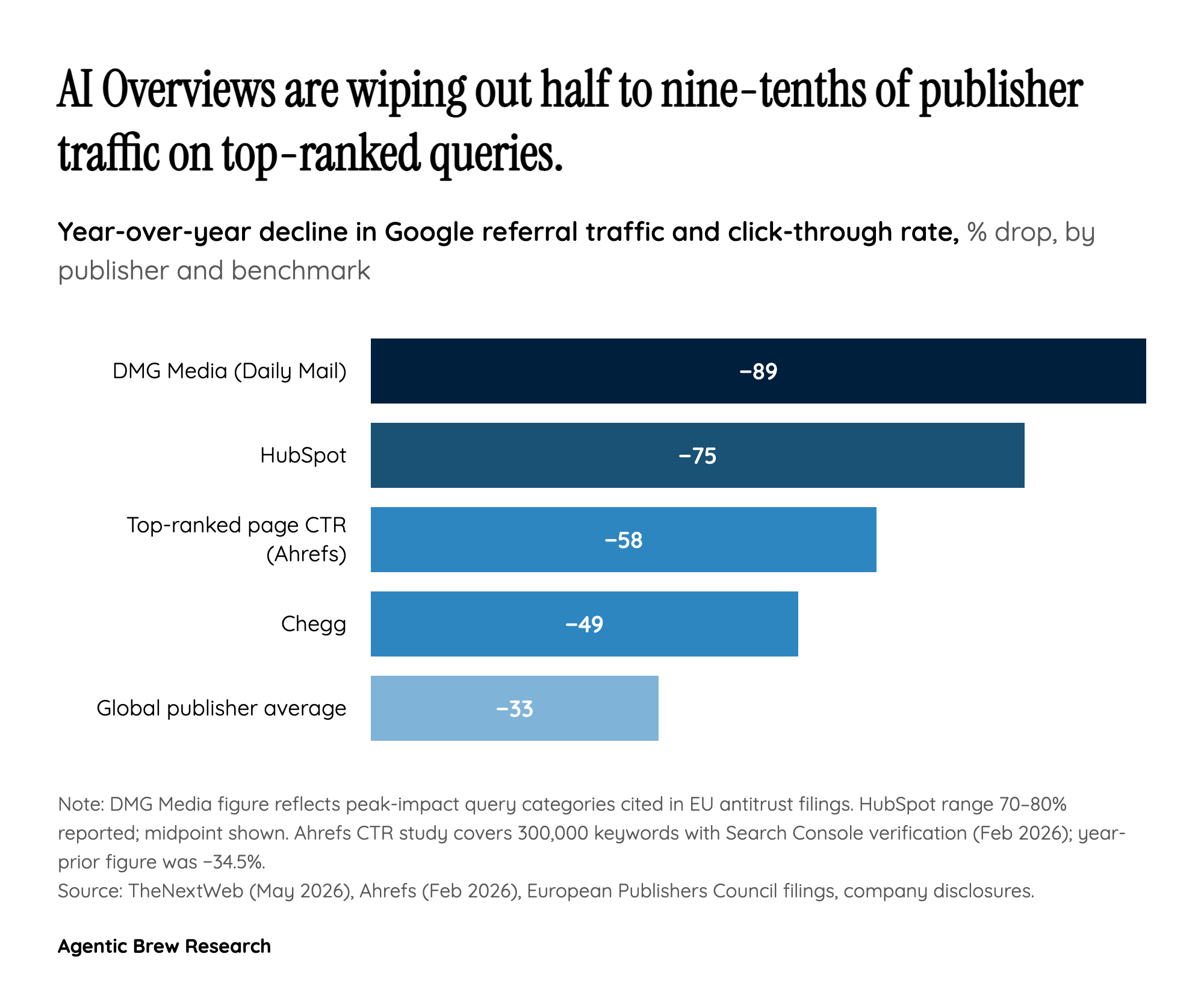
Publisher traffic decline by outlet — AI Overviews wipe out half to nine-tenths of top-ranked-page traffic. Sources: TheNextWeb, Ahrefs, EPC filings.

The most quantitatively damning evidence comes from Ahrefs. Director of Content Marketing Ryan Law re-ran their AI Overview impact study in February 2026 across 300,000 keywords cross-referenced with Search Console data, and the headline number nearly doubled in less than a year: 'the presence of an AI Overview now correlates with a 58% lower average clickthrough rate' on the top-ranking page, up from 34.5% in April 2025 [6].

Individual publisher case studies are worse than the aggregate: HubSpot is reportedly down 70-80%, Chegg down 49%, and DMG Media down as much as 89% on certain queries [7]. Globally, Google traffic to publishers fell 33% YoY by November 2025 [7]. The structural problem is that AI Overviews displace the click entirely — Pew Research found only 8% of users click a traditional result when an AI Overview is shown, compared to 15% without, and zero-click rates hit 80-83% on AI Overview pages [8]. Across all Google queries, 60% are now zero-click; for news it's 69% [7][9].

The SEO community is openly conceding the fight. The dominant sentiment on r/localseo is that long-tail and mid-tier sites are 'cooked' because AI only surfaces 'top dogs' — one commenter put it as 'if you do not make the top sources pulled into the context window your visibility is literally zero'. Yoast's SEO update quoted Condé Nast's CEO telling staff to plan as if search traffic will go to zero. That's not a hedge — it's an internal capitulation.

Ads-in-the-answer and Universal Cart: how Google monetizes the closed loop

If links go away, so does the keyword-bid auction that financed two decades of Google Ads. The I/O 2026 answer is two new ad formats unveiled at Google Marketing Live: Conversational Discovery ads, where 'Gemini builds creative in real time for that query', and Highlighted Answers, which generate curated recommendation lists labeled 'Sponsored' inside the AI response itself [10][11]. The auction moves from matching keywords to ranked URLs to matching intent to generated copy.

Universal Cart and AP2 then close the loop on the commerce side. Srinivasan's launch post frames Universal Cart as 'an intelligent shopping cart and your new hub for shopping on Google. It works across merchants and across services, so you can add things to your cart while you're browsing Search, chatting with Gemini, watching YouTube or even reading your Gmail' [4]. The mechanism: AP2 standardizes the agent-to-merchant handshake so Gemini can negotiate, check out, and pay on behalf of the user without a browser hop [5].

The combined effect is that the entire funnel — discovery, comparison, recommendation, checkout — collapses inside Google's surfaces. Independent merchants are pushed into the same posture publishers are already in: either get cited in the answer, or get bypassed. The Verge's I/O recap and Hey AI's analysis converge on the same framing: Google now treats AI agents, not human browsers, as the primary 'user' of the open web.

The 'enshittification' framing — and why the legal pile-on is gaining momentum

The Register's Liam Proven made the cleanest rhetorical hit: 'I feel like the great prophet Cory Doctorow kind of nailed this a couple of years ago now with this word, enshittification' [12]. Lily Ray at Amsive called it a 'devastating impact on the Internet' [7]; NPR escalated to 'extinction-level event' for online news [7][13]. These aren't isolated quotes — they're a coordinating narrative that publishers are bringing into court.

In February 2026, two parallel antitrust actions landed in the same window. Penske Media filed a U.S. federal suit alleging Google has shifted from a search engine to an answer engine that strips the incentive to click [14][15]. The European Publishers Council — DMG Media, the Guardian, News UK, and the New York Times — filed an EU complaint making the same argument [16][17]. The first U.S. test case, Helena World Chronicle / Emmerich Newspapers, was dismissed for lack of standing in March 2026 [18], but Penske is a different scale of plaintiff and the EU track has different procedural surface area.

On r/ArtificialInteligence, the dominant counter-take is structural rather than legal: Google's distribution moat — 4.3B Search, 3B Android, 2B Chrome users — means publishers can't credibly route around it. That's the strategic squeeze antitrust regulators have to break, and why this is shaping into the biggest open-web governance fight since the EU's link tax debates.

The exodus is real but small: who actually benefits from the backlash

Pitched against Google's 4.3B Search users, the search alternatives have rounding-error market share — but they're getting their clearest pitch in years. Winbuzzer's analysis argues Google's AI shift 'gives rivals a clearer pitch' for the first time since DuckDuckGo's privacy wedge in 2014 [19].

The shortlist users are migrating to splits along two axes: index ownership and AI exposure. Kagi (paid, $5/mo for 300 searches or $10/mo unlimited) pitches as ad-free AI-augmented search where the user is the customer; DuckDuckGo offers full opt-out of AI features and contextual-only ads on its own index; Brave runs an independent index with customizable 'Goggles' for result curation; Startpage acts as a privacy proxy returning Google results without exposing the user's IP [20].

What's new is the conversion narrative. Publisher executives, SEO professionals, and AI-skeptical communities (r/antiai's I/O 2026 thread hit 342 upvotes mocking AI saturation) are now actively recommending defection rather than just complaining. The economic ceiling is still small — none of these alternatives have ad-driven scale economics — but the political ceiling just rose: every quarter that AI Overviews push CTR lower is another quarter publishers, regulators, and power users find common cause.

Historical Context

2024-05-14
Launched AI Overviews in U.S. Search at I/O 2024, beginning the pivot from blue links to AI-generated answers.
2025-04-01
First Ahrefs CTR study finds a 34.5% click reduction on top-ranking pages when AI Overviews are shown.
2025-12-01
AI Overviews appear on 34.5% of all Google queries.
2026-02-01
Two parallel antitrust actions filed in the U.S. and EU accusing Google of cannibalizing publisher traffic via AI features.
2026-03-01
AI Overviews coverage jumps to 48% of Google queries, up from 34.5% three months earlier.
2026-03-20
Court dismisses Helena World Chronicle / Emmerich Newspapers antitrust case against Google for lack of standing — an early setback for publisher legal challenges.
2026-05-19
Pichai and Reid unveil the AI Mode-first Search redesign, Gemini 3.5 Flash as the new default model, Universal Cart, and AP2 at I/O 2026.
2026-05-20
Google unveils Conversational Discovery ads and Highlighted Answers — the first AI-native ad formats inside AI Mode.

Power Map

Key Players
Subject

Google I/O 2026 AI Search overhaul sparks open-web backlash

GO

Google (Sundar Pichai, CEO; Liz Reid, Head of Search; Vidhya Srinivasan, VP/GM Ads & Commerce)

Drove the I/O 2026 overhaul. Defends AI Overviews as generating more, not fewer, clicks; frames AI Mode as opt-in despite 1B MAU default rollout; positions Universal Cart and AP2 as a seamless cross-service commerce layer.

PE

Penske Media Corporation

Filed U.S. federal antitrust suit in Feb 2026 alleging Google has shifted from search engine to answer engine that removes the incentive to click external links.

EU

European Publishers Council (DMG Media, Guardian, News UK, NYT)

Filed EU antitrust complaint in Feb 2026 arguing Google's AI features replace rather than help publishers, with DMG Media reporting up to 89% traffic loss on some queries.

PU

Publishers in the firing line (HubSpot, Chegg, DMG Media, Condé Nast)

Reporting catastrophic traffic losses; Condé Nast's CEO has told staff to plan as if search traffic will be zero.

SE

Search alternatives (Kagi, DuckDuckGo, Brave Search, Startpage)

Positioned as primary beneficiaries of the backlash: Kagi paid ad-free AI-augmented search ($5/mo for 300 searches, $10/mo unlimited); DuckDuckGo free with full AI opt-out; Brave on its own independent index with customizable Goggles; Startpage as a privacy proxy returning Google results without IP exposure.

Fact Check

20 cited
  1. [1] Google I/O 2026 — the biggest upgrade to Search in 25 years
  2. [2] Google I/O 2026: All our announcements
  3. [3] Google Search as you know it is over
  4. [4] Universal Cart: your new hub for shopping on Google
  5. [5] Google's Universal Cart and Agent Payments Protocol at I/O 2026
  6. [6] AI Overviews now reduce clicks by 58% — Ahrefs 2026 update
  7. [7] Google's AI Search overhaul threatens publishers and the open web
  8. [8] Google AI Overviews updates 2026
  9. [9] Google AI search kills open web: 60% zero-click
  10. [10] Google AI Mode ads: Conversational Discovery and Highlighted Answers explained
  11. [11] Google tests new conversational ad formats in AI Mode and Search
  12. [12] Google has seriously leaned into AI enshittification lately
  13. [13] Google's AI search box and the future of online news
  14. [14] Google AI Overviews publisher traffic decline — antitrust lawsuit analysis
  15. [15] Antitrust filing says Google cannibalizes publisher traffic
  16. [16] European publishers file EU antitrust complaint over Google AI Overviews
  17. [17] European publishers' antitrust complaint over Google AI Overviews
  18. [18] US court dismisses news publishers' antitrust case over Google News AI use
  19. [19] Google's AI search shift gives rivals a clearer pitch
  20. [20] Google Search alternatives in the AI Overviews era

Source Articles

Top 3

THE SIGNAL.

Analysts

"After analyzing 300,000 keywords plus Search Console data, concludes the presence of an AI Overview now correlates with a 58% lower average clickthrough rate on the top-ranking page — nearly double the 34.5% decline measured in April 2025."

Ryan Law
Director of Content Marketing, Ahrefs

"Warns the redesign will have a devastating impact on the Internet's underlying economic model, as publishers lose the click-driven revenue that funds the open web."

Lily Ray
VP of SEO Strategy, Amsive

"Frames the I/O 2026 changes as a textbook case of Cory Doctorow's 'enshittification' — quality degrading as the platform tilts further toward extracting value from users and business customers."

Liam Proven
Open Source Reporter, The Register

"Defends the overhaul as a reimagining that improves user experience and frames the next chapter as the 'era of Search agents, where you can easily create, customize and manage multiple AI agents'."

Elizabeth (Liz) Reid
VP / Head of Search, Google

"Characterizes the AI Mode default as an 'extinction-level event' for online news outlets that depend on Google referrals."

NPR
Public broadcaster
The Crowd

"Today we are starting to roll out the biggest upgrade to the Google Search box in over 25 years — now completely reimagined with AI, along with Gemini 3.5 Flash as the new default model for AI mode users globally!"

@@OfficialLoganK4057

"A Google spokesperson responded to this TechCrunch article: "We're continuing to display blue links on the search results page in addition to AI responses. If someone chooses to ask a follow-up from an AI Overview, or selects the AI Mode button in the Search box, then that..."

@@Phil_Lewis_1096

"The time has come. Google is now showing ads within AI Mode for the first time ever. Similar to the ads that I had originally spotted showing within AI overviews earlier this year, the placement is at the bottom of the response. And as you can see, the ad results are labelled..."

@@brodieseo117

"Breaking News: Google just announced their official transition to AI-only search."

@u/darrenshaw_110
Broadcast
Google I/O 2026 keynote in 35 minutes

Google I/O 2026 keynote in 35 minutes

Google Thinks AI Agents Are the New Target Users For Web Search | Google I/O Analysis

Google Thinks AI Agents Are the New Target Users For Web Search | Google I/O Analysis

Google I/O AI search changes, AI mode & WordPress 7.0 | May 2026 SEO Update

Google I/O AI search changes, AI mode & WordPress 7.0 | May 2026 SEO Update