Claude Mythos 5 powers Claude Security vulnerability scanner
TECH

Claude Mythos 5 powers Claude Security vulnerability scanner

22+
Signals

Strategic Overview

  • 01.
    Claude Security's vulnerability scans now run on Claude Mythos 5, a Mythos-class model previously limited to vetted defenders through Project Glasswing, and the integration is in public beta for Claude Enterprise customers, billed as standard token usage with no separate add-on.
  • 02.
    Rather than exposing the model as an open prompt, Claude Security scans a selected GitHub repository, traces data flows across files, and returns findings classified by CWE category, severity, and confidence, with a suggested fix that requires human review before implementation.
  • 03.
    Alongside the product integration, Anthropic launched the Defender Advantage Fund (0xDAF), committing $35 million in Claude credits to organizations that patch and secure open-source software, building on $4 million in prior direct donations made under Project Glasswing.
  • 04.
    Anthropic-cited benchmarking shows Mythos 5 reproducing 83.1% of vulnerabilities on the CyberGym benchmark versus 66.6% for Claude Opus 4.6, and Project Glasswing access pricing has dropped from $25/$125 to $10/$50 per million input/output tokens as the program expanded to roughly 150 organizations.

Deep Analysis

The Wrapper Is the Safety Mechanism

Claude Mythos 5 and the generally available Claude Fable 5 are described as the same underlying model, with Fable 5 carrying additional safety measures for dual-use capabilities that Mythos 5 does not [1]. That gap is exactly why Claude Security is built the way it is: instead of putting Enterprise customers in front of an open prompt box, the product hands back a structured scan result, findings classified by CWE category, severity, confidence rating, and a suggested fix that a human must review before it ships [2]. The same model that finds a vulnerability is architecturally prevented from being steered into writing an exploit, because there is no free-text interface to steer.

That containment-by-product-design choice is also, functionally, a monetization mechanism, and the community reaction has picked up on the tension. Reaction on Reddit's ClaudeAI community, after a long comment thread, converged on the read that Anthropic is not handing over raw Mythos 5 access to anyone, enterprise or not; it is a narrowly scoped application with a fixed workflow, a world away from unrestricted model access. A visible undercurrent of that discussion was skepticism that the earlier 'too dangerous for general release' framing around Mythos itself functioned as a setup for this scan-only, paid access tier. Payward Co-CEO Arjun Sethi frames the same product decision more optimistically, arguing frontier AI reverses the usual attacker/defender asymmetry because a model can now read every line of code the way an attacker would, at machine scale [3].
Discovery Outpaces Defense: The New Bottleneck

Discovery Outpaces Defense: The New Bottleneck
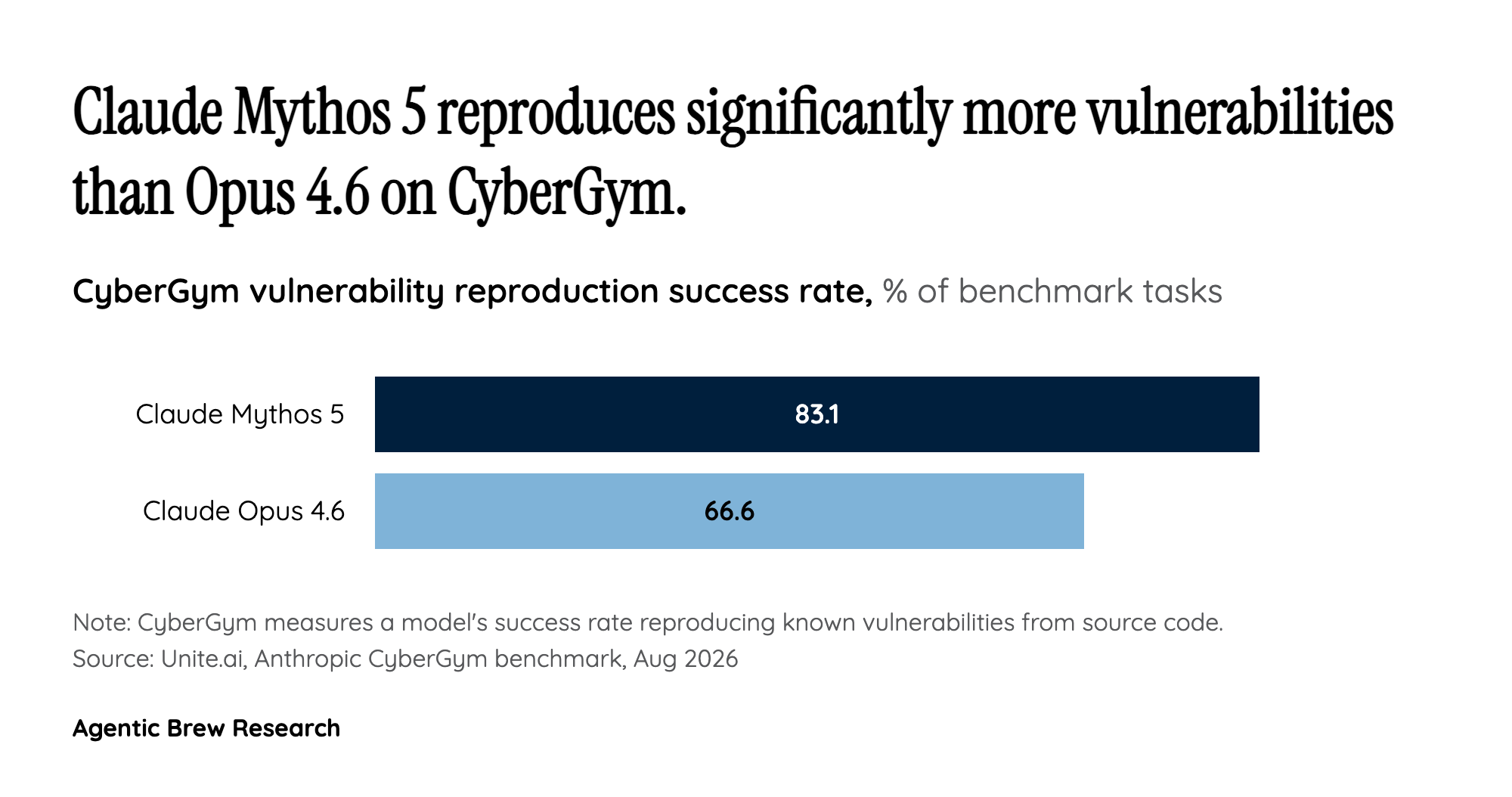
Claude Mythos 5 vs. Claude Opus 4.6 on the CyberGym vulnerability reproduction benchmark. Source: Unite.ai, Aug 2026.

Anthropic's headline capability claim is a jump on CyberGym, a vulnerability-reproduction benchmark, from 66.6% for Claude Opus 4.6 to 83.1% for Mythos 5 [4]. Interviews around the launch (including a Cloud Security Podcast conversation with Brinqa CSO Brad Hibbert) framed this less as a single event and more as a 'climate change' shift: continuous, compounding AI-driven discovery rather than one-off incidents like Heartbleed or Log4j, with discovery-to-exploit timelines compressing from months to weeks or days, and three chained medium-severity privilege-escalation bugs now sufficient to reach what previously required one critical CVE.

Security practitioners quoted around the launch pushed back on how much that capability actually changes for defenders day to day. Rich Mogull of the Cloud Security Alliance argues the cybersecurity story for the average practitioner has not changed and counsels methodical preparation over alarm [6]. Cynthia Kaiser of Halcyon goes further, noting adversaries are already highly effective without AI assistance, breaching some victims in under an hour, which undercuts the idea that AI scanning is the primary threat driver [5]. Analysts have also questioned Anthropic's own severity claims: reports of thousands of severe vulnerabilities trace back to expert contractors agreeing with Claude's severity rating in roughly 90% of just 198 manually reviewed cases, and at least one FFmpeg finding that Anthropic's own review concluded was not critical severity [5]. The practical effect, according to this critique, is that finding flaws faster does not shrink the real constraint, which is triage and patching capacity, not discovery.

Access Expands, Price Drops: The Glasswing Trajectory

Claude Security's public beta sits downstream of Project Glasswing, the invitation-only program Anthropic launched on April 7, 2026 with eleven founding partners including AWS, Apple, Cisco, CrowdStrike, Google, JPMorganChase, Microsoft, and NVIDIA, giving them access to a safety-loosened Mythos build for security research [7]. The program has since expanded substantially, adding about 150 organizations across 15+ countries and, by its own accounting, surfacing more than 10,000 high- or critical-severity flaws across participants; access remains invitation-only, NDA-bound, and approved in consultation with the US government [8]. Access pricing has also fallen: direct Glasswing access to Mythos 5 now costs $10 per million input tokens and $50 per million output tokens, down from $25 and $125 respectively for the earlier Mythos Preview [4].

The expansion has also pulled in a new sector. Payward, Kraken's parent company, joined Glasswing in mid-August 2026, becoming the first reported crypto firm with access, after more than 40 Bitcoin and crypto companies signed an open letter asking for frontier-model access specifically for defense [3]. That sequence, an open letter followed by Payward's admission into the program, is a concrete instance of sector-wide lobbying preceding entry into Glasswing.

Compressed Timelines Reach Regulators

Coverage of the private-preview period before this launch reported concrete downstream effects of faster vulnerability discovery: Mozilla fixed 271 Firefox vulnerabilities after testing Mythos, and researchers used it to chain together vulnerabilities that bypassed macOS protections. Those results are part of why observers describe the shift as a change in exploit timelines rather than a one-time capability bump, three chained medium-severity bugs now doing the work of a single critical CVE, and remediation windows that used to run 30, 60, or 90 days looking increasingly out of step with how fast attackers can move once a class of bug is public.

That compression has already reached regulators, at least in India: reporting describes India's CERT-In directing organizations to patch within 12 hours, the Reserve Bank of India holding consultations, and Punjab National Bank earmarking additional cybersecurity budget, all attributed to the faster exploit timelines associated with AI-assisted vulnerability discovery. The caveat attached to that reporting is important: hardening driven by tools like Mythos applies going forward, not retroactively, so legacy and already-deployed systems remain exposed even as newly scanned codebases get patched faster. Journalist Siddharth Jindal's framing of the underlying tension is worth keeping in view: Mythos finds vulnerabilities rather than creating them, but the same capability that identifies a flaw implies the capability to help patch it as well, which is the defensive promise and the dual-use risk in the same sentence.

Historical Context

2026-04-07
Project Glasswing launched, giving an initial set of vetted partners (AWS, Apple, Broadcom, Cisco, CrowdStrike, Google, JPMorganChase, Linux Foundation, Microsoft, NVIDIA, Palo Alto Networks) access to a safety-loosened version of Claude Mythos for security research.
2026-07-22
Anthropic released a Claude Security plugin for Claude Code in beta, a multi-agent vulnerability scanner running in the terminal.
2026-08-17
Payward announced it joined Project Glasswing, becoming the first reported crypto company with Claude Mythos 5 access, following an open letter from 40+ Bitcoin/crypto firms.
2026-08-21
Anthropic announced Claude Mythos 5 now powers Claude Security's vulnerability scans in Enterprise public beta and launched the $35M Defender Advantage Fund (0xDAF) for open-source security.
2026
Program expanded to approximately 150 new organizations across 15+ countries; access remains invitation-only, NDA-bound, and approved in consultation with the US government.

Power Map

Key Players
Subject

Claude Mythos 5 powers Claude Security vulnerability scanner

AN

Anthropic

Developer of Claude Mythos 5 and Claude Security; operator of Project Glasswing and the Defender Advantage Fund

PR

Project Glasswing founding partners (AWS, Apple, Broadcom, Cisco, CrowdStrike, Google, JPMorganChase, Linux Foundation, Microsoft, NVIDIA, Palo Alto Networks)

Initial vetted partners granted early access to Mythos-class models for critical-software defense

PA

Payward / Kraken

First reported crypto company to join Project Glasswing, using Claude Mythos 5 for its security division

CL

Claude Enterprise customers

End users of the Claude Security public beta powered by Mythos 5

Fact Check

8 cited
  1. [1] Introducing Claude Fable 5 and Claude Mythos 5
  2. [2] Anthropic Brings Claude Mythos 5 to Claude Security
  3. [3] Kraken Parent Payward Joins Anthropic's Project Glasswing With Claude Mythos Access
  4. [4] Anthropic Deploys Claude Mythos 5 in Security Tools, $35M Open-Source Fund
  5. [5] Security Experts on Claude Mythos and Hacking
  6. [6] Claude Mythos: Hype vs Reality
  7. [7] Claude Mythos 5 and Project Glasswing Security Teams
  8. [8] Claude Mythos 5 Project Glasswing Cyberdefenders Expansion

Source Articles

Top 3

THE SIGNAL.

Analysts

Calls Mythos 5 a real technical advance but says the public response to it is not yet substantiated by evidence, pointing to a communication gap between practitioners and policymakers.

Isaac Evans, Founder/CEO, Semgrep
Cautiously positive / measured

Argues the cybersecurity story for the average practitioner has not fundamentally changed and urges methodical preparation over panic.

Rich Mogull, Chief Analyst, Cloud Security Alliance
Skeptical of hype

Notes adversaries are already highly effective without AI, with ransomware crews breaching victims in under an hour, suggesting AI scanning is not the primary threat driver.

Cynthia Kaiser, former FBI cybersecurity official, Halcyon
Skeptical

Argues frontier AI reverses the traditional attacker/defender asymmetry by letting defenders read code at machine scale, the way an attacker would.

Arjun Sethi, Co-CEO, Payward (Kraken's parent)
Supportive
The Crowd

Claude Security scans now run on Claude Mythos 5, available today in public beta for all Claude Enterprise customers. Put our most capable security model to work on your codebase, no separate model access needed.

@@claudeai9111

Anthropicは、Claude Mythos 5をClaude Securityで利用可能にし、企業ユーザーがコードベースの脆弱性検出や修正案の生成に使えるようにした。直接モデルへ自由に指示する形ではなく、防御用途に限定したワークフローで提供する。 Claude SecurityはClaude...

@@yousukezan19

Oh Mythos 5 is no longer a dangerous model and can be used by enterprise now

@u/Key_Efficiency9885731
Broadcast
Find and fix security vulnerabilities with Claude

Find and fix security vulnerabilities with Claude

How Claude Mythos Changes Vulnerability Management: From CVSS to Exploitability

How Claude Mythos Changes Vulnerability Management: From CVSS to Exploitability

EXPOSED - Anthropic's Mythos Has Infosys & TCS on Alert: Claude Mythos Exposes vulnerabilities

EXPOSED - Anthropic's Mythos Has Infosys & TCS on Alert: Claude Mythos Exposes vulnerabilities