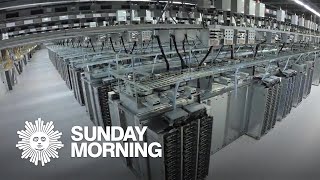
Global AI data center buildout strains power grids
TECH

Global AI data center buildout strains power grids

38+
Signals

Strategic Overview

  • 01.
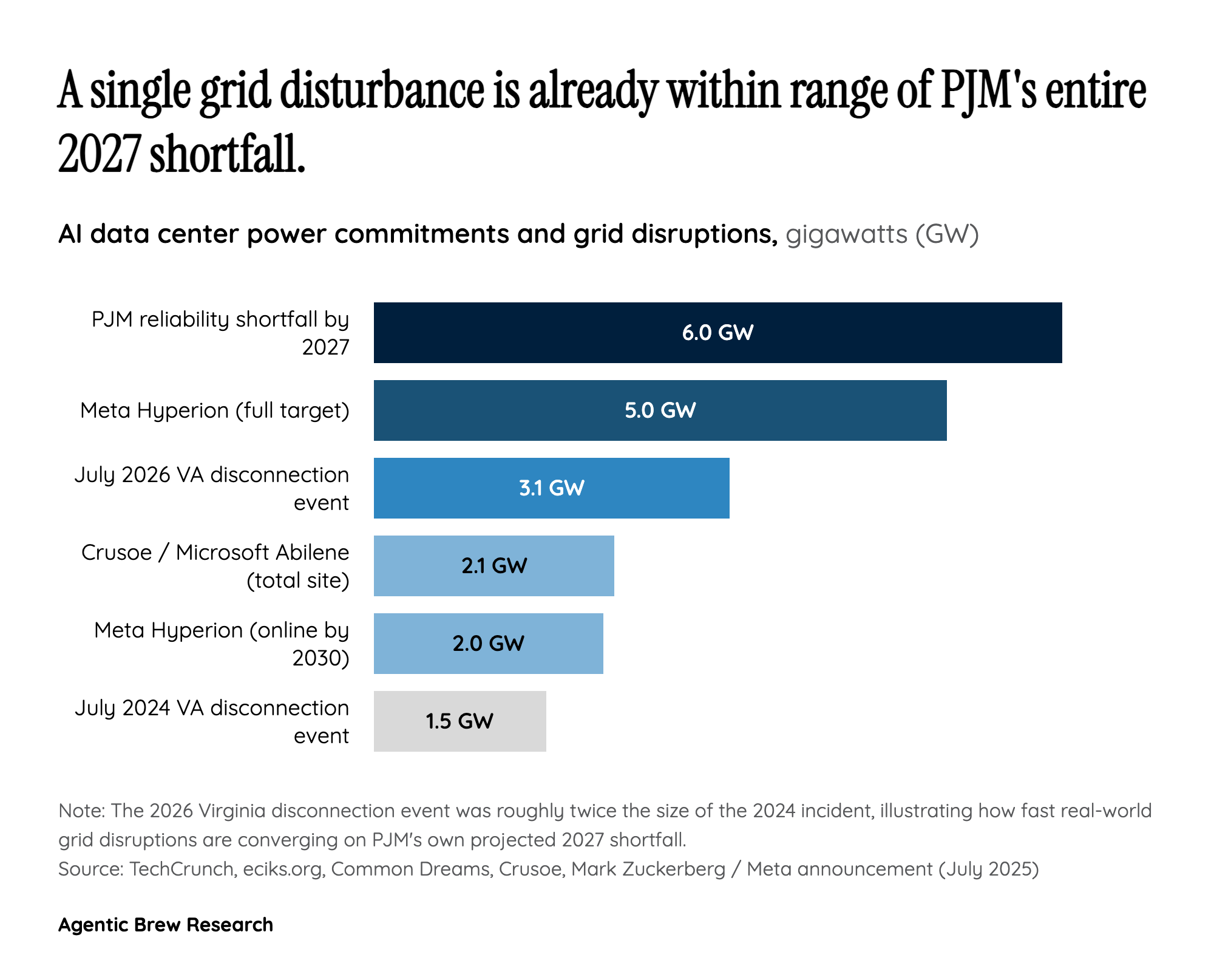
    A single transmission line failure near Washington, DC on July 22, 2026 knocked more than 3 gigawatts of AI data center load offline in seconds, sending a voltage disturbance across PJM's entire footprint from Virginia to Chicago and reviving warnings that America's largest grid was not built for AI-scale power swings.
  • 02.
    Even as the grid strains, AI infrastructure investment keeps accelerating: Crusoe and Microsoft are expanding their Abilene, Texas campus to 2.1 gigawatts, Meta is building a 5-gigawatt Hyperion data center, and HCLTech is committing $1.48 billion with Sarvam AI to build a new AI data center hub in Odisha, India.
  • 03.
    PJM's own independent market monitor says the grid operator's reserve margins have never been this thin, projecting a 6-gigawatt reliability shortfall by 2027 as data center demand grows 5-7 gigawatts a year against only 2-3 gigawatts of new power supply.
  • 04.
    The buildout is also straining hardware supply chains beyond the grid itself: rising CPU demand from Chinese AI data center operators has pushed some server chip prices up more than 40% since the start of 2026, pushing Intel and AMD to lock in long-term supply agreements without fixed pricing.

Deep Analysis

One Fallen Line, a Grid-Wide Wobble

On July 22, 2026, a single transmission line failure in Northern Virginia caused more than 3 gigawatts of AI data center load - about 3% of PJM's total demand at the time - to disconnect automatically, sending a voltage disturbance that was felt from Washington, DC all the way to Chicago [1]. Dominion Energy's system operations team stabilized the situation within about 10 minutes and reported no lasting impact to grid reliability [2]. The scale is what stands out: roughly 3.1 gigawatts dropped within 30 seconds, nearly twice the size of a similar July 2024 Virginia incident in which about 60 data centers pulled offline simultaneously and nearly triggered a blackout [3][4]. Ting Labs CEO Bob Marshall, whose company serves customers near the affected campuses, said the power-quality hit was immediately visible at the household level - flickering lights and noisy appliances. ON.Energy's Ricardo de Azevedo called the event 'the canary in the coal mine,' and Independent Electricity System Operator specialist Ali Zain Banatwala argued the deeper problem is procedural: grid operators still have no coordinated rule for how clusters of co-located data centers should disconnect or reconnect in sequence, rather than all at once, when something goes wrong upstream.
The Math That Doesn't Add Up

Behind the July incident is a supply-demand gap that PJM's own independent market monitor calls historic. Monitoring Analytics president Joe Bowring said reserve margins are at 'a crisis stage right now,' with data center load growth outpacing new generation for years running [5]. PJM's demand from data centers is projected to grow 5-7 gigawatts annually through 2032, while new power supply is being added at only 2-3 gigawatts a year [3]- a gap wide enough that PJM has flagged a 6-gigawatt reliability shortfall as soon as 2027 [5]. That mismatch is already showing up in bills: NRDC's Tom Rutigliano projects PJM consumers will pay an extra $163 billion through 2033, roughly $70 a month more per family by 2028, on top of a $9.4 billion capacity charge already passed through this summer [3]. The political fallout is starting to show: Bloomberg has reported that the AI-driven strain is fueling talk of breaking up PJM itself [6], even as federal regulators are moving in the opposite direction, ordering grid operators in June 2026 to fast-track connection approvals for large AI loads to 90 days [7]. That is two branches of policy pulling against each other in the same season - accelerate connections while reserve margins hit a historic low.

The Buildout Doesn't Wait for the Grid

None of this is slowing the physical construction boom. Crusoe just announced a new 900-megawatt phase of its Abilene, Texas campus built for Microsoft's AI infrastructure, bringing the site's total planned capacity to 2.1 gigawatts, with the first new building energized by mid-2027 [8]. Meta's Hyperion data center, unveiled by Mark Zuckerberg in July 2025 explicitly to get ahead of OpenAI and Google in the AI race, is designed to eventually reach 5 gigawatts of capacity across a footprint large enough to cover most of Manhattan, with 2 gigawatts expected online by 2030 [9]. The buildout is now global: HCLTech is committing 142.57 billion rupees ($1.48 billion) with Indian AI startup Sarvam to build its first AI data center in Bhubaneswar, Odisha, alongside a 5,000-seat technology hub set to open by 2028 [10]. Each of these projects is being planned and financed on its own timeline, largely independent of whether the local grid can absorb it - a mismatch the Virginia event just made visible in real time.

The Bottleneck Isn't Power Plants - It's Hardware

The Bottleneck Isn't Power Plants - It's Hardware
AI data center power commitments and grid disruptions, in gigawatts. A single 2026 grid disturbance (3.1 GW) is already within range of PJM's entire projected 2027 shortfall (6 GW).

A recurring theme across this cluster's coverage is that raw electricity generation may not be the tightest constraint - the physical hardware needed to move and process that power is. On the compute side, a surge in AI chip and CPU demand from Chinese AI data center operators has pushed certain server CPU prices up more than 40% since the start of 2026 and stretched Intel's wait times to roughly half a year, forcing Intel and AMD to sign long-term supply agreements that commit volume without locking in price [11][12]. AMD has revised its own server CPU market forecast to exceed $120 billion by 2030 on the strength of this demand [11]. Data centers represented just 6% of PJM's load in 2024; that share is projected to reach 24% by 2040 [1]- a trajectory that risks outpacing not just power plants, but the entire supply chain built to support them.

Historical Context

2024-07-10
About 60 data centers simultaneously disconnected from the grid, dropping roughly 1,500 MW and nearly triggering a blackout, foreshadowing the 2026 event.
2025-07-14
Mark Zuckerberg announced the 5 GW Hyperion data center and 1 GW Prometheus cluster to accelerate Meta's AI buildout.
2026-03-27
Crusoe announced a new 900 MW AI factory campus phase in Abilene, Texas, expanding total site capacity to 2.1 GW.
2026-06-04
Bloomberg reported the AI data center boom was creating pressure that risks a breakup of PJM, the largest US grid operator.
2026-06-18
FERC issued orders intended to speed grid connection approvals (targeting 90 days) for large AI data center loads.
2026-07-22
A transmission line failure caused over 3 GW of data center load to disconnect abruptly, sending a voltage disturbance from DC to Chicago.
2026-07-24
HCLTech announced a $1.48 billion investment with Sarvam AI to build its first AI data center in Odisha, India.

Power Map

Key Players
Subject

Global AI data center buildout strains power grids

PJ

PJM Interconnection

The largest US grid operator, serving 65-67 million people across 13 states, absorbed the 3+ gigawatt sudden disconnection, faces a projected 6-gigawatt reliability shortfall by 2027, and is now the subject of political calls for reform or breakup.

DO

Dominion Energy

The regional utility whose system operations team stabilized the grid within minutes of the Northern Virginia transmission line failure.

CR

Crusoe Energy / Microsoft

Developer (Crusoe) and customer (Microsoft) behind the expanding Abilene, Texas AI factory campus, now projected at 2.1 gigawatts of combined capacity.

HC

HCLTech / Sarvam AI

HCLTech is partnering with Indian AI startup Sarvam to build its first AI data center in Odisha, backed by a $1.48 billion investment, diversifying an IT services firm into AI infrastructure.

IN

Intel and AMD

Chip makers locking Chinese AI data center operators into long-term CPU supply agreements as agentic AI workloads increase CPU demand and prices surge, giving the chipmakers rare pricing leverage.

ME

Meta

Building the 5-gigawatt Hyperion data center to compete with OpenAI and Google in the AI race, illustrating the scale of capital flowing into new capacity regardless of grid readiness.

Fact Check

12 cited
  1. [1] One fallen power line exposed a growing AI data center problem. Here's how to fix it.
  2. [2] Massive Disconnect: Power Event Roils the Largest US Grid Operator
  3. [3] Northern Virginia Data Center Power Disconnect
  4. [4] Virginia Narrowly Avoided Power Cuts When 60 Data Centers Dropped Off the Grid at Once
  5. [5] Data Centers and the Strain on the Electric Grid
  6. [6] AI Data Center Boom Risks Breakup of Biggest US Power Grid Operator
  7. [7] US to Fast-Track Grid Connections for AI Data Centers
  8. [8] Crusoe Announces New 900 MW AI Factory Campus in Abilene, Texas to Support Microsoft AI Infrastructure
  9. [9] Mark Zuckerberg Says Meta Is Building a 5GW AI Data Center
  10. [10] India's HCLTech, Sarvam to Set Up $1.48 Billion AI Data Center in Odisha State
  11. [11] Intel, AMD Sign Long-Term CPU Supply Deals With Chinese AI Firms
  12. [12] Intel and AMD Lock In Year-Long CPU Deals With Chinese AI Firms as Prices Surge 40%

Source Articles

Top 5

THE SIGNAL.

Analysts

"Argues PJM's reserve margins are at a historic low point driven by data center load growth outpacing new generation."

Joe Bowring
President, Monitoring Analytics (PJM's independent market monitor)

"Says grid operators need coordinated ride-through and disconnection sequencing rules for co-located data center clusters to prevent future cascading events."

Ali Zain Banatwala
Senior Market Models Specialist, Independent Electricity System Operator

"Frames the Virginia incident as an early warning sign of larger grid instability risk as AI data center load scales."

Ricardo de Azevedo
CTO, ON.Energy

"Warns that continued data center growth exceeding available power supply will impose large added costs on PJM ratepayers."

Tom Rutigliano
Senior Advocate, NRDC

"Characterized the Northern Virginia disconnection as an unusually large power-quality event affecting residential customers near the affected data centers."

Bob Marshall
CEO, Ting Labs
The Crowd

"We need more power. Data center power demand in the US is projected to surge +253% from 2026 levels, to a record 194 gigawatts by 2035. One gigawatt is roughly equivalent to the capacity of a single traditional nuclear reactor. As a result, data centers are expected to account [text continues past observed cutoff]"

@@KobeissiLetter2222

"Loudoun County data centers are linked to power flickering across half the U.S. "This is what experts are worried about, right? The data centers are such a big load on the grid that they can have detrimental impact.""

@@nbcwashington39

"American who works building Data Centers says the amount of money he sees being poured into these projects, "It's like money isn't real" "Seeing the amount of money and labor and investment into this, and then you talk to some of your contractor friends and the budgets just [text continues past observed cutoff]"

@@WallStreetApes1821

"2027 to bring Blackouts due to data centers in Virginia and the rest of the US."

@u/AlternativeEchidna79414
Broadcast
Real Reason Why AI Data Centers Are Running Out of Power (It's Not Power Generation)

Real Reason Why AI Data Centers Are Running Out of Power (It's Not Power Generation)

Nationwide boom in AI data centers stirs resistance

Nationwide boom in AI data centers stirs resistance

The Story You're Not Hearing About AI Data Centers | Ayșe Coskun | TED

The Story You're Not Hearing About AI Data Centers | Ayșe Coskun | TED