Tesla and SpaceXAI push to automate labor with Grok, Robotaxi, and humanoid robots
TECH

Tesla and SpaceXAI push to automate labor with Grok, Robotaxi, and humanoid robots

24+
Signals

Strategic Overview

  • 01.
    In a July 10, 2026 memo, Elon Musk told Tesla staff to switch to xAI's Grok 4.5 when possible, citing its lower token costs versus competitors.
  • 02.
    Tesla's $200-per-week cap on employee AI spending, effective July 6, 2026, applies to Anthropic, OpenAI, and Google but exempts xAI's Grok.
  • 03.
    Musk frames Tesla's camera-only Cybercab, targeted below $30,000, as undercutting Waymo's roughly $150,000 lidar-based robotaxi fleet.
  • 04.
    Musk's stated goal is for AI and robots to make human work optional within ten to twenty years, with Optimus as Tesla's main long-term value driver.

Deep Analysis

The Cheapest Model, Not the Best One

On July 10, 2026, Musk sent Tesla staff a memo telling them to switch to Grok 4.5 'when possible,' citing its lower token costs versus competitors [1]. He did not argue Grok was better - he conceded the opposite, saying a rival model 'is definitely better than Grok 4.5, but most tasks don't require' that level of capability [1]. On a cited leaderboard Grok ranked ninth overall, behind models from OpenAI, Anthropic, and Google, and internally Tesla engineers have broadly preferred Anthropic's Claude for day-to-day development [1].

The economics are the whole argument. Grok reportedly runs at roughly $0.13 per task against about $1.57 for a top-tier rival, close to a twelve-fold gap [1]. Days earlier, Tesla imposed a $200-per-week cap on employee AI spending that applies to Anthropic, OpenAI, and Google but pointedly exempts xAI's Grok [2]. Follow the money and the mandate looks less like a benchmark decision than a corporate one: Tesla holds a roughly $2 billion stake in xAI [2], and xAI itself folded into SpaceX in a February 2026 all-stock deal that valued the combined company at about $1.25 trillion [6]. Directing Tesla's AI budget toward Grok routes spending into a company Musk separately controls. Musk pushed back on the 'mandate' framing publicly, saying he only asked teams to try Grok and to keep using other models where they outperform it.
One AI Stack, Three Products

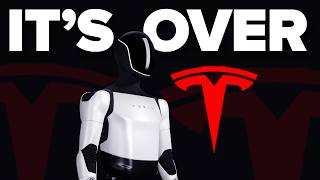
Grok is only the software layer of a much larger bet. The connective thesis across Musk's companies is that a single AI stack can power cars, robots, and office work alike. Tesla's Robotaxi and its Optimus humanoid both lean on the same camera-based, vision-only approach - cameras and a neural net rather than lidar - so the car collecting driving data and the robot collecting manipulation data feed one shared system. That framing lets Musk treat automation as a manufacturing problem: once the AI works, the constraint becomes how many bodies you can build.

The production targets are staggering. Tesla has said its first Optimus line at Fremont is designed for roughly one million units per year, with Gigafactory Texas prepared for up to ten million robots per year starting in 2027 [5]. Musk's stated endgame is that AI and robots make human work 'optional' within ten to twenty years, and he has said he wants around 80 percent of Tesla's long-term value to come from Optimus [4]. The originating claim behind this cluster - that Musk's companies alone could replace all physical and office labor by 2030 - is the aggressive edge of the same argument, though the production lines that would make it real are only now being installed.

By The Numbers: The Cost Bet Against Waymo

By The Numbers: The Cost Bet Against Waymo
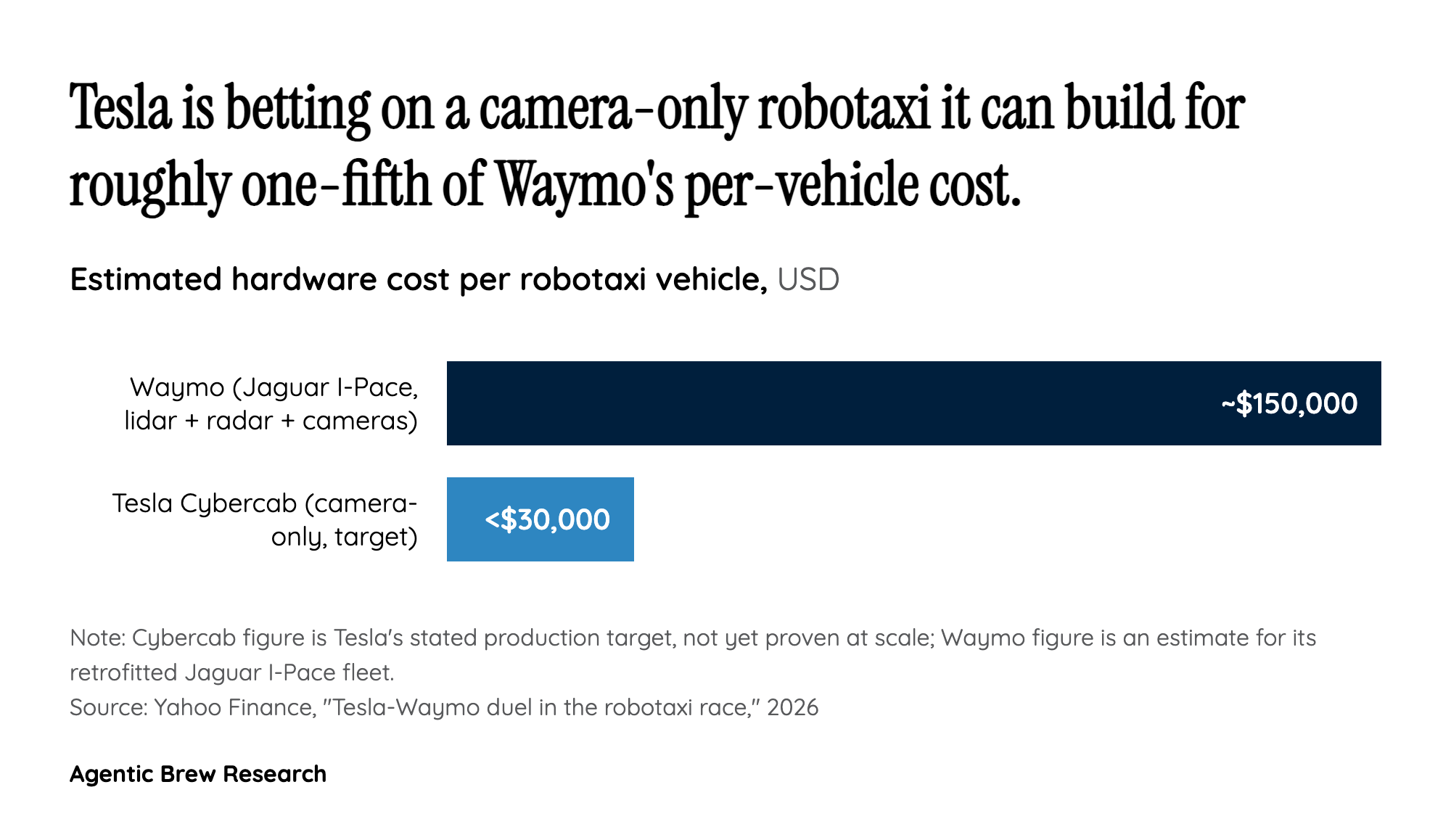
Estimated hardware cost per robotaxi vehicle: Waymo's lidar fleet versus Tesla's camera-only Cybercab target.

Strip away the rhetoric and Tesla's robotaxi case rests on one number: cost per vehicle. Waymo runs a retrofitted Jaguar I-Pace fleet estimated near $150,000 per car, bristling with lidar, radar, and cameras; Tesla is targeting a camera-only Cybercab priced below $30,000 - a figure it has not yet proven in production [3]. The logic is that the cheaper you build the car, the cheaper you run it, and the more you can flood onto the road, driving cost per mile toward zero.

The present-day scoreboard tells the opposite story. Waymo operates roughly 3,000 to 3,800 vehicles delivering about 500,000 paid rides a week across some ten U.S. metros, while Tesla has only around twenty unsupervised robotaxis on the road [3]. Musk is not betting on today's fleet; he is betting that Tesla's manufacturing scale eventually makes Waymo's per-vehicle economics impossible to defend. Whether camera-only autonomy clears the reliability and regulatory bar to justify that scale is the open question the numbers cannot yet answer.

What the Bulls and the Skeptics Each Get Right

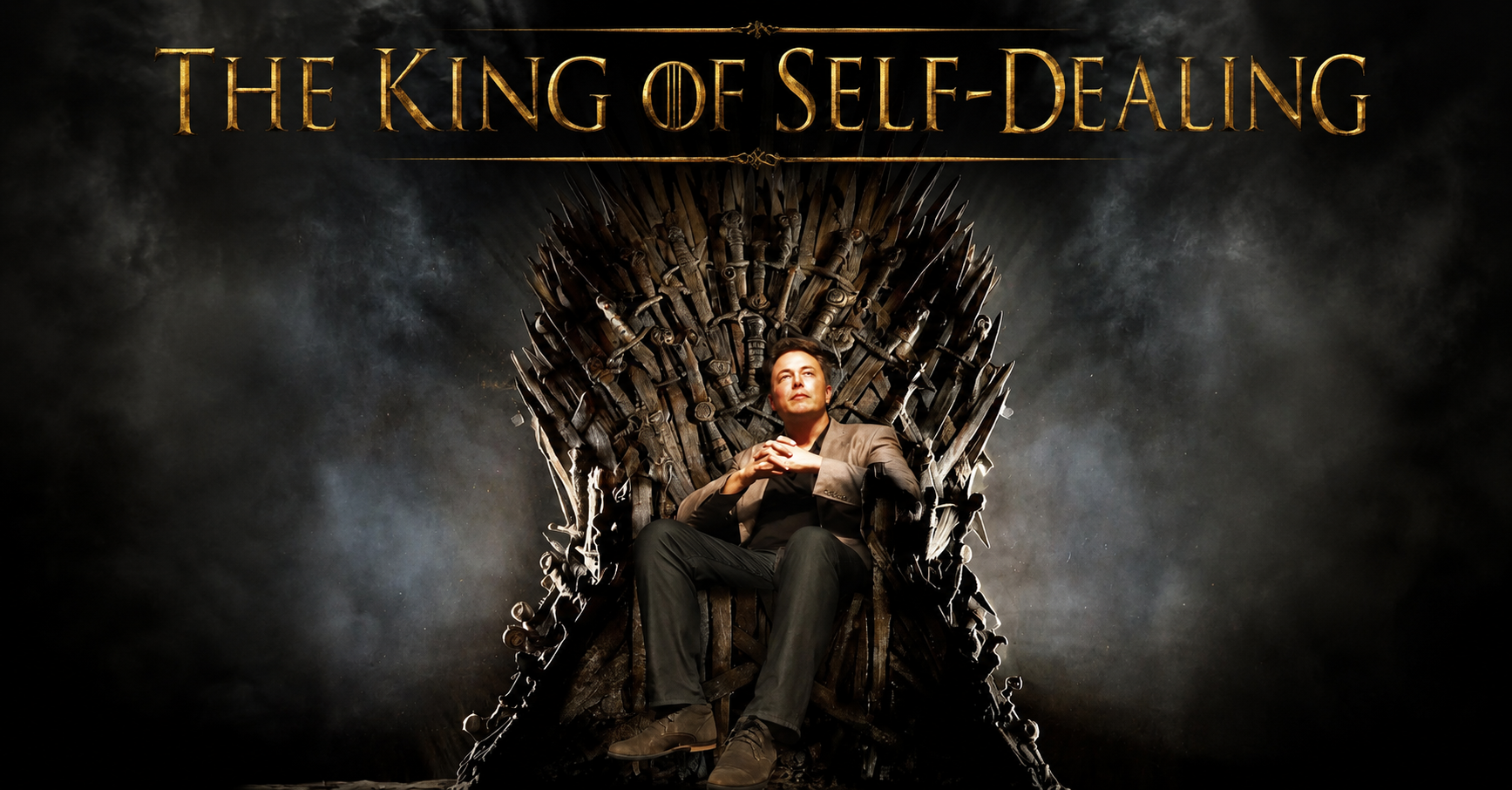
Two objections shadow the strategy. The first is governance. Steering Tesla's AI spend into xAI - a company Musk controls and in which Tesla holds a stake - has drawn conflict-of-interest concerns from institutional investors, who read the Grok-exempt spending cap as self-dealing dressed up as cost discipline [7]. The second is technical and regulatory reality.

The community reaction maps neatly onto that divide. On developer-heavy YouTube, the dominant framing is bullish and economics-first, presenting the Cybercab's cost and efficiency edge as a structural advantage Waymo cannot easily fix. In self-driving and Tesla-critical forums, the sharper counterpoint is that Tesla is competing with the entire autonomy field, not just Waymo, and that its thesis quietly assumes three unsolved gates: vision-only Level 4 autonomy actually working, regulators approving mass unsupervised fleets, and a liability framework for privately owned cars driving themselves for hire. The bulls are right that manufacturing scale is a real and underrated moat; the skeptics are right that none of those gates is yet cleared. Both can be true at once, which is exactly why the 2030 timeline is contested.

Historical Context

2021-08-19
Tesla announced the Optimus humanoid robot at its first AI Day.
2022-09-30
Semi-functional Optimus prototypes were shown at Tesla's second AI Day.
2024-10-01
Optimus featured at the 'We, Robot' Robotaxi and Cybercab event, with an estimated price near $30,000.
2026-02-02
SpaceX acquired xAI in an all-stock deal valuing the combined company at about $1.25 trillion, folding in Grok and X.
2026-07-06
Tesla's $200-per-week employee AI-spend cap took effect, exempting xAI's Grok.
2026-07-10
Musk's memo told Tesla staff to switch to Grok 4.5; he later said media had misrepresented it as a mandate.

Power Map

Key Players
Subject

Tesla and SpaceXAI push to automate labor with Grok, Robotaxi, and humanoid robots

TE

Tesla

Directs internal AI tooling toward Grok and caps spend on rivals, while betting its future on camera-only Robotaxi economics and mass Optimus production; holds a roughly $2 billion stake in xAI.

XA

xAI / SpaceXAI

Maker of Grok 4.5 and direct beneficiary of Tesla's Grok push; xAI merged into SpaceX in a February 2026 all-stock deal valuing the combined company at about $1.25 trillion.

AN

Anthropic

Its Claude model is the day-to-day preference of Tesla engineers, and is now de-prioritized under the spending cap in favor of Grok.

WA

Waymo

The robotaxi market leader Tesla frames as uncompetitive on cost and scale, currently running about 500,000 paid rides a week across roughly ten U.S. metros.

TE

Tesla institutional investors

Flag conflict-of-interest and governance concerns over Musk steering Tesla resources toward companies he separately owns and controls.

Fact Check

7 cited
  1. [1] Musk tells Tesla staff to switch to xAI's Grok
  2. [2] Tesla caps employee AI spending at $200 per week
  3. [3] Tesla-Waymo duel in the robotaxi race
  4. [4] When does Elon Musk say work will be optional and money irrelevant
  5. [5] Optimus (robot)
  6. [6] Musk announces xAI re-org following SpaceX merger
  7. [7] Tesla reportedly pushes staff toward Grok 4.5 as AI spending cap takes effect

Source Articles

Top 4

THE SIGNAL.

Analysts

"Concedes rival AI models are more capable than Grok 4.5 but argues most tasks do not need that capability, so cost efficiency wins; predicts AI and robots will make human work optional."

Elon Musk
CEO, Tesla and SpaceX

"Characterizes the Grok directive and Grok-exempt spending cap as self-dealing that steers Tesla money into Musk's own AI company rather than a pure cost decision."

Electrek
EV trade publication (editorial)
The Crowd

"As usual, legacy media is misrepresenting the situation. I just asked Tesla & SpaceX to try out Grok 4.5 to see if it solves their task, not use it no matter what! They should continue to use other AI models if those models outperform Grok."

@@elonmusk27257

"Tesla has dismantled its Model S and X production line in Fremont in just 46 days. The freed-up space will now be used to install the Optimus production line designed for a target capacity of 1 million units per year when fully ramped."

@@TheHumanoidHub500

"I can't hide it... Waymo is so fuckin UGLY. It has a massive roof LiDAR “hat,” radars poking out everywhere, 13 cameras + 4 lidars + 6 radars bolted on like it's my kid's sci-fi experiment for school. This car is over-engineered, expensive, and honestly all I can think about"

@@Teslaconomics211

"Exclusive: Elon Musk Tells Tesla Staff to Move to Using Grok"

@u/spacerfirstclass23
Broadcast
Tesla's $25,000 Robot Is Replacing Workers | Optimus Is Here

Tesla's $25,000 Robot Is Replacing Workers | Optimus Is Here

Tesla's Cybercab Destroys the Waymo Robotaxi on Every Metric That Matters

Tesla's Cybercab Destroys the Waymo Robotaxi on Every Metric That Matters

Tesla's Robotaxi Scaling Plans / New FSD & Grok in Parking Lots / Bold Cybercab Changes

Tesla's Robotaxi Scaling Plans / New FSD & Grok in Parking Lots / Bold Cybercab Changes