Claude's expressed values vary by model and language
TECH

Claude's expressed values vary by model and language

23+
Signals

Strategic Overview

  • 01.
    On July 13, 2026, Anthropic published research analyzing 309,815 anonymized Claude.ai conversations to measure how the values Claude expresses vary by which model is used and by the language of the conversation.
  • 02.
    The team took 3,307 values catalogued in earlier work, grouped them into 339 higher-level values, then used dimensionality reduction to derive four axes: Deference vs. Caution, Warmth vs. Rigor, Depth vs. Brevity, and Candor vs. Execution.
  • 03.
    By language, Claude leans warmest in Hindi and Arabic and most rigorous in English and Russian; by model, Sonnet 4.6 is warmer and more deferential while Opus 4.7 is more cautious, deeper, and more willing to push back.
  • 04.
    Anthropic stresses the study measures behavioral outputs, not intrinsic beliefs, and says it does not yet know what causes the variation or whether it is desirable.

The Same Business Plan, a Warmer Answer in Hindi

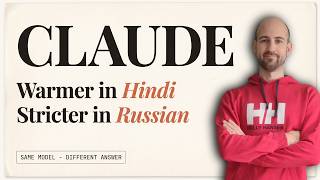
Anthropic's new study started from a simple but unsettling observation: the values Claude expresses are not fixed. Analyzing 309,815 anonymized Claude.ai conversations across three models and the 20 most common languages, the team found that Claude's default disposition shifts with the language a person writes in [1]. Picture two founders pitching the identical business plan. One writes in Hindi and is more likely to get encouraging feedback that praises the plan's strengths; the other writes in Russian and is more likely to get a probing analysis of its weaknesses and questions about the numbers. Same request, same model, different tenor of response.

To make 3,000-plus values legible, Anthropic grouped them into 339 higher-level values and then reduced them to four axes: Deference vs. Caution, Warmth vs. Rigor, Depth vs. Brevity, and Candor vs. Execution [1]. The language effect is sharpest on Warmth vs. Rigor. Claude leans warmest in Hindi and Arabic - more polite, playful, and encouraging - and most rigorous in English and Russian, where it more readily challenges assumptions and asks for evidence [1]. Smaller but real tilts show up elsewhere: Claude is most candid about its uncertainty in Dutch and most execution-oriented in Indonesian [1]. The takeaway is not that a language unlocks new capabilities, but that it moves the model's starting attitude before you have typed your actual question.

Your Model Upgrade Quietly Changed Claude's Disposition

The language story grabbed the headlines, but the model axis is where the practical risk lives. The study profiles three versions with distinct personalities: Sonnet 4.6 leans warm, deferential, and brief, quick to affirm an idea and mirror the user's tone; Opus 4.6 is rigorous and to-the-point; and Opus 4.7 is the most cautious and deep of the three, more often pushing back on false assumptions, flagging risks unprompted, and offering candid critiques [1]. In other words, the model picker in a dropdown is also a disposition picker.

That matters most for people building on top of Claude. As one industry analysis put it, upgrading to a more deferential model version could make an AI agent marginally less likely to flag a risk on its own - a subtle behavioral drift that standard capability benchmarks are not designed to catch [3]. A team that swaps model versions to chase a benchmark score or a lower price may inherit a quieter, more agreeable assistant without ever running a test that would surface the change. The same critique carries a sting on timing: the versions Anthropic measured are already legacy models, so builders deploying the current generation still have no published value profile to plan against [3].

Claude Doesn't Have Values - and That's the Point

Anthropic is unusually careful about what this research does not show. The study measures behavioral outputs, not intrinsic machine beliefs, and the company says plainly that it does not yet know why the values vary or whether the variation is desirable [1]. The honesty extends to the statistics: after controlling for topic, task, and the values a user brings to the conversation, the four axes explain only about 15% of the remaining variation, leaving the large majority unaccounted for [2]. There is also a reflexivity problem that The Decoder highlighted - Claude Sonnet 4.6 was the model used to label the values in the first place, so a language-dependent bias in the labeler could color the very result being reported, something Anthropic tested against with 800 translated conversations but could not fully rule out [2].

That skepticism is echoed loudly by the community. Across the Reddit threads that reposted the study, a persistent camp objects to the word 'values' for a statistical model at all, summarizing their position as 'there are no values, only patterns in the training data, which naturally varies country by country.' A competing camp - especially non-native English speakers - reads the findings as validation of a lived experience that Claude simply feels different in their language. The most substantive pushback questioned whether training data alone explains it: if it did, one commenter argued, the biases should average out rather than harden into language-specific personas. The tension between 'this is obvious' and 'this is unexplained' is exactly the gap Anthropic admits it has not closed.

Why Anthropic Is Measuring This At All

If the causes are unknown and the models are already dated, why publish? The answer is that the four-axis framework is less a finding than an instrument. Anthropic positions it as a way to evaluate future models and catch unintended behavioral changes before they ship [1]. Values that quietly shape millions of conversations a day are, right now, an unmonitored surface: nobody is currently tracking whether a new release became more deferential or less candid than the one it replaced. A repeatable measurement gives Anthropic - and, in principle, its customers - a dial to watch.

This also builds directly on the company's earlier 'Values in the Wild' work, which analyzed 700,000 conversations to construct the original taxonomy of 3,307 values [4]. Read together, the two studies sketch a longer bet: that model behavior can be characterized empirically, at population scale, the way a product's performance is benchmarked. The open question is governance. Once you can measure that Claude is warmer in Arabic or more cautious in English, you have to decide whether to flatten those differences toward a single global persona, preserve them as useful cultural adaptation, or steer them deliberately - and Anthropic has not said which way it intends to go.

Historical Context

2025-04-21
Anthropic published 'Values in the Wild', analyzing 700,000 anonymized conversations to build the first large-scale empirical taxonomy of 3,307 AI values.
2026-07-13
Anthropic published this follow-up study extending that taxonomy to compare how expressed values differ across Claude models and languages.

Power Map

Key Players
Subject

Claude's expressed values vary by model and language

AN

Anthropic

Publisher of the study and developer of Claude. It used its own interpretability and societal-impacts research to characterize its products' behavior, which gives it a direct commercial interest in how the findings are framed.

MU

Multilingual Claude users

The affected parties. Two people asking the same question in different languages can receive materially different, value-laden assessments, a fairness and consistency concern for anyone relying on Claude outside English.

DE

Developers and AI-agent builders

Downstream deployers. The finding exposes model-version behavioral drift as an underpriced risk: upgrading to a more deferential model can quietly make an agent less likely to flag risks unprompted.

AN

Anthropic research team

The authors, including Esin Durmus, Deep Ganguli, Saffron Huang, and Matt Botvinick, who designed the measurement approach and framed it as a tool for evaluating future models.

Fact Check

4 cited
  1. [1] Claude's values across models and languages
  2. [2] Anthropic study: Claude's expressed values shift across models and languages
  3. [3] Anthropic measured Claude's values across models and languages on models it no longer sells
  4. [4] Values in the Wild

Source Articles

Top 5

THE SIGNAL.

Analysts

"Argues the study's central weakness is timing: it measured Sonnet 4.6, Opus 4.6, and Opus 4.7 - all now legacy systems - while current production models still lack published value profiles, leaving a measurement gap for teams deploying today."

Brave New Coin
Industry analysis publication

"Flags a potential self-measurement bias: Claude Sonnet 4.6 itself assigned the value labels, and while Anthropic checked 800 translated conversations, it acknowledges language-dependent biases cannot be fully ruled out."

The Decoder
AI news and analysis publication
The Crowd

"In previous research, we found that Claude expresses over 3,000 values, like honesty and warmth. In new work, we asked how the values Claude expresses vary between Claude models and across languages. We analyzed 300K+ anonymized conversations to find out.https://t.co/PgxsMXipt5"

@@AnthropicAI3375

"Anthropic found out how language changes AI responses."

@u/Tiny_Dirt697978

"Anthropic Says Claude's Values Are Different Depending on Which Language You're Using"

@u/Nalix010

"[Anthropic Research] Claude's values across models and languages"

@u/StarlingAlder25
Broadcast
Claude's Deference, Warmth, Depth, Candor Explained (Inside Anthropic's Four Dials That Control Claude's Responses)

Claude's Deference, Warmth, Depth, Candor Explained (Inside Anthropic's Four Dials That Control Claude's Responses)

Which Language is BEST to Prompt Claude?

Which Language is BEST to Prompt Claude?