AMD acquires MEXT for AI memory optimization
TECH

AMD acquires MEXT for AI memory optimization

28+
Signals

Strategic Overview

  • 01.
    AMD acquired MEXT (Mext Corp.), a data center memory optimization startup, announced June 15, 2026; financial terms were not disclosed and the deal was described as likely small.
  • 02.
    MEXT's memory tiering technology lets NAND flash function as DRAM from the operating system's perspective, moving infrequently accessed data from expensive DRAM to lower-cost NAND to reduce DRAM costs.
  • 03.
    MEXT's Predictive Memory is a software-only solution that installs in under five minutes on x86 servers with no hardware, OS, or application changes; its AI engine runs on a single CPU core with no GPU.

Deep Analysis

The trick: an AI prefetcher that fools the OS into thinking flash is DRAM

MEXT's core sleight of hand is making the operating system treat cheap NAND flash as if it were DRAM [5]. The Predictive Memory Engine continuously monitors memory access patterns and uses AI models to forecast which pages stored in flash an application will need next, then preemptively moves them back into DRAM before the request lands [2][3]. Cold, infrequently accessed pages get demoted from expensive DRAM down to flash; hot pages get promoted back up just in time, so the latency penalty of touching flash is hidden behind the prediction.

Crucially, this is software-only: it installs in under five minutes on standard x86 servers with no hardware, OS, or application changes, and the AI engine runs on a single CPU core with no GPU, completing predictions in microseconds [4]. The community shorthand captures it well — a 'smart page file' or a modern, AI-driven take on Windows ReadyBoost — but the load-bearing difference is the predictive prefetch that aims to eliminate the swap-in stall traditional tiering suffers from.
Follow the money: a DRAM cost crisis is the real reason for the timing

Follow the money: a DRAM cost crisis is the real reason for the timing
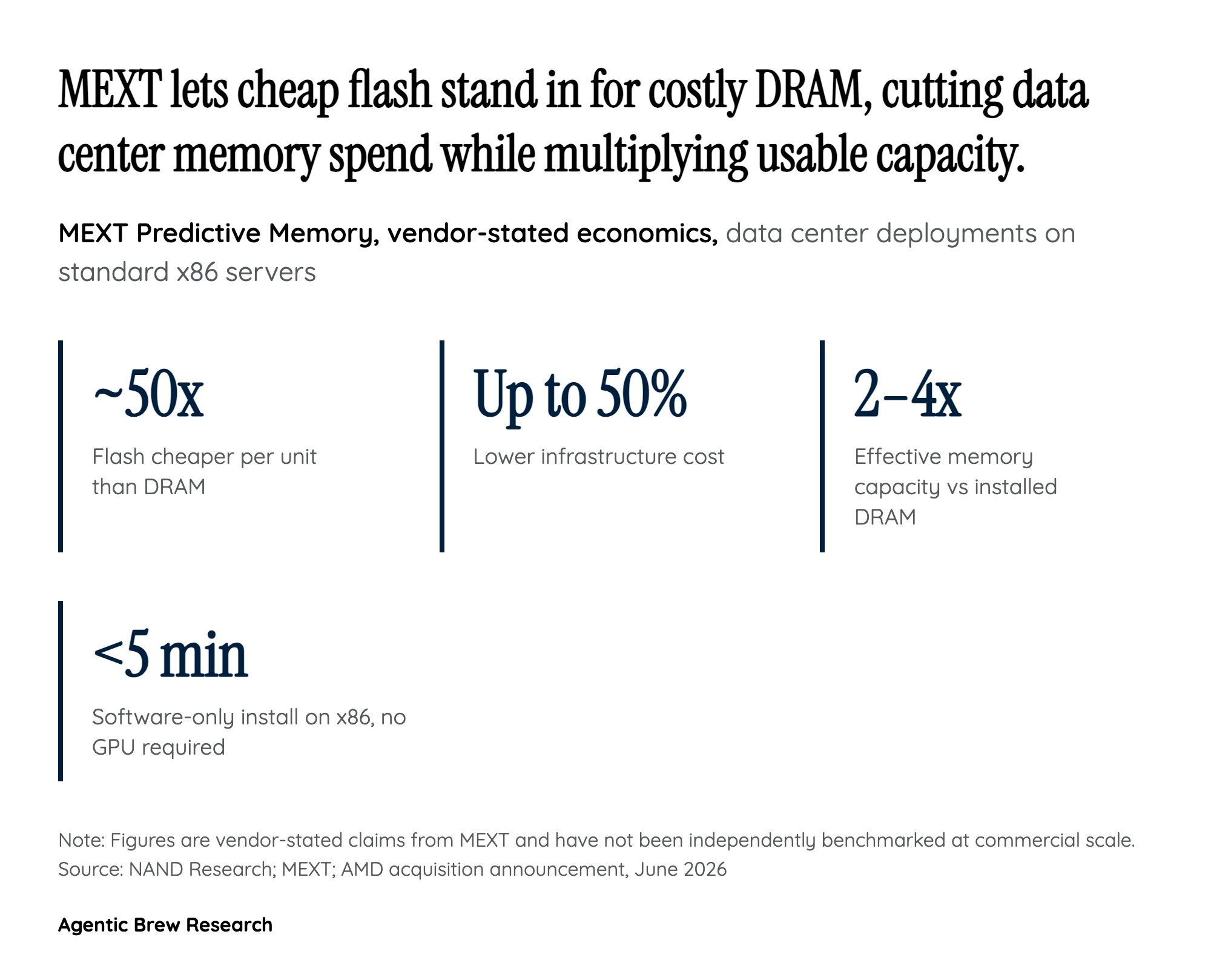
MEXT vendor-stated economics: flash is roughly 50x cheaper than DRAM, enabling up to 50% lower infrastructure cost and 2-4x effective memory capacity.

Why now? Because memory, not the CPU or GPU, is increasingly the binding constraint for AI, analytics, virtualization, and HPC workloads, even as installed DRAM often sits underutilized [1][5]. DRAM carries a structural cost problem with no near-term hardware fix, while flash costs roughly 50x less per unit, which is exactly the spread that makes AI-driven tiering economically compelling [3].

MEXT claims up to a 50% reduction in infrastructure costs and 2x-4x the effective memory capacity of installed DRAM, letting operators fit larger workloads into existing budgets and power envelopes [3][4]. With memory prices surging and supply scarce — a dynamic flagged as an economy-wide risk [8]— AMD gains a TCO lever to differentiate its data center stack rather than another piece of silicon to sell.

The contrarian read: tiny tuck-in, the Jevons question, and who really loses

Markets cheered — AMD shares rose more than 6% on the announcement [7]— but analysts are tempering expectations, framing this as a small technology tuck-in unlikely to move near-term revenue, even as it strengthens long-term AI infrastructure positioning; the deal terms were not disclosed and were described as likely small [2].

The sharper second-order debate is who gets hurt. If effective memory becomes cheaper, is this bearish for DRAM makers? The counterargument circulating among hardware-watchers is a Jevons-paradox read — cheaper effective memory expands total memory demand rather than shrinking it. There is also skepticism worth flagging in community discussion, where some recall past memory-compression announcements that briefly rattled memory stocks before fading. Either way, commercial validation at scale remains the open execution risk [6]. And an integration fork looms — whether AMD keeps MEXT proprietary to its own silicon or keeps it broadly deployable across x86 — alongside the basic execution risk of proving the gains in production.

Historical Context

2023
MEXT founded in Santa Clara by CEO Gary Smerdon, with a team drawn from CPU virtualization, data center flash, and internet infrastructure backgrounds.
2026-06-15
AMD announced the acquisition of MEXT; AMD shares rose over 6% on the news.

Power Map

Key Players
Subject

AMD acquires MEXT for AI memory optimization

AM

AMD

Acquirer; aims to integrate MEXT's memory tiering software across its data center portfolio to offer a more comprehensive compute solution and reduce customer dependence on costly DRAM.

ME

MEXT (Mext Corp.)

Acquired startup; Santa Clara, CA, founded 2023; developer of Predictive Memory software that makes flash behave like DRAM.

GA

Gary Smerdon

Founder and CEO of MEXT; frames memory, not compute, as the scaling bottleneck.

DA

Dan McNamara

AMD SVP and GM of Compute and Enterprise; expects MEXT integration to help enterprise customers unlock more value from infrastructure investments.

EN

Enterprise / cloud data center operators

Customers; benefit from expanded usable memory and reduced DRAM cost amid rising memory prices. Early MEXT deployments span media/entertainment, semiconductor EDA, and gaming.

Fact Check

8 cited
  1. [1] AMD Acquires MEXT for Memory Optimization
  2. [2] AMD buys data center memory optimization startup MEXT
  3. [3] MEXT Predictive Memory: Software to Control DRAM Costs
  4. [4] MEXT Launch Announcement
  5. [5] AMD takes over MEXT to address growing memory constraints in the data center
  6. [6] AMD Acquires MEXT to Address AI Memory Bottlenecks with Tech That Makes NAND Act Like DRAM
  7. [7] AMD Acquires MEXT to Tackle Data Center Memory
  8. [8] AMD-MEXT Deal and Ryzen AI

Source Articles

Top 5

THE SIGNAL.

Analysts

"MEXT addresses a real and growing problem; DRAM's structural cost problem has no near-term hardware solution."

Steve McDowell
Analyst, NAND Research

"Views the deal as just a nice technology tuck-in that adds to AMD's memory optimization capabilities, rather than a near-term revenue driver."

Code Acree
Analyst, Benchmark

"By integrating Mext's technology across the AMD data center portfolio, expects to help enterprise customers unlock greater value from their infrastructure investments while accelerating AI deployment."

Dan McNamara
SVP & GM, Compute and Enterprise, AMD

"Argues that memory, not compute, is the bottleneck limiting how fast organizations can scale."

Gary Smerdon
Founder & CEO, MEXT

"Sees MEXT's technology as a strong answer to memory becoming an increasingly critical component of modern compute infrastructure."

Robert Hormuth
Corporate Vice President, AMD
The Crowd

"Today, we're announcing that AMD has acquired MEXT, expanding our Data Center platform with breakthrough memory optimization technology designed to expand memory, reduce TCO, and help customers scale AI infrastructure more efficiently. Together, we aim to address growing memory"

@@AMD689

"$AMD is acquiring MEXT, an AI-driven memory optimization company for data center infrastructure. MEXT's tech helps make flash storage behave more like DRAM, expanding usable memory capacity while maintaining performance."

@@wallstengine432

"$AMD acquired MEXT to add AI-driven memory optimization technology to its data center portfolio. MEXT helps reduce memory bottlenecks by making flash storage act more like high-speed DRAM expanding usable capacity while lowering infrastructure costs."

@@StockSavvyShay376

"AMD "Today, we're announcing that AMD has acquired MEXT, expanding our Data Center platform with breakthrough memory optimization technology designed to expand memory, reduce TCO, and help customers scale AI infrastructure more efficiently...""

@u/Lixxon215
Broadcast
Predictive Memory: How MEXT Turns Cheap Flash Into DRAM

Predictive Memory: How MEXT Turns Cheap Flash Into DRAM