China outpacing the US in AI competitiveness through architecture innovation and energy buildout
TECH

China outpacing the US in AI competitiveness through architecture innovation and energy buildout

27+
Signals

Strategic Overview

  • 01.
    A global AI infrastructure investment boom is propping up China's economy at one of its weakest points in years, with AI-linked exports offsetting a continued property slump.
  • 02.
    China's GDP growth slowed to 4.3 percent year-on-year in Q2 2026, the weakest pace in more than three years, even as AI-related exports surged.
  • 03.
    DeepSeek has shipped original architectural innovations - Sparse Attention (DSA) and Manifold-Constrained Hyper-Connections (mHC) - that build on but are not copies of prior US work, cutting key-value cache memory costs dramatically.
  • 04.
    China's benchmark performance gap with top US AI models has narrowed to 2.7 percentage points as of March 2026, according to Stanford HAI's AI Index, even as US private AI investment vastly outpaces China's.

Deep Analysis

Innovation Under Constraint: How Chip Bans Backfired Into Better Architecture

Facing constrained access to top-tier chips, Chinese AI labs have not been playing catch-up by copying US architectures - they have been forced into a different kind of innovation: squeezing more capability out of less compute. DeepSeek's newest architecture, Manifold-Constrained Hyper-Connections (mHC), builds on but is structurally distinct from ByteDance's 2024 Hyper-Connections work [1], solving a training-instability problem that had made Hyper-Connections impractical at scale by constraining its mixing matrices to be doubly stochastic through a Sinkhorn-Knopp iterative projection [2]. DeepSeek CEO Liang Wenfeng is listed as a co-author on the paper.

The same pattern shows up in DeepSeek Sparse Attention (DSA), which extends the lab's earlier Multi-Head Latent Attention (MLA) innovation with a lightweight indexer that decides which tokens a query actually needs to attend to [3]. MLA alone already cut key-value cache memory by 57x versus standard multi-head attention; DSA's indexer squeezes per-token memory down further, to 132 bytes, enabling something close to constant-time decoding even at very long context lengths. None of this is copied from OpenAI or Anthropic - it is original systems engineering aimed squarely at the problem Chinese labs actually have: not enough advanced chips. Analysts tracking the space argue this compute scarcity, rather than despite it, is what pushed Chinese developers toward genuine efficiency breakthroughs instead of simply reproducing US model behavior [4].

The Money Paradox: A 23x Spending Gap, a 2.7-Point Capability Gap

The Money Paradox: A 23x Spending Gap, a 2.7-Point Capability Gap
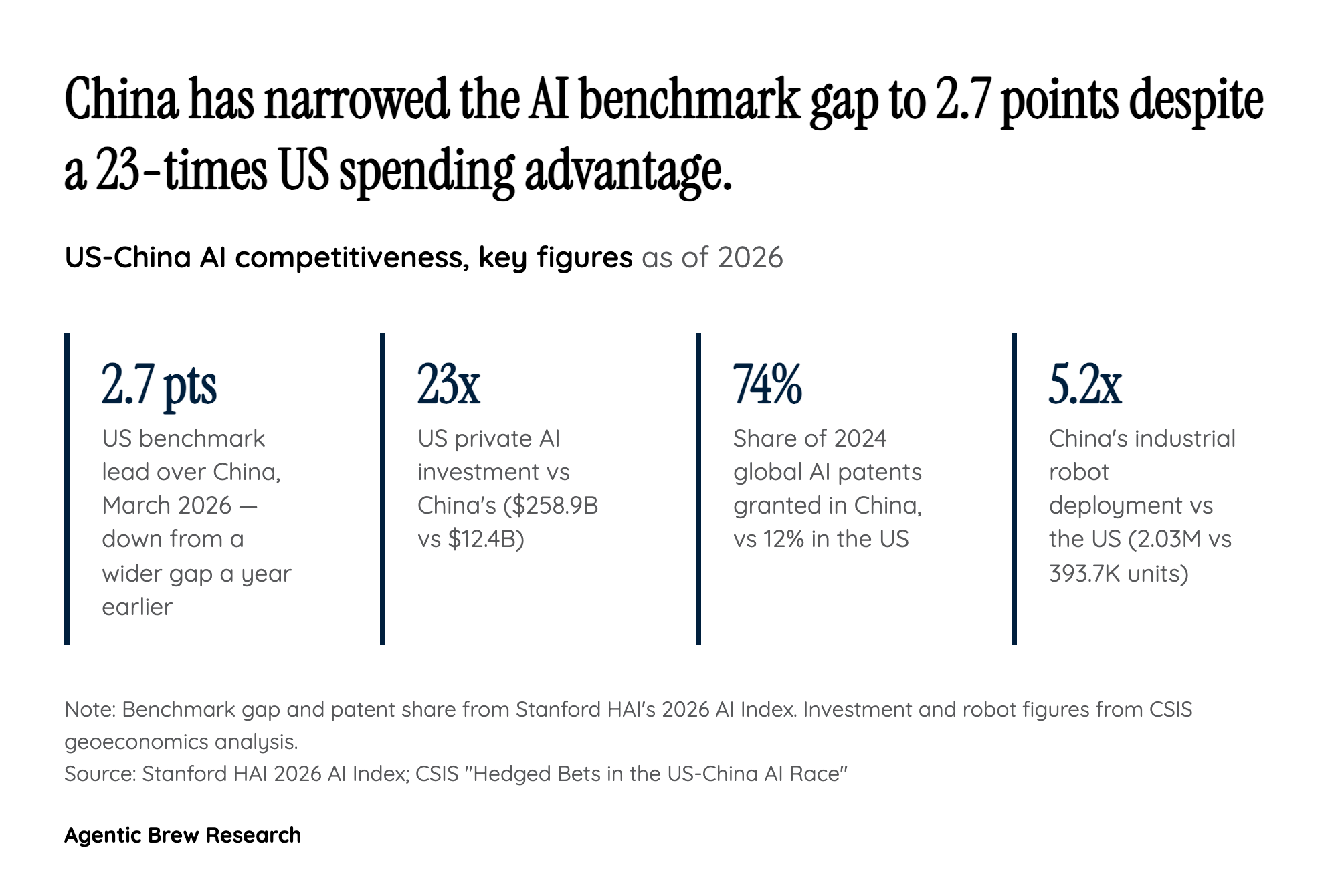
US-China AI competitiveness key figures: benchmark gap, spending gap, patent share, and robot deployment.

By the numbers that matter to boardrooms, the United States is still far ahead: American private AI investment is estimated at $258.9 billion against China's $12.4 billion, a gap the research cites as roughly 23 times [5]. Yet Stanford's 2026 AI Index found the top US model now leads the top Chinese model by just 2.7 percentage points on performance benchmarks, down from a wider gap a year earlier, after DeepSeek-R1 briefly matched the top US model on capability tests in February 2025 [5]. As the report's authors put it, China has been gradually gaining ground and this year appears to have nearly erased any US lead [6].

The patent numbers tell an even starker version of the same story: China accounted for more than 74 percent of the world's AI patent grants in 2024, versus 12 percent for the US [6]. Whatever one thinks of patent counts as a quality signal, they capture something spending totals miss - a much larger share of applied, incremental AI engineering is now happening inside Chinese institutions. Put together, the picture undercuts a comfortable assumption in Washington: that outspending China roughly 23-to-1 on compute and R&D would keep translating into a proportional capability lead. It has not.

The Energy Bet: Why Electricity, Not Chips, May Decide Round Two

If compute access defined the first phase of the AI race, the emerging consensus among energy analysts is that electricity will define the next one - and here China's structural position looks different. China has more than 30 gigawatts of nuclear capacity under construction, more than half of the entire global nuclear buildout, and added roughly 212 gigawatts of new solar capacity in 2025 alone, two-thirds of all solar installed worldwide in the first half of that year [7]. That is capacity being built years ahead of when it is strictly needed, effectively pre-positioning power for a data-center boom that has not fully arrived yet.

The US, by contrast, is already running into siting and supply constraints for the data centers it wants to build now: some projects need more than a gigawatt each, and turbine maker GE Vernova's order book is backlogged into 2029 [8]. Brookings projects China's data-center electricity demand will more than double by 2030 to around 277 terawatt-hours, while the US figure is projected higher in absolute terms at roughly 426 terawatt-hours, about 9 percent of total US demand - meaning the US still needs more power in absolute terms, but China's build-out pace suggests it will have an easier time actually delivering the power it needs, rather than discovering the bottleneck after the fact [8].

AI as Economic Ballast, Right When China Needs It Most

The China-is-catching-up narrative is landing at a specific and revealing moment: China's economy grew just 4.3 percent year-on-year in the second quarter of 2026, its slowest pace in more than three years, even as AI-linked exports surged [10]. AI-related exports alone contributed 1.1 percentage points to China's nominal GDP growth in the first four months of 2026, nearly triple their contribution for all of 2025 [14], and electronics and IT accounted for over half of the quarter's sequential economic expansion [9]. Julian Evans-Pritchard of Capital Economics called this a key source of economic resilience for the rest of the year and into 2027, but the framing matters: AI is being credited with keeping a weakening economy from a harder landing, not with generating broad-based growth [9].

That distinction has a downside risk attached. Economists tracking the shift warn that heavy state and private investment concentrated in AI, chips, and robotics is producing an increasingly imbalanced economy, one where traditional job-creating sectors like real estate and low-value manufacturing keep shrinking even as the tech sector props up the headline numbers [11]. In other words, China's AI success story and its economic fragility are, right now, largely the same story.

Is This the Wrong Race? The Case Against Taking the Scoreboard at Face Value

Not every analyst reads the benchmark convergence as proof China is winning. Jeffrey Ding, author of a book on how technology diffusion rather than raw capability determines great-power competition, argues that closing a leaderboard gap is a different thing from closing an economic one: there is a difference between demonstrated capabilities on isolated benchmarks and actual integration with improving business productivity [12]. By that standard, headline benchmark parity may be overstating how much ground China has actually made up in the industries that matter.

Mike Froman, president of the Council on Foreign Relations, pushes the critique further, suggesting the US is measuring the wrong thing entirely - describing the frontier-benchmark chase as racing toward the wrong finish line, while China treats AI as embedded infrastructure across its industrial base rather than a standalone product category to win [13]. The clearest evidence for that framing may be industrial robots, not chatbots: China now operates roughly 2,027,200 industrial robots against 393,700 in the US [13]. If the real contest is which country deploys AI most broadly through its existing economy rather than which one built the single best model, the scoreboard being watched most closely in Washington may not be the one that decides the outcome.

Historical Context

2024-05
Introduced Multi-Head Latent Attention (MLA), the foundation later extended by Sparse Attention (DSA).
2025-02
DeepSeek-R1 briefly matched the top US model on performance benchmarks, an early sign of the narrowing capability gap.
2026-01-06
Published its Manifold-Constrained Hyper-Connections (mHC) paper, seen as a candidate architecture for its forthcoming R2 model.
2026-07-15
Reported Q2 2026 GDP growth of 4.3 percent year-on-year, the slowest quarterly pace since 2022, alongside a surge in AI-linked exports.

Power Map

Key Players
Subject

China outpacing the US in AI competitiveness through architecture innovation and energy buildout

DE

DeepSeek

Chinese frontier lab behind the DSA, MLA, and mHC architectures cited as original technical advances rather than derivatives of US methods; CEO Liang Wenfeng is a listed co-author on the mHC paper.

CA

Capital Economics (Julian Evans-Pritchard)

Economic research firm whose head of China economics frames AI and tech exports as the chief support for Chinese growth right now, while cautioning it does not resolve deeper structural imbalances.

ST

Stanford HAI

Publisher of the 2026 AI Index, the primary data source cited across outlets for the narrowing US-China AI capability gap.

ZH

Zhipu AI

Released the open-source GLM-5.2 model for free under an MIT license within a day of US Commerce Department restrictions on Anthropic's models, demonstrating China's capacity to answer export-control moves with rapid open-weight releases.

AL

Alibaba (Qwen)

Its Qwen model was adopted by Airbnb CEO Brian Chesky in place of ChatGPT, evidence that Chinese models are gaining real commercial traction outside China rather than only topping benchmarks.

Fact Check

14 cited
  1. [1] DeepSeek Introduces Manifold-Constrained Hyper-Connections for R2
  2. [2] Analysis: Manifold-Constrained Hyper-Connections (mHC) from DeepSeek AI
  3. [3] DeepSeek Sparse Attention, From First Principles
  4. [4] Gwern on Creating Your Own AI Race and China's Fast Follower
  5. [5] Stanford HAI's 2026 AI Index Reveals China, U.S. Now Neck and Neck in Race for Global Dominance
  6. [6] China Has Nearly Erased the US Lead in AI, Stanford Report Finds
  7. [7] The AI Energy War: How China's Solar and Nuclear Outshine the U.S.
  8. [8] How Will the United States and China Power the AI Race?
  9. [9] AI Is the New Engine Keeping the Chinese Economy From a Harder Landing
  10. [10] China's GDP, Retail Sales and Investment Data for June
  11. [11] China's AI, Robotics Push Continues Amid Property Slump and Trade Risk
  12. [12] Inside the US-China AI Race
  13. [13] Charting Geoeconomics: Hedged Bets in the US-China AI Race
  14. [14] AI Is 'New Engine' Keeping Chinese Economy From Harder Landing

Source Articles

Top 4

THE SIGNAL.

Analysts

"AI-driven growth is a genuine source of resilience for China's economy but is not sufficient to fix deeper structural imbalances, and leaves the country exposed if the AI investment boom stalls."

Julian Evans-Pritchard
Head of China Economics, Capital Economics

"Cautions against conflating benchmark performance with real economic diffusion, arguing China's AI progress must be judged by business-productivity integration, not isolated capability tests."

Jeffrey Ding
Author, 'Technology and the Rise of Great Powers: How Diffusion Shapes Economic Competition'

"Questions whether the US is competing on the right metric, arguing China treats AI as embedded infrastructure across its industrial economy rather than chasing frontier benchmarks alone."

Mike Froman
President, Council on Foreign Relations

"Concludes China has essentially erased the AI model-performance gap with the US even as the US retains structural leads in capital, chips, and infrastructure."

Stanford HAI 2026 AI Index
Stanford Institute for Human-Centered AI
The Crowd

"There is now a path for China to surpass the U.S. in AI. Even though the U.S. is still ahead, China has tremendous momentum with its vibrant open-weights model ecosystem and aggressive moves in semiconductor design and manufacturing. In the startup world, we know momentum"

@@AndrewYNg3977

"BREAKING: 🇺🇸🇨🇳 China is now leading the AI race after spending ten times less of what the US did Kimi-K3 by @Kimi_Moonshot is now number 1 in the Frontend Code Arena with 1679 pts, surpassing Claude Fable 5."

@@Megatron_ron6444

"Anthropic drops a paper on the US-China AI race They believe the US and its allies may be able to lock in a 12-24 month frontier AI lead by 2028 if they close China’s access to advanced compute and copied model outputs. The report says China is not far behind because Chinese"

@@rohanpaul_ai483
Broadcast
Why AI is Collapsing: How China is Winning.

Why AI is Collapsing: How China is Winning.

Is America losing control of the AI race?

Is America losing control of the AI race?

Can China cheat its way to AI supremacy? | BBC News

Can China cheat its way to AI supremacy? | BBC News