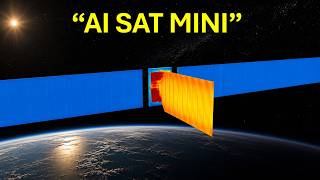
SpaceX orbital AI data centers and the AI1 compute satellite
TECH

SpaceX orbital AI data centers and the AI1 compute satellite

37+
Signals

Strategic Overview

  • 01.
    SpaceX unveiled the detailed design of its first-generation AI1 orbital data center satellite on June 9, 2026, days ahead of its IPO, via a roughly 30-minute video on its X account.
  • 02.
    AI1 carries a 120 kW average / 150 kW peak compute payload comparable to a single NVIDIA GB300 rack on the ground, with a 70-meter deployed wingspan operating in low Earth orbit at about 600 km.
  • 03.
    SpaceX plans two prototype AI1 satellites for launch in early 2027 and a Gigasat factory in Bastrop, Texas targeting 1 GW/year of orbital AI compute by late 2027, scaling toward terawatt scale via a planned Terafab chip facility.
  • 04.
    The unveiling landed alongside SpaceX's roughly $1.75T target IPO, with shares set to debut on Nasdaq under ticker SPCX and SpaceX aiming to raise $75B, after striking compute deals with Google and Anthropic.

Deep Analysis

The Knife-Edge Radiator: Why Cooling Is AI1's Real Engineering Bet

Strip away the spectacle of a 70-meter wingspan and AI1's hardest problem is thermodynamics. On Earth, a data center sheds the waste heat of its GPUs through fans, chilled water, and coolant loops — and that cooling burns 30-40% of total power while consuming water that can rival a mid-sized city. In a vacuum there is no air or water to carry heat away, so the only exit is radiation into the cold of space. SpaceX's answer is a deployable liquid radiator of up to roughly 110 square meters, designed to reject about 1,400 W/m2, fed by redundant pumping loops and wrapped in micrometeoroid shielding [4].

The clever detail is geometry: the radiator is oriented knife-edge to the sun, so it presents almost no surface to incoming sunlight while exposing its broad faces to deep space, maximizing heat dumped and minimizing heat absorbed [1]. Pair that with a 150 kW solar array delivering about 250 W/m2 and a claimed efficiency of roughly 70 kW per ton, and you have a self-contained power-and-cooling system. The catch the engineering elegance hides is mass: skeptics note that every square meter of radiator and every kilogram of pump and shield is a kilogram you paid rocket fuel to lift, and community technical reviews peg the radiator requirement at well over a thousand square meters per megawatt of compute.

One Satellite, One Rack: The Economics That Make Skeptics Wince

One Satellite, One Rack: The Economics That Make Skeptics Wince
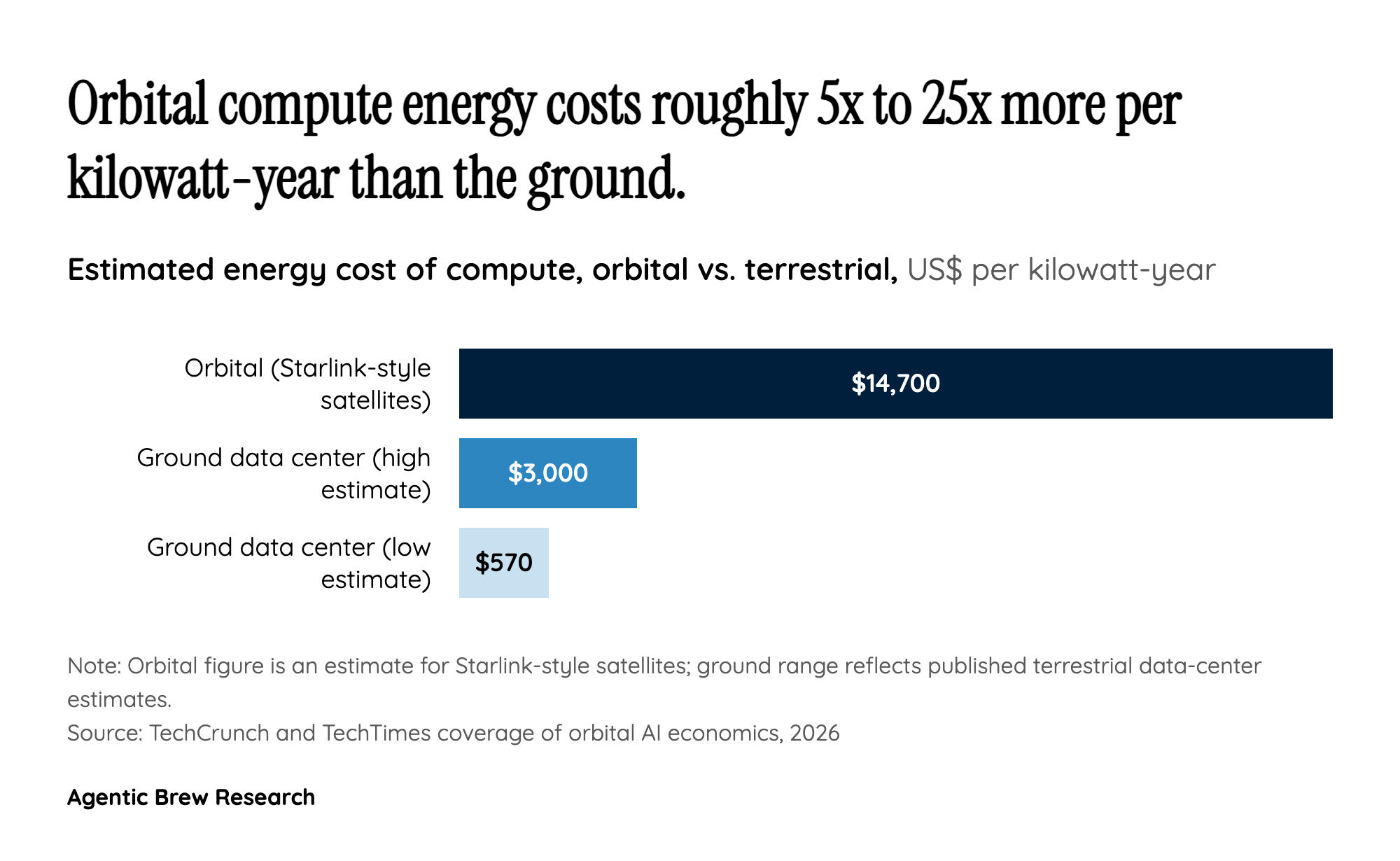
Estimated energy cost of compute, orbital vs. terrestrial (US$ per kW-year).

The blunt fact under AI1's vision is scale-per-unit: a single satellite delivers roughly the compute of one NVIDIA GB300 rack on the ground [3]. To build a gigawatt-class facility, you are launching and operating thousands of these objects. Critics argue the per-watt math is punishing — orbital compute costs roughly 3x per watt versus terrestrial, and one analysis pegs a 1 GW orbital data center at about $42.4B [4]. Energy delivered by Starlink-style satellites has been estimated at around $14,700 per kW-year against $570-$3,000 per kW-year on the ground [4].

Gartner's Bill Ray calls the whole category an economic 'bubble' and 'peak insanity' [8], and the AWS CEO dismissed orbital data centers as 'just not economical' [4]. There is also a servicing trap: hardware in orbit is hard to repair or upgrade, locking the satellite into whatever chips it launched with for its operational life, even as ground GPUs turn over every couple of years [9]. SpaceX is not yet profitable on this front either — its AI division reportedly posted a $2.5B operating loss last quarter on $818M of revenue, against $10.1B of total capex [7]. This is the central fault line of community reception: X audiences greeted the AI1 spec dump with high excitement, while Reddit and expert circles skewed sharply skeptical, with waste-heat and radiator-mass objections dominating the technical debate.

An IPO Looking for a Story: Why the Unveil Landed This Week

Timing is not incidental. AI1's reveal arrived days before SpaceX's roughly $1.75T IPO, with pricing slated for June 11 and trading June 12 under the proposed ticker SPCX, and a target raise near $75B [6]. Co-lead underwriter Morgan Stanley projects SpaceX revenue could reach $3.4T by 2040, with the AI division contributing up to $190B by 2030 [6]— numbers that need a narrative engine, and 'the AI economy moves to space' is exactly that.

The commercial scaffolding is already being poured: SpaceX struck deals to sell compute access to Google and Anthropic [10], and inked a roughly $920M/month arrangement with Google for about 110,000 NVIDIA GPUs locked in through mid-2029 [7]. That deal also doubled as a competitive shot — shares of terrestrial neocloud rivals like CoreWeave and Nebius fell on the news [7]. Read cynically, AI1 is a valuation instrument as much as a spacecraft; read charitably, it is SpaceX showing investors a concrete product behind the trillion-dollar story. Both readings can be true at once, which is precisely why the unveil works.

The Three-Way Orbital Race — And Why It's Suddenly Crowded

SpaceX is not pioneering an empty frontier. The orbital data center idea traces back to the 1980s 'Brilliant Pebbles' concept of on-orbit autonomous processing for missile defense [15], but the modern race is barely a year old and already three-sided. NVIDIA-backed Starcloud trained the first AI model in space in late 2025 and ran a version of Google Gemini in orbit [16], then hit a $1.1B valuation [12]and filed an FCC plan for up to 88,000 satellites [13]. Google, even as it buys SpaceX compute, is hedging with its own Project Suncatcher TPU satellites, with prototypes targeted for early 2027 [14].

SpaceX's structural edge is vertical integration: AI1 reuses Starlink V3 technology — solar cells and laser links — which Musk argues makes it a simpler build than a Starlink satellite itself [5], and the same Starship launch cadence and Gigasat factory that serve Starlink can churn out AI satellites in volume [2]. The roadmap escalates aggressively: 1 GW/year by late 2027, scaling roughly 10x annually toward terawatt scale, with a planned 2nm Terafab producing 100-200 billion radiation-hardened chips a year [6]. Whether that cadence advantage outruns the per-watt cost penalty is the unresolved question the next 18 months will answer.

What the Skeptics May Be Underweighting: The Grid Is the Real Constraint

The economic critique is strong, but the steelman for orbital compute is not that space is cheap — it is that the ground is becoming impossible. The bull case is explicitly framed as a bet on terrestrial failure: multi-year interconnection queues, utilities unable to build generation and transmission fast enough, and GPUs sitting idle because power physically cannot reach the racks [11]. In that world the relevant comparison is not orbital cost versus an ideal ground data center, but orbital cost versus a ground data center you are not permitted to power for years.

There are physical and regulatory tailwinds that pure per-watt math omits. Solar cells in space collect roughly 5x more energy than on Earth, and a sun-synchronous orbit can deliver near-continuous sunlight, sidestepping the storage problem entirely. And orbit is a regulatory-arbitrage play: no zoning fights, no NEPA reviews, no 'not in my backyard' resistance — SpaceX's own framing is that power, cooling, cost, and regulation can all be argued to favor space on a first-principles basis. The honest verdict is that AI1 is neither obvious folly nor sure thing; it is a high-variance bet whose payoff depends on whether terrestrial grid bottlenecks get worse faster than orbital economics improve [9].

Historical Context

1980s
The 'Brilliant Pebbles' program first envisioned autonomous on-orbit data processing, for missile defense.
2024-01
Founded in El Segundo, CA; a September 2024 white paper proposed building multiple gigawatts of orbital AI compute.
2025-03
Deployed a data backup machine on the surface of the Moon.
2025-11
Announced Project Suncatcher, a moonshot to launch TPU-equipped solar-powered orbital data centers with two prototypes planned by early 2027.
2025-12
Deployed an NVIDIA H100-class system in orbit, becoming the first to train an LLM and run a version of Google Gemini in space.
2026-02
Filed an FCC proposal for a constellation of up to 88,000 orbital data center satellites.
2026-06-09
Unveiled the AI1 satellite design along with its Gigasat and Terafab facility plans, days ahead of its IPO.

Power Map

Key Players
Subject

SpaceX orbital AI data centers and the AI1 compute satellite

SP

SpaceX / Elon Musk

Designer and pitchman of AI1 and the orbital data center program; unveiled the design ahead of the IPO and set the 1 GW-to-terawatt scaling roadmap, framing AI1 as a simpler build than Starlink.

NV

NVIDIA

Supplies the GPUs for initial orbital data centers; also backs rival Starcloud and is central to the SpaceX-Google deal involving roughly 110,000 of its GPUs, giving it leverage across nearly every player in the race.

GO

Google

Signed a roughly $920M/month AI compute deal with SpaceX through mid-2029 and is in talks on orbital data centers, while simultaneously running its own rival Project Suncatcher TPU-satellite program.

MO

Morgan Stanley

Co-lead IPO underwriter projecting SpaceX revenue could reach $3.4T by 2040, with the AI division contributing up to $190B by 2030 — projections that underpin the IPO valuation narrative.

ST

Starcloud

NVIDIA-backed rival space data center startup; first to train an LLM in space in 2025, now at a $1.1B valuation, and has filed an FCC plan for up to 88,000 satellites — the most direct competitor to SpaceX's orbital push.

Fact Check

16 cited
  1. [1] SpaceX details its AI1 compute satellite
  2. [2] SpaceX unveils 11 million square foot Gigasat factory
  3. [3] SpaceX details AI1 satellite data center, claims 150kW peak compute
  4. [4] SpaceX AI1 Orbital Data Center Bets on Space, But Power, Cooling, and Economics Stay Unproven
  5. [5] SpaceX reveals its first orbital data center, much simpler than a Starlink satellite, Musk says
  6. [6] Elon Musk, SpaceX IPO and AI1
  7. [7] SpaceX Signs $920 Million Monthly AI Deal With Google Days Before Blockbuster IPO
  8. [8] Peak Insanity: What You Need To Know About SpaceX's Orbital Data Centers
  9. [9] With attention on orbital data centers, the focus turns to economics
  10. [10] SpaceX reveals AI1 satellite design
  11. [11] Orbital data centers are a bet on terrestrial failure
  12. [12] Orbital AI: Seattle-area startup Starcloud hits $1.1B valuation
  13. [13] Orbital data centers: the space computing race in 2026
  14. [14] Space data centers: Starcloud, SpaceX and Project Suncatcher explained
  15. [15] Space-based data center
  16. [16] Nvidia-backed Starcloud trains first AI model in space

Source Articles

Top 5

THE SIGNAL.

Analysts

"Calls orbital data centers an economic 'bubble' and 'peak insanity,' arguing companies are wasting money because the underlying economics simply do not work."

Bill Ray
Analyst, Gartner

"Skeptical that orbital data centers scale economically near-term, calling them 'just not economical.'"

AWS CEO
CEO, Amazon Web Services

"Argues AI1 is a simpler engineering problem than Starlink: 'The AI satellite is essentially a lot of solar cells; you still need some laser links, but you don't have all of the super complex antennas that you have on a Starlink satellite.'"

Elon Musk
CEO, SpaceX

"Detailed the compute payload figures for AI1, including the 120 kW average compute draw."

Ian Dahl
Director of Satellite Engineering, SpaceX
The Crowd

"SpaceX has just officially unveiled its AI1 satellite, the first generation of its AI satellite. Overall Specs: • 150 kW peak compute payload • 120 kW average compute payload • 70 kW per ton • Compute provider interchangeable Dimensions: • Wingspan: 70 meters • Deployed"

@@SawyerMerritt14639

"BREAKING: SpaceX is requesting to launch and operate a constellation of 1 million satellites with unprecedented computing capacity (orbital data centers) to power advanced AI, according to a new FCC filing. SpaceX: "Launching a million satellites that operate as orbital data"

@@SawyerMerritt5511

"For the very first time Elon Musk explains the "space data center plan" of @SpaceX in detail and its AI1 orbital AI data center satellite - and suddenly it looks so much closer than I thought. He says "There's not some magic necessary that doesn't exist for AI satellites. As"

@@rohanpaul_ai99

"SpaceX has just revealed it's first AI satellite design"

@u/truecakesnake585
Broadcast
SpaceX Wants to Blast Data Centers Into Orbit. Here's What It May Take. | WSJ Pro Perfected

SpaceX Wants to Blast Data Centers Into Orbit. Here's What It May Take. | WSJ Pro Perfected

Elon Musk's Technical SpaceX Update: Manufacture, Launch, and Operate AI satellites at scale

Elon Musk's Technical SpaceX Update: Manufacture, Launch, and Operate AI satellites at scale

The Truth About SpaceX's "Orbital Datacenters"

The Truth About SpaceX's "Orbital Datacenters"