OpenAI GPT-5.5-Cyber and the Patch the Planet initiative
TECH

OpenAI GPT-5.5-Cyber and the Patch the Planet initiative

41+
Signals

Strategic Overview

  • 01.
    On June 22, 2026, OpenAI expanded its Daybreak cybersecurity initiative, releasing the full GPT-5.5-Cyber model, an updated Codex Security plugin, a Cyber Partner Program, and the Patch the Planet initiative.
  • 02.
    GPT-5.5-Cyber stays restricted to vetted defenders through OpenAI's Trusted Access for Cyber (TAC) program with identity-verified access, covering secure code review, vulnerability triage, malware analysis, red teaming, and penetration testing.
  • 03.
    Patch the Planet, founded with Trail of Bits and in collaboration with HackerOne, funds expert researchers and equips them with Codex Security and GPT-5.5-Cyber to find, validate, and fix vulnerabilities in critical open-source projects alongside maintainers; more than 30 projects (including cURL, Go, Python, and pyca/cryptography) have committed to participate.

The scarce resource is no longer the bug -- it's the patch

Patch the Planet reframes what AI changes about security. Trail of Bits, the initiative's founding partner, argues that frontier models have made vulnerability discovery cheap, so "the expensive part of security work has moved" toward patch development, hardening, and disclosure coordination [1]. The program's design follows that logic: AI models surface candidates, but full-time human security engineers manually triage findings, reproduce evidence, strip duplicates, write patches, and coordinate disclosure with maintainers alongside the projects themselves [1].

In practice this matters because machine-speed discovery can drown maintainers in noise faster than they can respond, so the bottleneck -- and the funded labor -- shifts to validated remediation rather than raw bug counts [2]. More than 30 open-source projects, including cURL, Go, Python, Sigstore, and pyca/cryptography, have committed to participate, with OpenAI and HackerOne supporting the funding and coordinated-disclosure workflow [2][3].

Benchmark gains are incremental, and the most damning comparison is missing

Benchmark gains are incremental, and the most damning comparison is missing
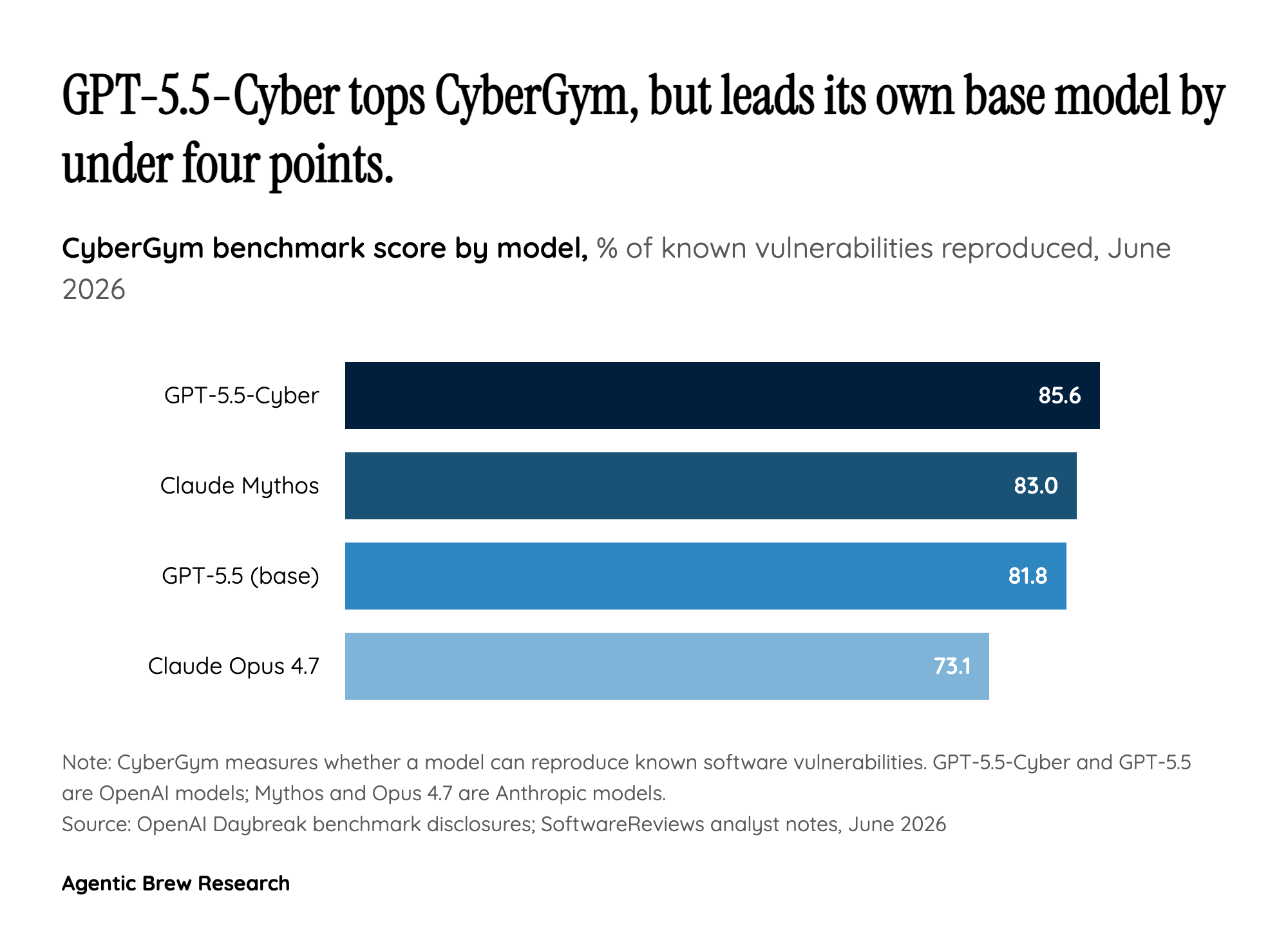
CyberGym benchmark scores: GPT-5.5-Cyber leads, but only narrowly over Anthropic's Mythos and its own base model.

On the headline CyberGym benchmark, the full GPT-5.5-Cyber scored 85.6%, up from 81.8% for standard GPT-5.5 -- billed as the highest single-model score on the benchmark [3]. It posted larger relative jumps on exploitation-focused tests: 39.5% on ExploitGym (vs 25.95%) and 69.8% on SEC-bench Pro (vs 63.1%) [3].

The community read is more skeptical. The cyber-specialized model beats the general-purpose Claude Mythos (~83% on CyberGym) by only a few points, and developer forums noted that plain GPT-5.5 already lands within a hair of the specialized variant -- a 'benchmax' rather than a leap. Analysts also flagged that OpenAI's own benchmark charts omitted the higher-scoring Mythos from the comparison, sharpening the impression of selective framing [4]. The takeaway: the gains are real but narrow, and the marketing gap is doing some of the heavy lifting.

Tiered gating is OpenAI's deliberate counter to Anthropic's full withholding

Daybreak ships three tiers: standard GPT-5.5 with normal safeguards, GPT-5.5 with Trusted Access for Cyber for verified defensive work in authorized environments, and the permissive GPT-5.5-Cyber for red teaming and controlled validation [5]. That architecture is the strategy. Where Anthropic kept Claude Mythos fully gated -- the model that found and patched 271 Firefox vulnerabilities -- OpenAI chose calibrated access over withholding, betting that identity-verified distribution to vetted defenders beats locking the capability away entirely [4].

The dual-use stakes are not hypothetical: the UK AI Security Institute found that GPT-5.5 "solved a 20-hour expert-level network attack simulation composed of 32 steps end-to-end" [6], and SoftwareReviews warns that "a model that helps defenders discover and validate vulnerabilities can also lower the barrier for offensive actors if access controls fail" [4]. The entire gating apparatus exists to keep that failure from happening.

Gated access is the friction story the community is actually living

The public reaction splits along familiar lines: accelerationist enthusiasm on one side and benchmark skepticism on the other, with a recurring 'GPT Cyber vs Claude Mythos arms race' narrative running across X and YouTube coverage. The independent video coverage skews measured-skeptic rather than alarmed, with the highest-reach reviewers stressing that AI-driven offense still leaves detectable footprints for defenders.

But the most concrete, repeated complaint is operational, not philosophical. In OpenAI's own community channels, the dominant thread is friction around Trusted Access: KYC and Persona identity verification are required, ban triggers are unclear (one developer feared a ban merely for building a web scraper), and some verified users still could not reach Codex Security weeks after approval. Privacy-conscious holdouts are simply refusing to hand over biometric and PII data to get in. The signal here is that the gate OpenAI built as a safety feature is also the product's biggest adoption tax.

Historical Context

2026-03
Codex Security launched as OpenAI's application-security agent in a March 2026 research preview before being expanded under Daybreak.
2026-04-24
GPT-5.5 was released with expanded cybersecurity safeguards and tighter controls on higher-risk activity.
2026-05-11
OpenAI launched the Daybreak cybersecurity initiative, combining the GPT-5.5 model family with Codex Security and partner integrations.
2026-06-22
OpenAI expanded Daybreak with the full GPT-5.5-Cyber model, an updated Codex Security plugin, the Cyber Partner Program, and Patch the Planet.

Power Map

Key Players
Subject

OpenAI GPT-5.5-Cyber and the Patch the Planet initiative

OP

OpenAI

Creator of GPT-5.5-Cyber, Codex Security, and the Daybreak program, and lead funder of Patch the Planet; controls gated access via Trusted Access for Cyber.

TR

Trail of Bits

Founding partner of Patch the Planet; provides full-time security engineers who manually triage AI findings, reproduce evidence, remove duplicates, develop patches, and coordinate disclosure with maintainers.

HA

HackerOne

Collaborator on Patch the Planet, supporting coordinated disclosure and the bug-bounty / researcher workflow.

CY

Cyber Partner Program members (Accenture, Akamai, Check Point, Cisco, Cloudflare, CrowdStrike, IBM, Palo Alto Networks, Fortinet, Oracle, Zscaler, NVIDIA)

Security providers integrating GPT-5.5 with Trusted Access for Cyber into their products and services.

AN

Anthropic

Primary competitor; its gated Claude Mythos model scored higher than standard GPT-5.5 on CyberGym and previously found and patched 271 Firefox vulnerabilities, framing the OpenAI release as a competitive response.

OP

Open-source maintainers (cURL, Go, Python, Sigstore, pyca/cryptography)

Recipients of vetted vulnerability reports and patches; provide project-specific threat models and documentation that improve AI signal quality.

Fact Check

6 cited
  1. [1] Introducing Patch the Planet
  2. [2] Patch the Planet
  3. [3] OpenAI launches new security tools and updates GPT-5.5-Cyber
  4. [4] GPT-5.5-Cyber: The Next Claude Mythos
  5. [5] OpenAI Launches Daybreak for AI-Powered Cybersecurity
  6. [6] Our evaluation of OpenAI's GPT-5.5-Cyber capabilities

Source Articles

Top 5

THE SIGNAL.

Analysts

"Frontier models have made finding vulnerabilities cheap; the costly, valuable work has shifted to patch development, hardening, and disclosure coordination -- "the expensive part of security work has moved." The firm also stresses that manual expert triage is essential to control AI false positives, noting that PyCA's security documentation "was dramatically effective at reducing false positives.""

Trail of Bits
Security firm, Patch the Planet founding partner

"Evaluation found GPT-5.5 capable of autonomous, expert-level offense: "GPT-5.5 solved a 20-hour expert-level network attack simulation composed of 32 steps end-to-end," raising concerns about autonomous-offense capability."

UK AI Security Institute (AISI)
Government AI evaluation body

"The tooling is inherently dual-use: "a model that helps defenders discover and validate vulnerabilities can also lower the barrier for offensive actors if access controls fail." The analysts also flag that OpenAI omitted the higher-scoring Mythos from its benchmark charts."

SoftwareReviews analysts
Industry analyst note
The Crowd

"We're expanding OpenAI Daybreak to help democratize patching vulnerable software at machine speed: - Codex Security plugin: find, validate, and fix vulnerabilities right inside Codex - The full version of GPT-5.5-Cyber model: a great model for trusted defenders - Cyber Partner Program"

@@OpenAI3149

"GPT-5.5-Cyber is our most capable cyber model yet, designed for advanced, authorized defensive work: tracing vulnerable code, validating issues, developing patches, and preparing evidence for human review."

@@OpenAI1181

"Patch the Planet is our effort to help open source maintainers move from security findings to merged fixes. We're working with Trail of Bits, HackerOne, Calif, researchers, and maintainers to bring Codex Security and advanced models into the remediation process, with human review."

@@OpenAI529

"an updated GPT-5.5 Cyber outperforms Mythos 5 in CyberGym"

@u/Outside-Iron-8242184
Broadcast
NEW Mythos, GPT-5.5 Cyber & AI Security: Hype or Reality?

NEW Mythos, GPT-5.5 Cyber & AI Security: Hype or Reality?

GPT-5.5 Cyber est la pour detroner Claude Mythos : l'IA sans barrieres lance !

GPT-5.5 Cyber est la pour detroner Claude Mythos : l'IA sans barrieres lance !

What is GPT-5.5-Cyber?

What is GPT-5.5-Cyber?