SpaceX completes record $75B IPO with $2.1T market debut
TECH

SpaceX completes record $75B IPO with $2.1T market debut

55+
Signals

Strategic Overview

  • 01.
    SpaceX priced the largest IPO in history, fixing 555.6 million Class A shares at $135 to raise roughly $75 billion at a valuation near $1.77 trillion.
  • 02.
    Shares (SPCX) opened on the Nasdaq at $150, more than 10% above the offer, and closed the first day at $160.95, up 19.2%, for a roughly $2.11 trillion market capitalization.
  • 03.
    The debut made Elon Musk the world's first trillionaire on paper, lifting his net worth from about $795 billion to an estimated $1.1 trillion, while he retained voting control above 82% under a one-year lockup.
  • 04.
    Goldman Sachs led underwriting on a record-low 0.75% gross spread, with Fortune estimating the syndicate's soft-dollar windfall from the first-day pop could exceed $5 billion.

Deep Analysis

The Pop Was the Plan

SpaceX did not so much discover a price as decree one. The shares were fixed at $135 before the roadshow even began, with no range and no book-building tug-of-war, making this the largest IPO in history at roughly $75 billion raised [4]. The stock then opened on the Nasdaq at $150, more than 10% above the offer, and closed its first day at $160.95, a 19.2% gain that lifted the company to a roughly $2.1 trillion market capitalization [1]. On a $75 billion raise, that one-day jump represents billions of dollars SpaceX could have captured for itself and instead handed to the investors lucky enough to receive an allocation. Yet the banks are unlikely to mourn it: SpaceX accepted a record-low 0.75% gross underwriting spread, and Fortune estimated the soft-dollar windfall flowing back to the syndicate, led by Goldman Sachs, which controlled the share allocation, could exceed $5 billion [2]. The discount was less a gift to the public than a lever the underwriters could pull to reward their best clients.

The more consequential machinery sits in the index plumbing. Nasdaq quietly revised its methodology effective May 1, 2026, so that a top-40 company by market cap can join the Nasdaq-100 after just 15 trading days, with no minimum-float requirement [3]. That rule turns the passive index funds that track the Nasdaq-100 into forced buyers of SPCX within weeks, regardless of price. The S&P 500 went the other way: after backlash, S&P Dow Jones Indices reversed a fast-track plan and kept its 12-month seasoning and profitability tests, which, given SpaceX's losses, block inclusion until at least mid-2027 [3]. The result is a stock with a thin public float, an unusually high retail allocation, and a guaranteed wave of mechanical demand bearing down on it.

By the Numbers: The Valuation Wall Street Can't Agree On

By the Numbers: The Valuation Wall Street Can't Agree On
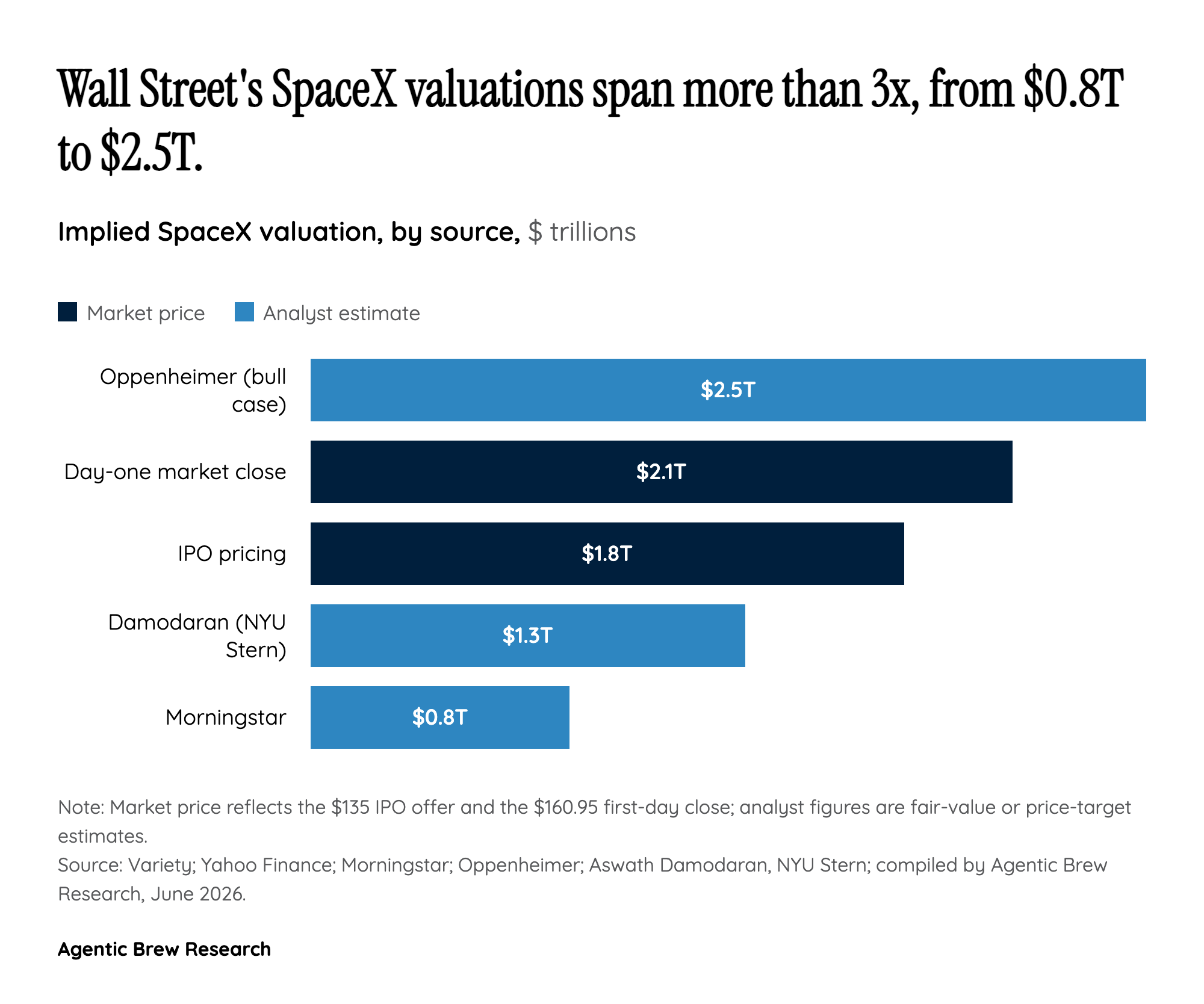
Independent analysts value SpaceX well below its $2.1T market debut; only the bull case exceeds it.

Strip away the spectacle and a $2.1 trillion price tag still has to be justified by something. The people who do that math for a living are not convinced. Aswath Damodaran, the NYU Stern professor known as the dean of valuation, pegs SpaceX at about $1.3 trillion, roughly 28% below the IPO price, and says even that figure stretches the bull case to its limit [6]. Morningstar's Nicolas Owens is harsher still, with a fair-value estimate near $780 billion, less than half the offering valuation [5]. CFRA initiated coverage at Sell with a $115 price target, citing execution risk and capital intensity [7]. Even the most bullish call in circulation, from Oppenheimer, reaches only about $2.5 trillion, so the full range of estimates runs from Morningstar's roughly $780 billion floor to that ceiling, a spread of more than 3x.

What the optimistic numbers quietly assume is that three separate bets all pay off at once: that Starship becomes a commercially reusable workhorse, that Starlink keeps expanding its margins, and that SpaceX's newly bolted-on AI ambitions actually monetize. Today only one engine, Starlink, reliably generates cash, and the AI unit was merged into the company only shortly before the roadshow. The valuation, in other words, is priced for a future in which nearly everything goes right simultaneously. The chart below shows just how wide the professional disagreement runs.

A Trillionaire on Paper, With the Keys in Hand

The headline that traveled fastest was personal: Elon Musk became the world's first trillionaire, his net worth vaulting from roughly $795 billion to an estimated $1.1 trillion in a single session [1]. But the more durable story is about control, not wealth. Post-IPO, Musk holds voting power above 82% and is barred from selling a single share for 366 days [1]. Public investors are, in effect, buying a minority economic interest in a company whose every major decision Musk can dictate alone, a governance structure even more concentrated than the founder-controlled tech IPOs that came before it.

That gap between paper and pocket also shaped how the moment landed with the people closest to it. Coverage celebrating thousands of SpaceX employees becoming instant millionaires collided, in community discussion, with a blunt reality check: lockups and blackout periods mean those gains are unrealized, and a stock priced for perfection can fall a long way before anyone is allowed to sell. The dominant retail conversation was less celebration than wary arithmetic, mixing genuine admiration for the achievement with deep skepticism about the price.

The Opening Act for the AI IPO Wave

SpaceX is the opening act, not the whole show. Anthropic has already filed confidentially and OpenAI is expected to follow within weeks, which makes SPCX a live stress test for how public markets will digest a cluster of richly valued, AI-soaked mega-listings arriving almost simultaneously [8]. The risk analysts keep flagging is crowding-out: when a single multi-trillion-dollar name enters the indices and soaks up allocation, capital that would otherwise spread across the market gets concentrated into a handful of narratives, and the same pool of money is asked to underwrite several mega-IPOs at once.

The comparison being made out loud is the dot-com era. Northeastern University's Karthik Krishnan questions whether these are true valuations or an expectation of what investors feel they can flip, while his colleague Marc Meyer says the current enthusiasm feels similar to the run-up that preceded the 2000 collapse [8]. The community reaction tracked that unease: the single most-discussed angle online was not Musk's wealth but the index-inclusion mechanics, specifically the argument that loosened rules effectively conscript passive retirement money into buying at peak valuations. How SpaceX trades from here will tell OpenAI and Anthropic whether the IPO window is open, or whether it is already closing behind them.

Historical Context

2014
Alibaba's $25 billion listing was the prior largest IPO on a U.S. exchange; SpaceX's $75 billion raise is roughly triple it.
2026-05-01
Nasdaq's revised index methodology took effect, enabling top-40 newcomers to join the Nasdaq-100 after 15 trading days.
2026-06-04
S&P reversed course on fast-tracking SpaceX into the S&P 500 after backlash, keeping its 12-month seasoning rule.
2026-06-12
SpaceX debuted on the Nasdaq, closing up 19.2% at $160.95 for a roughly $2.11 trillion market cap and making Musk the first trillionaire.

Power Map

Key Players
Subject

SpaceX completes record $75B IPO with $2.1T market debut

EL

Elon Musk

Controlling shareholder who became the first paper trillionaire; retains 82%+ voting power and a 366-day lockup, so public investors buy a minority economic stake in a company he alone directs.

GO

Goldman Sachs

Lead-left underwriter that controlled share allocation; accepted a record-low 0.75% spread but stands to be the biggest beneficiary of the first-day pop in soft dollars.

NA

Nasdaq

Listing exchange whose revised methodology lets top-40 newcomers join the Nasdaq-100 after just 15 trading days, forcing passive funds to buy SPCX within weeks.

S&

S&P Dow Jones Indices

Index provider that reversed a fast-track plan after backlash, keeping its 12-month seasoning and profitability tests so SpaceX cannot join the S&P 500 before mid-2027.

Fact Check

8 cited
  1. [1] SpaceX Stock Soars in Nasdaq Debut, Making Elon Musk the World's First Trillionaire
  2. [2] How SpaceX's bankers, led by Goldman Sachs, stand to win big on the record IPO
  3. [3] How the SpaceX IPO Will Affect the S&P 500 and Nasdaq-100
  4. [4] SpaceX makes Nasdaq debut as the largest IPO in history
  5. [5] What Wall Street's valuation experts really think SpaceX is worth
  6. [6] The Dean of Valuation Thinks SpaceX Is Worth 28% Less Than Its IPO Price
  7. [7] CFRA Initiates SpaceX Stock Rating at Sell on Execution Concerns
  8. [8] Anthropic, OpenAI and SpaceX are racing to IPO. Is it a bubble?

Source Articles

Top 5

THE SIGNAL.

Analysts

"Values SpaceX at about $1.3 trillion, roughly 28% below the IPO price, and says even that figure takes the bull case to its limits."

Aswath Damodaran
Professor, NYU Stern School of Business

"Estimates SpaceX's fair value at roughly $780 billion, less than half the IPO target valuation."

Nicolas Owens
Analyst, Morningstar

"Initiated coverage at Sell with a $115 price target, citing execution risk, elevated valuation, and capital intensity."

CFRA Research
Equity research firm

"Questions whether the mega-valuations are real, saying it is hard to tell whether they are true valuations or an expectation of what investors feel they can flip."

Karthik Krishnan
Northeastern University

"Says the current AI and IPO enthusiasm feels similar to the early-2000s dot-com bubble."

Marc Meyer
Northeastern University
The Crowd

"Rule changes for the SpaceX $SPCX IPO: Index providers waived the profitability requirement and cut the seasoning window from 90 days to 5. This forces over $30 trillion in passive 401k and retirement money to buy SpaceX at IPO valuations. Bloomberg Intelligence estimates S&P"

@@Hedgeye10018

"BREAKING: The SpaceX, $SPCX, IPO will be quoted at 9:50 AM ET today and begin trading at 10:00 AM ET. Currently, the stock is indicated to open ~25% higher, making SpaceX the 7th largest public company in the world and Elon Musk the first trillionaire in history."

@@KobeissiLetter9692

"Oppenheimer has initiated coverage on SpaceX stock ($SPCX) with an Outperform rating and a $190 price target, which would be a $2.5 trillion market cap. "We see potential for SPCX to leverage terrestrial compute expertise as a bridge (and possible back-up plan) to enable key"

@@SawyerMerritt4996

"SpaceX locks in IPO price of $135, making it largest stock debut ever"

@u/jsg24fps6000
Broadcast
The SpaceX IPO Is Wild

The SpaceX IPO Is Wild

SpaceX: The IPO where the math doesn't matter | About That

SpaceX: The IPO where the math doesn't matter | About That

SpaceX looking to price IPO at $135 per share, offering 555.6 million shares

SpaceX looking to price IPO at $135 per share, offering 555.6 million shares