Meta launches Muse Spark 1.1, its first paid low-cost AI model
TECH

Meta launches Muse Spark 1.1, its first paid low-cost AI model

65+
Signals

Strategic Overview

  • 01.
    Meta launched Muse Spark 1.1 on July 9, 2026, a multimodal reasoning model built for agentic tasks, tool and computer use, and coding, available through the new Meta Model API in public preview and inside Meta AI.
  • 02.
    It is Meta's first paid AI developer model, priced at $1.25 per million input tokens and $4.25 per million output tokens with $20 in free credits per new account, a shift from the company's open-source Llama strategy.
  • 03.
    Mark Zuckerberg promoted the launch in his first X post in more than three years, calling Muse Spark a strong agentic and coding model at a very low price.
  • 04.
    The model carries a 1 million-token context window, supports parallel execution through sub-agents, and its OpenAI-compatible API offers structured output and parallel tool calling, though the developer preview is limited to US developers at launch.

The paywall Meta swore it would never build

For years Meta's AI pitch was that models should be free. Llama was the counterweight to closed labs, given away to win developer goodwill and commoditize the layer its rivals sold. Muse Spark 1.1 quietly retires that posture. It is Meta's first paid AI developer model, delivered through a new Meta Model API in public preview and inside Meta AI, and it is proprietary rather than open-weight [9]. The company frames the move as pragmatic, saying it hopes to open-source future versions, but the direction of travel is unmistakable: a product-focused, revenue-bearing model shipped ahead of any open release [7].

The pivot is inseparable from the people now running the effort. Muse Spark is the first model in the family from the reorganized Meta Superintelligence Labs, led by Chief AI Officer Alexandr Wang, who arrived through a roughly $15B Scale AI deal [3]. It follows the disappointing debut of Llama 4, and the launch reads as a reset - a ground-up overhaul that trades the open-source flag for a controlled product Meta can price, tune, and monetize. Skeptical developer voices reviewing the launch framed it exactly this way, as a proprietary Llama replacement, with the real question being what Meta's spending spree can and cannot buy in frontier AI.

Ad money as an inference weapon

Ad money as an inference weapon
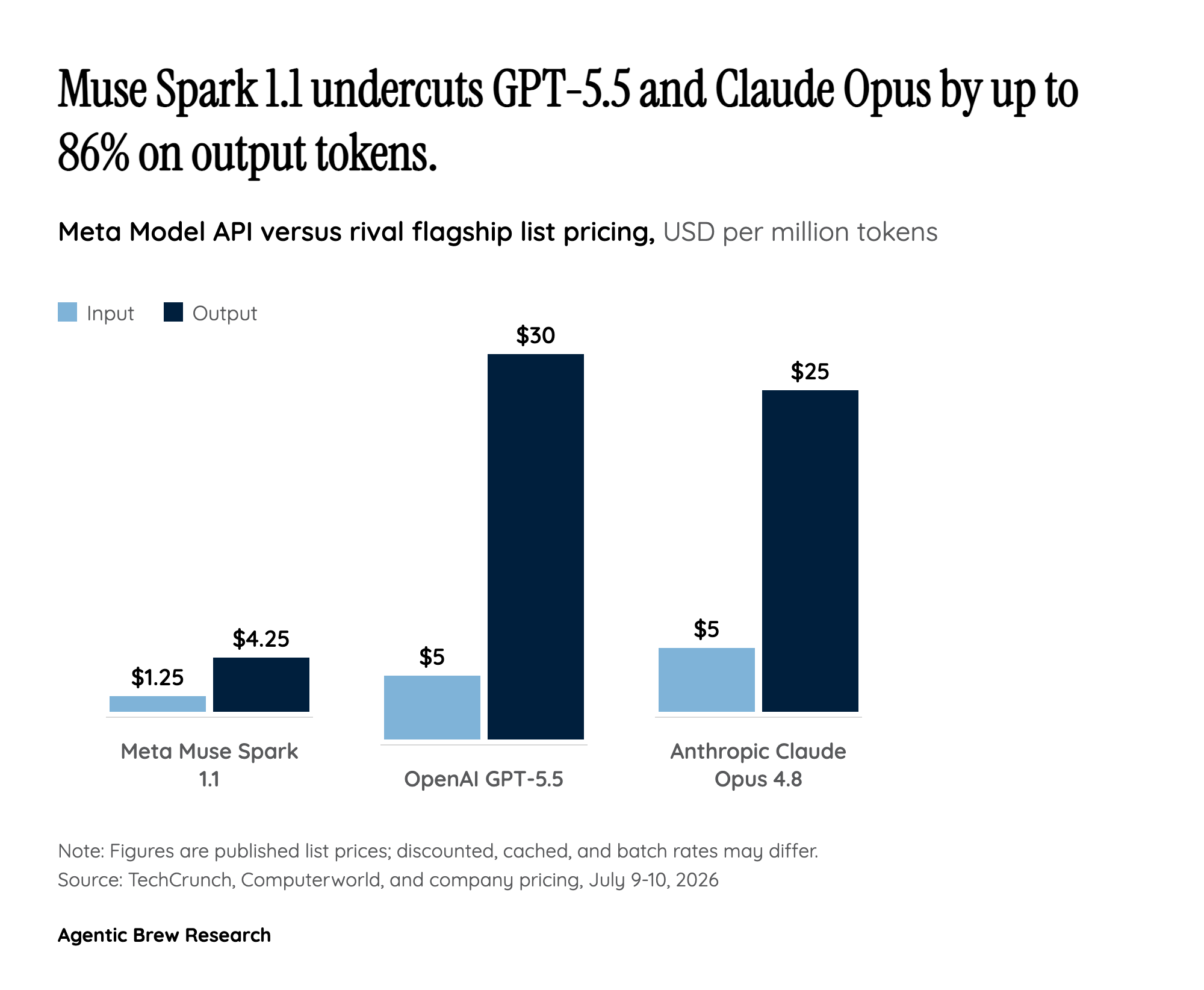
Meta Model API list pricing versus GPT-5.5 and Claude Opus 4.8, in USD per million tokens.

The number that makes Muse Spark dangerous is not on its spec sheet. Meta generates more than $60 billion in annual profit from advertising, a cash engine that lets it treat model inference as a loss leader rather than a business that must clear a margin [6]. Priced at $1.25 per million input tokens and $4.25 per million output tokens, the API lands at roughly one quarter of what OpenAI and Anthropic charge for their top-tier models [2][11]. That is not a rounding-error discount; it is a structural challenge aimed at labs whose economics depend on high API margins.

Analysts read the pricing as a market event more than a product one. Pareekh Jain of Pareekh Consulting notes that output tokens are usually the largest expense in coding, customer-service, and automation agents, and pegs Muse Spark's output price at about 86% below GPT-5.5 and more than 90% below Claude Opus 4.8 [4]. The-Decoder frames the launch as a squeeze on pure-play labs likely to force responses through price cuts, cheaper tiers, and better cached or batch rates [6]. Even CIOs who never touch Muse Spark benefit, Jain argues, because its mere existence hands them leverage to negotiate volume discounts and strengthens the case for multi-model procurement over single-vendor dependence [4].

Cheap is real - frontier is negotiable

Meta's marketing leans on a simple story: a strong agentic and coding model at a very low price. The benchmarks tell a more textured one. Muse Spark 1.1 genuinely leads on agentic and tool-use evaluations, topping MCP Atlas at 88.1, JobBench at 54.7 (against Opus at 48.4 and GPT-5.5 at 38.3), and Finance Agent v2 at 57.2, while edging Opus on Humanity's Last Exam at 62.1 to 57.9 [5]. For workloads built around tool orchestration and long-running agents, the value-per-dollar case is strong on its own terms.

Pure coding is where the model stops leading. On Terminal-Bench 2.1 it posts 80.0 behind GPT-5.5 at 83.4 and Opus at 82.7, on SWE-Bench Pro it trails Opus 61.5 to 69.2, on OSWorld-Verified it sits at 80.8 against Opus at 83.4, and on DeepSWE 1.1 it lands at 53.3 well behind GPT-5.5 at 67.0 [5]. Launch reviewers mirrored the split, with one calling it a solid all-rounder that one-shot a Flappy Bird clone yet lagged the frontier on long-horizon agent and advanced coding tasks. The honest read is that Muse Spark is not the best coding model on the market - it is a very good one that costs a quarter as much, which for most teams is the more useful sentence.

The community's asterisks

Developer reaction was mixed-positive, and the sharpest threads pushed past the headline price. The dominant frame across community discussion was value-per-token: with agent workloads racking up runaway token bills, a genuinely cheap capable model is treated as a big deal for continued adoption. But the enthusiasm came with asterisks. One recurring argument holds that sticker price is not real price - a commenter pointed out that GLM 5.2 nominally matches Muse Spark's rate yet effectively sells for a third or less through fp8 providers on OpenRouter, so Muse Spark is not automatically the cheapest option in practice.

Other caveats clustered around trust and access. Reviewers voiced benchmark skepticism and a wait-and-see stance until the model is broadly available, and flagged friction from the US-only region lock and a credit-card requirement to claim free credits. Testers of non-coding use cases reported weak roleplay and character adherence, a reminder that the agentic and coding tuning does not generalize everywhere. The most consequential thread surfaced a CNBC report in which Alexandr Wang confirmed Meta is working on an open-source variant of Muse Spark - met with cautious optimism and a fair amount of nothingburger-until-they-ship pragmatism [10].

Historical Context

2023-07
Zuckerberg's previous X post before the Muse Spark launch, making the July 2026 announcement his first in more than three years.
2026-04-08
Meta debuted its first major AI model since the deal to bring in Alexandr Wang, as it tried to catch Google and OpenAI after spending billions.
2026-07-09
Meta released Muse Spark 1.1, the first paid model from its reorganized Superintelligence Labs, following the disappointing debut of Llama 4.

Power Map

Key Players
Subject

Meta launches Muse Spark 1.1, its first paid low-cost AI model

ME

Meta / Mark Zuckerberg (CEO)

Launched the model and its first paid API, and can subsidize the API as a strategic loss leader given roughly $60B in annual ad profit, pressuring pure-play labs.

AL

Alexandr Wang (Chief AI Officer, Meta Superintelligence Labs)

Leads the reorganized Meta Superintelligence Labs that produced Muse Spark, joined via a roughly $15B Scale AI deal, and is driving the hybrid proprietary and open strategy.

OP

OpenAI and Anthropic

Direct competitors undercut on price, dependent on high API margins, and expected to respond with price cuts and cheaper tiers.

EN

Enterprise developers and CIOs

Gain leverage in procurement, able to use Muse Spark pricing to negotiate volume discounts and justify multi-model procurement even if they never adopt the model.

Fact Check

11 cited
  1. [1] Introducing Muse Spark and the Meta Model API
  2. [2] Meta enters the crowded AI coding battle with Muse Spark 1.1
  3. [3] Meta releases Muse Spark 1.1 from Wang's Superintelligence Labs
  4. [4] Meta launches low-cost Muse Spark 1.1 as enterprise AI spending comes under scrutiny
  5. [5] Muse Spark 1.1 benchmarks
  6. [6] Meta's Muse Spark 1.1 API pricing squeezes OpenAI and Anthropic as the AI price war heats up
  7. [7] Meta's Muse Spark and the new Meta Model API
  8. [8] Meta prices Muse Spark 1.1 API at $1.25/$4.25 per M tokens
  9. [9] Meta Muse Spark AI model and Alexandr Wang's Superintelligence Labs
  10. [10] Meta jumps into AI coding market to chase Anthropic and OpenAI
  11. [11] Meta's Muse Spark 1.1 opens paid API at one-quarter of Anthropic and OpenAI rates

Source Articles

Top 5

THE SIGNAL.

Analysts

"Muse Spark's aggressive output pricing shifts enterprise procurement leverage toward buyers and shows frontier inference is getting cheaper."

Pareekh Jain
Principal Analyst, Pareekh Consulting

"The pricing strengthens the case for multi-model procurement and gives CIOs negotiating power even if they never adopt Muse Spark."

Pareekh Jain
Principal Analyst, Pareekh Consulting
The Crowd

"(1) Today we're releasing Muse Spark 1.1 -- a strong agentic and coding model at a very low price. It's available through our new Meta Model API and in Meta AI."

@@finkd42839

"We're excited to introduce Muse Spark 1.1, a significant upgrade from the first Muse Spark model we released earlier this year. Along with this release, we are launching a public preview of the new Meta Model API where developers can access Muse Spark 1.1. The model is also..."

@@AIatMeta4861

"muse spark 1.1 can be even better than opus 4.8 at 20% of the cost"

@@alexandr_wang446

"Muse spark 1.1 has been released with the lowest cost."

@u/Snoo26837437
Broadcast
Meta AI Muse Spark Is HERE - Testing Meta's New Frontier Model!

Meta AI Muse Spark Is HERE - Testing Meta's New Frontier Model!

Meta AI Muse Spark IS INCREDIBLE! Powerful Coding & Multimodal Model! (Fully Tested)

Meta AI Muse Spark IS INCREDIBLE! Powerful Coding & Multimodal Model! (Fully Tested)

Muse Spark - Meta's NEW Llama Replacement

Muse Spark - Meta's NEW Llama Replacement