Microsoft and NVIDIA's agentic PC stack
TECH

Microsoft and NVIDIA's agentic PC stack

43+
Signals

Strategic Overview

  • 01.
    At Computex 2026 and Build 2026, NVIDIA and Microsoft unveiled a joint full-stack agentic AI architecture spanning Windows AI PCs, deskside DGX systems, Azure, and Microsoft Foundry.
  • 02.
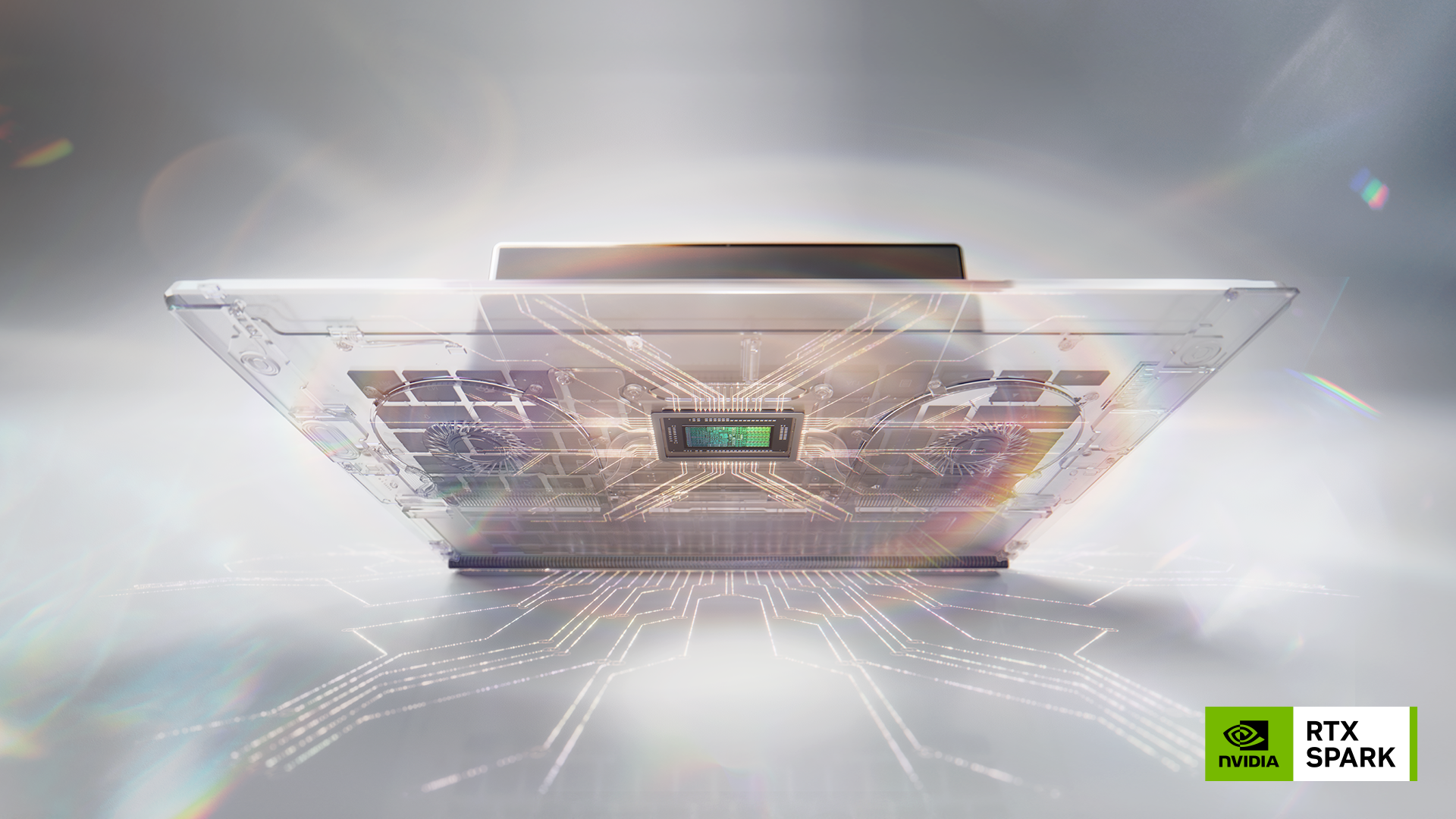
    RTX Spark is an Arm-based superchip with 20 Grace CPU cores, a Blackwell GPU with 6,144 CUDA cores, 128GB of LPDDR5X unified memory at ~300 GB/s, and 1 petaflop of AI performance — landing in fall 2026 across Surface, ASUS, Dell, HP, Lenovo, and MSI.
  • 03.
    DGX Station for Windows turns the desk into a trillion-parameter workstation: GB300 Grace Blackwell Ultra, 748GB coherent memory, 20 petaflops FP4, with the ability to run frontier models up to 1 trillion parameters locally.
  • 04.
    Microsoft Scout is an always-on personal agent for Microsoft 365 acting autonomously across Teams, Outlook, OneDrive, and SharePoint, built on the new OpenClaw open-source framework and assigned its own governed Entra identity.
  • 05.
    NVIDIA OpenShell, released under Apache 2.0, sandboxes each agent in its own container and evaluates every outbound call against policy before it can reach files, networks, or credentials.
  • 06.
    Microsoft's AI Superintelligence Team shipped seven in-house MAI models led by MAI-Thinking-1 — a 35B-active / ~1T-total sparse MoE reasoning model with a 256K context window, trained on commercially licensed data and explicitly without distillation from OpenAI's GPT series.

Deep Analysis

The triple decoupling: Microsoft is reducing dependence on OpenAI, x86, and the cloud — in one keynote

Read the two-day Build/Computex announcement as a single move and it becomes a decoupling, not a product launch. On the model layer, Microsoft's AI Superintelligence Team shipped MAI-Thinking-1, a 35B-active / ~1T-total sparse MoE reasoning model trained on commercially licensed data and explicitly without distillation from OpenAI's GPT series [1]. On the silicon layer, NVIDIA RTX Spark — 20 Grace cores, a Blackwell GPU with 6,144 CUDA cores, 128GB unified LPDDR5X — replaces Qualcomm, Intel, and AMD as the headline chip for the next wave of Copilot+ class Windows PCs [2]. On the deployment layer, DGX Station for Windows pulls a 20-petaflop, 748GB-coherent, trillion-parameter workstation onto the user's desk, so frontier-scale inference no longer has to live in Azure [3]. Pavan Davuluri framed the through-line cleanly, describing the move as "scaling the full power of Windows from thin-and-light PCs to data-center-class workstations" [3]. The PR talks like a partnership; the architecture talks like Microsoft de-risking three vendor relationships at once.
1 petaflop on the box, 300 GB/s on the bus: the spec the marketing won't say out loud

NVIDIA's hero number for RTX Spark is 1 petaflop of AI performance with 128GB of unified memory [2]. The number that doesn't make the headline slide is roughly 300 GB/s of memory bandwidth [4]. On developer-facing local-LLM communities, the bandwidth ceiling drew the sharpest reaction: practitioners running large local models have argued the chip is bandwidth-bound for the workloads it markets to, and have drawn unfavorable comparisons to higher-bandwidth Apple Silicon alternatives at similar price points. Mainstream gaming subreddits piled on for a different reason, openly mocking Jensen Huang's "you ask and the PC does the work" framing. Morgan Stanley's $2,900 N1X and $1,800 N1 floor cited by PCWorld [5]overlaps with community price speculation. PCWorld's Alaina Yee positioned the platform for "developers and early adopters rather than mainstream consumers" [5]. The petaflop is real; whether it can be fed at memory bandwidth for the largest local models is the open question, and the community is treating it as the dealbreaker until benchmarks prove otherwise.

OpenShell + scoped Entra identities: the governance layer is what actually makes always-on agents shippable

The most underplayed piece of the stack is the runtime, not the silicon. NVIDIA OpenShell, released under Apache 2.0, sandboxes each agent in its own container and "every outbound call is evaluated against policy before it can reach files, networks or credentials" [6]. Microsoft Scout, built on the new OpenClaw open-source framework, runs under that model, and Microsoft is explicit that "every agent operates under its own governed Entra identity" rather than a shared service account [7]. That last sentence is the one that turns Scout from a demo into something an enterprise security team can actually deploy: scoped identity per agent means audit, revocation, and least-privilege all map onto existing Entra tooling. NVIDIA's Chris Marriott was direct about the enterprise angle for the deskside DGX form factor: "As enterprises scale AI agents across their organizations, they need AI infrastructure that can connect directly to the applications and workflows that power their business" [3]. Discussion among Build 2026 attendees in Microsoft-focused threads has gravitated toward the same conclusion — that Spark plus WSL containers plus OpenClaw governance is the part of the announcement that holds up as a real developer pitch, separate from the consumer-facing Copilot narrative.

Surface RT, redux? The historical case for caution

Steven Sinofsky, who ran the Windows division when NVIDIA and Arm got their first Windows shot, used the announcement to remind the industry how that ended: "The first Surface ran on Nvidia Tegra ARM chips precisely because the graphics processor and drivers were so much better than others and Nvidia was a fantastic partner" [8]— and Surface RT, with NVIDIA Tegra 3 and Windows RT, became a commercial flop on a locked-down OS and weak performance [8]. The 2026 setup avoids Windows RT's app-compatibility prison, but it inherits the price problem: Morgan Stanley pegs RTX Spark PCs at $2,900+ for N1X and $1,800+ for N1 [5], against a DRAM market where contract prices are up 58-63% this quarter and memory now sits at roughly 35% of HP's PC BoM [9]. Layer on AMD's Gorgon Halo pushing on-device memory to 192GB at competitive prices [9]and Qualcomm's incumbent Copilot+ Snapdragon X position, and the path-dependence becomes the risk: the agentic-PC story is technically more credible than 2012, but the pricing and supply environment is harsher than it has been in a decade.

Historical Context

2011-01
At CES 2011, Microsoft showed Windows running on NVIDIA Tegra Arm silicon for the first time, kicking off Windows on Arm.
2012-10
The original Surface RT shipped with NVIDIA Tegra 3 and Windows RT; the locked-down OS and weak performance made it a commercial flop, ending NVIDIA's first run at Windows on Arm.
2026-05-31
RTX Spark is announced at Computex 2026 as NVIDIA's first Arm Windows chip in over a decade, with the official partnership unveiled the same day.
2026-06-02
At Build 2026 Microsoft unveils Scout, seven MAI models led by MAI-Thinking-1, the OpenClaw framework, and DGX Station for Windows — extending the agentic PC stack into the OS and model layers.

Power Map

Key Players
Subject

Microsoft and NVIDIA's agentic PC stack

NV

NVIDIA

Supplies the agentic PC silicon (RTX Spark Arm superchip, GB300 Grace Blackwell Ultra) and the Apache-2.0 OpenShell agent runtime; re-enters the Windows-on-Arm market it last attempted with Tegra/Surface RT in 2010-2013.

MI

Microsoft

Owns Windows, the Scout agent, the OpenClaw framework, the MAI model family, Foundry, and Azure; this stack shifts Microsoft from Copilot distributor to model maker, runtime owner, and hardware vendor (the Surface RTX Spark Dev Box is the named first-party developer machine).

OE

OEM partners (ASUS, Dell, HP, Lenovo, MSI; Acer and GIGABYTE to follow)

Manufacture the RTX Spark laptops/desktops and DGX Station for Windows units, distributing the agentic PC across consumer, developer, and enterprise channels.

QU

Qualcomm / Intel / AMD

Incumbent Copilot+ PC silicon vendors whose Snapdragon X, Lunar Lake, and Ryzen AI Max (Gorgon Halo) lines now face NVIDIA on Windows-on-Arm and on local-LLM workloads; AMD's Gorgon Halo and RTX Spark are positioned head-to-head on on-device agentic computing.

OP

OpenAI

Microsoft's longstanding frontier-model partner, now partially displaced inside Microsoft's own stack: MAI-Thinking-1 was explicitly trained without distillation from OpenAI's GPT series, signalling reduced dependence.

Fact Check

9 cited
  1. [1] Microsoft Build 2026: MAI-Thinking-1, First In-House Reasoning Model Trained Without OpenAI Data
  2. [2] NVIDIA and Microsoft Bring a New Generation of Windows PCs to Life with NVIDIA RTX Spark
  3. [3] NVIDIA DGX Station for Windows Puts a Trillion-Parameter AI Supercomputer on Every Enterprise Desk
  4. [4] NVIDIA unveils RTX Spark superchip at Computex 2026: new platform promises to turn Windows into an agentic AI OS
  5. [5] The price of NVIDIA RTX Spark PCs is going to hurt
  6. [6] Microsoft Build 2026: NVIDIA and Microsoft Deliver the Full Stack of Agentic AI Across Windows, Devices and Cloud
  7. [7] Introducing Microsoft Scout: Your always-on personal agent
  8. [8] Microsoft veteran recalls the last time NVIDIA and Arm was the future of Windows
  9. [9] AMD's Gorgon Halo pushes on-device AI memory to 192GB as DRAM prices hit 15-year high

Source Articles

Top 5

THE SIGNAL.

Analysts

"Framed RTX Spark + Windows as a paradigm shift from app-launch to intent-driven computing: "The PC is being reinvented. For forty years, you launched apps. Click. Type. With RTX Spark and Microsoft Windows, you ask — and the PC does the work.""

Jensen Huang
CEO, NVIDIA

"Positions RTX Spark as a tangible step toward unmetered local AI on every Windows desktop: "Our goal is to deliver unmetered intelligence to every home and every desk with Windows. RTX Spark marks a real breakthrough towards that vision.""

Satya Nadella
CEO, Microsoft

"Casts the partnership as scaling Windows from ultraportables up to data-center-class workstations: "Today, we're taking that collaboration to the next level, scaling the full power of Windows from thin-and-light PCs to data-center-class workstations with DGX Station powered by GB300.""

Pavan Davuluri
EVP Windows + Devices, Microsoft

"Argues enterprises scaling agents need on-prem infrastructure wired into their existing workflows: "As enterprises scale AI agents across their organizations, they need AI infrastructure that can connect directly to the applications and workflows that power their business.""

Chris Marriott
VP Enterprise Platforms, NVIDIA

"Pegs RTX Spark PCs at premium developer/enterprise pricing, with N1X models starting around $2,900 and N1 models around $1,800."

Morgan Stanley (cited by PCWorld)
Sell-side analyst note

"Frames RTX Spark pricing as targeting "developers and early adopters rather than mainstream consumers," raising questions about Copilot+ adoption velocity."

Alaina Yee
Senior Editor, PCWorld

"Reminds the industry that NVIDIA-Arm-on-Windows has been tried before with Surface RT/Tegra: "The first Surface ran on Nvidia Tegra ARM chips precisely because the graphics processor and drivers were so much better than others and Nvidia was a fantastic partner.""

Steven Sinofsky
Former President, Microsoft Windows Division
The Crowd

"Introducing NVIDIA DGX Station for Windows, the world's most powerful deskside AI supercomputer with Windows powered by NVIDIA GB300. ✅ Run frontier AI models with up to 1 trillion parameters locally ✅ Build and run secure AI agents on Windows with NVIDIA OpenShell ✅ Built by"

@@nvidianewsroom2875

"Microsoft Scout is a new AI personal assistant built on OpenClaw. Scout is Microsoft's "first real personal assistant," and you can download the desktop app today. Full details 👇"

@@tomwarren467

"NVIDIA and Microsoft just announced a new class of Windows PCs powered by RTX Spark. Basically thin and light laptops and compact desktops built for the "personal AI agent" era. • Up to 1 PFLOP of AI performance • Up to 128GB unified memory • Up to 6,144 Blackwell RTX cores"

@@BenGeskin117

"NVIDIA just announced the RTX Spark CPU, developed with Microsoft, at Computex."

@u/pedro197400
Broadcast
NVIDIA GTC Taipei 2026 Keynote | Full Replay

NVIDIA GTC Taipei 2026 Keynote | Full Replay

Microsoft Build 2026 | Satya Nadella Opening Keynote

Microsoft Build 2026 | Satya Nadella Opening Keynote

After 90 Minutes Of AI, NVIDIA Finally Revealed Its terrifying new PC plan

After 90 Minutes Of AI, NVIDIA Finally Revealed Its terrifying new PC plan