
The Sell-the-News Paradox: Why a 34% Beat Sent Shares Down
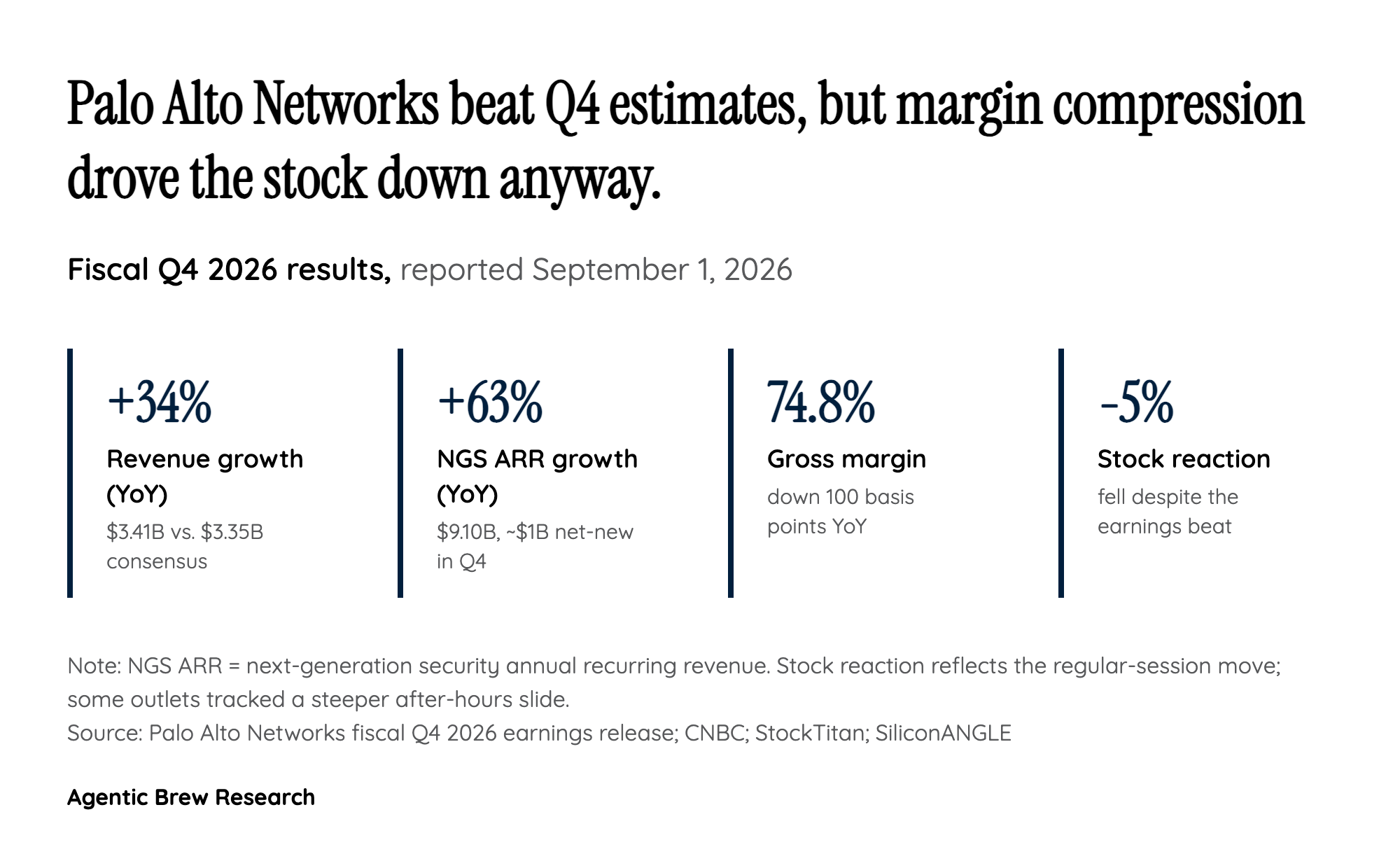
Palo Alto Networks delivered one of its cleanest beats in recent memory: revenue up 34% year-over-year to $3.41 billion versus a $3.35 billion consensus, and non-GAAP EPS of $1.02 versus $0.98 expected [1]. Next-generation security annual recurring revenue jumped 63% to $9.10 billion, with nearly $1 billion of net-new NGS ARR added in the quarter alone [2]. Yet the stock fell roughly 5% in the regular session and kept sliding after hours to $355.64 [3], with some outlets tracking an overall slide closer to 8% [4]- a textbook sell-the-news reaction to what was, on paper, a standout quarter.
The disconnect traces to costs, not growth. Gross margin slipped 100 basis points to 74.8%, and management guided cloud hosting and memory/storage costs to grow faster than revenue through FY2027 [5]. Investors zeroed in on that trajectory even as the company issued FY2027 guidance of $14.10-14.20 billion in revenue [2]. Wall Street's professional bulls stayed bullish - Jefferies and Bank of America both kept Buy ratings, arguing the drop reflected priced-in perfection rather than a broken thesis [6]- but retail sentiment on forums like r/wallstreetbets ran more skeptical, with a long-running debate over whether a stock trading near 299 times earnings can keep justifying that multiple once acquisition-driven growth is stripped out. Same-day YouTube earnings breakdowns raised a parallel concern, flagging a roughly 93x forward P/E ratio as hard to square with any slowdown in organic growth. The retail skepticism and the professional margin concerns are, in effect, the same worry expressed in different vocabularies.