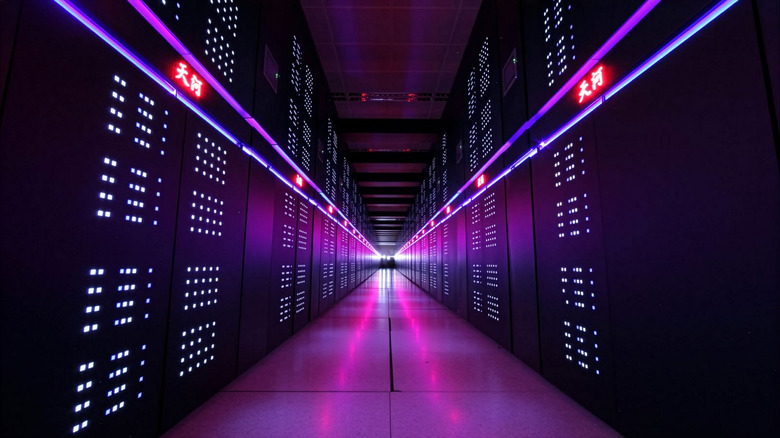
China's LineShine becomes world's fastest supercomputer using only CPUs
TECH

China's LineShine becomes world's fastest supercomputer using only CPUs

30+
Signals

Strategic Overview

  • 01.
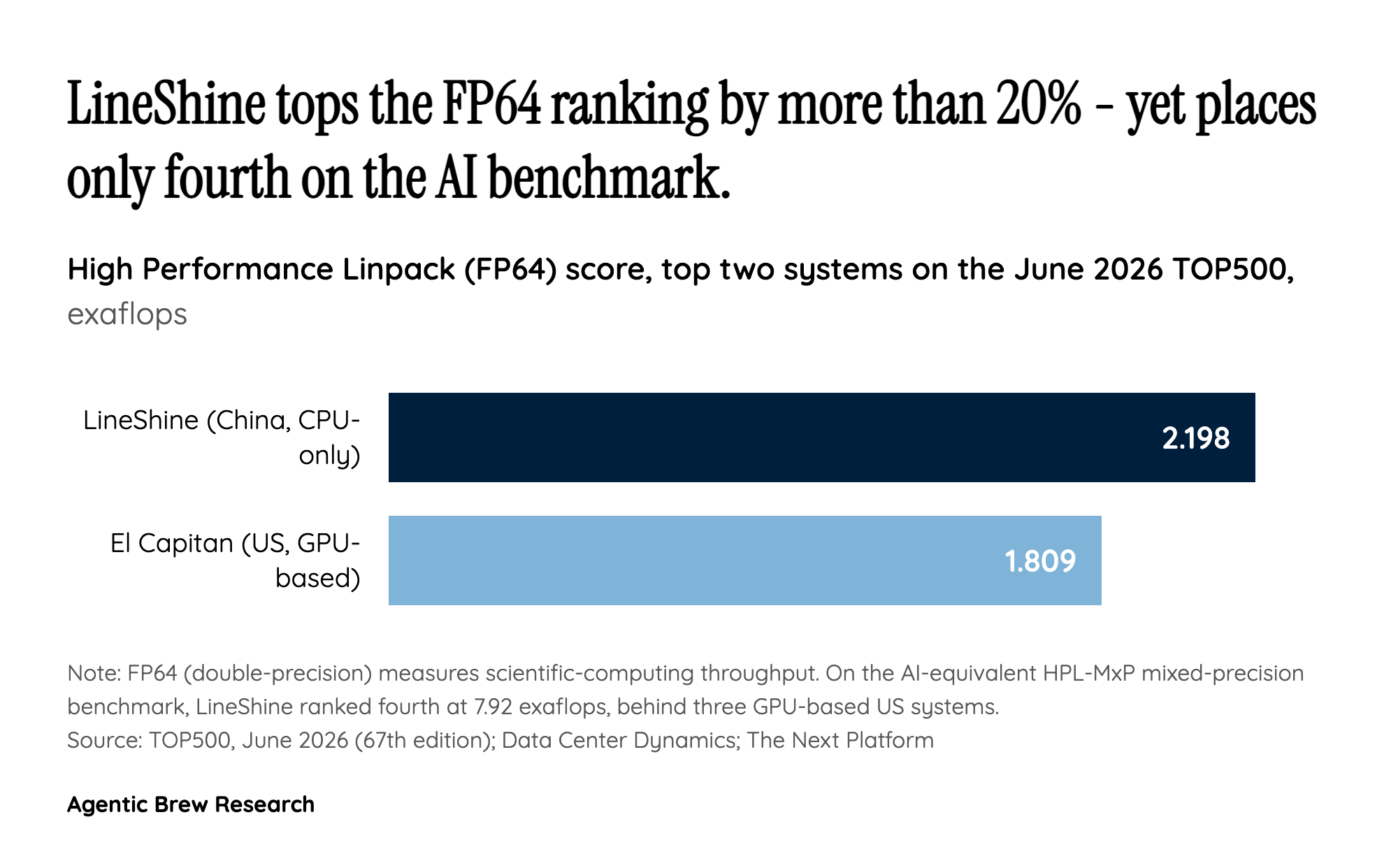
    China's LineShine topped the June 2026 (67th edition) TOP500 list with 2.198 exaflops of High Performance Linpack performance, more than 20 percent ahead of America's El Capitan at 1.809 exaflops.
  • 02.
    LineShine is the first system on the public TOP500 list to sustain more than 2 exaflops of double-precision (FP64) performance using only CPUs, with no GPU accelerators.
  • 03.
    The system runs on a fully domestic stack - the LX2 processor, the LingQi interconnect, domestic storage, and the Kylin operating system - and is operated by the National Supercomputing Centre in Shenzhen.
  • 04.
    Despite leading the standard FP64 ranking, LineShine placed only fourth on the AI-equivalent HPL-MxP mixed-precision benchmark at 7.92 exaflops, behind three GPU-based American systems.

Deep Analysis

The Headline Hides the Asterisk: #1 for Science, #4 for AI
The Headline Hides the Asterisk: #1 for Science, #4 for AI
LineShine leads the FP64 (HPL) ranking by more than 20% over El Capitan, but ranks only fourth on the AI-equivalent HPL-MxP benchmark.

The phrase "world's fastest supercomputer" is doing a lot of quiet work. LineShine earned the title on the High Performance Linpack benchmark, which measures double-precision (FP64) math - the kind used in climate models, fluid dynamics, and nuclear simulation. There it posted 2.198 exaflops, more than 20 percent ahead of El Capitan's 1.809 exaflops [1]. It is the first machine on the public list to clear 2 exaflops of FP64 using CPUs alone [2].

But AI training does not run on FP64. It runs on lower-precision math, and the benchmark built to approximate that workload is HPL-MxP. On that test LineShine came in fourth at 7.92 exaflops, sitting behind three GPU-based American systems [3]. The gap is not a rounding error - it is the whole story inverted. Addison Snell of Intersect360 Research put the ceiling bluntly: "If the hyperscalers submitted their systems, this 'world's fastest' would not crack the top five" [3]. In other words, LineShine is genuinely the most powerful publicly ranked machine for traditional science, and simultaneously not in the AI conversation that dominates today's chip rivalry.


The Loophole at the Center: Why CPUs Slipped Through

Washington's export controls were aimed at GPUs - the accelerators most useful for training large AI models. LineShine routes around that by baking GPU-style matrix and vector math into general-purpose CPUs and scaling out an enormous CPU-only fleet instead [3]. Because CPUs face far looser restrictions than high-end accelerators, the design exploits what analysts describe as a regulatory gap. Jimmy Goodrich of the University of California Institute on Global Conflict and Cooperation called for tightening it directly: "The US government should have stronger controls on the export and manufacturing of CPUs for the China market. It is a loophole in the current regulations" [4].

The community reaction split along exactly this line. On Reddit, the most technically engaged threads pushed back on the "bypassing the ban" framing entirely, arguing the real achievement is domestic manufacturing and self-reliance rather than a clever sanctions dodge - and noting that sustained sanctions are precisely what produced this outcome. That reframing matters: if the headline is "China beat the export controls," the policy response is to plug a CPU loophole; if the headline is "sanctions accelerated a fully domestic supply chain," the policy calculus is harder and less reassuring.

Under the Hood: An All-Chinese Stack From Silicon to OS

What makes LineShine a self-sufficiency milestone rather than just a fast machine is that every major layer is domestic: the LX2 processor, the LingQi interconnect, the storage subsystem, and the Kylin operating system [3]. The scale is the point - the HPL configuration spans 13,789,440 LX2 CPU cores across 22,680 nodes [5]. Each LX2 packs 304 cores at 1.55 GHz across two compute dies with ARMv9 SVE/SME vector extensions and on-package HBM, delivering up to 60.3 FP64 teraflops per chip [5]. The whole system draws 42.2 MW [5].

The component most experts single out is not the chip but the network. The LingQi (LQLink) interconnect provides 1.6 Tb/sec of bandwidth per node at a single-hop latency of 1.07 microseconds [5]. Stitching nearly fourteen million cores into one coherent machine is an interconnect-and-topology problem before it is a FLOPS problem, and the engineers reacting on Reddit converged on exactly that read - the network design, not the raw core count, is the genuinely hard part. SMIC fabricating the LX2 on its 7nm (N+3) process closes the loop, showing the leading-edge silicon was made at home [5].

What the Skeptics and the HPC Crowd Are Actually Watching

Among researchers, the more interesting question is architectural, not geopolitical. HPC systems researcher Torsten Hoefler flagged that this is the first time in a while the top spot went to a homogeneous CPU machine and asked openly whether heterogeneity - the CPU-plus-GPU pairing that has defined leadership systems - is still inevitable, especially as CPUs gain HBM and tensor-style features like ARM's SME. That is the genuinely open thread: LineShine may be less a one-off sanctions artifact than an early data point for whether fat, accelerator-laden CPUs can claw back ground from discrete GPUs.

The skeptical counterweight is just as sharp. Technically minded commenters note that CPUs lose badly on dollars-per-FLOP, power, and cooling, and that calling any single number "world's fastest" flattens real architectural tradeoffs - CPUs run MIMD workloads while GPUs run SIMD/SIMT, so they are not interchangeable. The honest synthesis is the one the experts keep circling: this is a legitimate science-computing milestone and a domestic-manufacturing flex, wrapped in a headline that overclaims on the one workload - AI - where it ranks fourth [3].

Historical Context

2017-06
The last time a China-based system topped the TOP500 before LineShine, leaving a roughly nine-year gap at the summit.
2019
China stopped submitting systems to the TOP500 list after 2019 amid US sanctions and export controls.
2026-04-27
LineShine was publicly announced and became operational in the first half of 2026.
2026-06-23
LineShine took the No. 1 spot on the June 2026 TOP500 list around the ISC conference in Hamburg, joining a tier of five publicly verified exascale systems.

Power Map

Key Players
Subject

China's LineShine becomes world's fastest supercomputer using only CPUs

NA

National Supercomputing Centre in Shenzhen (NSCC-SZ)

Host and co-designer of LineShine; deployed the system, co-developed the LX2 chip, and submitted the result to TOP500 - the institution whose decision to publicly rank the machine put it on the global map.

HU

Huawei (HiSilicon)

Co-designed the LX2 / LingKun Armv9 processor with NSC Shenzhen, making it central to an all-domestic chip supply that sidesteps US export controls on high-end accelerators.

SM

SMIC

Fabricated the LX2 chips on its 7nm (N+3) process, demonstrating that China can manufacture leading-edge HPC silicon domestically while under sanctions.

LA

Lawrence Livermore National Laboratory (El Capitan)

Operator of the displaced No. 2 system, the AMD-powered El Capitan at 1.809 exaflops, whose dethroning is the symbolic core of the story.

U.

U.S. export-control regulators

Their GPU restrictions drove China toward a CPU-only design; analysts argue CPUs face far looser controls, leaving a regulatory loophole that LineShine exploited.

Fact Check

5 cited
  1. [1] LineShine: All-CPU Chinese supercomputer named world's most powerful
  2. [2] China's LineShine dethrones El Capitan as the world's fastest supercomputer
  3. [3] China's LineShine supercomputer tops TOP500 with no US chips
  4. [4] China tops world supercomputer ranking
  5. [5] A Deep Dive On China's LineShine All-CPU Exaflops-Class Supercomputer

Source Articles

Top 3

THE SIGNAL.

Analysts

"He argues current U.S. rules are too weak on the chips LineShine relied on: "The US government should have stronger controls on the export and manufacturing of CPUs for the China market. It is a loophole in the current regulations.""

Jimmy Goodrich
University of California Institute on Global Conflict and Cooperation

"He was struck less by the performance than by the disclosure itself: "What I'm surprised by is that they submitted it.""

Addison Snell
Intersect360 Research

"He cautions the ranking measures high-precision Linpack rather than real AI capacity: "If the hyperscalers submitted their systems, this 'world's fastest' would not crack the top five.""

Addison Snell
Intersect360 Research
The Crowd

"Surprise: Chinese LineShine supercomputer takes the #1 spot on the #Top500 and #HPCG lists! First time since a while that spot is taken by a homogeneous CPU machine. So is heterogeneity here to stay? CPUs with HBM and tensor cores (e.g., ARM SME). Congrats Yutong and folks."

@@thoefler78

"Thanks again to US sanctions—the same scenario plays out once more. The 67th TOP500 list of the world's most powerful supercomputers, released on the 23rd in Hamburg, Germany, shows the Chinese supercomputer "LineShine" (Lingsheng) debuting at the number one spot."

@@loong_of73

"Mainland China's LineShine Supercomputer uses domestic Chinese made Huawei LX2 Armv9 CPUs and no GPUs at all. The system is CPU-only, with each LX2 package featuring 304 cores, and the deployed system using roughly 47,000 CPUs overall."

@@treasureh8nter23

"China bypasses US GPU bans with 1.54-exaflops 'LineShine' supercomputer — CPU-only monster packs 2.4 million Huawei-designed Armv9 cores"

@u/Steap-Edit358
Broadcast
How China built the world's fastest supercomputer | LineShine | Nvidia | AMD | Technology

How China built the world's fastest supercomputer | LineShine | Nvidia | AMD | Technology

Worlds Fastest Super Computer is in China from LineShine - Chinese Beat Americans Even With Embargos

Worlds Fastest Super Computer is in China from LineShine - Chinese Beat Americans Even With Embargos

US Vs. China: LineShine Supercomputer Takes No.1 Spot, Beating America's El Capitan | FP Explains

US Vs. China: LineShine Supercomputer Takes No.1 Spot, Beating America's El Capitan | FP Explains