Stripe has agreed to acquire AI model-routing startup OpenRouter for more than $7 billion, a markup of over 5x on OpenRouter's $1.3 billion valuation from a Series B round closed just 82 days earlier, expanding Stripe from payments infrastructure into AI model routing and usage-based billing for inference spend.
TECH

Stripe has agreed to acquire AI model-routing startup OpenRouter for more than $7 billion, a markup of over 5x on OpenRouter's $1.3 billion valuation from a Series B round closed just 82 days earlier, expanding Stripe from payments infrastructure into AI model routing and usage-based billing for inference spend.

53+
Signals

Strategic Overview

  • 01.
    Stripe has agreed to acquire OpenRouter for more than $7 billion, confirmed by Bloomberg on August 16, 2026, making it Stripe's largest acquisition to date.
  • 02.
    The price is more than five times OpenRouter's $1.3 billion valuation from a $113 million Series B round that closed just 82 days earlier, in May 2026.
  • 03.
    OpenRouter provides a unified API to more than 400 AI models from OpenAI, Anthropic, DeepSeek and others, serving roughly 8 million developers.
  • 04.
    Stripe already processed OpenRouter's billing, tax, and fraud checks before the acquisition, giving it a close view of the startup's growth and transaction activity.
  • 05.
    Neither company has officially confirmed the deal; a Stripe spokesperson said the company does not comment on rumors or speculation.
  • 06.
    OpenRouter was founded in 2023 by Alex Atallah, a Stanford and Palantir alum who co-founded NFT marketplace OpenSea, along with Louis Vichy.

Deep Analysis

The Financial Mechanics: How a $1.3B Startup Became a $7B Acquisition in 82 Days
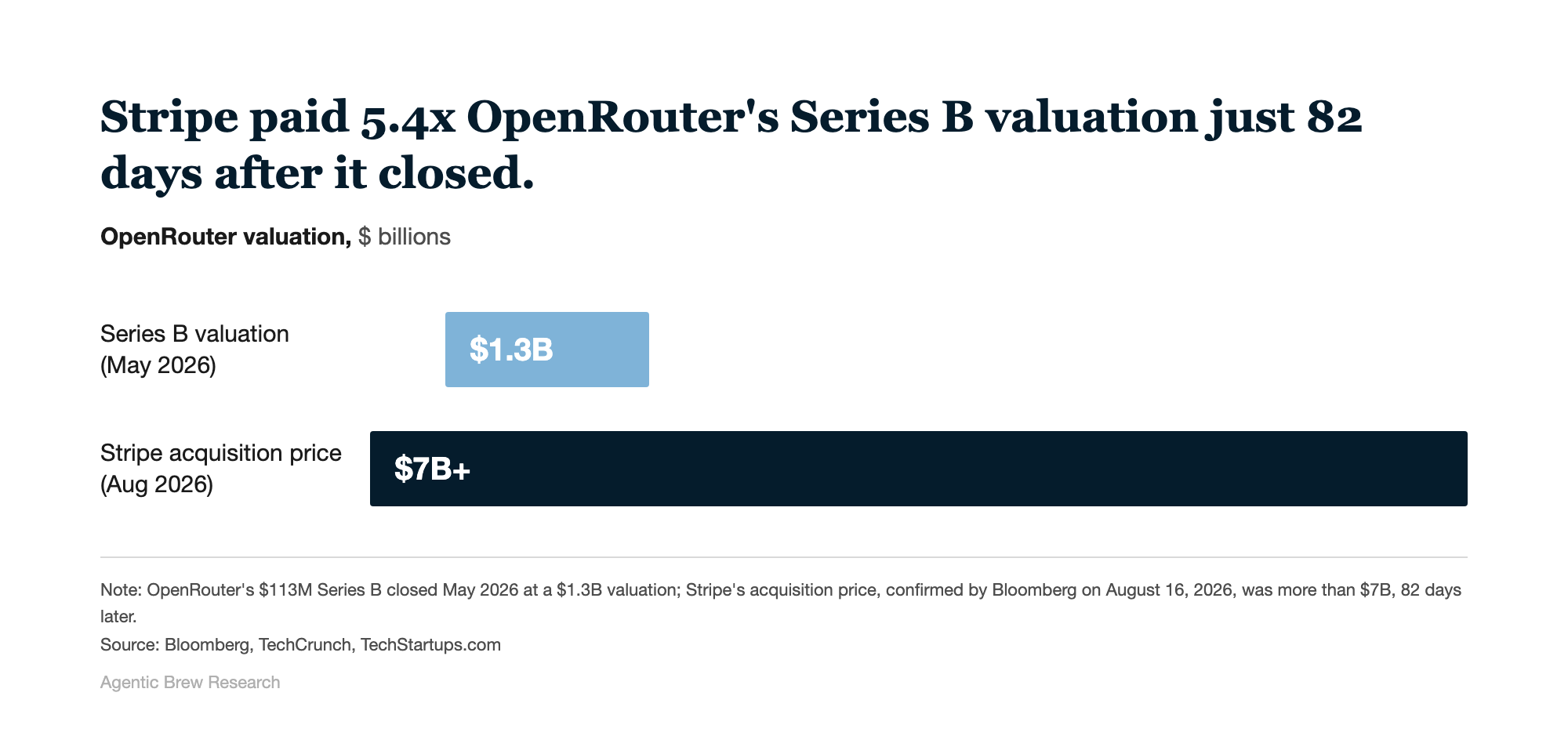
The Financial Mechanics: How a $1.3B Startup Became a $7B Acquisition in 82 Days
OpenRouter's Series B valuation vs. Stripe's acquisition price, 82 days apart.

Bloomberg confirmed on August 16, 2026 that Stripe finalized an agreement to acquire OpenRouter for more than $7 billion[1], a price more than five times the $1.3 billion valuation OpenRouter's $113 million Series B had set just 82 days earlier[2]. PitchBook analyst Rudy Yang framed the deal as core to Stripe's stablecoin and agentic-payments strategy, with model routing serving the payments side of that thesis[2].

OpenRouter's own revenue trajectory explains part of the urgency behind the price. Annualized revenue reportedly grew from about $19 million at the end of 2025 to roughly $50 million by March 2026[3], which puts the $7 billion price tag at somewhere near 140 times revenue even before accounting for the growth rate itself. Weekly token throughput reached 25 trillion by May 2026, a fivefold increase in six months[3]- the kind of volume growth that turns a modest percentage take-rate on inference spend into a business worth defending with a multi-billion-dollar premium, roughly $5.7 billion more than its three-month-old price.


Owning Both Sides of the AI Transaction Loop

The strategic logic goes beyond the multiple. Stripe already processed OpenRouter's billing, tax, and fraud checks before the acquisition was even publicly reported, giving it a close view of the startup's growth and transaction activity ahead of any negotiation[4]. Owning the router as well as the ledger lets Stripe control both halves of an AI transaction: OpenRouter decides which model handles a given request and what that request is worth, while Stripe settles the payment[2]. That combination is central to Stripe's push into the 'agentic economy,' where AI systems transact with progressively less human involvement and inference, payments, and settlement need to be tightly interconnected[2].

This is also the most expensive entry in an 18-month run of acquisitions building a financial infrastructure layer for AI. Stripe closed its purchase of stablecoin infrastructure firm Bridge for $1.1 billion in February 2025 (its largest deal until now), added Privy's embedded crypto-wallet infrastructure in mid-2025, and completed its acquisition of usage-based billing company Metronome in January 2026[5]. OpenRouter slots directly into that stack as the metering layer purpose-built for AI spend specifically.

The Neutrality Problem

OpenRouter's pitch has always rested on neutrality - a single access point across 400-plus models that prevents any one provider from locking developers in, as CEO Alex Atallah has described it[6]. Analysts have already flagged the obvious tension in the deal: OpenRouter's core value proposition rests on being neutral, and it is now owned by a payments company with its own transaction-fee incentives[2].

Developer communities reacted with more skepticism than enthusiasm, invoking familiar fears about acquired tools degrading over time once an incumbent absorbs them, tempered by the fact that Stripe is relatively well-regarded compared to typical acquirers. Debate split over whether OpenRouter's routing code is a thin, easily replicated moat or whether its real value lies in negotiated volume discounts and reliability at scale - an unresolved argument rather than a settled one. In at least one specialized developer community, the concern got more concrete: Stripe's payment-processing terms of service could pressure OpenRouter to drop providers that tolerate adult content or to end anonymous and crypto payment options, prompting early discussion of alternative routers as a hedge.

The Geopolitical Wildcard: Chinese Models Now Dominate OpenRouter's Traffic

The acquisition also lands amid a dramatic shift in whose models OpenRouter actually routes. US-model token share on the platform fell from about 70% in June 2025 to roughly 30% by June 2026, while Chinese open-weight providers - led by DeepSeek and Alibaba's Qwen - rose to a combined 44-61% share, with DeepSeek alone accounting for 16-18%[7]. That shift means a US payments giant is now positioned to route and bill the majority of traffic running through Chinese-developed models[8].

Security analysts note that routers accumulate sensitive telemetry - prompt data, model-selection patterns, spending concentration, and request-level traffic visibility - representing a third-party risk that most security teams have not formally evaluated[7]. Folding that telemetry into a systemically important payments company raises the stakes of any future breach, audit, or disclosure requirement well beyond what a standalone routing startup would have carried on its own.

Historical Context

2023
Founded by Alex Atallah and Louis Vichy.
2025-02
Closed its acquisition of stablecoin infrastructure firm Bridge for $1.1 billion, its largest deal until the OpenRouter acquisition.
2025-06
Acquired Privy's embedded crypto-wallet infrastructure, covering more than 75 million accounts and 1,000+ developer teams.
2026-01
Completed its acquisition of Metronome, a usage-based billing company.
2026-05
Announced a $113 million Series B at a $1.3 billion valuation, led by Sequoia, a16z, Menlo Ventures, and CapitalG.
2026-07
The Wall Street Journal reported the two companies were in acquisition talks, with early figures cited around $10 billion.
2026-08-16
Bloomberg reported the deal finalized at more than $7 billion, Stripe's largest acquisition to date.

Power Map

Key Players
Subject

Stripe has agreed to acquire AI model-routing startup OpenRouter for more than $7 billion, a markup of over 5x on OpenRouter's $1.3 billion valuation from a Series B round closed just 82 days earlier, expanding Stripe from payments infrastructure into AI model routing and usage-based billing for inference spend.

ST

Stripe

Acquirer; already handled OpenRouter's billing, tax (Stripe Tax) and fraud detection (Stripe Radar) before the deal, and is positioning itself as the financial and metering layer for the AI agent economy.

OP

OpenRouter / Alex Atallah (CEO)

Target company; Atallah publicly frames OpenRouter as 'the Stripe for AI,' a neutral single access point across 400+ models that prevents vendor lock-in, and declined to confirm deal terms before the close.

SE

Series B investors (Sequoia, a16z, Menlo Ventures, CapitalG/Alphabet)

Backed the May 2026 $113M round at a $1.3B valuation and realize more than a 5x markup on that stake in roughly three months via the acquisition.

MO

Model providers routed through OpenRouter (OpenAI, Anthropic, DeepSeek, etc.)

Supply-side partners whose inference traffic and revenue flow through the platform; a Stripe-owned router raises neutrality and commoditization questions for them.

CH

Chinese open-weight model makers (DeepSeek, Alibaba Qwen)

Have gained 44-61% of OpenRouter's token volume by mid-2026, raising regulatory questions now that a US payments company routes and bills that traffic.

Fact Check

8 cited
  1. [1] Stripe Nears Deal to Buy AI Firm OpenRouter for Over $7 Billion
  2. [2] Stripe Acquires OpenRouter for Over $7 Billion, More Than 5x Its Valuation Three Months Ago
  3. [3] Stripe To Acquire OpenRouter For Over $7 Billion: Reports
  4. [4] Stripe to Acquire OpenRouter in $7 Billion Deal
  5. [5] Stripe OpenRouter Acquisition
  6. [6] Stripe Will Reportedly Acquire AI Gateway Startup OpenRouter for $7B
  7. [7] Why a Payments Company Wants an AI Model Router: Tokens Are Acting Like Currency
  8. [8] Stripe Reportedly to Acquire OpenRouter for Over $7 Billion

Source Articles

Top 5

THE SIGNAL.

Analysts

Said Stripe's biggest priorities in emerging technology are stablecoins and agentic payments, with the model-routing layer serving that second goal.

Rudy Yang
Analyst, PitchBook

Describes OpenRouter as 'the equivalent of Stripe for AI' because it gives customers a single access point across systems and prevents lock-in; when asked directly on 20VC about a reported $10 billion Stripe sale, said 'I can't comment, but... whatever happens, we're going to execute on the vision... for safe access to AI where one monopoly doesn't take over,' and on a roughly 22% stake implying a large personal payout said 'I don't really think about it.'

Alex Atallah
CEO and Co-founder, OpenRouter

Flag that OpenRouter's core value proposition has always rested on being neutral - a router that doesn't favor any one model provider - which is now in tension with being owned by a payments company.

Unattributed industry analysts
Cited across multiple outlets

Argues routers accumulate sensitive telemetry - prompt data, model-selection patterns, spending concentration, and request-level traffic visibility - representing a third-party risk most security teams have not formally evaluated.

Security Boulevard analysis
Industry security commentary
The Crowd

Stripe has finalized an agreement to acquire OpenRouter for more than $7 billion, according to a report from Bloomberg. This is more than five times the $1.3 billion valuation from OpenRouter's funding round just 82 days ago.

@@AndrewCurran_6676

BREAKING: Stripe acquiring OpenRouter for $7B+. ▫️ Was valued at $1.3B in May ▫️ 8M users, access to 400+ AI models Stripe just became the payment layer for AI itself. What does that mean for model lock-in?

@@vc_corner0

As an openrouter customer for a year now, here is how i interpret: openrouter is a hero entity with cross vendor price, latency and quality data across 400+ models. The upside for stripe- >Own the payment+routing layer for AI inference >Become the neutral "Mastercard" of the [truncated]

@@VarshineSri5

Stripe will reportedly acquire AI gateway startup OpenRouter for $7B+

@u/Justgototheeffinmoon792
Broadcast
OpenRouter CEO: Why Chinese Open Models Are Beating the US | Why Enterprises Fear OpenAI & Anthropic

OpenRouter CEO: Why Chinese Open Models Are Beating the US | Why Enterprises Fear OpenAI & Anthropic

Is Stripe Buying OpenRouter for $10 Billion?

Is Stripe Buying OpenRouter for $10 Billion?

Will OpenRouter sell for $10BN to Stripe?

Will OpenRouter sell for $10BN to Stripe?

Stripe has agreed to acquire AI model-routing startup OpenRouter for more than $7 billion, a markup of over 5x on OpenRouter's $1.3 billion valuation from a Series B round closed just 82 days earlier, expanding Stripe from payments infrastructure into AI model routing and usage-based billing for inference spend. — AI News | Agentic Brew