Meta launches Muse Image and previews Muse Video
TECH

Meta launches Muse Image and previews Muse Video

33+
Signals

Strategic Overview

  • 01.
    Meta Superintelligence Labs launched Muse Image, its first in-house image generation model, free across the Meta AI app, meta.ai, Instagram Stories in the US, and WhatsApp in limited countries, with Facebook coming soon.
  • 02.
    Alongside Muse Image, Meta previewed Muse Video, a text-to-video model with native audio support that it says is competitive on prompt adherence, visual fidelity, and temporal consistency, coming soon to creators and Meta AI.
  • 03.
    Muse Image was internally code-named Mango and built under the Superintelligence Labs division led by Chief AI Officer Alexandr Wang, the lab's second major release after the Muse Spark language model in April 2026.
  • 04.
    Meta AI users can @-mention any public Instagram account in a prompt to pull that profile's photos into AI images, a feature enabled by default that users must manually opt out of.

Meta Finally Owns the Pixels

For years Meta filled its image-generation gap with outside models, leaning on partners rather than shipping a first-party generator at the frontier. Muse Image ends that arrangement. It is billed as the first media generation model developed by Meta Superintelligence Labs [1], the division led by Chief AI Officer Alexandr Wang [2], and it was internally code-named Mango [3]. The strategic read is vertical integration: instead of routing its most-used surfaces through someone else's model, Meta now controls the full stack from research to the Instagram Stories camera.

Why do this in-house at all? Owning the model means owning the roadmap, the cost curve, and the data flywheel. Every Instagram Story, WhatsApp chat, and Meta AI prompt becomes a distribution channel Meta no longer has to share economically or strategically. It also removes a dependency risk - if the model is core to your ad business and your consumer apps, renting it from a competitor or a startup is a liability. Meta positions Muse Image as generally surpassing Google's Nano Banana 2 on benchmarks while trailing only ChatGPT's image generator [4], which tells you the target: parity with the two labs it most wants to catch.

The Model That Plans Before It Draws

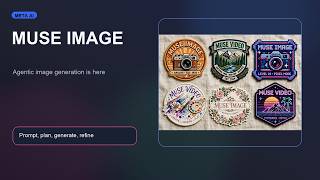
Muse Image's most technically distinctive claim is that it does not directly map a prompt to pixels. Instead it operates as an agent: it invokes search and coding tools to improve accuracy and self-refines its own generations [1]. In practice this means the model can reason through an ambiguous request, look something up, and iterate on a draft before returning a final image - closer to how a human designer works than a single forward pass. Meta's own framing pairs Muse Image with Muse Spark, the lab's language model, so the reasoning and the rendering are two halves of one system.

The launch also leans on precision editing rather than one-shot generation. Meta says the model follows instructions faithfully, edits with precision, and composes from multiple references [1], and it can pull other Instagram users into an image via @mentions of their public profiles [5]. Every output carries an invisible watermark, a Content Seal that Meta says survives cropping, compression, resizing, and screenshotting [1]. The agentic loop is the differentiator worth watching - if self-refinement meaningfully lifts prompt adherence, it is a template rivals will copy.

Free for You, a Weapon for the Ad Business

The consumer framing is generosity - Muse Image is free for everyday creation [3]- but the business logic points at monetization from two directions. Power users who exceed a usage limit are pushed toward Meta's paid subscription plans [3], and, more consequentially, advertisers will soon be able to generate and vary image-based ad creative through Advantage+, Meta's AI-powered ad tool [2]. That folds a state-of-the-art image model straight into the machinery that produces Meta's revenue.

The implication for anyone in the creative-services business is stark: if a brand can spin up and A/B test unlimited ad visuals inside Meta's ad manager at near-zero marginal cost, the value of outsourced creative production falls. That prospect - not the Stories filters - is why the launch reads as an ad-business move as much as a consumer one. Meta is not just shipping a toy for Stories - it is shipping a cost-reduction engine for the customers who pay its bills, which is why the free consumer tier and the Advantage+ integration are really the same strategy viewed from two ends.

Opted In By Default, No Warning

The launch's most contested feature is not a capability but a default. Any Meta AI user can @-mention a public Instagram account in a prompt, and the system pulls that profile's photos as references to generate images of that person - with the feature on by default for public accounts and no consent step [5]. Meta's help page also states users will not be notified when their content is used by AI features [5], so the first time you learn your likeness was used may be when you see the image.

The opt-out is real but limited. Turning it off (Instagram Profile, then Sharing and reuse) stops future generations from using your content, but any images already created are not deleted [5]. This default-on, no-notification, no-retroactive-deletion combination is precisely the angle that surfaced in community discussion, where the privacy concern was the standout non-official talking point on Reddit even as the broader launch reception there stayed muted and skeptical. On X the mood ran the other way - celebratory, though driven largely by Meta's own accounts, with independent validation coming mainly from benchmark leaderboards rather than outside reviewers. That split - promotional enthusiasm on one platform, privacy unease on another - is the honest picture of a same-day launch.

Historical Context

2026-04
The lab debuted its first large language model, Muse Spark, its first major release before Muse Image.
2026-07-07
Meta launched Muse Image and previewed Muse Video, its first in-house media generation models.

Power Map

Key Players
Subject

Meta launches Muse Image and previews Muse Video

ME

Meta Superintelligence Labs

Developer of Muse Image and Muse Video; owning image and video generation in-house lets Meta stop relying on outside model providers and control its own creative stack.

AL

Alexandr Wang

Chief AI Officer leading Meta Superintelligence Labs, under whom Muse Image was built; he also oversaw the April Muse Spark launch, giving him direct authority over Meta's generative model roadmap.

AD

Advertisers and brands

Target users of Muse Image via Advantage+, Meta's AI-powered ad tool, to generate and vary image-based ad creative, tying the model directly to Meta's core revenue engine.

IN

Instagram public-account users

Can be pulled into AI images via @mentions of their public profiles; opted in by default and must manually opt out, giving them little control over how their likeness is reused.

OP

OpenAI, Google, and Anthropic

Rivals Meta is racing across AI modalities; Meta benchmarks Muse Image against Google's Nano Banana 2 and ChatGPT's image generator, framing the launch as a competitive catch-up.

Fact Check

5 cited
  1. [1] Introducing Muse Image and Muse Video
  2. [2] Meta launches Muse Image, its first in-house AI image generator
  3. [3] Meta rolls out Muse, a new AI image generator
  4. [4] Meta debuts new AI image-generation model inside chatbot, Instagram
  5. [5] Meta Now Lets Anyone Use Your Instagram Photos in AI Images - Unless You Opt Out

Source Articles

Top 5

THE SIGNAL.

Analysts
The Crowd

"Introducing Muse Image and Muse Video, the first media generation models developed by Meta Superintelligence Labs. Muse Image is our most advanced image generation model yet. It follows instructions faithfully, edits with precision, composes from multiple references, and draws"

@@AIatMeta1265

"1/ releasing muse image today — the first image generation model from MSL. it's agentic: pairs with muse spark to reason through your prompt, search the web, and plan before it generates. people get what they meant on the first try. live now in the Meta AI app."

@@alexandr_wang1570

"Meta Muse Video just entered the Video Arena at #3. @AIatMeta's new video model scored 1459 in the Text-to-Video Arena. It outperforms Alibaba's HappyHorse 1.0 by +30pts and ranks ahead of Grok Imagine, Sora 2 Pro and Google Veo-3.1 models. Meta has now reached the video AI"

@@arena243

"Meta's new Muse Image model can use anyone's public Instagram photos unless they opt out"

@u/call_me_ninza2
Broadcast
Meta Muse Image: Agentic Image Generation in Meta AI

Meta Muse Image: Agentic Image Generation in Meta AI

Meta Rolls Out Muse Image in Instagram and Edits Gets Bilingual Captions

Meta Rolls Out Muse Image in Instagram and Edits Gets Bilingual Captions