Moonshot AI's Kimi K3 model launch and ecosystem adoption
TECH

Moonshot AI's Kimi K3 model launch and ecosystem adoption

42+
Signals

Strategic Overview

  • 01.
    Moonshot AI released the full open weights of Kimi K3 on July 27, 2026: a 2.8-trillion-parameter Mixture-of-Experts model with native vision understanding and a 1-million-token context window.
  • 02.
    Demand in the days after launch was high enough that Moonshot temporarily paused new subscriptions to protect service for existing users.
  • 03.
    K3 replaces K2's unrestricted Modified MIT license with a threshold-based commercial license: resellers of K3 inference or fine-tuning must negotiate a separate agreement with Moonshot once their trailing-12-month revenue exceeds $20 million.
  • 04.
    Three days after K3's release, OpenAI cut GPT-5.6 Luna input pricing 80% (from $1 to $0.20 per million tokens) and output pricing from $6 to $1.20 per million tokens, with a smaller 20% cut to GPT-5.6 Terra.

Architecture Behind the Efficiency Claim

Kimi K3's headline number is 2.8 trillion total parameters, but the more consequential number is how few of them fire on any given token. The model activates just 16 of 896 experts per request - roughly 1.8% - under a new Stable LatentMoE framework, paired with two new mechanisms Moonshot calls Kimi Delta Attention (KDA) and Attention Residuals (AttnRes) [1]. Moonshot's own technical report frames the result as approximately a 2.5x improvement in scaling efficiency over Kimi K2, and describes K3 as trailing the very top proprietary models (Claude Fable 5, GPT-5.6 Sol) while still consistently outperforming other tested models across its evaluation suite [1]. The practical footprint matters too: quantized weights via MXFP4/MXFP8 shrink storage from 5.6 terabytes to about 1.56 terabytes, a roughly 72% reduction that makes self-hosting materially more feasible for organizations with serious infrastructure [2]. The active-parameter count per request lands around 104 billion out of 2.8 trillion total [2]- the story is sparsity, not brute-force scale.

A License That Only Bites Once You Scale

Kimi K2 shipped under a Modified MIT license with no meaningful commercial strings attached, which helped it become one of 2025's most-adopted open-weight models. K3 changes that calculus: any company offering K3 inference or fine-tuning to third parties must negotiate a separate agreement with Moonshot once its trailing-12-month revenue from that business exceeds $20 million [3]. That threshold is high enough to leave hobbyists and small deployments untouched, but it puts every hyperscaler and neocloud reselling K3 - the kind of company likely to cross $20M quickly - into a direct commercial relationship with Moonshot. It hasn't slowed distribution: at least nine API providers made K3 available alongside Dell Enterprise Hub and Microsoft Foundry within days of release [4]. Notably, AWS's offering is still self-managed only - deployable via SageMaker HyperPod or EKS rather than as a fully managed Bedrock model, with the earlier Kimi K2.5 remaining the version actually on Bedrock's managed service at time of reporting [5].

The Chip Trail: Alibaba's Cluster and a Contested Distillation Claim

Behind K3's training run sits a compute story that's become as newsworthy as the model itself. Reporting places Moonshot's training infrastructure on a roughly 20,000-chip Nvidia cluster supplied through Alibaba's cloud [6][7], with multiple outlets identifying the chips as H200s - a characterization Alibaba specifically denies, while not denying the underlying ~20,000-chip count itself. Moonshot separately confirmed accessing Blackwell-class processors through a Southeast Asian channel [6]. That disclosure drew a pointed accusation from the White House's Michael Kratsios, who alleged Moonshot illegally acquired Blackwell chips and, without evidence, that it used distillation from Anthropic's Fable model to train K3 [6]. That second claim deserves a caveat: TechCrunch's own July 23 reporting on the question concluded that exploiting Anthropic's Fable isn't how K3 got so good, explicitly countering the distillation narrative [8]. The chip-acquisition question and the distillation question are separate claims with very different evidentiary footing, and coverage has sometimes blurred them together.

Why OpenAI Blinked First

The clearest signal that K3 changed the competitive map isn't a benchmark - it's OpenAI's price sheet. Three days after Moonshot's open-weight release, OpenAI cut GPT-5.6 Luna input pricing 80% and output pricing 80% as well, with a smaller 20% cut to GPT-5.6 Terra, explicitly framing the move around cost efficiency [9][10]. The pressure is legible in K3's own positioning: Moonshot priced it at roughly 60% of Claude Opus 4.8 and about half of GPT-5.6 Sol [16], while posting a BrowseComp score of 91.2 against Claude Fable 5's 88.0 and GPT-5.6 Sol's 90.4 [11]. On agentic coding tasks, one analysis put K3's rollout cost at $4.65 versus $13.41 for Claude Fable 5 - roughly 2.8x more solved tasks per dollar [11]. Markets reacted fast and then second-guessed themselves: the Nasdaq dropped about 1% with chip stocks selling off in the days after the announcement [12], before analyst commentary calling the China-model fears 'misplaced' coincided with a premarket rise in GOOGL, MSFT and AMZN [13].

The Developer Reaction: Awe, Skepticism, and a Rate-Limit Reality Check

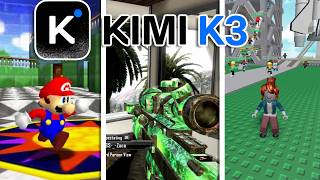
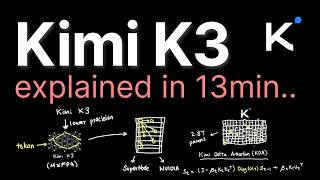
Developer reaction to K3's release split along a familiar fault line: awe at what the model could actually do, and skepticism about what "open" really means for a download most people can't run locally. On X, one widely circulated thread pointed to Moonshot's own claim that K3 autonomously designed a chip in a 48-hour proof-of-concept run - a striking capability signal that also invited pushback, since a separate thread questioned how meaningful open-weight access is when the hardware bar to run the model at home is so high; a third, quieter post was simply an individual engineer working through the architecture step by step. That same tension showed up on YouTube, where an architecture walkthrough broke down the MoE sparsity and Stable Latent MoE compression approach for a technical audience, while a coding demo showed the model generating multiple playable 3D browser games from single prompts in agentic auto-approve mode - the kind of result that reads as a genuine capability jump rather than marketing.

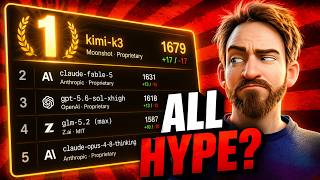
A more skeptical hands-on review complicated the picture: Creator Magic's video found K3 landed #1 on a live front-end-coding leaderboard and out-executed a Claude coding agent in a side-by-side test, but also hit usage and rate limits quickly on a paid plan, a real-world cost caveat set against the benchmark wins. Reddit's r/LocalLLaMA community leaned into the accessibility angle instead, with an actively-discussed extreme local self-hosting build alongside threads on community-released quantized versions that shrink K3's footprint enough for enthusiast hardware - genuine technical excitement laced with jokes about just how much GPU it takes to self-host a model this large. A parallel r/GeminiAI debate over whether Google is falling behind K3 despite its resource advantages also recirculated an unsubstantiated claim online that K3 was distilled from Anthropic's Claude models; that allegation isn't corroborated by the reporting above and is best read as chatter rather than an established fact.

Historical Context

2025-07
Moonshot's open-source pivot began with Kimi K2, an open-source MoE model (32B activated / 1T total parameters) under a Modified MIT license, which became one of the strongest open-weight models of 2025.
2026-01
Moonshot accelerated its open-source strategy with the release of K2.5.
2026-05
Moonshot raised $2 billion at a $20 billion valuation ahead of the K3 launch.
2026-07-16
Moonshot unveiled Kimi K3, claiming competitive performance with Claude Fable 5 and substantial gains over Opus 4.8 and GPT-5.6 on certain evaluations, while in a funding round valuing it at $31.5 billion.
2026-07-27
Moonshot released Kimi K3's full open weights and a 47-page technical report for unrestricted download, coinciding with Xi Jinping's speech at the World AI Conference in Shanghai; the announcement was followed by a roughly 1% Nasdaq drop as chip stocks sold off.
2026-07-30
OpenAI cut GPT-5.6 Luna and Terra pricing by up to 80%, three days after Kimi K3's open-weight release.
2026-07-31
Bloomberg reported that Kimi K3 was trained using a 20,000-chip Nvidia cluster supplied via Alibaba's cloud.

Power Map

Key Players
Subject

Moonshot AI's Kimi K3 model launch and ecosystem adoption

MO

Moonshot AI

Beijing-based startup that built and released Kimi K3; backed by Alibaba, reportedly at $300M ARR as of June 2026 and seeking a new round at a $50B valuation ahead of a possible Hong Kong IPO.

AL

Alibaba Group

Major Moonshot investor that supplied the training compute, reportedly a 20,000-chip Nvidia cluster; Alibaba specifically denies the H200 chip-type characterization while not denying the underlying ~20,000-chip count itself.

NV

Nvidia

Chip supplier whose processors underpin Moonshot's training infrastructure; CEO Jensen Huang commented that companies should be allowed to use Chinese models.

MI

Microsoft (via Fireworks AI on Foundry)

Made K3 deployable on Microsoft Foundry/Azure through a Fireworks AI inference partnership, with Microsoft Foundry handling enterprise procurement, identity, billing and governance; also reportedly tested K3 for Copilot.

OP

OpenAI

Cut GPT-5.6 Luna and Terra API pricing by 80% and 20% respectively within three days of K3's release, under direct competitive pressure from a cheaper, capable open-weight model.

WH

White House / Michael Kratsios

US administration official who accused Moonshot of illegally acquiring Blackwell chips via Southeast Asia and, without evidence, of distilling Anthropic's Fable model to train K3; Moonshot confirmed the Southeast Asian Blackwell access.

Fact Check

16 cited
  1. [1] Kimi K3 - Moonshot AI blog
  2. [2] Dell, DigitalOcean bring Kimi K3 to enterprise AI
  3. [3] Kimi K3 on Microsoft Foundry
  4. [4] Kimi K3 providers - Artificial Analysis
  5. [5] Deploying Kimi K3 on AWS
  6. [6] Moonshot's Kimi and the 20,000 Nvidia chip Alibaba cluster
  7. [7] Moonshot's Kimi built on 20,000 Nvidia chip cluster from Alibaba
  8. [8] Experts say exploiting Anthropic's Fable isn't how Kimi K3 got so good
  9. [9] OpenAI slashes GPT-5.6 prices by up to 80% as AI cost war heats up after Moonshot AI's Kimi K3 release
  10. [10] OpenAI cuts GPT-5.6 prices
  11. [11] Why Kimi K3 signals a convergence toward open-weight models
  12. [12] Kimi: threat or menace?
  13. [13] GOOGL, MSFT, AMZN stocks rise premarket, analyst says China's Kimi K3 AI fears misplaced
  14. [14] Introducing Kimi K3 through Fireworks AI on Microsoft Foundry
  15. [15] Kimi K3 on Nebius
  16. [16] Kimi K3 AI breakthrough: what Wall Street analysts say

Source Articles

Top 5

THE SIGNAL.

Analysts

Sees K3's algorithmic progress as evidence AI capability advances are continuing, which he calls positive for the overall industry since a stalling of progress would be the real bear case.

Malik Ahmed Khan, Morningstar analyst
Bullish on the broader AI ecosystem

Notes Moonshot priced K3 at about 60% of Claude Opus 4.8 and roughly half of GPT-5.6 Sol, framing the step-up from free/cheap prior open models as bullish for the corporate AI landscape.

Alex Liu, BofA Securities analyst
Reads K3's premium pricing as a positive signal, not a threat

K3 ranked second overall on the Vals AI index and third on Artificial Analysis's Intelligence Index, trailing only Claude Fable and GPT-5.6 Sol Max while undercutting both on price, and placed first on the Frontend Code Arena benchmark.

Nathan Lambert, AI researcher
Assesses K3's competitive benchmark standing

Called China's Kimi K3 fears for Google, Microsoft and Amazon 'misplaced,' coinciding with a premarket rise in GOOGL, MSFT and AMZN shares.

Wall Street analyst commentary via TradingView/Stocktwits
Argues fears about K3's impact on US tech stocks are overblown
The Crowd

Kimi for chip design (RSI needs new hardware as well). "As an early proof of concept, Kimi K3 designed a chip to serve a nano model built on its own architecture. In a single 48-hour autonomous run, K3 built, optimized, and verified the chip using open-source EDA tools on the..."

@@bookwormengr85

The biggest open AI model ever released has a dirty secret. Kimi K3's weights are free. All 2.8 trillion parameters. The download? 1.4 terabytes. You can't run it on your laptop. Or your gaming PC. Most companies can't run it on their servers. So what does "open" actually...

@@JulianGoldieSEO0

finally made it through the architecture section of kimi k3. hoping the training part goes a little easier on me 😮‍💨

@@pradheepraop10

How is Google getting outpaced by Kimi-K3? A tech monolith shouldn't be losing like this.

@u/metalbug4414
Broadcast
Kimi K3 explained in 13min..

Kimi K3 explained in 13min..

Kimi K3 is just ridiculous

Kimi K3 is just ridiculous

Kimi K3: Don't Believe the Hype (I Paid to Test)

Kimi K3: Don't Believe the Hype (I Paid to Test)