Trump's 'Super Intelligence Force' AI task force
TECH

Trump's 'Super Intelligence Force' AI task force

42+
Signals

Strategic Overview

  • 01.
    President Trump formally announced the creation of the 'Super Intelligence Force' (SIF) on October 4, 2026, chaired by Director of National Intelligence Jay Clayton and tasked with coordinating the federal government's AI effort. The task force must deliver a comprehensive assessment of AI/superintelligence risks and opportunities within 120 days and clarify the federal government's appropriate role.
  • 02.
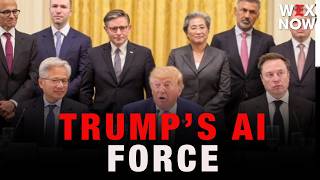
    SIF's creation follows a September 29, 2026 executive order, 'Inaugurating the Era of Super Intelligence,' directing federal agencies to replace 'Artificial Intelligence'/'AI' with 'Super Intelligence'/'SI' in official communications, and a related White House meeting where six companies - OpenAI, Anthropic, Google, Meta, Nvidia, and SpaceX's AI division - signed a voluntary, non-binding safety 'constitution.'
  • 03.
    The task force's charter explicitly directs it to develop plans for countering SI-enabled threats 'while preventing overregulation and regulatory capture that would stifle innovation and competition,' placing Vice President JD Vance, Treasury Secretary Scott Bessent, and Defense Secretary Pete Hegseth among its core decision-makers, alongside outside advisers David Sacks and Condoleezza Rice.

Deep Analysis

What the Task Force Actually Controls

On paper, SIF looks like a command structure: a chair (DNI Jay Clayton), three vice chairs covering consumer protection (FTC's Andrew Ferguson), defense R&D (Emil Michael), and infrastructure (Scott Kupor), plus core decision-makers in Vance, Bessent, and Hegseth and outside advisers Sacks and Rice [1]. It reports directly to Trump and Chief of Staff Susie Wiles [2]. But its actual deliverable in the near term is a report, not a rule: within 120 days it must assess superintelligence risks and opportunities and recommend 'the federal government's appropriate role' [1][3]. Nothing in the charter requires that report to produce binding regulation - the structure is built for coordination and assessment, not enforcement.
A Rebrand Wrapped in a Mandate

SIF did not emerge in isolation. It follows an executive order, signed days earlier, ordering federal agencies to purge the term 'Artificial Intelligence' in favor of 'Super Intelligence' across official communications [4], itself foreshadowed by Trump telling the UN General Assembly that 'artificial' makes intelligence sound 'fake.' TechCrunch's Kirsten Korosec reads the whole campaign as a messaging exercise: a way to move public perception away from 'AI is going to kill us, it's scary, it is going to take jobs' toward a friendlier frame where 'super intelligence is not' [5]. Elon Musk's decision to rename SpaceXAI to 'SpaceXSI' - 'No more AI. SI. It's better' - shows the branding shift spreading into industry even as the substantive policy content stays thin [6][7].

China Framing Supplies the Urgency

Clayton's own justification for SIF leans almost entirely on geopolitical competition rather than AI's intrinsic risks: 'The risk of not being first is high. Not being first increases the identified, and unidentified, risks, particularly from our adversaries' [1][8]. That framing is reinforced by reporting on China's roughly $280 million 'Supermind' AI tracking platform, funded largely by the Shenzhen government, cited as the kind of state-backed effort the US is racing against [9]. Casting the risk as falling behind rather than moving too fast is also what justifies the charter's instruction to avoid 'overregulation and regulatory capture' - a competitiveness argument doubles as a deregulation argument.

A Voluntary Pact With No Enforcement Mechanism

The safety 'constitution' signed by OpenAI, Anthropic, Google, Meta, Nvidia, and SpaceX's AI division at the same White House meeting sets no penalties, requires no public disclosure of audits, and gives the government no formal enforcement role - TechCrunch's Sean O'Kane calls it 'deeply non-binding ... completely voluntary' [5]. Colleague Anthony Ha adds that the appearance of industry-government unity obscures real friction: Treasury is friendlier toward Anthropic while the Defense Department remains hostile, meaning the same administration speaks with different voices depending on which company is in the room [5]. Analysts cited by Fox News go further, noting that 'a task force report cannot by itself replace legislation, establish criminal liability or override statutory mandates of independent regulators' - meaning any durable guardrails would still require Congress and formal rulemaking [10].

Official Triumph, Public Skepticism

The administration's own framing has been celebratory: officials have presented SIF as cutting red tape and partnering with industry to keep America ahead, a tone amplified even as other reporting notes the announcement landed amid growing public pressure for an AI slowdown rather than an acceleration [11]. That gap showed up in how the story spread. A cable-news panel publicly questioned whether this administration is equipped to manage AI risk at all, while broader online reaction leaned toward comparisons with the satirical film Idiocracy and skepticism that current AI systems are anywhere close to genuine superintelligence - with much of the conversation fixating on the optics and timing of the rebrand rather than the substance of what the task force will actually produce in 120 days.

Historical Context

2026-09-22
Trump told the 81st UN General Assembly he wants the US to drop the term 'AI' for 'super intelligence,' arguing the word 'artificial' makes intelligence sound 'fake.'
2026-09-29
Trump signed the executive order 'Inaugurating the Era of Super Intelligence,' mandating federal agencies replace 'AI' with 'SI' in official materials.
2026-10-04
Trump met with tech CEOs at the White House, where six companies signed a voluntary 'Joint Commitment on Frontier Responsibilities,' then formally announced the creation of the Super Intelligence Force.
2026-10-05
Musk said he would rename SpaceXAI to 'SpaceXSI,' posting on X, 'No more AI. SI. It's better,' echoing Trump's terminology push.

Power Map

Key Players
Subject

Trump's 'Super Intelligence Force' AI task force

JA

Jay Clayton

Director of National Intelligence; chairs SIF and is described in coverage as Trump's 'AI czar,' framing US AI leadership as a national-security imperative

AN

Andrew Ferguson

FTC Chairman; vice chair handling consumer-protection and civil-liberties aspects of SIF's mandate

EM

Emil Michael

Under Secretary of Defense/War for Research and Engineering; vice chair coordinating defense R&D

SC

Scott Kupor

Director, Office of Personnel Management; vice chair liaising on critical infrastructure

JD

JD Vance

Vice President; core decision-maker on SIF alongside fellow core members Treasury Secretary Scott Bessent and Defense Secretary Pete Hegseth; the task force ultimately reports to President Trump and Chief of Staff Susie Wiles

DA

David Sacks

Venture capitalist and former White House AI czar; outside adviser to SIF on national security, alongside fellow outside adviser and former Secretary of State Condoleezza Rice

Fact Check

11 cited
  1. [1] BiGGo Finance: Trump Super Intelligence Force task force structure
  2. [2] CBS News: AI Super Intelligence Force, Trump, Jay Clayton
  3. [3] BiGGo Finance: Super Intelligence Force 120-day assessment deadline
  4. [4] Freshfields: Trump executive order mandates shift to Super Intelligence
  5. [5] TechCrunch: Can Super Intelligence and a non-binding safety pact solve AI's image problem?
  6. [6] TechSpot: Elon Musk says SpaceXAI will become SpaceXSI following Trump push
  7. [7] Yahoo News: Elon Musk says he will rename his company SpaceXSI
  8. [8] ABC News: President Trump announces creation of Super Intelligence Force
  9. [9] Newsweek: China-US conflict over artificial intelligence and espionage
  10. [10] Fox News: Trump taps top officials to lead new Super Intelligence Force
  11. [11] Washington Post: Trump launches Super Intelligence Force after calls for AI slowdown

Source Articles

Top 5

THE SIGNAL.

Analysts

“Clayton argues that losing the race to build superintelligence first is itself the danger: "The risk of not being first is high. Not being first increases the identified, and unidentified, risks, particularly from our adversaries."”

Jay Clayton (DNI, SIF Chair)
Frames falling behind geopolitical rivals, not AI's own dangers, as the central risk

“O'Kane describes the signed accord as "deeply non-binding ... completely voluntary," arguing it functions more as a public-relations gesture than an accountability mechanism.”

Sean O'Kane (TechCrunch)
Skeptical the accompanying industry safety pact carries any real enforcement power

“Korosec frames the rename as an attempt to detach AI from fear-based narratives: it's "a rebranding effort around AI ... AI is going to kill us, it's scary, it is going to take jobs - but super intelligence is not."”

Kirsten Korosec (TechCrunch)
Views the entire 'Super Intelligence' push as messaging rather than substantive policy

“Ha notes that "different White House factions maintain conflicting stances on Anthropic - with the Treasury Department favorable while the Defense Department remains hostile," suggesting the unified-front optics of the pact and task force paper over real disagreement.”

Anthony Ha (TechCrunch)
Points to unresolved internal administration splits over specific AI companies

“Analysts caution that "a task force report cannot by itself replace legislation, establish criminal liability or override statutory mandates of independent regulators," meaning durable AI rules still require Congress and formal rulemaking.”

Unnamed policy analysts (via Fox News)
Raise accountability concerns about governing AI through a task force rather than law
The Crowd

“I am announcing the formation of the Super Intelligence Force (SIF). The Super Intelligence Force is tasked with coordinating the effort of the Federal Government to ensure that America continues to lead the World in Super Intelligence, which many say is bigger than the [continues in attached image]”

@@WhiteHouse32990

“It is my great honor to serve on President Trump's Super Intelligence Force (SIF). At the @DeptofWar we have seen what is possible when red tape is removed and America's best technology is rapidly put into action. Working alongside America's leading technology companies, we are...”

@@USWREMichael9353

“President Trump announcing a new 'Super Intelligence Force' to coordinate the federal government's AI response and to help coordinate consumer engagement with tech companies. @AlexandriaHoff has the latest.”

@@FoxNews363

“Trump launches 'Super Intelligence Force' after calls for AI slowdown”

@u/deeptechdegen751
Broadcast
President Trump announces new federal "Super Intelligence Force"

President Trump announces new federal "Super Intelligence Force"

Trump announces 'Super Intelligence Force' led by DNI Jay Clayton

Trump announces 'Super Intelligence Force' led by DNI Jay Clayton

'Worst possible president in charge right now' to handle A.I.: Author

'Worst possible president in charge right now' to handle A.I.: Author

Trump's 'Super Intelligence Force' AI task force — AI News | Agentic Brew