Agentic AI workflows go mainstream
TECH

Agentic AI workflows go mainstream

22+
Signals

Strategic Overview

  • 01.
    Both Gartner and McKinsey named agentic AI the top enterprise technology trend for 2026, moving teams of coordinated agents from experiment to board-level priority.
  • 02.
    Multi-agent systems - networks of specialized agents coordinated by an orchestrator, each focused on a different workflow stage - are seen by Forrester and Gartner as the breakthrough pattern replacing single-shot chatbots for end-to-end enterprise tasks.
  • 03.
    Despite the interest, McKinsey found that in any given business function no more than 10% of organizations report scaling AI agents, showing production deployment still trails experimentation.
  • 04.
    Enterprises are increasingly treating agentic AI as an organizational-redesign question - how work, decisions and roles are structured - rather than just a technology-placement decision.

The Trend Everyone Named and Almost No One Scaled
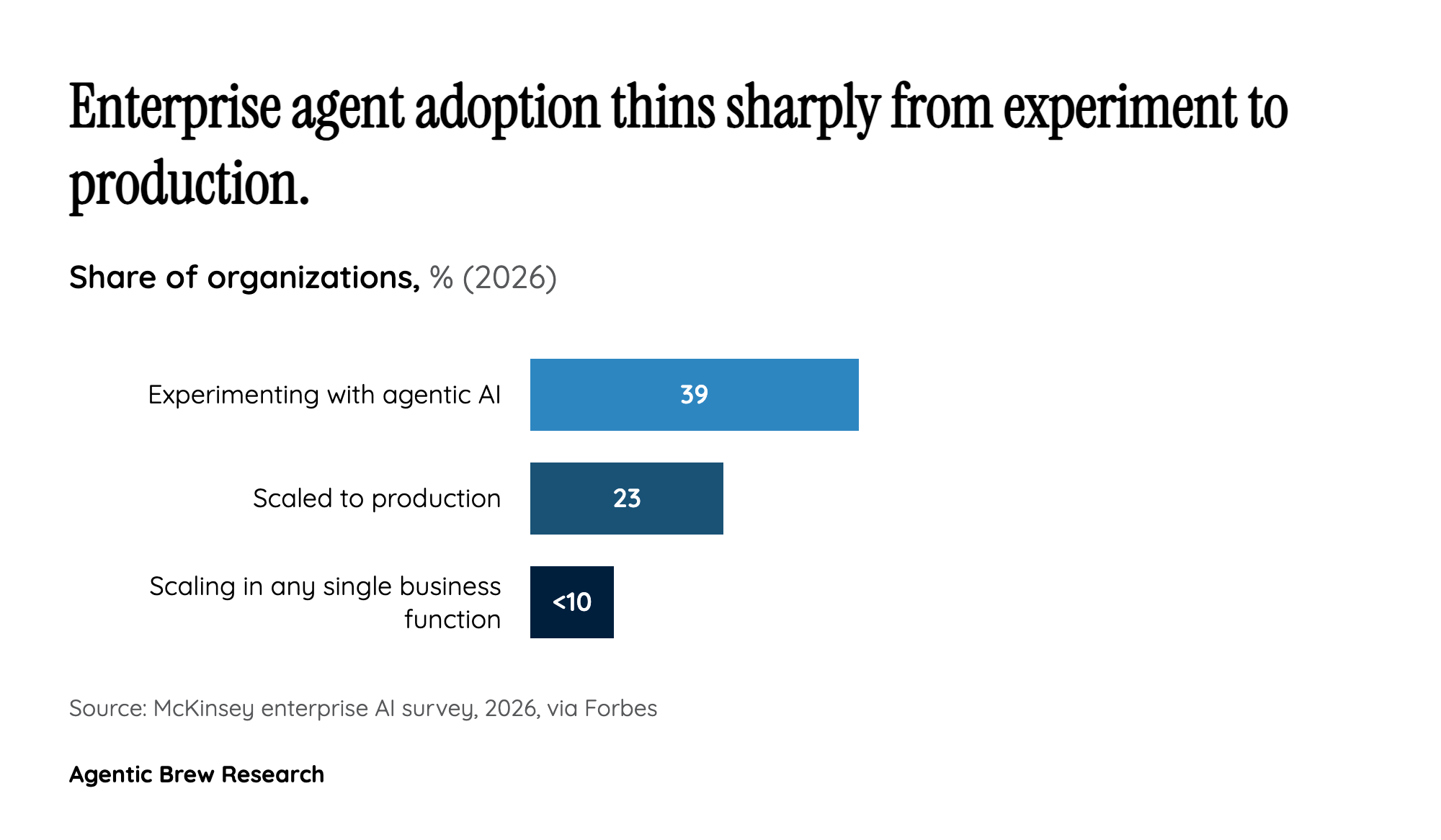
The Trend Everyone Named and Almost No One Scaled
Share of organizations experimenting with, scaling to production, and scaling per-function agentic AI - McKinsey, 2026.

Agentic AI enters 2026 with the rarest of endorsements: Gartner and McKinsey both crowned it the top enterprise technology trend for the year [1]. That designation matters less as a forecast than as a budget signal - once the big analyst houses stamp a category, enterprise money follows. Bloomberg's Salesforce feature captures why this cycle feels different from past AI waves: leaders say they are no longer just deciding where technology sits, but 'how work itself will be redesigned, how decisions will be made and what kind of enterprise they want to become' [2].

And yet the deployment reality is strikingly thin. McKinsey's own data shows that in any given business function, no more than 10% of organizations report scaling AI agents [3], and it separately estimates that fewer than 10% of organizations have deployed agentic workflows end-to-end [1]. Box CEO Aaron Levie puts it bluntly: most companies 'aren't even using coding agents at scale, let alone for the rest of knowledge work' [3]. So the headline story of 2026 is a paradox - the single most-hyped enterprise technology is also one of the least actually operationalized. That gap between mandate and production is exactly where the interesting fights, and the interesting failures, are happening.

The Workflow Layer Beats the Model

The most useful reframing to come out of this cycle is that the hard part of agentic AI is not the model - it is everything around it. Both Gartner and Forrester describe the breakthrough pattern as multi-agent systems: networks of specialized agents, each owning a stage of the workflow, coordinated by an orchestrator [4]. In practice a chatbot answers a question in one shot; an agentic system plans, acts, calls tools, checks its own work and iterates until an end-to-end task is done. The intelligence that matters lives in that loop, not in any single prompt.

This is where the builder community and the analysts actually agree. On the developer side of X and in production-focused subreddits, the dominant refrain is that execution, orchestration, integrations, tracing, approvals and reliability - not raw model quality - are what decide whether an agent ships to production. Practitioners point to a discipline they call agentic engineering, distinguished from casual 'vibe coding' by real skills like spec design, evaluation loops and security oversight, with tooling and workshops now shipping from the largest labs and cloud vendors. The implication for buyers is uncomfortable: swapping in a smarter model rarely rescues a workflow whose orchestration and guardrails were never built. The moat is the plumbing.

Follow the Bill, Not the Token Price

Vendors are selling a falling-cost story, and it is partly real: Anthropic launched Claude Sonnet 5 explicitly as a cheaper way to run agents [5], and reported returns are eye-catching, with an average of roughly 171% ROI on deployed agents and cited gains like a 40-60% cut in procurement cycle time [6]. Analysts add that AI agents could unlock $2.6-4.4 trillion in annual value across business use cases [7], which is the number every deck quotes.

The practitioner ledger looks different. Among experienced developers, the tone is markedly more skeptical and, frankly, exhausted: leadership wants autonomous 'fleet orchestration' while engineers report burnout, unreliable output and runaway bills. The load-bearing anecdote is a harness engineer who stood up a ten-agent 'team' and then showed the invoice - four figures to ship a single feature in a day, and thousands more just to compress an eight-hour job into four - noting that painstakingly built agent skills can go stale within about a week. That is the hidden bill under the falling per-token price: parallel agents multiply the number of runs, retries and context reloads, so the unit cost can drop while the total cost climbs. It also explains executive caution that inference prices still need to fall much further before large fleets pencil out at enterprise scale [8].

Why 40% of These Projects Get Killed

Gartner's most-quoted warning is a hard number: it projects that 40% of agentic AI projects will be canceled by the end of 2027, largely due to 'agent-washed' tools deployed without redesigning the underlying process, on top of weak data foundations [9]. Agent-washing is the tell - bolting an LLM onto an unchanged workflow and calling it an agent. On Reddit the same critique lands as a punchline: skeptics dismiss much of the trend as 'just CICD workflows' or 'a github action with an LLM call slapped on,' and call the pitch of a system taking a ticket from product straight to a pull request without human interaction 'a wild reach.'

The deeper constraint is governance and data readiness. A large share of enterprises already in production still lack adequate governance, and agents perform poorly on disorganized data while most organizations remain mid-journey on data consolidation and access controls [10]. This reframes the adoption gap from earlier: the reason only a sliver of functions scale agents is not timidity but plumbing - messy data and thin guardrails cap how far autonomy can safely go. It also validates the community's insistence that human-in-the-loop verification is non-negotiable and that the realistic near-term fit is greenfield prototypes, triage and targeted automation, not lights-out end-to-end enterprise delivery. Gartner's projected embed rate - task-specific agents in 40% of enterprise applications by end of 2026, up from under 5% in 2025 [9]- will only convert to durable value where the process, not just the model, was redesigned.

Historical Context

1986
Published 'The Society of Mind', the most-cited theoretical blueprint for the view that intelligence emerges from many simple interacting agents.
1990
The 1990s popularized multi-agent systems and belief-desire-intention (BDI) architectures, giving agents formal ways to coordinate.
2023-03-28
First publicly demonstrated end-to-end autonomous LLM agents (BabyAGI on Mar 28, AutoGPT on Mar 30), launching the single-agent LLM era.
2026-03-19
At GTC, Huang projected Nvidia would have about 75,000 employees working with 7.5 million agents within a decade - a 100:1 ratio.

Power Map

Key Players
Subject

Agentic AI workflows go mainstream

NV

Nvidia (Jensen Huang, CEO)

Supplies the compute powering agent fleets; Huang is the most prominent public voice predicting a roughly 100-to-1 agent-to-human workforce, framing agents as coworkers rather than job-killers.

MI

Microsoft (Copilot Studio)

Reported market leader in enterprise agent deployments at about 31% share, pulled by Microsoft 365 distribution, with computer-using agents reaching general availability in May 2026.

SA

Salesforce (Agentforce) with AWS

Partnering to scale agents across unified data, security, contact centers and procurement; cited at about 24% share with 200,000-plus deployments in year one.

AN

Anthropic

Powers roughly 18% of enterprise agent deployments via the Claude API across 3,000-plus customers, and launched a cheaper Claude Sonnet 5 explicitly positioned to run agents at lower cost.

MC

McKinsey, Gartner and Forrester

Analyst firms shaping enterprise agendas; their designation of agentic AI as the top 2026 trend legitimizes budgets, while their cancellation and adoption-gap warnings temper expectations.

Fact Check

11 cited
  1. [1] Gartner and McKinsey Name Agentic AI the Top Enterprise Technology Trend
  2. [2] As Companies Bet Big on Agentic AI, Strategies Must Shift to Drive Results
  3. [3] 10% Of Enterprise Functions Use AI Agents, McKinsey Finds
  4. [4] Multi-Agent Frameworks
  5. [5] Anthropic launches Claude Sonnet 5 as a cheaper way to run agents
  6. [6] Top Agentic AI Companies 2026
  7. [7] AI Agents In Enterprise Market Survey: McKinsey, PwC, Deloitte, Gartner
  8. [8] Palo Alto CEO Arora on AI pricing
  9. [9] AI Agent Adoption in 2026: What the Analysts Data Shows
  10. [10] Agentic AI Enterprise Adoption 2026: The Governance Gap
  11. [11] Agentic Workflows: Patterns and Best Practices for Enterprise

Source Articles

Top 1

THE SIGNAL.

Analysts

"Predicts a workforce where a small human headcount manages massive fleets of always-on agents, framing it as opportunity over displacement: 'Those 75,000 employees will be working with 7.5 million agents.'"

Jensen Huang
CEO, Nvidia

"Argues mainstream agentic adoption is still early - 'the majority of companies aren't even using coding agents at scale, let alone for the rest of knowledge work.'"

Aaron Levie
CEO, Box

"Estimates that fewer than 10% of organizations have deployed agentic workflows end-to-end, meaning true production deployment remains rare despite the hype."

McKinsey
Analyst firm (institutional view)
The Crowd

"Karpathy's Agentic Engineering finally has proper tooling! (built by Google) Karpathy defined agentic engineering as the discipline that separates production agent work from vibe coding. The core skills he listed were spec design, eval loops, and security oversight."

@@_avichawla597

"Anthropic just dropped 5 workshops on building self-improving agentic systems from scratch: 00:00 - Ship your first Claude agent 36:44 - Build memory for Claude agents 1:05:06 - Make your agent autonomous 1:26:46 - Set up a proactive agent 2:03:35 - self-improving agents"

@@cyrilXBT297

"Opus 4.8's most underrated feature. Everyone is talking about the model. The benchmarks, the honesty improvements, the cheaper fast mode. But the feature that shipped alongside it might matter more for how we actually build: Dynamic Workflows in Claude Code."

@@DailyDoseOfDS_61

"For folks heavily using a agentic engineering, What does your workflow look like? What tools do you use? What's your harness like?"

@u/Enum163
Broadcast
Agentic AI Frameworks Explained: Workflows, Multi-Agent, & Production

Agentic AI Frameworks Explained: Workflows, Multi-Agent, & Production

AGENTIC WORKFLOWS: Build & Sell AI Automations (2026)

AGENTIC WORKFLOWS: Build & Sell AI Automations (2026)

From Zero to Your First Agentic AI Workflow in 26 Minutes (Claude Code)

From Zero to Your First Agentic AI Workflow in 26 Minutes (Claude Code)