Z.ai (Zhipu) releases GLM-5.2 flagship coding model
TECH

Z.ai (Zhipu) releases GLM-5.2 flagship coding model

31+
Signals

Strategic Overview

  • 01.
    Z.ai (Zhipu) released GLM-5.2, its new flagship coding model, on June 13, 2026, available immediately to all GLM Coding Plan tiers (Lite, Pro, Max, Team) at no extra cost.
  • 02.
    The model ships with a usable 1-million-token context window (model id glm-5.2[1m]) and a maximum output capped at 131,072 tokens, positioned as a coding-first system for agentic coding tasks and long-horizon refactors.
  • 03.
    The standalone API, the Z.ai chatbot, and MIT-licensed open weights were all scheduled for the following week, framing the launch around accessible, open frontier intelligence.
  • 04.
    Zhipu published no benchmark numbers at launch (no SWE-bench Verified, LiveCodeBench, or HumanEval), leaving its coding and long-horizon performance claims vendor-asserted and unverified.

The Rollout Paradox: Open-Frontier Rhetoric, Paywalled and Throttled

GLM-5.2's launch messaging leans hard on radical openness — frontier intelligence that should be open, usable, and buildable, with MIT-licensed weights promised for the following week [5]. Yet on launch day the only way to touch the model was a paid GLM Coding Plan subscription, with no standalone API and no public chatbot until the next week [2]. That gap is the central tension. The model is treated as an advanced, premium-quota system: reportedly 3x the standard consumption rate at peak hours and 2x off-peak, so even paying users burn their allowance fast [6]. Coding Plan quotas are tiered — roughly 80 prompts per 5 hours on Lite, 400 on Pro, and 1,600 on Max, with Team seats managed separately [1].

That contradiction is what the community fixated on. Independent testers and commentators reported severe first-party throttling on launch day, and one analyst directly questioned the economics of a plan where the heaviest users appear to be penalized rather than rewarded. The result: a model marketed as accessible, open frontier intelligence that, for its first week, was gated, metered, and prone to slowing under load — with many users explicitly planning to wait for the open weights and run GLM-5.2 through third-party providers instead.

The Verification Vacuum: No Official Benchmarks, So YouTube Is the Evidence

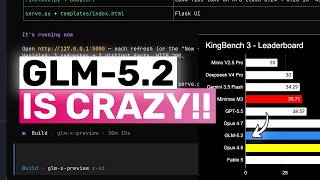
Zhipu shipped GLM-5.2 with no benchmark numbers and no technical report — no SWE-bench Verified, no LiveCodeBench, no HumanEval — so every coding and long-horizon claim is vendor-asserted [2]. That vacuum pushed the only available evidence onto independent testers, who split sharply. Hands-on reviewers showcased practical agentic builds (a browser OS, C++ games, a 3D-printer simulation) and clocked a large speed gain — one measured roughly 296 tokens per second, about 3x faster than GLM-5.1.

One benchmark-style reviewer ranked it at the top of his own reasoning test at a fraction of a rival's price, yet still withheld approval, citing weak attention to detail (it couldn't produce a playable Minecraft clone or an escapable horror game) and brutal rate limits, burning most of a five-hour quota in a single hour. Another tester scored it near-frontier, roughly 6% below Opus 4.8. The community treated these informal benchmarks with open skepticism, noting they are no-name tests rather than standardized evaluations. For context, the predecessor GLM-5.1 reportedly reached ~94.6% of Claude Opus 4.6's coding score [9]— the kind of like-for-like comparison GLM-5.2 conspicuously lacks at launch.

Geopolitics and the No-NVIDIA Lineage: Open Weights as a Weapon

GLM-5.2 is the third quarterly flagship in a lineage explicitly built to route around US hardware: GLM-5 was a 744B-parameter MoE model trained entirely on Huawei Ascend chips with MindSpore and no NVIDIA dependency, shipped just after Zhipu became the first publicly-listed Chinese AI lab [8]. The MIT-license decision is read not as charity but as a calculated move to commoditize high-end coding intelligence and turn the global developer community into free R&D and distribution [4]. The strategic logic is a data flywheel and developer brand loyalty that could accelerate future GLM iterations faster than rivals who keep weights behind paid APIs [4].

GLM-5.2 is positioned squarely as a permissively licensed, cost-effective alternative to Claude Code and GPT-5.5 [3]. And the openness is competitive within China too: the community framed the release as pressure on DeepSeek to hasten its next model, with GLM and Kimi each already on their third flagship iteration [5].

The Cadence and Flywheel: Quarterly Shipping as the Real Moat

What may matter more than any single benchmark is the pace. The GLM line has shipped roughly quarterly — 8+ major releases in 18 months — moving GLM-4 (June 2024) to GLM-4.6 (September 2025) to the frontier GLM-5 (February 2026) to GLM-5.1 (April 2026) to GLM-5.2 in June 2026 [7]. The release was also explicitly feedback-driven, rolled out to Coding Plan users hours after public feedback, suggesting a tight loop between users and the next iteration.

Community analysis suggests GLM-5.2 is likely not a larger pretrain than GLM-5.1 — plausibly a similar-scale model augmented with sparse-attention techniques to unlock the 1M window — which fits a cadence built on incremental, fast-cycle improvement rather than expensive ground-up rebuilds. Combined with MIT weights and out-of-the-box compatibility with major agentic coding tools [2], the strategy is less about winning one benchmark and more about compounding: cheap, frequent, open releases that keep developers in the ecosystem and feed the next model. One known ceiling on that flywheel: GLM-5.2 is text-only, with no vision input, a gap rivals can still exploit.

Historical Context

2024-06
Released GLM-4, the start of the modern GLM lineage.
2025-09
Released GLM-4.6, the first Chinese flagship to run on Cambricon chips at FP8 + Int4.
2026-02-11
Released GLM-5, a 744B-parameter MoE frontier model trained entirely on Huawei Ascend chips with MindSpore (no NVIDIA dependency), shortly after becoming the first publicly-listed Chinese AI lab.
2026-04
Released GLM-5.1, whose coding benchmark score reportedly rose to ~94.6% of Claude Opus 4.6's coding performance.
2026-06-13
Released GLM-5.2 to all GLM Coding Plan tiers with a 1M context window, with API, chatbot, and MIT weights promised the following week.

Power Map

Key Players
Subject

Z.ai (Zhipu) releases GLM-5.2 flagship coding model

Z.

Z.ai / Zhipu AI

Developer and vendor of GLM-5.2; first publicly-listed Chinese AI lab (HKEX, Jan 2026), driving an open-source coding strategy aimed at building a developer data flywheel.

GL

GLM Coding Plan subscribers (Lite/Pro/Max/Team)

End users who received GLM-5.2 immediately at no extra cost across all tiers; Team customers get seat-based management, usage tracking, and code privacy.

AN

Anthropic (Claude) / OpenAI (GPT)

Proprietary incumbents positioned as targets; GLM-5.2 is framed as a permissively licensed, cost-effective alternative to Claude Code and GPT-5.5.

DE

DeepSeek / Kimi (Chinese rivals)

Competing Chinese frontier/coding labs in a fast-iteration open-source race; GLM and Kimi are each on their third flagship iteration.

AG

Agentic coding tool ecosystem (Claude Code, Cline, Roo Code, Goose, etc.)

Distribution channel — out-of-the-box compatibility lets GLM-5.2 plug straight into existing developer workflows.

Fact Check

9 cited
  1. [1] GLM-5.2: Z.ai's Flagship Coding Model and Coding Plan Release
  2. [2] GLM-5.2 Release: 1M Context and Coding-First Design
  3. [3] GLM-5.2 Launch Roundup
  4. [4] Zhipu's GLM-5.2 MIT-License Open-Source Strategy
  5. [5] Zhipu Drops GLM-5.2 as Open Frontier Intelligence
  6. [6] Z.ai GLM-5.2 Coding Plan: OpenAI-Compatible Endpoint
  7. [7] Zhipu GLM Model Lineage 2026
  8. [8] GLM-5: China's First Public AI Company Ships a Frontier Model
  9. [9] GLM-5.1 vs Claude Opus 4.6 Coding Benchmark

Source Articles

Top 5

THE SIGNAL.

Analysts

"Praised the launch timing strategy as deliberately chosen to minimize business disruption: launching on a Saturday to avoid disrupting weekday business users, with a mid-day local launch so engineers could monitor."

Alex J. Champandard
AI researcher/commentator

"Critiqued the GLM Coding Plan business model, arguing a sound model should ensure the most core, highest-volume users generate the largest profit rather than the other way around."

Deli Chen
AI commentator

"Frames releasing GLM-5.2 under an MIT license as a calculated strategic move designed to commoditize high-end coding intelligence and build a developer data flywheel."

China Daily Brief Editorial
News curation outlet (editorial)
The Crowd

"Intelligence should be open, accessible, and ready to build with, empowering every developer, everywhere. GLM-5.2 is now available to all GLM Coding Plan users, including Lite, Pro, Max, and Team plans. As our new flagship model, GLM-5.2 delivers"

@@Zai_org7098

"Thanks for all the feedback. GLM-5.2 will begin rolling out to all Coding Plan users in 3 hours."

@@ZixuanLi_1740

"GLM 5.2 just dropped from Z.ai. And the release is a mess. No benchmarks. No API. They released it on a Saturday in response to the US government banning Claude Fable 5. The only way to touch it is their GLM Coding Plan. A flagship model launch with zero"

@@bridgemindai381

"To developers: GLM-5.2 is now fully open, cutting-edge intelligence belongs to everyone."

@u/Smart-Cap-2216287
Broadcast
GLM-5.2 Is INSANE – Is This the BEST New Open Source Model?

GLM-5.2 Is INSANE – Is This the BEST New Open Source Model?

Vibe Coding With GLM 5.2

Vibe Coding With GLM 5.2

GLM-5.2 (Fully Tested): I got EARLY ACCESS & This MODEL is CRAZY!

GLM-5.2 (Fully Tested): I got EARLY ACCESS & This MODEL is CRAZY!