Jensen Huang's Korea Remarks Reignite 'Race to Superintelligence' Debate
TECH

Jensen Huang's Korea Remarks Reignite 'Race to Superintelligence' Debate

27+
Signals

Strategic Overview

  • 01.
    Nvidia CEO Jensen Huang made the remarks that set off this debate at the Korea Society's annual gala in New York on September 28, 2026, where he received the 2026 Van Fleet Award for his contributions to U.S.-South Korea relations and to the AI and semiconductor industries. His framing was that 'South Korea's ambition is larger than the scale of its human capital.'
  • 02.
    Huang's core argument was that AI and automation remove population as a ceiling on national ambition: 'Korea may be a small country by total population, but with AI it can punch above its weight.'
  • 03.
    In the same speech he rejected AI-doom narratives outright, describing AI as software rather than a living, self-aware entity - 'AI is software, not a living thing, so it doesn't spin out of control on its own. It's less self-aware than a pet rock' - and put a number on it: 'The probability that the world ends in 2030 is zero percent.'
  • 04.
    Huang positioned himself between the two camps, saying 'I believe not in doom or in optimism, but in responsible optimism,' and pledged to extend Nvidia's partnership with Korea's chipmakers: 'I have worked with Korea for the past 33 years, and I will work with Korea for 33 more.'
  • 05.
    He also used the Korea comparison as a critique of the United States, praising Korean receptiveness to technology: 'Korea's enthusiasm for and openness to technology works as a great strength, and my worry is that the U.S. may fail to embrace technology out of excessive fear.'
  • 06.
    The rhetoric sits on top of a very large commercial relationship. Huang pledged a $500 billion partnership with SK Group in July 2026 after meeting President Lee Jae Myung, and Nvidia has also committed GPU supply to a South Korean national AI cloud computing center project, with GPU allocations also going to Samsung.
  • 07.
    The speech reopened an existing fight rather than starting a new one. Anthropic CEO Dario Amodei has called Huang's characterization of his safety position 'an incredible and bad faith distortion,' former Anthropic alignment lead Evan Hubinger has estimated a greater than 10% chance AI destroys humanity within a decade, and Florida Governor Ron DeSantis has publicly mocked Nvidia's 'superintelligence factories' language as a euphemism for surveillance infrastructure.

Deep Analysis

The Compliment Is Also a Supply Contract

Huang delivered the population line at the Korea Society's annual gala in New York on September 28, 2026, while accepting the 2026 Van Fleet Award for his contributions to U.S.-South Korea relations and to the AI and semiconductor industries [1]. Read cold, 'Korea may be a small country by total population, but with AI it can punch above its weight' is futurism about demographics and automation [2]. Read in context, it is procurement talk. The same speech bundled the compliment with a commitment: 'I have worked with Korea for the past 33 years, and I will work with Korea for 33 more,' with Korea's manufacturing strength explicitly framed as core to Nvidia's 'factories of intelligence' [2]. Korean coverage carried the same transcend-your-headcount argument and added the comparative edge Huang put on it, that Korean openness to technology is a strength while his worry is that the United States may fail to embrace technology out of excessive fear [3]. The capital behind the rhetoric is not subtle. In July 2026 Huang met President Lee Jae Myung and pledged a $500 billion partnership with SK Group [4]. Nvidia has also committed GPU supply to a South Korean national AI cloud computing center project [5]. Meetings in New York the same week as the gala reportedly focused on 8th-generation HBM and AI factories [6], with GPU allocation on the table alongside Samsung's Jay Y. Lee [7]. A June 2026 Korea tour had already repositioned the relationship from Nvidia supplier to physical-AI partner, including a prominent Nvidia AI research center under construction in Korea and open recruiting for it [8]. The directional dependency matters: Nvidia's roadmap needs Korean memory at least as much as Korea's growth narrative needs Nvidia's endorsement. 'Punch above its weight' is what a buyer says about a supplier it cannot replace.

The Real Opponent Is Not Demographics, It Is the Safety Camp

The Korea framing got the headlines, but the combative part of the speech was aimed at AI-safety researchers. Huang described AI as 'software, not a living thing, so it doesn't spin out of control on its own. It's less self-aware than a pet rock,' and then quantified his dismissal of extinction scenarios: 'The probability that the world ends in 2030 is zero percent.' He placed himself in a third position, 'not in doom or in optimism, but in responsible optimism' [2]. That rhetorical middle is narrower than it sounds. The same reporting that captured the zero-percent line also carried Huang arguing that development should move as fast as possible irrespective of anyone else, and rejecting new regulation [10]. Both ends of the argument push back hard. Dario Amodei has called Huang's characterization of his position - that Amodei wants only Anthropic permitted to build AI - 'just an incredible and bad faith distortion,' and says what he advocates is a race to the top on safety standards rather than a monopoly on building [9]. Evan Hubinger, formerly leading Anthropic's Alignment Science organization, supplies the direct numerical rebuttal to zero percent, putting the chance AI destroys humanity within a decade above 10% and stating that 'we do not yet have a plan to solve alignment for superintelligence and are not clearly on track to' [10]. Notice the asymmetry in how each side argues. Huang offers a probability with no mechanism and an analogy about pet rocks. The safety side offers an absence - no working alignment plan - which is harder to refute and harder to monetize. A zero-percent claim from the vendor selling the compute is a claim about confidence, not about evidence, and that is precisely the gap critics are attacking.

'Superintelligence Factories' Is Becoming a Political Liability

The most underrated development in this cycle is that the pushback is no longer only coming from alignment researchers. Florida Governor Ron DeSantis attacked the exact phrase Nvidia uses to market AI data centers, reducing it to 'Superintelligence factories = surveillance centers' [11]. That is a different kind of threat than a disagreement over extinction probabilities. Safety critics argue about a future state; a sitting governor is arguing about physical buildings, in states that have to zone, power and tax them. Nvidia's own vocabulary supplies the attack surface. 'Factories of intelligence' is designed to make data centers sound like industrial policy - jobs, exports, national capability - which is also what makes them a target once the frame flips from productive capacity to population-scale monitoring. The Korea speech used that industrial vocabulary approvingly to describe Korean manufacturing's role in Nvidia's build-out [2], which means the same phrasing is doing promotional work abroad and taking political fire at home. The practical risk for Nvidia is not that anyone agrees with the surveillance characterization in detail. It is that 'superintelligence factory' gives opponents of a specific permit a slogan, and infrastructure gets blocked locally far more often than it gets blocked philosophically.

Who Is Actually Amplifying This, and Who Is Not

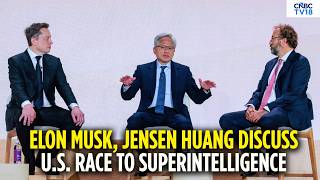
The social footprint of the Korea quote is worth reading carefully, because it looks larger than it is. On X, the dominant pattern is wire-style republication and paraphrase of the quote by headline and newswire accounts, with almost no organic argument attached. The debate framing comes from a small number of accounts that fold the quote into a pre-existing 'race to superintelligence' narrative, rather than from people reacting to anything Korea-specific. The real volume lives elsewhere. Long-form video is where this argument is actually being consumed at scale: a major tech podcast episode featuring Huang, built explicitly around a 'doomer hoax' framing of the AI-safety debate, a high-profile interview episode built around Huang's own argument that AI alarmism has gone too far, and broadcast coverage of a joint Musk and Huang event framed around U.S. competitiveness in the race to superintelligence, including a joint declaration on superintelligence safety. That distribution shape explains why these remarks land the way they do. The population line is a quotable fragment that travels through aggregators; the pace-versus-safety argument underneath it is delivered in long-form interviews that reach far more people and are far more persuasive. Anyone tracking this story through quote-tweets is reading the shadow, not the object.

Historical Context

2025-08-01
On the 'Big Technology' podcast, Amodei rebutted Huang's claim that he believes only Anthropic should be trusted to build AI, calling it an outrageous, bad-faith distortion. An earlier round of the same Huang-versus-safety-camp feud that the Korea remarks later fed.
2026-06-07
On an earlier Korea trip, Huang praised Nvidia's partnerships with LG, SK hynix, Samsung, Hyundai and Naver and announced a prominent Nvidia AI research center being built in Korea, with active recruiting of local researchers.
2026-07-25
Huang met South Korea's president and pledged a $500 billion partnership with SK Group.
2026-09-28
In meetings with Samsung and SK leadership in New York, discussions reportedly centered on 8th-generation HBM and AI factories, immediately ahead of the Korea Society gala.
2026-09-28
Huang received the Korea Society's 2026 Van Fleet Award in New York and used the gala speech to deliver the population, superintelligence and AI-safety remarks at the center of this story.

Power Map

Key Players
Subject

Jensen Huang's Korea Remarks Reignite 'Race to Superintelligence' Debate

JE

Jensen Huang / Nvidia

Nvidia CEO and the company's chief negotiator for Korean partnerships with Samsung, SK hynix, Hyundai, Naver and LG. Made the Korea population remarks and frames AI and automation as the lever that lets a small-population country pursue superintelligence-scale goals.

SA

Samsung Electronics / Jay Y. Lee

Memory and HBM design partner receiving GPU allocations and covered by Huang's extended 33-year collaboration commitment.

SK

SK hynix / SK Group (Chey Tae-won)

Memory-chip partner at the center of Nvidia's supply chain. Huang pledged a $500 billion partnership with SK Group and extended collaboration for another 33 years.

SO

South Korean government / President Lee Jae Myung

Government counterpart that met Huang and secured Nvidia GPU supply commitments, including for a national AI cloud computing center project.

AN

Anthropic / Dario Amodei

The principal AI-safety counterweight in this dispute. Publicly rejects Huang's characterization of Anthropic's position, specifically the claim that Amodei wants only Anthropic to be allowed to build AI.

RO

Ron DeSantis, Governor of Florida

Political critic who attacked Nvidia's 'superintelligence factories' framing for AI data centers, recasting it as surveillance infrastructure.

Fact Check

11 cited
  1. [1] Huang receives Korea Society's 2026 Van Fleet Award in New York
  2. [2] Nvidia CEO rejects AI doom talk, vows 33 more years with Korea
  3. [3] Huang says AI lets Korea transcend its human-capital limits
  4. [4] Jensen Huang meets President Lee, pledges $500 billion
  5. [5] Nvidia to supply GPUs for Korea's national AI cloud computing center
  6. [6] Huang, Samsung and SK leaders discuss 8th-generation HBM and AI factories
  7. [7] Huang meets Samsung's Jay Y. Lee on GPU allocations and chip partnership
  8. [8] Huang's Korea tour showcases country's rise from Nvidia supplier to physical AI partner
  9. [9] Anthropic CEO Dario Amodei fires back at Jensen Huang
  10. [10] Jensen Huang says there is a 0% chance AI destroys the world by 2030
  11. [11] Ron DeSantis takes aim at Nvidia CEO Jensen Huang: superintelligence factories are surveillance centers

Source Articles

Top 1

THE SIGNAL.

Analysts

“Rejects Huang's portrayal of his safety stance as wanting AI development restricted to Anthropic alone, calling it 'just an incredible and bad faith distortion,' and says what he actually advocates is a 'race to the top' on safety standards.”

Dario Amodei
CEO, Anthropic

“Directly contradicts Huang's zero-percent doom estimate, putting the chance that AI destroys humanity within a decade at greater than 10% and arguing the industry has no working plan for the problem: 'Anthropic is trying its best, but we do not yet have a plan to solve alignment for superintelligence and are not clearly on track to.'”

Evan Hubinger
Former Alignment Science organization lead, Anthropic

“Attacks the vocabulary rather than the technology, arguing that what Nvidia markets as intelligence infrastructure is something else in practice: 'Superintelligence factories = surveillance centers.'”

Ron DeSantis
Governor of Florida
The Crowd

“Nvidia CEO Jensen Huang: Korea's aspirations are greater than your human capital. It's still a small country in terms of overall number of citizens. With AI and automation, you could punch well above your weight. You could achieve your aspiration without the limitations of a...”

@@clashreport54

“NVIDIA CEO JENSEN HUANG SAYS 'KOREA'S ASPIRATIONS ARE GREATER THAN YOUR HUMAN CAPITAL', NOTING IT IS 'STILL A SMALL COUNTRY IN TERMS OF OVERALL NUMBER OF CITIZENS', BUT THAT WITH AI AND AUTOMATION 'YOU COULD PUNCH WELL ABOVE YOUR WEIGHT' AND ACHIEVE ITS ASPIRATIONS 'WITHOUT THE...”

@@FirstSquawk42

“NVIDIA Founder, President and CEO Jensen Huang explains the four things America must get right to win the race to superintelligence: Huang starts from one premise: superintelligence is not an upgrade to existing computing but a total rebuild of it. "Superintelligence is a...”

@@realBigBrainAI32
Broadcast
Jensen Huang: The Doomer Hoax, Superintelligence is Here, and The Future of AI (ft. President Trump)

Jensen Huang: The Doomer Hoax, Superintelligence is Here, and The Future of AI (ft. President Trump)

Jensen Huang Thinks A.I. Alarmism Has Gone Too Far | The Ezra Klein Show

Jensen Huang Thinks A.I. Alarmism Has Gone Too Far | The Ezra Klein Show

U.S. Race To Superintelligence: Elon Musk & Jensen Huang Discuss AI's Future | JD Vance | N18G

U.S. Race To Superintelligence: Elon Musk & Jensen Huang Discuss AI's Future | JD Vance | N18G

Jensen Huang's Korea Remarks Reignite 'Race to Superintelligence' Debate — AI News | Agentic Brew