Nvidia's 15%+ AI server price hike tied to soaring memory (DRAM) costs
TECH

Nvidia's 15%+ AI server price hike tied to soaring memory (DRAM) costs

26+
Signals

Strategic Overview

  • 01.
    Nvidia has told some of its biggest customers that prices of servers containing its AI chips are rising more than 15% in many cases, driven by soaring memory chip costs.
  • 02.
    The increases take effect on systems shipping starting early 2027 and cover the flagship Vera Rubin and Grace Blackwell chip families, with the exact size varying by chip generation and memory configuration.
  • 03.
    Contract server manufacturers that build for large data center operators, including Microsoft, Google, and Oracle, have already informed those customers of the upcoming increases.
  • 04.
    On a rack's full bill of materials, memory's cost share has jumped from roughly 5-10% to 25-30% as memory costs rose an estimated 435%, alongside sharp increases in PCB, MLCC, and substrate costs.

Deep Analysis

Memory, Not Silicon, Is Setting Nvidia's New Price Tag
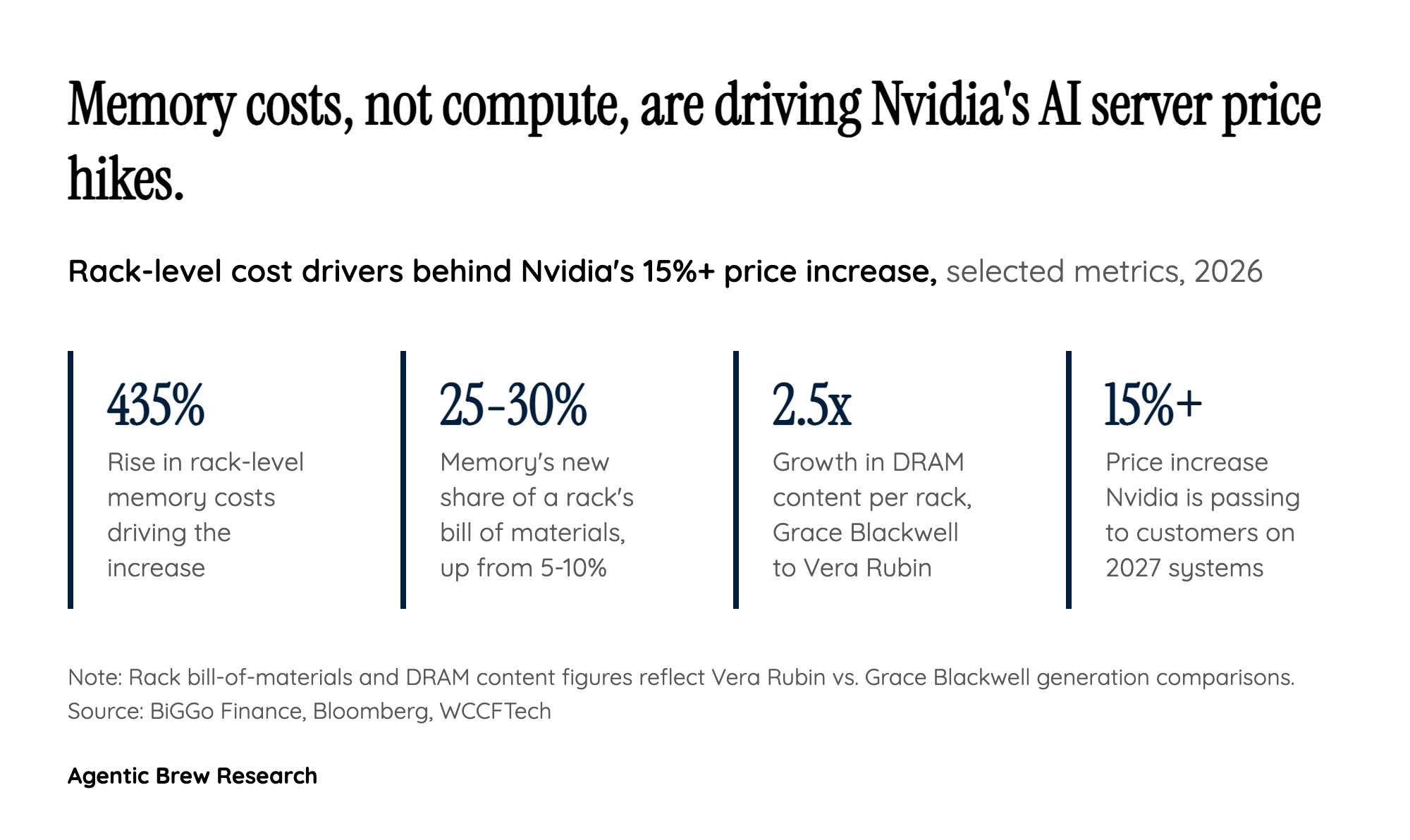
Memory, Not Silicon, Is Setting Nvidia's New Price Tag
Rack-level cost drivers behind Nvidia's 15%+ AI server price increase.

Nvidia has told its biggest customers that AI server prices are rising more than 15% in many cases [1], with the increases landing on systems shipping from early 2027 and covering the flagship Vera Rubin and Grace Blackwell lines [7]- but the sticker shock traces back to a component Nvidia doesn't even make. On a rack's full bill of materials, memory has swelled from a 5-10% slice to 25-30% as memory costs alone rose an estimated 435%, alongside sharp increases in PCB (+233%), MLCC (+182%), and ABF substrate (+82%) costs [2]. The imbalance gets worse with every new chip generation: Nvidia's upcoming Vera Rubin platform reportedly needs a memory bill more than double Grace Blackwell's, with DRAM content swelling roughly 2.5x in a single product cycle [3]. That's because a single AI server now consumes 8-10 times the DRAM of a conventional server, and HBM production for AI accelerators eats up to 3x the wafer capacity per gigabyte of a standard DRAM chip [4]- meaning Nvidia's own architecture roadmap is compounding a supply problem it doesn't control.


Who Actually Foots the Bigger Bill

Contract manufacturers that assemble AI servers for Microsoft, Google, and Oracle have already relayed the increase to those hyperscalers directly [5], putting the biggest cloud players first in line to absorb the cost. The dollar figures show why it matters: Nvidia's next-generation Vera Rubin NVL72/NVL144 racks are quoted at roughly $5 million to $8.8 million per unit, up from $2.8 million to $6.5 million for today's Blackwell GB200/GB300 racks [6]. The server assemblers themselves - Hon Hai/Foxconn, Quanta, Wistron - aren't capturing that upside either; as Nvidia supplies more of the pre-built compute tray and memory eats a bigger share of costs, their gross margins are reportedly compressing even as absolute dollar profit grows, for example from around 2.7% on a GB300 rack toward roughly 1.9% on a VR200 rack [2]. The pressure doesn't stop at hyperscalers: it's cited as weighing on projects like Europe's roughly 20 billion euro AI 'gigafactory' plans and Nebius's Finnish data center expansion, and AWS has reportedly already raised its own GPU prices by around 20% in response [7]. The same memory shortage is spilling into consumer electronics too - memory's share of PC bill of materials reportedly jumped from 15-18% to 35% at one major PC maker in a single quarter [8]- a reminder that this isn't an AI-only cost problem.

The Monopoly Testing Another Monopoly

What makes this notable is who's holding the leverage. Nvidia has been the industry's most dominant AI chip supplier, notifying customers of the increases rather than negotiating around them [5]. Yet the real price-setters here are three memory makers - Samsung, SK Hynix, and Micron - who control most of the world's DRAM and HBM production. Samsung's own global marketing chief, Wonjin Lee, warned as early as January 2026 that 2026 supply issues would 'affect everyone, not just Samsung' and were 'an industry-wide reality' [9], a call that's now playing out through Nvidia's price list. Wall Street's read is that Nvidia's own pricing power survives this regardless: DA Davidson's Gil Luria projects Nvidia can hold roughly 75% gross margins through 2030 because hyperscalers still have no viable alternative to its chips [10]. In effect, two oligopolies are colliding - a memory-supply oligopoly extracting more from a compute oligopoly - and for once it's Nvidia passing along a cost increase rather than dictating one from a position of total control.

Suspicious Timing, and the Cracks in the Inevitability Story

The disclosure landed just ahead of Nvidia's next earnings report, and that timing did not go unnoticed among investors. Some read the leak as a convenient way to pre-justify upcoming guidance and lock in a narrative of expanding margins before results land. Others pushed back on the assumption that hyperscaler demand is simply inelastic: many of Nvidia's biggest buyers are financing AI buildouts with debt while running negative free cash flow, raising the question of who actually absorbs a rack price approaching $8.8 million if a customer can't. There's an irony underneath the numbers too - Nvidia's own chip demand is part of what pulled memory-maker capacity toward AI production in the first place, since a single AI server needs 8-10 times the DRAM of a normal one [4], meaning Nvidia's supply-chain success helped create the price pressure now being passed back to it. This is also not a contained, one-time event: the same dynamic already reached consumer hardware, with RTX 5090 gaming GPU pricing reportedly climbing toward $5,000 from a $1,999 launch price [11], and TrendForce projects DRAM contract prices to keep rising another 13-18% quarter over quarter into the third quarter of 2026 [12]. Markets shrugged on the day the report broke - Nvidia's stock dipped less than 1% while Samsung's shares rose nearly 4% [13]- a small but telling sign of who investors think is winning this round.

Historical Context

2025
A global memory supply shortage began, driven by AI infrastructure buildouts, with DRAM prices rising 172-200% and DDR5 up as much as 414% over the year.
2026-01-07
Samsung publicly warned of industry-wide memory shortages and price surges continuing into 2026.
2026-01-10
AI memory was reported effectively 'sold out' amid an unprecedented price surge, with SK Hynix's HBM, DRAM, and NAND capacity essentially booked for all of 2026.
2026 (early)
Nvidia and AMD had already warned board partners of gaming GPU price increases tied to the same memory shortage, with RTX 5090 pricing reportedly climbing toward $5,000 from a $1,999 launch price.

Power Map

Key Players
Subject

Nvidia's 15%+ AI server price hike tied to soaring memory (DRAM) costs

NV

Nvidia

Passing rising component costs on to customers rather than absorbing them, despite roughly 75% gross margins and a dominant position in AI accelerators.

MI

Microsoft, Google, Oracle

Hyperscaler customers notified by contract server builders of the incoming price increases on Vera Rubin and Grace Blackwell systems.

SA

Samsung, SK Hynix, Micron

The three dominant DRAM/HBM makers whose tight supply and pricing power are forcing Nvidia's cost increases, giving them outsized leverage across the AI hardware industry.

SE

Server ODMs (Hon Hai/Foxconn, Quanta, Wistron)

Build servers under contract; absolute profits are expected to grow but gross margins are compressing as rack prices climb and Nvidia supplies more of the assembled system.

Fact Check

13 cited
  1. [1] Nvidia Customers Notified About AI-Related Price Hikes Above 15%
  2. [2] Vera Rubin Server Economics: Memory, PCB, and Substrate Costs Reshape Nvidia's Rack Margins
  3. [3] Nvidia Vera Rubin Memory Bill Doubles Grace Blackwell's As DRAM Cost Swells 2.5x
  4. [4] Samsung and SK Hynix Warn AI-Driven Memory Shortages Could Last Until 2027 and Beyond As HBM Demand Explodes
  5. [5] Nvidia customers notified about AI-related price rises above 15%
  6. [6] The Price of Nvidia's Vera Rubin NVL72
  7. [7] Nvidia's AI Server Price Increase Is Tied to Memory Costs
  8. [8] 2025-present global memory supply shortage
  9. [9] Samsung Warns of Memory Shortages Driving Industry-Wide Price Surge in 2026
  10. [10] Nvidia's 75% Profit Margins Could Hold Through 2030 As Hyperscalers Lack Alternatives
  11. [11] Nvidia Shares Slide Amid Rumors of Next-Gen GPU Price Hikes
  12. [12] Nvidia Is Massively Hiking GPU Prices: What Does That Mean for NVDA Stock?
  13. [13] Nvidia Warns Top Customers: AI Server Prices Jumping 15%+

Source Articles

Top 5

THE SIGNAL.

Analysts

Warned in a January 2026 interview that semiconductor supply issues in 2026 would be an industry-wide problem, not specific to Samsung.

Wonjin Lee
President and Head of Global Marketing, Samsung

Projects Nvidia can maintain gross profit margins around 75% through 2030 because hyperscalers lack viable alternatives and remain dependent on Nvidia's AI data-center chips.

Gil Luria
Analyst, DA Davidson
The Crowd

BREAKING: Nvidia, $NVDA, is hiking prices of many servers containing its AI chips by more than 15% as memory costs soar, per Bloomberg. The price hikes will go into effect on systems shipped early next year and will include those with the flagship Vera Rubin and Grace Blackwell

@@KobeissiLetter3194

NVIDIA $NVDA REPORTEDLY JUST TOLD CUSTOMERS ABOUT AI-RELATED PRICE HIKES OF MORE THAN 15% - Bloomberg

@@StockMKTNewz616

scoop: Nvidia raising prices for data center AI servers. Big buyers were notified this week of 15%+ increases. w/ @ianmking

@@BrodyFord_90

NVIDIA customers notified about AI-related price hikes above 15%, Bloomberg News reports

@u/wafflepiezz418
Broadcast
Console/PC Prices Expected To Skyrocket As AI Causes Massive DRAM Shortage And Inflation

Console/PC Prices Expected To Skyrocket As AI Causes Massive DRAM Shortage And Inflation

AI Causing DRAM Prices to Surge 50% in Q3 2026 - High Memory Prices Until 2028

AI Causing DRAM Prices to Surge 50% in Q3 2026 - High Memory Prices Until 2028

NVIDIA GPU Prices Just EXPLODED… What Happens to Ai GPU Rentals?

NVIDIA GPU Prices Just EXPLODED… What Happens to Ai GPU Rentals?

Nvidia's 15%+ AI server price hike tied to soaring memory (DRAM) costs — AI News | Agentic Brew