Amazon's Pecos County Gas Plant for AI Data Centers
TECH

Amazon's Pecos County Gas Plant for AI Data Centers

26+
Signals

Strategic Overview

  • 01.
    Amazon has confirmed it is the financial backer and power off-taker of GW Ranch, a 7.65-gigawatt, 35-turbine natural gas plant being built off-grid in Pecos County, Texas, exclusively to power a new AI data center campus.
  • 02.
    In January 2026 the Texas Commission on Environmental Quality issued GW Ranch a permit allowing up to 33 million tons of CO2 in annual emissions, which would exceed the country's largest coal plant and could make it the single largest greenhouse-gas source in the U.S.
  • 03.
    The site, developed by Pacifico Energy, spans more than 8,000 acres in the Permian Basin and also includes 1.8 GW of battery storage and up to 750 MWac of solar, with first power targeted for Q1 2027.
  • 04.
    The story was broken by market-intelligence outlet Cleanview/Distilled Earth, which used satellite imagery of land-clearing to connect three newly filed Amazon data center construction permits to the GW Ranch site.

Deep Analysis

The Power Plant That Breaks the Chart
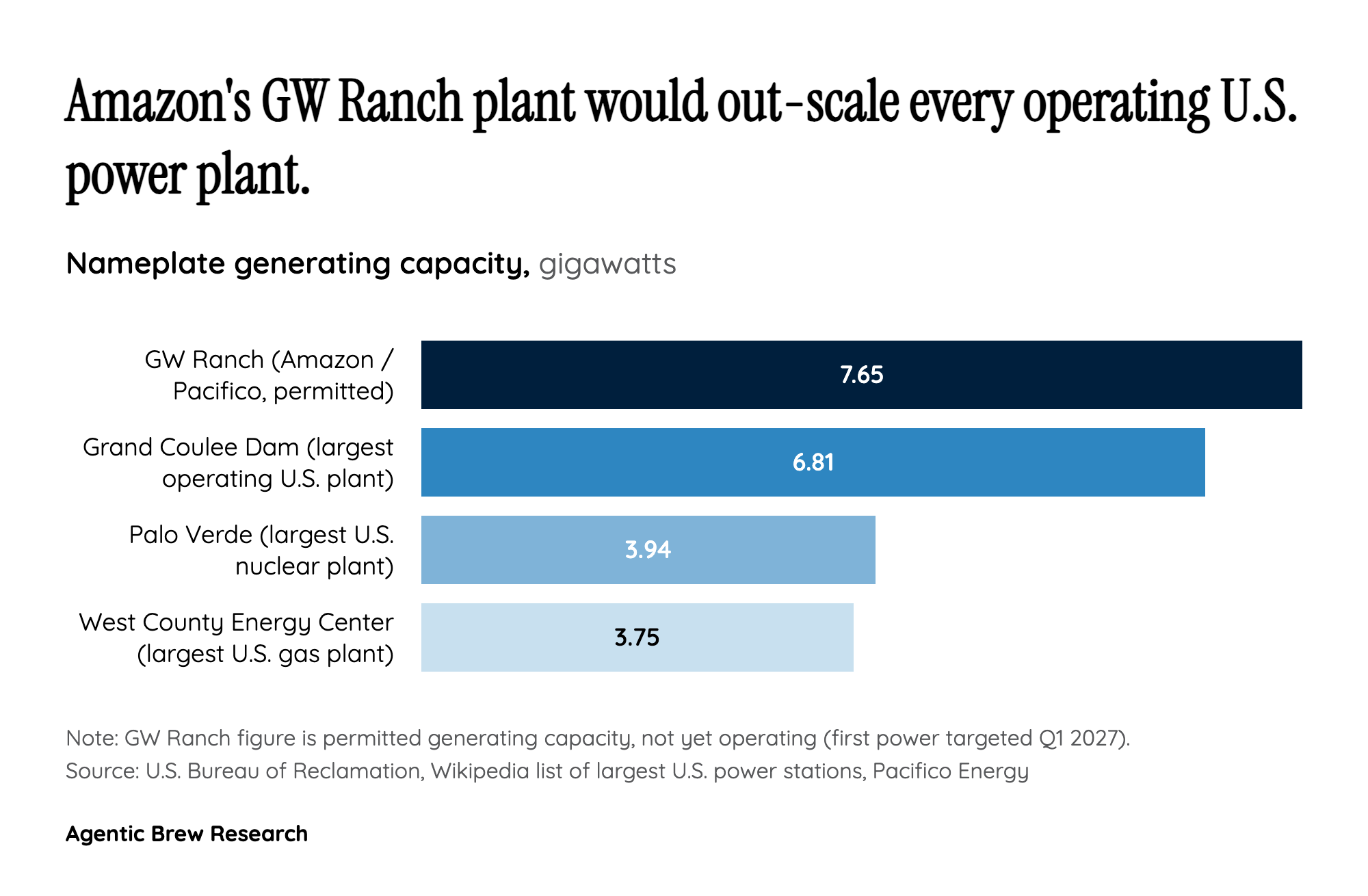
The Power Plant That Breaks the Chart
GW Ranch's permitted 7.65 GW capacity compared to the largest currently operating U.S. power plants of each type.

Amazon has confirmed it is the financial backer and power off-taker behind GW Ranch, a 7.65-gigawatt, 35-turbine natural gas plant under construction on more than 8,000 acres in the Permian Basin of Pecos County, Texas [1]. The company says the plant, developed by Pacifico Energy, will run "new on-site generation that won't raise electricity costs for Texas families" [1], and pairs the gas turbines with 1.8 GW of battery storage and up to 750 MWac of solar on the same site [2]. Pacifico first announced the project a year earlier, in August 2025, describing a smaller 5-gigawatt scope before it grew to today's 7.65 GW across 35 turbines [3].

To put that number in perspective: an AP wire story reports that GW Ranch's permitted 7.65 GW capacity would be larger than any natural gas power plant currently operating in the United States [4]. That figure would also exceed the roughly 6,809-megawatt (6.8 GW) capacity of Grand Coulee Dam, currently the largest power station of any kind operating in the U.S. [9]- a comparison between two independently sourced numbers, not a claim either source makes directly. Developer Pacifico Energy itself has called GW Ranch the "largest power project" in the United States, as reported by Inside Climate News [8], though that superlative is the developer's own characterization rather than an independently verified finding. Amazon itself had not been named as the plant's financial backer until early August 2026, when the market-intelligence outlet Cleanview/Distilled Earth matched satellite imagery of active land-clearing at the site to three newly filed Amazon data center construction permits and got the company to confirm the connection on the record [1], a scoop that was quickly picked up by wire outlets and tech press [4]. Amazon is targeting first power delivery by the first quarter of 2027 [2].


Off the Grid, On the Hook

The defining design choice at GW Ranch is not the plant's size but its isolation: it will run entirely disconnected from the Texas grid, at least in its early phase, with Amazon describing it as "designed to transition to grid-connected service as interconnection timelines allow" [1]. That framing is deliberate. Amazon's public position is that behind-the-meter generation lets it "pay the full costs of powering our operations" rather than relying on new transmission and generation infrastructure that would ultimately be billed to ordinary Texas ratepayers, whose electricity costs have already climbed alongside AI-driven demand growth [1]. The plant will also draw on non-potable, brackish groundwater rather than water sources used for drinking or irrigation, an apparent attempt to head off a second front of local opposition around water use in an already water-stressed region [6].

That doesn't mean the project avoids local friction. Reporting on the deal notes a broader, increasingly bipartisan wariness toward large data centers landing in rural and suburban Texas communities, driven by concerns that these facilities bring relatively few permanent local jobs while carrying a track record - at grid-connected sites elsewhere - of utility rate increases and reliability problems [5]. Amazon counters that framing by pointing to its existing Texas footprint: roughly 40 carbon-free energy projects totaling near 10 GW of capacity across the state, positioned as evidence the company is a net contributor to Texas's energy mix even as GW Ranch itself burns gas [6].

The Net-Zero Math Doesn't Add Up

In January 2026, the Texas Commission on Environmental Quality quietly issued GW Ranch an air permit allowing it to emit up to 33 million tons of carbon dioxide annually [5]. Run at that ceiling, GW Ranch would exceed the emissions of the largest coal plant in the United States and become, by a wide margin, the single largest greenhouse-gas source anywhere in the country [5]- a claim that requires the caveat that power plants rarely run at their full permitted maximum, but one that still sits uneasily next to Amazon's own Climate Pledge commitment to reach net-zero emissions by 2040 [6].

The criticism isn't limited to the raw tonnage. John Rogers, an energy analyst at the Union of Concerned Scientists, argues the deeper problem is a missed opportunity: "There are more efficient ways to use gas. Virtually none of these plants are proposing to use those, and that matters for on-site pollution, both direct and climate" [4]. His point is that GW Ranch and its peers are choosing conventional gas turbine technology over more efficient alternatives at exactly the moment scale would make efficiency gains matter most. Not every reading of the story agrees the plant is uniquely dirty, though - some pushback has argued that GW Ranch isn't dirtier per megawatt than a typical gas plant, it's simply several times larger, and that the "most polluting plant in America" framing conflates scale with intensity. Either way, if the roughly 97 GW of behind-the-meter gas capacity now planned across hyperscalers is ever run at full output, estimates put the collective toll north of 200 million tons of CO2 a year - comparable to the annual emissions of more than 45 million cars [4].

Amazon Isn't Alone in the Gas Rush

GW Ranch is not an isolated bet - it's the leading edge of an industry-wide pattern. Roughly 30 miles away, Microsoft and Chevron announced their own 2-gigawatt off-grid natural gas data center campus near Pecos in June 2026 [1]. Meta, meanwhile, has struck a reported $1.6 billion power-and-pipeline infrastructure deal with Williams to build a natural gas-powered data center campus in Ohio [7]. Data center developers have announced nearly 60 behind-the-meter gas power projects industry-wide since the start of 2025, adding up to roughly 90 gigawatts of combined planned capacity, with Amazon, Microsoft, Google, and Meta all committing significant capital to natural gas power in 2026 [7].

The pattern reveals the actual constraint driving these deals: it isn't a gas preference, it's grid queue length. Every hyperscaler racing to bring AI compute online faster than interconnection timelines allow is reaching for the same playbook - buy land, buy turbines, skip the queue. That convergence is also what turns an individual company's power decision into a collective climate liability; no single hyperscaler's behind-the-meter plant would reshape the national emissions picture on its own, but a dozen of them running simultaneously plausibly could [4]. Whether regulators, competitors, or the companies' own sustainability pledges catch up to that arithmetic before 2028 - the year Pacifico projects GW Ranch's first gigawatt comes online - remains the open question [2].

Historical Context

2025-08-20
Announced the GW Ranch project, initially describing 5 gigawatts of off-grid power for AI before the scope grew to 7.65 GW across 35 turbines.
2026-01
Issued GW Ranch an air permit authorizing emissions of up to 33 million tons of CO2 annually.
2026-06
Announced a separate 2 GW off-grid natural gas data center campus near Pecos, Texas, roughly 30 miles from the Amazon/GW Ranch site.
2026-07-24
Satellite imagery showed active land clearing underway at the Pecos County site.
2026-08-07
Publicly linked Amazon's construction permits to GW Ranch and obtained Amazon's on-record confirmation, prompting wide wire pickup.

Power Map

Key Players
Subject

Amazon's Pecos County Gas Plant for AI Data Centers

AM

Amazon

Financial backer and sole power off-taker of GW Ranch; frames the deal as protecting Texas ratepayers from AI-driven infrastructure costs while its permitted emissions ceiling sits in tension with its 2040 net-zero Climate Pledge.

PA

Pacifico Energy

Developer of the GW Ranch gas, battery, and solar complex; a California-headquartered developer with over $5 billion raised, 1.5 GW of operating capacity, and a 7 GW project pipeline, whose scope on this project grew from 5 GW to 7.65 GW in a year.

TE

Texas Commission on Environmental Quality (TCEQ)

State regulator that issued the January 2026 air permit authorizing up to 33 million tons of CO2 emissions annually, the approval that makes the plant's scale possible.

CL

Cleanview / Distilled Earth

Market-intelligence outlet that broke the story by matching satellite imagery to Amazon's construction permits, prompting Amazon's on-record confirmation and triggering wide wire pickup.

MI

Microsoft / Chevron

Building a comparable 2 GW off-grid natural gas data center campus roughly 30 miles from GW Ranch, showing Amazon's approach is already being mirrored by a direct AI infrastructure competitor.

ME

Meta

Pursuing a parallel natural-gas strategy via a reported $1.6 billion power-and-pipeline deal with Williams for a gas-powered data center campus in Ohio, part of the same industry-wide pattern.

Fact Check

9 cited
  1. [1] Amazon is behind one of the largest gas plants in Texas
  2. [2] GW Ranch
  3. [3] Pacifico Energy Announces GW Ranch Project Bringing 5 Gigawatts of Reliable Off-Grid Power for AI Innovation
  4. [4] Amazon's massive private gas plant for AI data centers
  5. [5] Amazon Is Creating the Biggest Pollution Source in the Entire Country
  6. [6] Amazon behind massive private gas plant for new data centres
  7. [7] Amazon Natural Gas Power Plant for AI Data Center in Texas
  8. [8] Developer calls GW Ranch in Pecos County, Texas, the 'largest power project' in U.S.
  9. [9] Grand Coulee Dam

Source Articles

Top 5

THE SIGNAL.

Analysts

Criticizes the industry-wide trend of behind-the-meter gas plants for AI data centers as an inefficient choice with avoidable pollution consequences.

John Rogers
Energy analyst, Union of Concerned Scientists
The Crowd

This week I found permits and satellite photos suggesting Amazon is backing what could be the largest gas power plant ever built in the US. I just got off the phone with the company and confirmed they're behind it. Amazon confirmed that it has acquired a site in Pecos County,

@@curious_founder2194

Amazon is backing a 7.65 GW gas plant in West Texas. I sorted all 14,036 operating U.S. power plants by size to see where that lands. It doesn't land anywhere (nothing on the American grid is that big).

@@JEBistline140

An Amazon gas power plant in Texas could become the most polluting power plant in the US Amazon is being permitted to release around 33 million tons of CO2 to power an AI data center

@@interesting_aIl207

Amazon Is Creating the Biggest Pollution Source in the Entire Country - Amazon has bought a site in Texas where it plans to build a data center campus.

@u/B-Z_B-S178
Broadcast
Amazon Is Building a 7.65GW Private Gas Plant for AI — Permitted for 33M Tons of CO2 | AI Daily Aug

Amazon Is Building a 7.65GW Private Gas Plant for AI — Permitted for 33M Tons of CO2 | AI Daily Aug

Texas Data Center: Amazon Is Building the Most Polluting Power Plant in America

Texas Data Center: Amazon Is Building the Most Polluting Power Plant in America

TX APPROVES LARGEST PERMITTED DATA CENTER IN U.S.

TX APPROVES LARGEST PERMITTED DATA CENTER IN U.S.