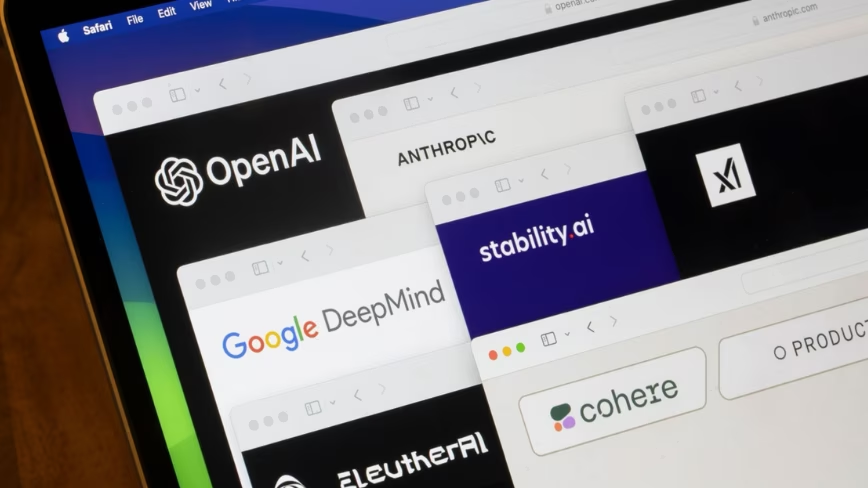
AI CEOs at G7 push for US-led AI coalition amid restrictions on Anthropic model
TECH

AI CEOs at G7 push for US-led AI coalition amid restrictions on Anthropic model

44+
Signals

Strategic Overview

  • 01.
    At an hours-long closed-door G7 lunch in Evian-les-Bains, France on June 17, 2026, Anthropic CEO Dario Amodei and Google DeepMind CEO Demis Hassabis pitched heads of state on a US-led coalition to shape international AI rules and standards, while OpenAI's Sam Altman called for an international standards forum modeled on the Financial Stability Board.
  • 02.
    The summit unfolded days after the Trump administration imposed export-control measures blocking any foreign national from accessing Anthropic's newest models, Fable 5 and Mythos 5 — restrictions Anthropic abruptly enforced by disabling access to comply.
  • 03.
    Rattled by what they called a US 'kill switch,' G7 leaders weighed a 'trusted partners' framework — a vetted list of allied nations and approved companies exempt from the broad restrictions — with Commerce Secretary Howard Lutnick pitching the exemption scheme, though no binding commitments emerged.

Deep Analysis

The kill-switch paradox: control mechanisms come for their architects

The defining irony of the G7 gathering is that the AI industry spent years asking governments to build levers of control over frontier models — and then watched one of those levers slam down on Anthropic itself. Amodei used the lunch to propose structured, government-mediated access to frontier models and China-excluding trade in chips and critical components [1], the kind of state-managed gatekeeping that the foreign-national ban on Fable 5 and Mythos 5 now embodies in practice [2]. The trigger was a national-security rationale: the administration cited cyber risk, Amazon had flagged to the White House that certain Anthropic safety guardrails could be bypassed, and the models were described as having unprecedented ability to find and exploit vulnerabilities [3]. The mechanism matters. Because the order reached down to the level of who may use a deployed model — not just who may buy a chip — Anthropic had no graceful option but to switch access off for every foreign national at once. That is precisely the 'turn off the switch' scenario Macron warned about [3], made real in days rather than hypothesized in white papers. Europe's reaction was blunt: MEP Brando Benifei said 'The Anthropic kill switch shows that tech sovereignty was never abstract' [5]. The companies that wanted standards now have to live inside them.
Coalition or moat? Why the CEOs want it and how everyone else reads it

The US labs have a coherent commercial logic for backing a coalition: a structured-access regime keeps frontier models legally exportable to allies and heads off the worst case — a blanket deployment freeze. Anthropic itself warned that if the standard behind the ban were applied across the industry, it would essentially halt all new model deployments for every frontier provider [2]. A coalition with vetted 'trusted partners' is, from that vantage, market preservation dressed as governance: Altman's pitch for a Financial Stability Board-style forum to set testing standards and provide impartial capability analysis fits the same goal of an orderly, exportable rulebook [1]. But allies and the developer community read the same proposal as a regulatory moat. On Reddit, r/ClaudeAI's verdict was a 'resounding no,' parsing the coalition as 'CEO advantage yes, user advantage no' — a standards body that entrenches the incumbent labs while voicing 'zero faith' in the administration to lead it. Sentiment also split by founder: Hassabis drew genuine goodwill, while Amodei and Altman were treated more cynically. Cohere's Aidan Gomez gave the critique its sharpest frame, warning that 'a monopoly of intelligence is inherently brittle' and that a handful of centralized entities would 'control the parameters of global commerce, security, and thought' [4]. The gap between 'we are setting standards' and 'you are building a cartel' is the summit's central unresolved tension.

The sovereignty backlash reshaping European and Indian strategy

For US allies, the episode hardened a strategic conclusion: depending on American AI you cannot control is itself the risk. Macron pressed for ways around the ban and to broaden access to Mythos [8], while Modi argued that democratic nations need unfettered access to top models to protect critical infrastructure [3]. The proposed remedy — a 'trusted partners' list of vetted allied nations and approved companies that Commerce Secretary Lutnick pitched [6]— would let entities from allied countries regain access to models from Anthropic, OpenAI and Google [7], but it also reframes access as a privilege Washington grants rather than a market firms can rely on. Europe's response was to assert it should not have to ask: Commission spokesperson Thomas Regnier insisted 'We are a trusted partner. I would challenge you to find a more trusted partner than Europe' [5]. The deeper shift is toward treating AI as critical infrastructure and backing sovereign alternatives, an agenda the kill-switch fears have now accelerated [5]. That instinct echoed across non-US founders on X, where Zoho's Sridhar Vembu distilled the mood as a call for self-reliance — sovereignty, not access, as the lesson. The practical fear, voiced by both Benifei and developers, is that allies splinter into competing, mutually exclusive AI dependency blocs.

The contrarian read — and what is actually new versus 2025

Not everyone sees a deliberate geopolitical weapon. The IAPP argues the foreign-person scope 'looks more like an artifact of the legal tool than a weapon aimed at Europe,' contending the real aim was to pause or pull the models for all users on cybersecurity grounds, with the nationality cut-out an accident of the statute used [9]. Read that way, the 'kill switch' is less a strategic dial and more a clumsy emergency brake — which, for allies, is arguably scarier, because it means access can vanish without anyone intending it as policy. The historical frame sharpens this. Washington has been climbing the AI stack since the 2022 chip controls, and in January 2025 the AI Diffusion Rule went further than any prior measure by controlling frontier closed-weight model weights themselves (ECCN 4E091, models trained above 10^26 operations) under a tiered scheme that gave 18 allies near-unrestricted access while capping others [10]. The Trump administration rescinded that rule in May 2025 [11]. The 'trusted partners' framework now floated at the G7 would, in effect, rebuild a tiered access regime the US recently dismantled — only this time triggered reactively by a single company's model and negotiated under summit pressure rather than designed in advance. The whiplash, more than any one ban, is what has allies hedging.

Historical Context

2022-10-07
The US enacted comprehensive export controls on advanced semiconductor technologies, beginning a climb up the AI stack that started at chips and would eventually reach model weights.
2025-01-15
The AI Diffusion Rule introduced the first-ever control on frontier closed-weight AI model weights (new ECCN 4E091, models trained above 10^26 operations) via a tiered access framework granting 18 allies near-unrestricted chip access while capping second-tier nations.
2025-05-01
Rescinded the Diffusion Rule, removing the tiered framework that had governed access to frontier chips and model weights.
2026-06-13
Washington imposed export-control measures blocking all foreign-national access to Fable 5 and Mythos 5; Anthropic abruptly disabled both to comply, setting the stage for the G7 confrontation four days later.

Power Map

Key Players
Subject

AI CEOs at G7 push for US-led AI coalition amid restrictions on Anthropic model

DA

Dario Amodei (Anthropic CEO)

Co-proponent of the US-led coalition; pushed for structured access to frontier models and China-excluding trade in chips and critical components. His company's models triggered the export ban that disabled access for all foreign nationals.

SA

Sam Altman (OpenAI CEO)

Called for an international forum to set globally accepted testing standards and serve as a venue for cooperation among nations; OpenAI's Chris Lehane likened the body to the Financial Stability Board.

PR

President Trump / Commerce Sec. Howard Lutnick

Ordered the Anthropic foreign-access ban on national-security grounds; Lutnick led the pitch for the 'trusted partners' exemption framework to other G7 nations.

EM

Emmanuel Macron (France) and Narendra Modi (India)

Macron, the host, warned the US could 'turn off the switch' and pushed talks to broaden access to Anthropic's Mythos; Modi argued democratic nations need unfettered access to top models to protect critical infrastructure.

MA

Mark Carney (Canada PM)

The only G7 leader to publicly endorse US leadership of the coalition; Canada had separately been granted access to Mythos earlier in the month.

AI

Aidan Gomez (Cohere CEO)

Leading critic; framed the episode as proof of dependency risk and argued nations and firms must own rather than rent AI, warning against 'digital serfdom.'

Fact Check

11 cited
  1. [1] Anthropic and Google DeepMind CEOs call for US-led AI coalition at G7
  2. [2] US foreign access ban on Anthropic models puts control over AI in the spotlight
  3. [3] World leaders want American AI. They just don't want America to be able to turn it off
  4. [4] AI digital sovereignty takes center stage at G7 as Cohere's Aidan Gomez warns against dependency
  5. [5] AI takes centre stage at G7 as Western fears over US kill switch get real
  6. [6] G7 weighs 'trusted partners' scheme for access to US AI models
  7. [7] G7 considers trusted partners framework for US AI models
  8. [8] Macron Seeks Way Around Trump's Ban on Anthropic's AI Models
  9. [9] The Anthropic episode: probably a security challenge in need of governance, certainly not Europe's kill switch
  10. [10] New US Export Controls on Advanced Computing Items and Artificial Intelligence Model Weights
  11. [11] Framework for Artificial Intelligence Diffusion

Source Articles

Top 5

THE SIGNAL.

Analysts

"Argues that real sovereignty means controlling, not renting, your AI, and that dependence on a few centralized providers is a strategic and resilience risk: 'True digital sovereignty is about choice and control. It is the ability to decide who sees your data, who modifies your systems, and who has the power to turn them off.' He warns that 'a monopoly of intelligence is inherently brittle.'"

Aidan Gomez
CEO, Cohere

"Reads the shutdown as concrete proof that tech sovereignty was never an abstraction — 'The Anthropic kill switch shows that tech sovereignty was never abstract' — and cautions against locking allies into competing AI dependencies."

Brando Benifei
Member of the European Parliament (S&D, Italy)

"Insists Europe is itself the model trusted partner and should act on its own terms: 'We are a trusted partner. I would challenge you to find a more trusted partner than Europe.'"

Thomas Regnier
European Commission spokesperson for tech sovereignty

"Offers a contrarian read: the foreign-person scope of the ban 'looks more like an artifact of the legal tool than a weapon aimed at Europe,' arguing the apparent intent was to pause the models for all users on cybersecurity grounds rather than to punish allies."

IAPP analysis
International Association of Privacy Professionals
The Crowd

"I've had a number of conversations with folks inside and outside government about the current situation with Anthropic, and here is what I believe to be true: — As we know, Anthropic publicly released its Mythos class models earlier this week under the commercial name Fable."

@@DavidSacks25490

"This is big: all access to Mythos and Fable AI models disabled for everyone outside America. First thoughts: 1. Technology is the ultimate weapon. National sovereignty, national security, all of it is now about technology. 2. Globalization is dead and Bharat must find her own way."

@@svembu12496

"We are entering a new era of the Cold War. Dario Amodei and Demis Hassabis are calling for a "U.S.-led coalition to shape rules and standards around artificial intelligence," excluding China. "Dario Amodei also said in his address that the coalition should structure access to [frontier models]""

@@kimmonismus747

"World leaders meet with top AI CEOs at G7 summit in France"

@u/BuildwithVignesh657
Broadcast
Trump Attends G7 Lunch With OpenAI's Sam Altman, Anthropic's Dario Amodei, & Google's Demis Hassabis

Trump Attends G7 Lunch With OpenAI's Sam Altman, Anthropic's Dario Amodei, & Google's Demis Hassabis

G7 Leaders discuss AI Governance with Tech company's chiefs at France Summit

G7 Leaders discuss AI Governance with Tech company's chiefs at France Summit

G7 Leaders Meet Sam Altman, AI CEOs To Discuss Future Of Artificial Intelligence

G7 Leaders Meet Sam Altman, AI CEOs To Discuss Future Of Artificial Intelligence