
Anthropic launches Claude Opus 4.8 with dynamic workflows
TECH

Anthropic launches Claude Opus 4.8 with dynamic workflows

64+
Signals

Strategic Overview

  • 01.
    Anthropic released Claude Opus 4.8 on May 28, 2026, just 41 days after Opus 4.7, with day-one distribution across claude.ai, Claude Code, AWS Bedrock, GitHub Copilot, and Cursor at unchanged standard pricing.
  • 02.
    A new Dynamic Workflows research preview inside Claude Code lets a JavaScript script orchestrate up to 16 concurrent subagents and 1,000 agents per run for codebase-scale tasks.
  • 03.
    Fast mode now runs 2.5x faster and 3x cheaper at $10/$50 per million input/output tokens (down from $30/$150), while standard pricing stays at $5/$25.
  • 04.
    The release lands the same day Anthropic disclosed a $65 billion Series H round at a $965 billion valuation, framed publicly as a bridge to its forthcoming Mythos-class models.

Dynamic Workflows Is the Real Headline, Not the Model Bump

Anthropic itself calls the Opus 4.8 model gain 'modest but tangible' and openly signals that the new features shipped alongside the model may matter more than the model update [1]. The feature carrying that weight is Dynamic Workflows, a Claude Code research preview that turns codebase-scale automation into a scripted orchestration problem rather than a single prompt.

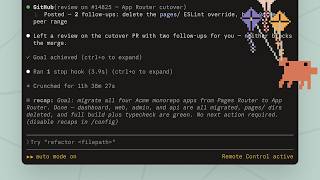
A Dynamic Workflow is, concretely, a JavaScript script that spins up parallel subagents [2]. The runtime allows up to 16 concurrent agents at any moment and caps each run at 1,000 agents total [3], available on Max, Team, and Enterprise plans running Claude Code v2.1.154 or later. Anthropic pairs this with two new commands surfaced in its launch demo, /goal for stating a feature spec and /remote-control for the 'hand off long-running coding work and walk away' pattern.

The practical capability that unlocks is unglamorous but consequential: Claude Code with Opus 4.8 can now carry out codebase-scale migrations across hundreds of thousands of lines [4]. That moves the model from per-file assistant into something closer to a scripted engineering process, which is also why Anthropic chose to bundle it with the release rather than ship it as a standalone tool.

The 41-Day Cadence Is an IPO Signal

Opus 4.8 arrived 41 days after Opus 4.7 [5], a noticeably tighter cadence than the prior multi-month Opus rhythm. The timing is not incidental. On the same day, Anthropic disclosed a $65 billion Series H at a $965 billion valuation, putting it ahead of OpenAI's reported $850 billion mark and making Claude the first frontier model available on all three major cloud hyperscalers [6].

Read together, the cadence, the flat standard pricing, the 3x cheaper fast mode, and the same-day distribution across AWS Bedrock [7], GitHub Copilot [8], and Cursor [9]describe a company optimizing for developer surface-area lock-in ahead of a capital event. Anthropic openly frames Opus 4.8 as a bridge to its forthcoming Mythos-class models, which it expects to bring to all customers 'in the coming weeks' [10].

The efficiency numbers from independent evaluator Artificial Analysis sharpen the business read: Opus 4.8 uses about 15 percent fewer passes per task and 35 percent fewer output tokens than Opus 4.7 [1], which effectively rolls back the perceived cost step-up users complained about under 4.7 without touching the list price.

Bifurcated Reception: Hype on X, Trauma-Bonded on Reddit

The X.com response was effectively unbridled. Anthropic's official launch post drew tens of thousands of likes and thousands of replies inside a day, with GitHub, VS Code, and Cursor accounts amplifying same-day. Independent evaluator Artificial Analysis crowning Opus 4.8 the GDPval-AA leader at 1890, against 1769 for GPT-5.5 and 1314 for Gemini 3.1 Pro [1], hardened the 'coding leadership reaffirmed' narrative among practitioners. Developer-facing accounts surfaced the new /ultracode reasoning level inside Claude Code as the headline practical recipe.

Reddit told a different story. Across r/ClaudeAI, r/claude, and r/technology the dominant register was skepticism and a kind of trauma-bonding around Opus 4.6, which power users now treat as the gold-standard baseline. The community's auto-generated TL;DR summed it up as 'less Hooray, new model and more Please, for the love of all that is holy, do not take away Opus 4.6.' A vocal minority praised 4.8 as 'a lot better, and fuckin cheap,' but the larger camp warned of token-burn behavior, context-window confusion between the default 200K and the 1M variant, and effort-control toggles that one user said were 'basically ignored.' One r/technology poster ran 4.8 on the openmark.ai logical-reasoning eval and reported 44 percent, below Opus 4.6, Opus 4.7, GPT-5.4, and even Gemini 3.1 Flash Lite.

The gap between platforms is itself the story. X is reacting to capability claims at the top of the funnel; Reddit is reacting to a year of perceived behavioral regressions inside long-running production sessions. Both can be true at once.

The Honesty Upgrade Is the Quiet Production Wedge

The Opus 4.8 changelog buries what is arguably its most enterprise-relevant change: the model is roughly four times less likely than Opus 4.7 to let flaws in its own code pass unremarked [11]. Anthropic frames this as 'sharper judgment, greater honesty about its own limitations, and longer autonomous operation,' and Bridgewater Associates is quoted as praising the model's tendency to proactively flag issues with inputs and outputs [5].

For production users this matters more than another benchmark point. A model that hedges when it should hedge is a model you can put inside an agent loop without a human reviewer parsing every step. That is the same shift Dynamic Workflows assumes; if you are going to orchestrate up to 1,000 subagent runs, you cannot afford a high baseline rate of confidently-wrong intermediate outputs.

The risk is that the marketing language ('a more honest Claude') is read as alignment theater. r/technology threads mocked the framing directly, with one widely-upvoted post characterizing the broader subreddit response as 'pure copium' about how useful Claude already is for displacement. The technical claim and the marketing claim are not the same thing, but the four-times figure is concrete enough to test in production.

The Buried Risk: Prompt-Injection Regression

Underneath the honesty gains is a regression Anthropic's own materials surface but partner coverage largely ignores: Gray Swan red-teaming reports Opus 4.8's prompt-injection attack-success rate at roughly 9.6 percent, against 6.0 percent for Opus 4.7 [11]. That is a meaningful jump in the wrong direction for a release whose flagship feature is an orchestration runtime designed to run hundreds of subagents over a codebase or a long-horizon coding task.

The risk surface compounds with Dynamic Workflows. A JavaScript-orchestrated graph of up to 1,000 subagent runs touching real repositories means many more places where untrusted content (issue text, README files, dependency READMEs, log output) can reach a model that is now slightly more susceptible to following injected instructions. Anthropic shipped the orchestration first and is iterating on safeguards in parallel, telling customers it expects to bring Mythos-class models with stronger safeguards in the coming weeks [10].

For teams deploying Opus 4.8 inside agentic loops, the practical implication is unchanged from earlier Opus releases but more urgent: treat any content the agent ingests as potentially adversarial, sandbox file-system and shell access, and watch tool-call patterns for the prompt-injection signatures specific to your domain. The 'modest but tangible' framing applies on the safety axis too, just in the opposite direction.

Historical Context

2025-05
Shipped the original Claude Opus 4, establishing the modern Opus line as Anthropic's frontier coding model.
2025-11-24
Released Claude Opus 4.5, continuing the cadence of incremental Opus point releases.
2026-02-05
Released Claude Opus 4.6 with a 1M-token context window beta, the version Reddit power users now treat as the gold-standard baseline.
2026-04-16
Made Claude Opus 4.7 generally available across GitHub Copilot and partner surfaces, setting up the 41-day cadence to 4.8.
2026-05-28
Launched Claude Opus 4.8 with Dynamic Workflows research preview, effort controls, and a cheaper fast mode, while disclosing a $65 billion Series H at a $965 billion valuation.

Power Map

Key Players
Subject

Anthropic launches Claude Opus 4.8 with dynamic workflows

AN

Anthropic

Model developer shipping Opus 4.8 across its own surfaces (claude.ai, Claude Code, API, Cowork) at flat pricing while positioning the release as a transitional bridge to Mythos-class models in the coming weeks.

AM

Amazon Web Services (Bedrock)

Hosting partner offering Opus 4.8 through Bedrock and a Claude Platform on AWS endpoint with unified AWS billing, deepening cloud-vendor coupling for enterprise buyers.

GI

GitHub Copilot

Primary developer distribution channel rolling Opus 4.8 to Pro+, Business, and Enterprise across VS Code, Visual Studio, CLI, JetBrains, Xcode, Eclipse, github.com, and GitHub Mobile with a 15x premium-request multiplier until usage-based billing begins on June 1, 2026.

CU

Cursor

Independent IDE that shipped Opus 4.8 in its model picker at launch, keeping Anthropic at the front of agentic-coding tool defaults.

MI

Microsoft Azure and Google Cloud

Make Claude the first frontier model available on all three major hyperscalers, broadening enterprise procurement paths and pressuring single-cloud AI commitments.

BR

Bridgewater Associates

Early enterprise tester whose feedback Anthropic highlighted, praising Opus 4.8's proactive flagging of input and output issues in production analytics work.

Fact Check

12 cited
  1. [1] Anthropic ships Claude Opus 4.8 as a modest but tangible improvement that tops GPT-5.5
  2. [2] Claude Opus 4.8 release: dynamic workflows
  3. [3] Anthropic ships Claude Opus 4.8 alongside Dynamic Workflows and cheaper Fast Mode
  4. [4] Anthropic Releases Claude Opus 4.8
  5. [5] Anthropic releases Opus 4.8 with new 'dynamic workflow' tool
  6. [6] Anthropic raises $65 billion at a $965 billion valuation
  7. [7] Claude Opus 4.8 is now available on AWS
  8. [8] Claude Opus 4.8 is generally available for GitHub Copilot
  9. [9] Anthropic releases Opus 4.8 on path to Mythos
  10. [10] Claude Opus 4.8
  11. [11] Anthropic's Claude Opus 4.8 is here with 3x cheaper fast mode
  12. [12] Anthropic Claude Opus 4.8 Fast Mode

Source Articles

Top 5

THE SIGNAL.

Analysts

"Describes the model gain itself as 'modest but tangible' and signals that the bundled features shipped alongside Opus 4.8 may matter more than the model update."

Anthropic
Model developer, official launch statement

"Reports Opus 4.8 uses roughly 15 percent fewer passes per task and 35 percent fewer output tokens than Opus 4.7, arguing the efficiency gains offset the earlier 4.7 price step-up."

Artificial Analysis
Independent model evaluator

"Reports Anthropic's claim that Opus 4.8 outperforms competitors on key benchmarks spanning agentic coding, reasoning, financial analysis, and knowledge work."

Axios
Tech news outlet

"Highlights Opus 4.8's tendency to proactively flag issues with inputs and outputs as the most useful behavioral shift in their workflows."

Bridgewater Associates
Enterprise early tester quoted by Anthropic
The Crowd

"Introducing Claude Opus 4.8: it builds on Opus 4.7 with sharper judgment, more honesty about its own progress, and the ability to work independently for longer than its predecessors. Available today at the same price."

@@claudeai55689

"This is amazing. Do this: 1. Set model to Opus 4.8 2. Reasoning effort to /ultracode Enables Claude Code's new Dynamic Workflows. Claude will autonomously detect complex tasks, write an orchestration script, and spawn an agent swarm."

@@daniel_mac81256

"Anthropic just launched Claude Opus 4.8, and it is the new leader on our GDPval-AA benchmark for agentic real-world work tasks Opus 4.8 scored 1890 on GDPval-AA at launch with its 'max' effort setting, +137 points from Opus 4.7 and +121 points ahead of the next-best model,"

@@ArtificialAnlys991

"Introducing Claude Opus 4.8"

@u/ClaudeOfficial1900
Broadcast
Embrace long-running tasks with Opus 4.8 and Claude Code

Embrace long-running tasks with Opus 4.8 and Claude Code

Vibe Coding With Claude Opus 4.8

Vibe Coding With Claude Opus 4.8

Claude Opus 4.8 actually blew my mind...

Claude Opus 4.8 actually blew my mind...