Micron Q3 2026 AI memory earnings blowout past Nvidia and Meta
TECH

Micron Q3 2026 AI memory earnings blowout past Nvidia and Meta

34+
Signals

Strategic Overview

  • 01.
    Micron reported record fiscal Q3 2026 revenue of $41.46 billion, up 74% sequentially and 346% year-over-year, with adjusted EPS of $25.11 versus roughly $21 expected.
  • 02.
    Micron posted a company-record 84.9% gross margin that surpassed both Nvidia (~75%) and Meta (~82%), making the memory maker tech's new margin leader.
  • 03.
    Micron's entire 2026 HBM supply is sold out under multi-year contracts, and it disclosed 16 strategic customer agreements, 14 of which carry roughly $100 billion in cumulative minimum-price revenue.
  • 04.
    Micron guided fiscal Q4 2026 to roughly $50 billion in revenue (+/- $1B), ~86% gross margin and ~$31 EPS, well above Wall Street's ~$42.9 billion estimate, sending MU shares up about 13% after hours.

Deep Analysis

The Commodity Maker That Out-Margined Nvidia
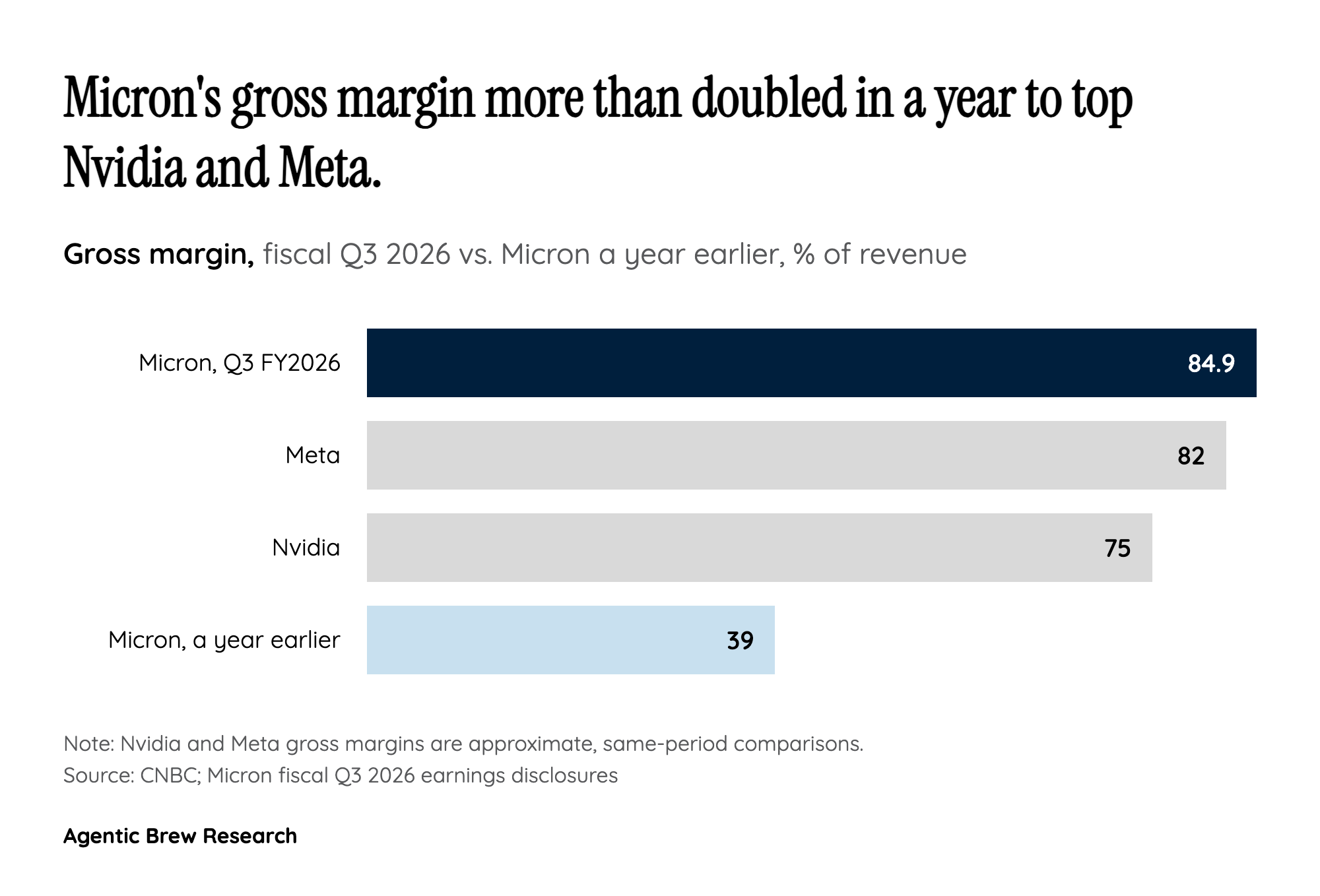
The Commodity Maker That Out-Margined Nvidia
Micron fiscal Q3 2026 gross margin (84.9%) vs. Nvidia (~75%) and Meta (~82%), with Micron a year earlier (~39%) for contrast.

For most of its history Micron has been the textbook cyclical commodity business: it makes interchangeable memory chips, competes mainly on cost, and watches its margins collapse every time supply catches up with demand. Q3 2026 inverted that story. Micron's 84.9% gross margin did not just beat its own prior records, more than doubling from a year earlier, it surpassed Nvidia's roughly 75% and Meta's roughly 82%, the two companies most associated with AI value capture [1]. A memory maker is now keeping more of every revenue dollar than the company designing the accelerators and the company building the largest AI platform.

The mechanism is scarcity, not better silicon. High-bandwidth memory (HBM) stacks many DRAM dies vertically and sits next to a GPU to feed it data fast enough to keep its compute units busy. Because every modern AI accelerator needs a large allotment of HBM, and because HBM is far harder to manufacture than ordinary memory, the chip that used to be a passive component became the gating part of the entire AI stack. When the part everyone needs is sold out, the supplier sets the price. That is why Micron, historically the price-taker, briefly became the highest-margin name in big tech, reframing who actually captures the economics of the AI boom.


Who Pays: The Memory Tax And The $22B Prepayment

Record margins mean someone on the other side is paying more, and the bill is landing in two very different places. The first is the data center. Hyperscalers and large AI customers are not just signing contracts, they are prepaying: Micron disclosed roughly $22 billion in expected customer cash, including about $18 billion in deposits, effectively funding the fabs that will make the memory they have already promised to buy [2]. When buyers are wiring billions in advance to lock down capacity, it is the clearest possible signal that demand has outrun supply, and indeed Micron says it can fulfill only 55-60% of its core customers' demand [3].

The second payer is you. The same capacity reallocation that enriches Micron starves the conventional DRAM and NAND that goes into laptops and phones. An HBM3E module can sell for roughly $60-$100 versus $5-$10 for comparable conventional DDR5, so every maker rationally shifts its best lines toward AI memory and lets consumer supply tighten [3]. Analysts have begun calling the downstream price increase an 'AI memory tax,' warning of a real hit to the 2026 smartphone and PC markets as higher memory prices pass through to retail devices [4]. The AI buildout, in other words, is partly being financed by the cost of your next computer.

Why This Isn't A One-Quarter Spike

The reflexive skeptic read on any memory blowout is that it is the top of a cycle. What makes this print different is how much of the future has already been contracted. Micron's entire 2026 HBM supply is sold out under multi-year contracts, and it has shipped over $1 billion in next-generation HBM4 revenue [5]. More striking, 14 of its 16 strategic customer agreements carry roughly $100 billion in cumulative revenue at minimum price, meaning even in a downturn those deals have a contractual floor [2]. CFO Mark Murphy told investors that even at that floor price, margins should stay significantly above prior peak margins, a structural claim no previous memory cycle could make.

The supply side reinforces the lag. Adding memory capacity is not a software toggle; it requires large, complex greenfield fab expansions that take years, with meaningful new supply not expected until 2027-2028 [3]. CEO Sanjay Mehrotra framed tight conditions as persisting beyond calendar 2027, and the SK Group chairman has warned the HBM shortage could stretch toward 2030 [5]. So the bull case is not 'demand is high right now,' it is 'demand is locked in contractually while new supply is physically years away,' which is a far more durable setup than the spot-price spikes of past cycles.

The Contrarian Read: Shovel Parts vs. A Broken Cycle

Not everyone is convinced the new normal is normal. The sharpest skeptic framing, which circulated on investing forums, is that the print only proves 'the companies selling shovel parts to the people selling shovels are making tons of money', a reminder that supplier profits can be spectacular precisely because they sit upstream of an unproven demand thesis. The deeper bear argument is mean reversion: memory names have a long record of going vertical and then giving it all back once inventory normalizes and pricing softens, and one widely cited analysis bluntly argues every memory cycle ends the same way [6]. If AI capital expenditure decelerates even modestly, the contracted floors protect revenue but not the multiple the stock now trades on.

The community reaction captured exactly this tension. On Reddit, the dominant voice was celebratory, with wallstreetbets traders crediting the print with 'saving the market' after a jittery week for chip stocks, while a vocal minority kept hammering cyclicality and AI-bubble risk. On finance YouTube, Wedbush's Dan Ives framed the earnings as a market-wide 'gut check moment', a referendum on whether the entire AI-capex trade is durable rather than a story about one chipmaker. That is the real stake here: Micron's margins are being read less as a company result and more as a live test of whether AI demand is structural or a bubble waiting to deflate.

Historical Context

2023
HBM and cloud-related memory was about 17% of Micron's DRAM revenue, before AI demand reshaped the product mix.
2025
DRAM prices rose roughly 172% across the year as the AI boom broke the memory market, with HBM growing to nearly half of Micron's DRAM revenue.
2026-Q1
DRAM prices surged roughly 90% in Q1 2026 versus Q4 2025 as capacity was structurally reallocated toward AI data center products.
2026-06-22
Micron and Anthropic announced a strategic agreement pairing a multi-year supply deal with a Series H investment, pushing MU shares up about 5% to a record.
2026-06-24
Micron reported blowout fiscal Q3 2026 results and raised guidance, with shares surging roughly 13-15% after hours.

Power Map

Key Players
Subject

Micron Q3 2026 AI memory earnings blowout past Nvidia and Meta

MI

Micron Technology (MU)

The memory, DRAM, NAND and HBM maker reporting the blowout; sold-out HBM capacity and pricing power drove record revenue and the highest gross margin in tech.

HY

Hyperscalers and cloud customers

Source of the ~$100 billion in contracted agreement revenue and roughly $22 billion in prepayment deposits; their demand outruns supply, with Micron able to fulfill only 55-60% of it.

AN

Anthropic

AI lab and new Micron customer; signed a multi-year memory and storage supply deal and received a strategic Series H investment from Micron to secure capacity for training and serving Claude.

SA

Samsung and SK Hynix

Rival memory makers also benefiting from surging DRAM and HBM prices; the SK Group chairman warned the HBM shortage could persist toward 2030.

CO

Consumers and device makers

On the losing side of the squeeze; surging DRAM and NAND prices flow through to PCs and smartphones as an 'AI memory tax,' with analysts flagging a 2026 hit to those markets.

Fact Check

6 cited
  1. [1] Micron is tech's new margin king as memory crisis pushes company past Nvidia and Meta
  2. [2] Micron Q3 2026 slides: record margins, $100B customer agreements
  3. [3] How AI broke the memory market
  4. [4] Micron earnings 2026: record margins confirm an AI memory tax on your next PC
  5. [5] Micron Q3 FY2026 earnings: revenue, HBM, and the AI memory boom
  6. [6] Every memory cycle ends the same

Source Articles

Top 5

THE SIGNAL.

Analysts

"Expects tight memory conditions to persist beyond calendar 2027 because of AI-driven demand across all segments coupled with structural supply constraints, with HBM4 ramping twice as fast as HBM3E."

Sanjay Mehrotra
CEO, Micron Technology

"Margins more than doubled year-over-year to a record, and even at the floor price under long-term commitments, he expects margins to stay significantly above prior peak margins."

Mark Murphy
CFO, Micron Technology

"Hiked Micron's price target from $535 to $1,625, a roughly 204% increase, reflecting the scale of the AI memory demand surge."

Timothy Arcuri
Analyst, UBS

"Says memory and storage are central to how efficiently Anthropic can train and serve Claude, and the Micron deal secures the supply the company needs."

Tom Brown
Co-founder & Chief Compute Officer, Anthropic
The Crowd

"Today, Micron reported our Q3 FY26 financial results. Learn more: https://t.co/23iktTsc8n"

@@MicronTech1864

"MICRON TECHNOLOGY Q3 RESULTS CRUSH ESTIMATES; Q4 GUIDANCE SMASHES WALL STREET FORECASTS - REVENUE: $41.46B VS $35.59B EST. - ADJ. EPS: $25.11 VS $20.60 EST. - NET INCOME: $28.24B - ADJ. NET INCOME: $28.86B - Q4 REVENUE GUIDANCE: $50.00B VS $42.92B EST."

@@FirstSquawk181

"Micron posts record Q3 FY2026 - $41.5B revenue (+346% YoY) as AI memory demand reshapes the data center buildout. $41.46B revenue, 84.6% gross margin - up from $9.3B a year ago, GAAP EPS of $24.67; Q4 guide of ~$50B at ~86% margin signals demand still accelerating"

@@McnallieM2

"Micron tops Q3 earnings estimates, offers better-than-expected outlook and declares dividend"

@u/King-of-Limbs-07240
Broadcast
Micron Earnings to Be 'Gut Check Moment' for Markets, Dan Ives Says

Micron Earnings to Be 'Gut Check Moment' for Markets, Dan Ives Says

Micron Earnings Take on New Gravity With Market on Edge Over AI

Micron Earnings Take on New Gravity With Market on Edge Over AI

Micron: $1,750 Stock Price Prediction with a Strong Buy Rating (MU 2026 Analysis)

Micron: $1,750 Stock Price Prediction with a Strong Buy Rating (MU 2026 Analysis)