OpenAI Stopped Racing on Capability and Started Racing on the Bill
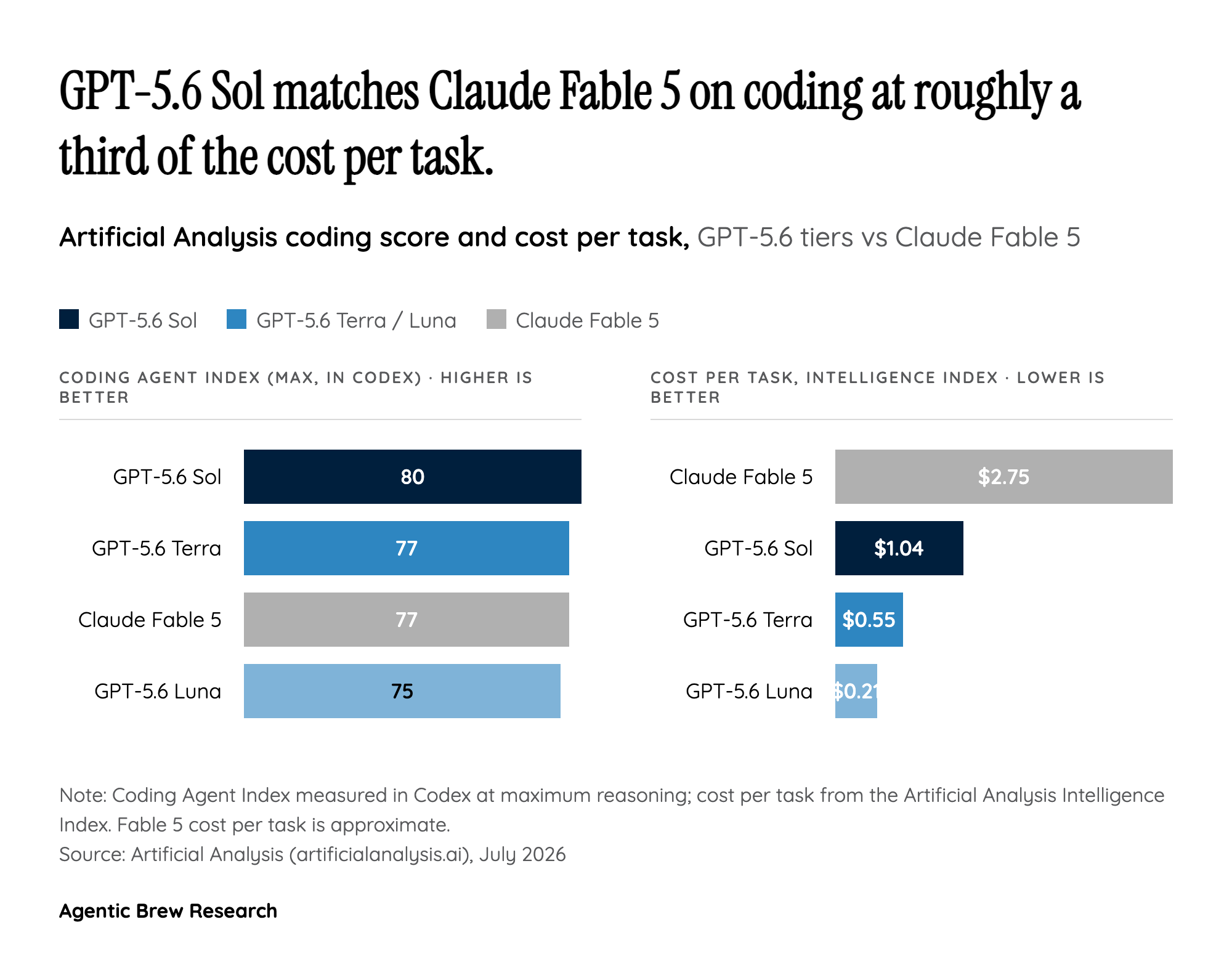
The most consequential thing about GPT-5.6 is not what it can do - it is how much it costs to make it do anything. OpenAI led the launch with token efficiency rather than a headline capability jump, pricing Sol at $5 in and $30 out per million tokens, Terra at $2.50 in and $15 out, and Luna at $1 in and $6 out [5]. Sam Altman touted Sol as 54% more token efficient on agentic coding tasks [5], and OpenAI said the family was explicitly trained to get more useful work from every token [2]. This is a deliberate reframing of the frontier from raw intelligence toward performance per dollar.
The reason for the pivot is visible in the market. Enterprises scaling AI have been hit with what Counterpoint Research's Neil Shah called bill shocks from rising token consumption [2], and the Ramp AI Index for May 2026 showed Anthropic leading OpenAI in business adoption for the first time, 34.4% to 32.3% [8]. When your rival is winning enterprises on value, matching its intelligence at a third of the price is a sharper weapon than beating it on a benchmark. Artificial Analysis pegged Sol at $1.04 per task versus roughly $2.75 for Claude Fable 5 in its Intelligence Index [3], and Terra was pitched at about twice as cheap as GPT-5.5 [4]. The tiering itself - one model line, three durable capability rungs that advance on their own cadence - lets buyers dial cost against difficulty instead of overpaying a flagship for routine work.