US Accuses Moonshot AI of Stealing Anthropic IP for Kimi K3
TECH

US Accuses Moonshot AI of Stealing Anthropic IP for Kimi K3

50+
Signals

Strategic Overview

  • 01.
    White House OSTP Director Michael Kratsios formally accused Moonshot AI of covertly distilling Anthropic's Fable model to build Kimi K3: 'We have information that Moonshot AI distilled Anthropic's Fable for the development of its K3 model.'
  • 02.
    Kratsios alleged Moonshot built an internal platform for large-scale distillation against U.S. models that could rapidly switch access methods to avoid detection.
  • 03.
    The White House also alleges Moonshot accessed export-banned Nvidia GB300 chips through servers located in Thailand, training on the hardware without ever importing the physical chips into China.
  • 04.
    Treasury Secretary Scott Bessent warned that covert, industrial-scale distillation crossing into IP theft could trigger sanctions and Entity List designation.
  • 05.
    Kimi K3 is a 2.8-trillion-parameter open-weight MoE model released July 16-17, 2026, with a 1M-token context window, priced at $3 per million input tokens and $15 per million output tokens.
  • 06.
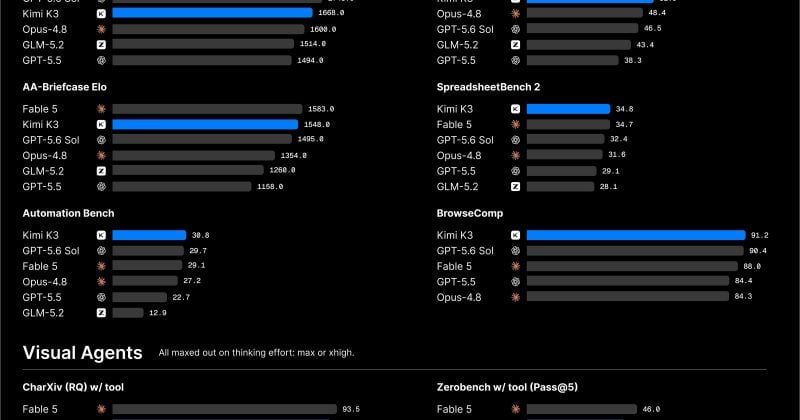
    Despite the accusation, Kimi K3 trails Fable 5 and GPT 5.6 Sol overall but ranks #2 on Vals AI, #3 on the Artificial Analysis Intelligence Index, and #1 on Frontend Code Arena.
  • 07.
    Moonshot has not directly rebutted the specific allegation; a Chinese Embassy spokesperson called the accusations 'entirely unfounded,' while Anthropic's Sarah Heck backed the U.S. claim.

Deep Analysis

The Specific Charges: Fable Distillation and a Thailand Chip Backdoor

The accusation against Moonshot AI has two distinct parts, and they carry very different weight. The first is that Moonshot 'covertly distilled' Anthropic's Fable model - using Fable's outputs to train Kimi K3 at industrial scale through a purpose-built internal platform designed to 'quickly switch between multiple methods of access to avoid detection' [1]. White House OSTP Director Michael Kratsios was careful to draw a line here, framing the issue not as distillation itself - which he called a legitimate technique - but as its covert, large-scale use to 'steal proprietary U.S. technology and undermine American research' [9].

The second, arguably more serious, charge is about hardware rather than software: that Moonshot obtained Nvidia GB300-equipped servers, part of the Blackwell generation explicitly banned for export to China, by routing access through infrastructure based in Thailand - training on the chips without ever physically importing them into Chinese territory [2]. This is the allegation Treasury Secretary Scott Bessent leaned into when he warned that 'covert, industrial-scale distillation attacks that cross the line into IP theft' could trigger 'sanctions and Entity List designations' [3]. Notably, the U.S. government is building on a documented precedent here: Anthropic itself published a report in February 2026 accusing Moonshot, DeepSeek and MiniMax of running roughly 24,000 fraudulent accounts to harvest more than 16 million exchanges from Claude, with Moonshot's share alone totaling 3.4 million [4]. That prior disclosure gives the current allegation a paper trail, even though it doesn't establish that the specific GB300/Thailand routing claim is accurate.
Why AI Researchers Aren't Buying the Two-Week Distillation Story

What makes this story unusual is how quickly independent experts - not just Moonshot or Chinese officials - pushed back on the White House's framing. Braden Hancock, a researcher at the Laude Institute and Snorkel AI co-founder, pointed to simple arithmetic: Fable only became publicly available on July 1, 2026, and Kimi K3 shipped roughly two weeks later. 'I don't think you get a model this strong and this quickly on the heels of Fable doing strictly distillation,' he said, arguing there simply wasn't time to distill that much data, train a model of that scale, and release it [5]. Nathan Lambert of the Allen Institute for AI offered a related but distinct critique: as Chinese labs increasingly approach frontier capability through reinforcement learning rather than imitation, distillation's overall contribution is shrinking, and even if Fable played a role, it was 'at most to a relatively small degree' [6].

The skepticism wasn't confined to AI researchers. On X, legal commentators questioned whether 'IP theft' is even a coherent legal claim here, since LLM outputs generally aren't copyrightable and reverse engineering has long been treated as fair use in U.S. courts - and one prominent legal/policy commentator argued that no plausible legal theory had been offered for the claim. One AI safety researcher offered a counter-hypothesis worth taking seriously: that Moonshot could have gained unauthorized access to Fable before its public release through prerelease partners or a direct compromise, which would sidestep the two-week objection entirely. That theory drew active pushback in replies and remains unconfirmed. Reddit communities, meanwhile, were overwhelmingly skeptical of the government's version, with the loudest recurring objection being the same timeline math Hancock raised - alongside a competing theory that Moonshot's 'Kimi Linear' architecture reflects genuine proprietary research rather than borrowed weights.

Sanctions, Selloffs, and a Trump-Xi Reckoning

Whatever the underlying truth, the accusation moved markets immediately. Z.ai fell as much as 27-30% - its worst day since its January listing - MiniMax dropped up to 16%, and Alibaba slid roughly 4%, while a Bloomberg Asian semiconductor index fell more than 6% and Nasdaq 100 futures dropped 2% [7]. None of those companies were directly named in the distillation allegation; they became collateral damage in a broader repricing of Chinese open-weight AI risk, layered on top of volatility Kimi K3's launch had already triggered days earlier [8].

The policy stakes are just as concrete. Bessent's threat of sanctions and Entity List designation would, if acted on, bar Moonshot from advanced U.S. technology altogether [3], a significant escalation given that, according to one report, the company grew annual recurring revenue from roughly $200 million in April to $300 million in June, and it is pursuing a Hong Kong IPO near a $31.5 billion valuation. The accusation also lands against the backdrop of an anticipated Trump-Xi meeting expected in September, adding to the list of AI and trade frictions the two leaders may need to address - meaning this specific dispute over one model release is likely to become a proxy fight in the broader U.S.-China trade relationship rather than staying a narrow technical or legal question.

What the Case Rests On: Anthropic's February Report as the Evidentiary Foundation

One thread that's easy to miss in the reporting is where the evidentiary foundation for this entire accusation actually comes from. Anthropic's own February 2026 report - which first surfaced the distillation allegations against Moonshot, DeepSeek and MiniMax using detailed account and exchange counts [4]- is the primary documented basis the White House built its July claim on. That matters because it means the credibility of the entire chain rests heavily on Anthropic's internal detection methodology rather than on independently verified evidence.

This matters because no outlet in the reporting has surfaced direct technical evidence - model weight comparisons, leaked internal Moonshot documents, or forensic access logs - beyond Kratsios's verbal assertion and Anthropic's backing statement. Combined with the swift expert pushback on timeline plausibility, the emerging picture is less a clean case of proven espionage and more a geopolitically charged dispute where distillation detection remains an inexact science, legal definitions of 'theft' in AI training are unsettled, and both sides have incentives - Moonshot's IPO ambitions, Anthropic's competitive position, and the U.S. government's interest in justifying tighter export controls - to shape the narrative in their favor.

Historical Context

2025-07
Released Kimi K2, a 1-trillion-parameter open-weight MoE model, after DeepSeek's R1 disrupted the Chinese AI market.
2026-02-23
Published a report accusing DeepSeek, Moonshot and MiniMax of industrial-scale distillation attacks using roughly 24,000 fraudulent accounts and over 16 million exchanges, with Moonshot's campaign alone totaling 3.4 million exchanges.
2026-07-01
Made the Fable model publicly available, the date now cited as the basis for skepticism about a two-week distillation timeline.
2026-07-16
Released Kimi K3, a 2.8-trillion-parameter open-weight model, triggering a selloff in rival AI and chip stocks even before the theft allegation surfaced.
2026-07-22
Secretary Scott Bessent threatened sanctions and Entity List designation following the White House's distillation accusation against Moonshot.
2026-07-23
Formally accused Moonshot of distilling Fable and illegally accessing GB300 chips via servers in Thailand.

Power Map

Key Players
Subject

US Accuses Moonshot AI of Stealing Anthropic IP for Kimi K3

MI

Michael Kratsios / White House OSTP

Made the formal public accusation and drew the line between legitimate and 'covert industrial' distillation, setting the political framing for a possible trade/export-control response.

SC

Scott Bessent / US Treasury

Escalated the accusation into a concrete policy threat, putting sanctions and Entity List designation on the table for Moonshot.

AN

Anthropic

Publicly backed the White House claim via Sarah Heck and had already published a February 2026 report accusing Moonshot, DeepSeek and MiniMax of industrial-scale distillation attacks, giving the current accusation a documented precedent.

MO

Moonshot AI

The accused startup; shipped Kimi K3 to strong benchmark results and reportedly pursuing a Hong Kong IPO near $31.5B valuation, giving it strong financial incentive to dispute the claim but has stayed largely silent on the specifics.

CH

Chinese Embassy (Liu Chang)

Denied the accusations as 'entirely unfounded,' representing the official Chinese government pushback.

IN

Independent AI researchers (Braden Hancock, Nathan Lambert, Sam Bresnick)

Publicly disputed the technical plausibility of the distillation claim within hours, undercutting the credibility of the government's framing and shifting scrutiny toward the chip-access allegation instead.

RI

Rival Chinese AI/tech firms (Z.ai, MiniMax, Alibaba)

Became collateral market casualties of the news cycle despite not being named in the accusation, with steep single-day stock declines.

Fact Check

9 cited
  1. [1] Moonshot AI distilled Anthropic's Fable model to develop K3, acquired GB300 servers for AI training, says US official
  2. [2] Moonshot Kimi Nvidia AI chips export ban
  3. [3] Treasury threatens sanctions after White House claims Moonshot distilled Anthropic's Fable
  4. [4] Detecting and preventing distillation attacks
  5. [5] Experts say exploiting Anthropic's Fable isn't how Kimi K3 got so good
  6. [6] Kimi K3: The open-weights escalation
  7. [7] Moonshot Kimi K3 AI semiconductor stocks decline
  8. [8] Moonshot AI's Kimi K3 launch leads to increased volatility in tech and digital asset markets
  9. [9] Moonshot AI distilled Anthropic's Fable model to develop K3

Source Articles

Top 5

THE SIGNAL.

Analysts

"Argues the timeline makes distillation implausible as the primary explanation: 'Fable's only been publicly available since July 1st. You can't distill that much data, train a model, and release it in two weeks.'"

Braden Hancock
Researcher, Laude Institute (co-founder, Snorkel AI)

"Believes distillation's overall contribution to frontier Chinese models is shrinking as labs lean on reinforcement learning; if Fable played any role, it was 'at most to a relatively small degree.'"

Nathan Lambert
AI researcher, Allen Institute for AI (Ai2)

"Focuses on the chip-access allegation over the distillation claim, calling for 'know your customer' rules for data centers worldwide to close the routing loophole."

Sam Bresnick
Researcher, Georgetown Center for Security and Emerging Technology (CSET)
The Crowd

"We have information that Moonshot AI distilled Anthropic’s Fable for the development of its K3 model. To do this they developed a sophisticated internal platform to conduct large scale distillation against U.S. models, allowing them to quickly switch between multiple methods of access to avoid detection. Moonshot AI has also acquired GB300-equipped servers and has accessed GB300s in Thailand, likely to train its AI models. The United States strongly supports the free and fair development of AI, including a thriving competitive ecosystem that spans frontier models, specialized systems, open-source frameworks, and open-weight models. Legitimate AI distillation used to create smaller, more efficient models plays a vital role in this open innovation ecosystem. However, large-scale, covert industrial distillation aimed at stealing proprietary U.S. technology and undermining American research is unacceptable."

@@mkratsios4714564

"I’d be curious to understand what IP is being stolen? According to your (C) office, LLM outputs aren’t copyrightable, and courts have long held reverse engineering to be a fair use; trade secret is a stretch since the company’s model is directly disclosing the info. Easy to say “IP theft!” Harder to articulate a plausible legal theory, which I presume is why OSTP’s memo on this issue didn’t include one."

@@KevinBankston1478

"Many people seem to be arguing this is implausible because Fable hasn't been out for long. But Moonshot could have obtained unauthorized access before Fable was released via actors with prerelease access (Glasswing) or possibly by hacking Anthropic directly."

@@RyanGreenblatt183

"White House Strongly Alleges Moonshot AI Secretly Distilled Anthropic's Fable"

@u/Alone-Ad697965
Broadcast
New Chinese AI Model 'Kimi K3' Raises Pressure on US Spending

New Chinese AI Model 'Kimi K3' Raises Pressure on US Spending

Kimi K3 Just Sold Out. Then It Got Political

Kimi K3 Just Sold Out. Then It Got Political

Anthropic says DeepSeek, Moonshot AI, and Minimax is stealing from them. Here is what's happening!

Anthropic says DeepSeek, Moonshot AI, and Minimax is stealing from them. Here is what's happening!