China's LineShine tops TOP500 supercomputer ranking
TECH

China's LineShine tops TOP500 supercomputer ranking

21+
Signals

Strategic Overview

  • 01.
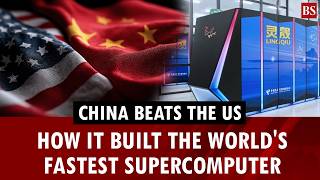
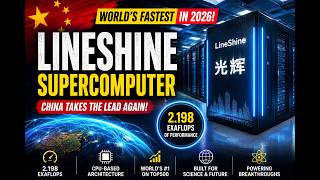
    China's LineShine debuted at No. 1 on the 67th TOP500 list (June 2026), hitting 2.198 exaflops on the High Performance Linpack benchmark and displacing the US El Capitan system.
  • 02.
    It is the first system in TOP500 history to exceed two exaflops of sustained double-precision performance using CPUs only, with no GPUs.
  • 03.
    The debut marks the first time since 2017 that a Chinese system has led the TOP500.
  • 04.
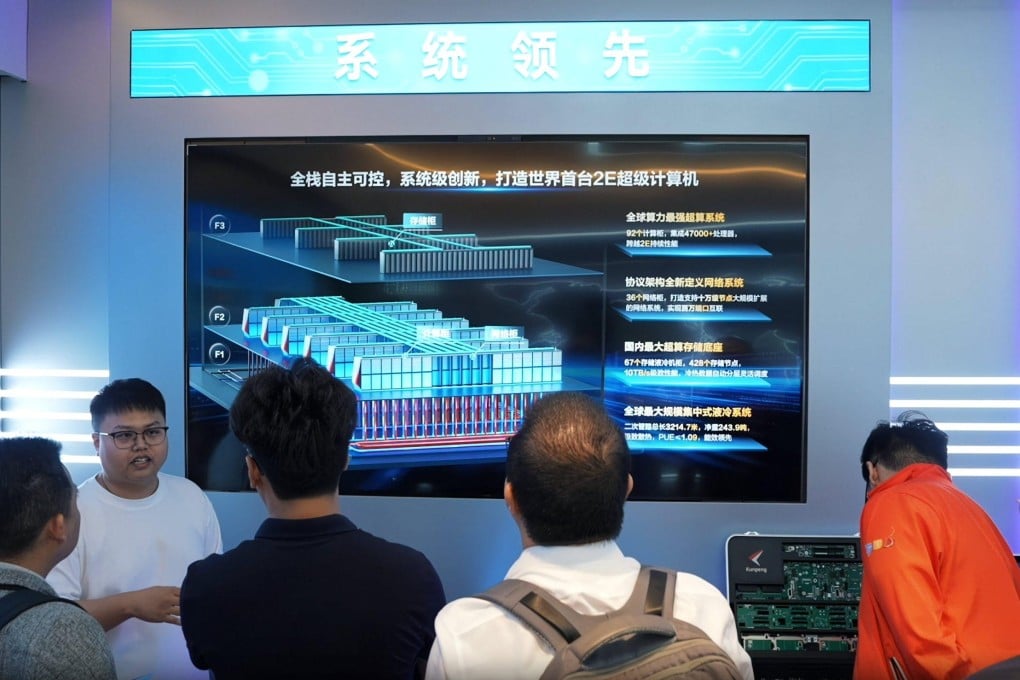
    LineShine is built entirely on domestic hardware and software at the National Supercomputing Centre in Shenzhen: 13.79 million cores across 304-core LX2 processors, the proprietary LingQi interconnect, and the Kylin operating system.

Deep Analysis

The Exascale Machine That Doesn't Have a Single GPU

Every other machine at the top of the supercomputing world leans on graphics chips — the same kind of Nvidia and AMD accelerators that power AI training. LineShine doesn't. It reaches 2.198 exaflops, meaning roughly 2.2 quintillion calculations per second, using 13.79 million conventional CPU cores spread across custom 304-core LX2 processors clocked at 1.55 GHz [1]. That makes it the first system in TOP500 history to sustain more than two exaflops of double-precision performance on CPUs alone [1].

The headline number undersells where the real engineering lives. Wiring nearly 14 million cores together so they behave as one machine is a networking problem more than a chip problem, and LineShine's proprietary LingQi interconnect is what keeps the whole array fed with data. The payoff shows up in efficiency: the system sustained about 80% of its 2.736-exaflop theoretical peak [1], a ratio GPU-accelerated machines rarely reach because their accelerators stall waiting on memory. Among the high-performance-computing researchers reacting to the result, the loudest thread wasn't the raw speed — it was whether a homogeneous, GPU-free CPU machine can keep winning at this scale, reopening a question the field thought GPUs had settled: is heterogeneity still the only road to the top?

By The Numbers: A Commanding Lead at the Top

By The Numbers: A Commanding Lead at the Top
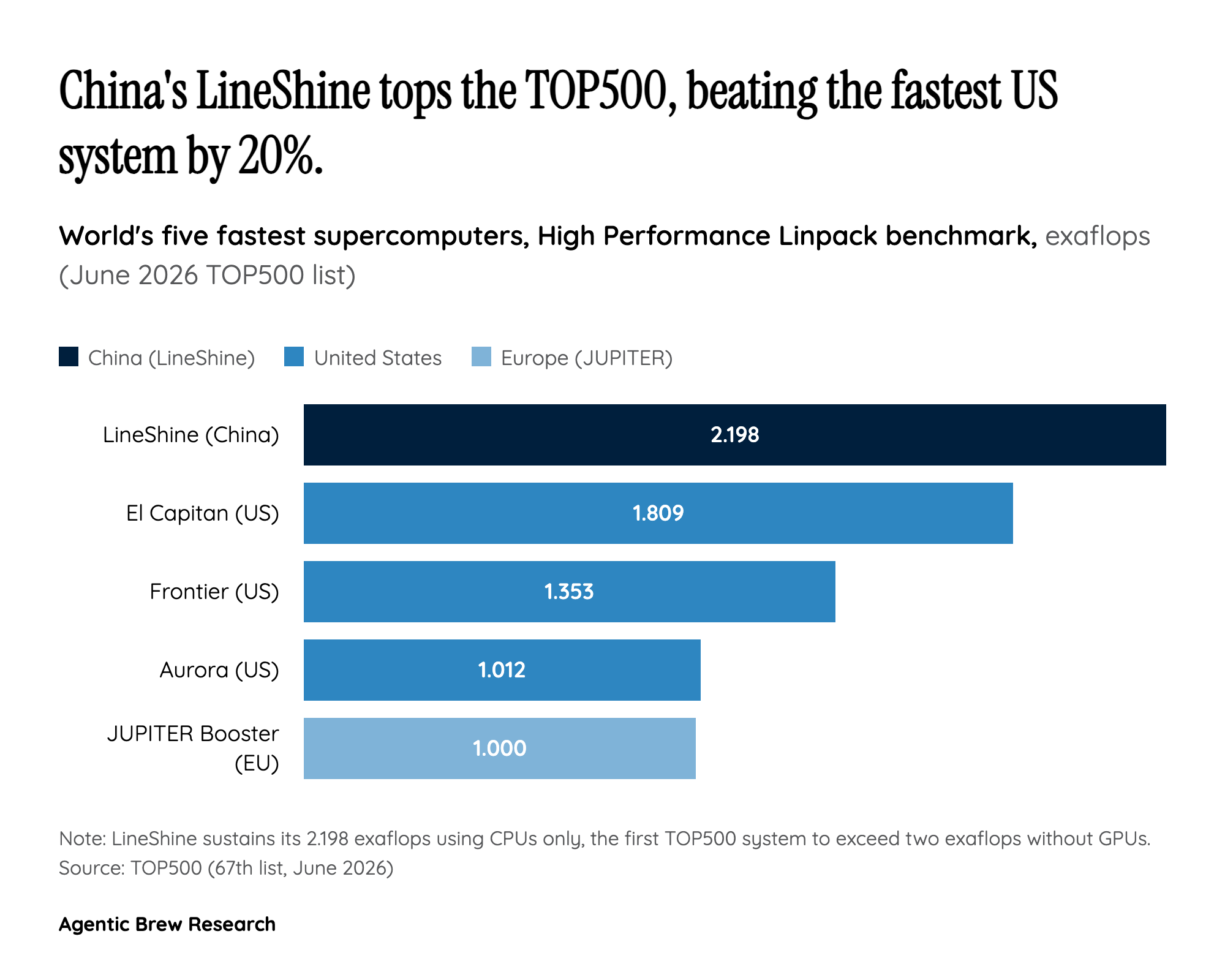
LineShine leads the June 2026 TOP500 by about 20% over the fastest US system, El Capitan, on the High Performance Linpack benchmark.

On the High Performance Linpack benchmark that defines the TOP500, LineShine's 2.198 exaflops sits roughly 20% ahead of the United States' El Capitan at Lawrence Livermore, which now holds second place at 1.809 exaflops [1][4]. The rest of the top five — Frontier, Aurora, and Europe's JUPITER Booster — are American and European GPU systems clustered between 1.0 and 1.35 exaflops, so LineShine doesn't merely lead, it resets the ceiling [1]. Its debut also lifted the number of systems sustaining more than one exaflop on Linpack from four to five [1].

The machine draws about 42.2 megawatts to do it [1]— roughly the electricity of a small town — a reminder that leadership at this tier is now as much an energy-and-infrastructure feat as a silicon one.

The Asterisk: First on Linpack, Not on AI

Topping the TOP500 measures one specific thing: 64-bit floating-point math, the precision that scientific simulations need. It is not the math that trains AI models, which runs at lower precision on GPUs and specialized tensor hardware. On those mixed-precision workloads LineShine falls behind several US GPU-accelerated systems, and the clusters widely believed to be the genuine giants of AI compute — run by Microsoft, Amazon, Meta, Alphabet, and xAI's Colossus — don't submit to the list at all [3]. That makes 'world's fastest' both true and incomplete in the same breath.

The gap is structural rather than a tuning problem: a CPU-only design optimized for simulation can't simply be pointed at AI training and match purpose-built accelerators, no matter how many cores it adds. For Beijing the scientific-computing crown still matters — weather, nuclear, materials, and aerospace modeling all run on exactly this kind of double-precision hardware — but anyone reading the headline as 'China now leads in AI compute' is reading a benchmark that was never measuring it.

Why Export Controls Produced the Machine They Were Meant to Prevent

The uncomfortable subtext of LineShine is that it exists because of US policy, not in spite of it. Cut off from Nvidia GPUs and advanced chipmaking tools, China had to build the entire stack itself — the LX2 processor, the LingQi interconnect, the LingKun platform, and the Kylin operating system — and it did [1]. Jack Dongarra, the Turing Award winner who co-founded the TOP500, put it plainly: export controls 'may slow China's access to certain advanced components, but they also provide a strong incentive to develop domestic alternatives' [3], and he argued China can now build technology 'as good as – or maybe even better than' existing options despite the restrictions [2].

That is the strategic story analysts are watching. Addison Snell, a longtime HPC analyst, cautioned that the United States still leads in overall technology but 'the gap is not wide,' framing the moment around 'digital sovereignty' — the idea that controlling your own compute stack is now a national-security asset, not just an engineering preference [3]. LineShine is the first concrete proof that sweeping controls can accelerate exactly the self-reliance they were designed to prevent, and it is unlikely to be the last time that tradeoff is tested.

Historical Context

2010-11
The first Chinese supercomputer to headline the TOP500 list.
2013-06
Held the world No. 1 spot for six consecutive lists through November 2015.
2016-06
Reached the top at about 93 petaflops using homegrown chips and held No. 1 until 2018 — China's last TOP500 leader before LineShine.
2022-01
China reduced and then halted top-list submissions amid trade frictions and export blacklisting, going dark at the top of the TOP500.
2026-06-23
Debuted at No. 1, reclaiming the supercomputing crown for China for the first time since 2017.

Power Map

Key Players
Subject

China's LineShine tops TOP500 supercomputer ranking

NA

National Supercomputing Centre in Shenzhen / Shenzhen Cloud Computing Center

Host and builder of LineShine; delivered China's first TOP500 No. 1 in nearly a decade using an all-domestic hardware and software stack.

LA

Lawrence Livermore National Laboratory (US)

Operator of El Capitan, the displaced former No. 1, now ranked second at 1.809 exaflops.

TO

TOP500 / Jack Dongarra

Maintains the ranking and the Linpack benchmark; co-founder Dongarra provided the expert validation that frames how the result is read.

US

US export-control regime

Blocks China's access to advanced GPUs and chipmaking tools, which shaped LineShine's CPU-only design and pushed Beijing toward a fully domestic stack.

US

US AI hyperscalers (Microsoft, Amazon, Meta, Alphabet, xAI's Colossus)

Operate the AI-focused systems widely believed to exceed LineShine on AI workloads, but they do not submit to the TOP500, complicating the 'world's fastest' framing.

Fact Check

4 cited
  1. [1] LineShine Debuts at No. 1 as the TOP500 Enters a New Global Exascale Era
  2. [2] Return to the top: China's LineShine beats US El Capitan in Top500 supercomputer rankings
  3. [3] China takes US crown for world's fastest supercomputer
  4. [4] China regains world's top supercomputer ranking with LineShine

Source Articles

Top 4

THE SIGNAL.

Analysts

"Called LineShine the first CPU-only system to reach exascale and argued China can develop technology 'as good as – or maybe even better than' existing options despite US export controls."

Jack Dongarra
TOP500 co-founder, Turing Award winner

"Said export controls 'may slow China's access to certain advanced components, but they also provide a strong incentive to develop domestic alternatives.'"

Jack Dongarra
TOP500 co-founder, Turing Award winner

"Said the US still leads globally in technology but 'the gap is not wide,' and framed the result around 'digital sovereignty' as a key theme in supercomputing and AI."

Addison Snell
HPC industry analyst
The Crowd

"Now the Top500 and other rankings announcement. Chinese LineShine system is # 1 (also in HPCG). China's back!"

@@ProfMatsuoka97

"Surprise: Chinese LineShine supercomputer takes the #1 spot on the #Top500 and #HPCG lists! First time since a while that spot is taken by a homogeneous CPU machine. So is heterogeneity here to stay? CPUs with HBM and tensor cores (e.g., ARM SME). Congrats Yutong and folks."

@@thoefler75

"China's LineShine supercomputer dethrones El Capitan in Top 500 list"

@@tomshardware27

"China bypasses US GPU bans with 1.54-exaflops 'LineShine' supercomputer — CPU-only monster packs 2.4 million Huawei-designed Armv9 cores"

@u/Steap-Edit358
Broadcast
Worlds Fastest Super Computer is in China from LineShine - Chinese Beat Americans Even With Embargos

Worlds Fastest Super Computer is in China from LineShine - Chinese Beat Americans Even With Embargos

How China built the world's fastest supercomputer | LineShine | Nvidia | AMD | Technology

How China built the world's fastest supercomputer | LineShine | Nvidia | AMD | Technology

China's LineShine Supercomputer | The World's Fastest Supercomputer in 2026?

China's LineShine Supercomputer | The World's Fastest Supercomputer in 2026?