Google SynthID Detector Public Launch
TECH

Google SynthID Detector Public Launch

42+
Signals

Strategic Overview

  • 01.
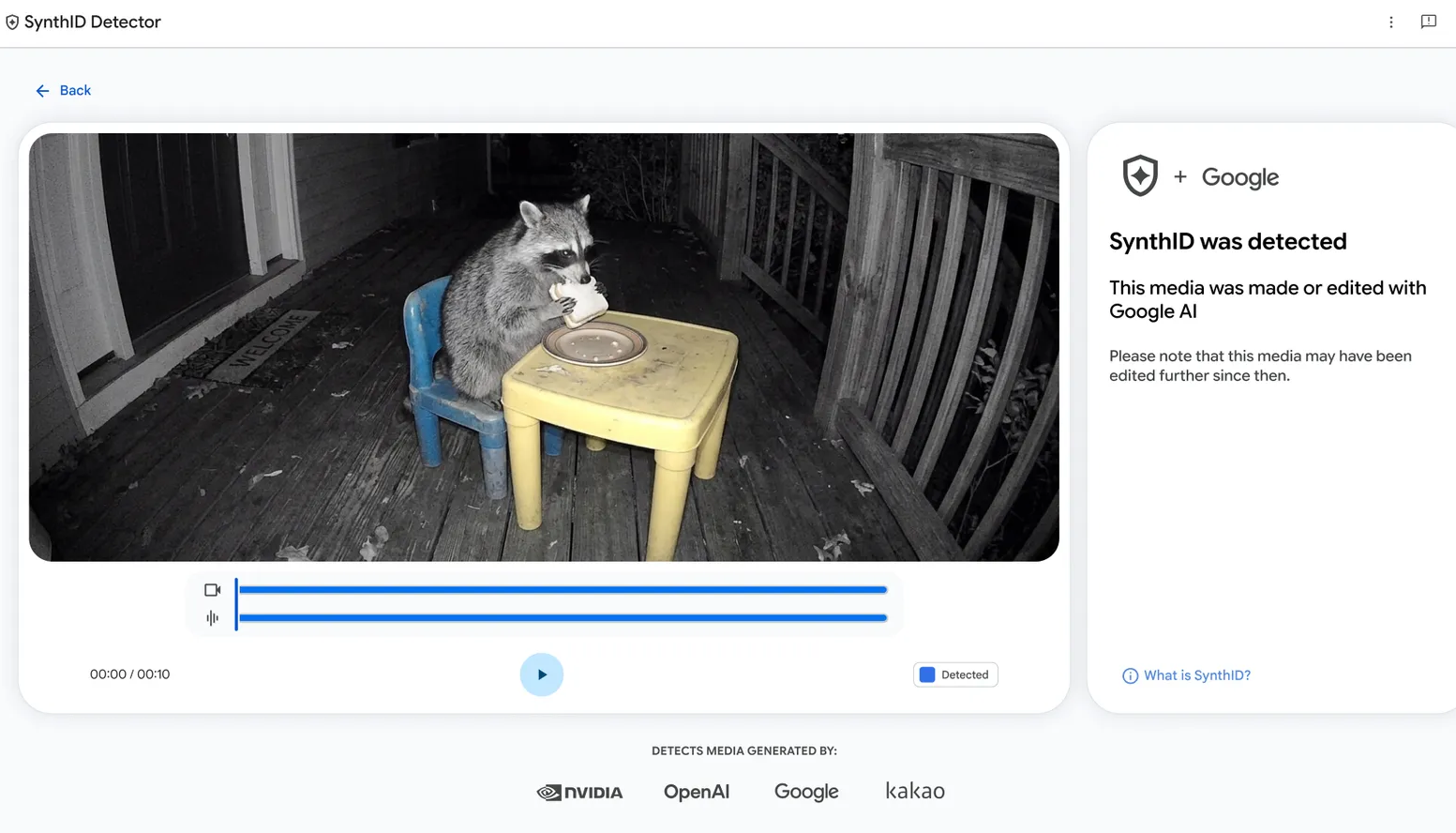
    Google opened SynthID Detector to the public worldwide in English on October 7-8, 2026, turning a tool previously restricted to journalists, researchers, and media professionals into a public portal at synthid.com.
  • 02.
    The tool lets anyone check whether an image, video, or audio file carries a SynthID watermark from Google or a partner, confirming AI involvement from Google or its partners.
  • 03.
    Users must sign in with a Google, OpenAI, or Apple account to access the public checker.
  • 04.
    The public tool caps usage at roughly 10 checks per day per user, combined across images, video, and audio.
  • 05.
    The detector only recognizes watermarks from Google and partners OpenAI, Nvidia, and Kakao; Apple support is announced but not yet live, with no release date given.
  • 06.
    Google states the tool is not a general AI detector - a negative result does not prove that media is human-made, only that no supported watermark was found.
  • 07.
    More than 180 billion images and videos, plus 240,000 years of audio, have been watermarked with SynthID since its 2023 launch, with verification infrastructure now handling over 1 million requests daily across Search, the Gemini app, and Chrome.

A Watermark Checker, Not a Lie Detector

Google's framing is that anyone can check if media was made with AI from Google or its partners [1], but the company is explicit that the tool only confirms the presence of a SynthID watermark, not the absence of AI involvement - a negative result does not prove a file is human-made [2]. Analysts describe the distinction bluntly: SynthID "works more like a barcode scanner than a lie detector" [3]- it reads a label when one exists and says nothing useful when it doesn't. That gap showed up immediately in hands-on testing: the detector correctly identified ChatGPT and Gemini images, but returned a flat "no AI watermarks detected" on a clearly AI-made puppy video simply because the generator wasn't a SynthID partner [4]. Technically, the watermark is embedded directly into an image's pixels, into every frame of a video, into the audio spectrogram before it's converted back to a waveform, or into the probability distribution of next-word choices for text - a design meant to survive ordinary edits like compression, trimming, and filtering, per Google DeepMind's own technical explainer. That makes the detector's blind spot a coverage problem - which companies opted in - rather than a technical flaw in the watermark itself.

The Partner Club Has Four Members, and the Biggest Names Aren't In It

The detector currently recognizes marks only from Google, OpenAI, Nvidia, and Kakao; Apple is "coming soon" with no release date, even though an Apple account is already one of the three sign-in options required to use the tool [5][8]. Everything outside that club is effectively invisible: a Grok-generated image went completely undetected in testing [7], and neither xAI's Grok nor Anthropic's Claude watermark their output at all [6]. Meta isn't a holdout waiting to join, either - it runs its own separate, incompatible AI-detection system, and a Reuters investigation cited by Gizmodo found that system "sometimes fails to flag content that was created with Meta's AI tools," particularly cropped images [7]. Google itself concedes the fragmentation won't resolve quickly: building industry-wide standards takes time because image, audio, and video all carry different technical requirements [6].

The Watermark Survives Compression, Not a Determined Adversary

Google's own robustness testing found watermarked images withstood 300 successive rounds of randomized compression and resizing, but became undetectable once those already-degraded images were cropped by roughly 20 percent [8]. That's a narrow survival window, and academic security researchers have already found a way through it: a team presenting MarkNull at USENIX Security 2026 demonstrated watermark-removal techniques that defeat SynthID while preserving image quality [3]. The skepticism isn't confined to a conference paper - Reddit discussions describing the watermark as trivially stripped via a simple screenshot-and-upscale trick, plus talk of building a dedicated removal tool, were already circulating before this week's public rollout even reached a general audience.

Ten Checks a Day, Three Accounts, No Guarantee

The public tool caps usage at roughly ten checks a day per signed-in user, combined across images, video, and audio [8], and access itself requires signing in with a Google, OpenAI, or Apple account [5]. Combined with the partner-only coverage and the cropping vulnerability, the launch reads less like a finished authentication layer for the internet and more like a narrow, rate-limited first checkpoint - useful for confirming when Google-ecosystem AI tools were involved, largely uninformative for everything else.

The Split Reaction: Celebration on X, Skepticism on Reddit

Google and DeepMind's own announcements framed the launch as an industry-wide transparency milestone, and that framing traveled - a Japanese tech-news account picked up the story, describing it as the moment ordinary users can run their own fake-detection checks. The reception inside AI-builder communities was less celebratory. On generative-AI forums, the open question wasn't whether the tool works, but why Google is moving into deepfake detection at this scale and who else could realistically compete once it does - alongside a side debate over whether Europe's content-labeling rules are the real driver. Separately, skepticism about whether the watermark can be defeated predates this week's wider rollout entirely - a workaround culture that beat the global launch to the internet.

Historical Context

2023-08
SynthID launched in beta as an image watermarking tool for content generated by Google's Imagen model.
2024
SynthID expanded beyond images to audio, with SynthID-Text deployed on Gemini Web and App endpoints.
2026-05
OpenAI adopted SynthID support, and the cumulative watermarking total passed 10 billion pieces of content.
2026-07
SynthID video watermarking work was published, extending the system to per-frame watermarking.
2026-09-30
SynthID Bio, a protein-sequence watermarking system, was published in Nature.
2026-10-07
SynthID Detector, previously limited to journalists, researchers, and media professionals, opened globally to the public in English at synthid.com.

Power Map

Key Players
Subject

Google SynthID Detector Public Launch

GO

Google / Google DeepMind

Creator and operator of the SynthID watermarking technology and the SynthID Detector verification portal at synthid.com.

OP

OpenAI

Partner whose AI-generated media (e.g., ChatGPT images) can be flagged by SynthID Detector; adopted SynthID support in May 2026.

NV

Nvidia

Partner whose AI-generated content is detectable via SynthID.

KA

Kakao

Partner whose AI-generated content is detectable via SynthID.

AP

Apple

Announced future partner; SynthID support for Apple-generated images is 'coming soon' with no release date, despite an Apple account already being a required sign-in option.

ME

Meta

Non-partner; operates its own separate, incompatible AI-content detection system rather than adopting SynthID.

XA

xAI (Grok) and Anthropic (Claude)

Non-partners; their AI-generated content is not watermarked and is invisible to SynthID Detector.

Fact Check

8 cited
  1. [1] SynthID: AI content transparency (Google blog)
  2. [2] Google SynthID Detector Goes Global With OpenAI, Nvidia, Kakao
  3. [3] Google's SynthID AI Watermark Checker
  4. [4] I tested Google's new SynthID Detector on AI slop. There's a big catch
  5. [5] Google Opens SynthID Watermark Detector To Public
  6. [6] Google debuts SynthID Detector tool for flagging AI-generated content, but it's far from perfect
  7. [7] Google launches new website to detect AI fakes, but don't assume it's perfect
  8. [8] Google Opens SynthID AI Watermark Checker To Everyone

Source Articles

Top 5

THE SIGNAL.

Analysts

“Characterizes SynthID as a watermark-presence check, not a lie-detector style authenticity verdict.”

theneuron.ai analysis
Cautionary / explanatory framing

“Argues an undetected watermark tells users almost nothing useful, since many legitimate explanations exist besides authenticity.”

theneuron.ai analysis
Skeptical of negative-result interpretation

“Points to academic work demonstrating watermark-removal attacks that can defeat SynthID while preserving image quality.”

theneuron.ai analysis (citing USENIX Security 2026 researchers)
Security concern

“Notes the tool is weak against the large volume of non-watermarked AI content circulating online.”

SiliconANGLE report
Critical of coverage gaps

“Concedes that building industry-wide watermarking standards is slow going given differing technical needs across media types.”

Google (company statement, via SiliconANGLE)
Acknowledges fragmentation

“Confirms the tool works correctly for partner-model content but returns uninformative 'not detected' responses for anything outside the partner list, limiting its everyday usefulness.”

PCWorld (hands-on tester)
Practical / mixed
The Crowd

“Today, we're expanding SynthID Detector in partnership with @OpenAI, @NVIDIA, Kakao & soon @Apple as part of an industry-wide effort to make AI-generated content more transparent. Available globally in English, our verification portal lets you check if media was made with AI”

@@Google5660

“SynthID Detector is now available to everyone. Check whether online content was generated using @GoogleAI, or with tools from our industry partners – including @OpenAI, @NVIDIA, Kakao and coming soon, @Apple. Try it out”

@@GoogleDeepMind1392

“Google が「SynthID Detector」を世界展開。画像・動画・音声がAI生成かを無料で検証できるポータルで、OpenAI・NVIDIA・Kakao、近日Appleも参加する業界横断の取り組み。 フェイク判定を一般ユーザーが自分で回せる時代が来た。英語UIだが日本からも利用可能。”

@@masahirochaen57

“SynthID available globally starting today”

@u/Temporary-Baby905712
Broadcast
SynthID: A tool for watermarking and identifying AI-generated content

SynthID: A tool for watermarking and identifying AI-generated content

SynthID – Watermarking and identifying AI-generated text

SynthID – Watermarking and identifying AI-generated text

Google Synth ID | Google's AI Content Detection Tool

Google Synth ID | Google's AI Content Detection Tool

Google SynthID Detector Public Launch — AI News | Agentic Brew