ChatGPT, Claude, Grok, and Gemini outage on September 3, 2026
TECH

ChatGPT, Claude, Grok, and Gemini outage on September 3, 2026

43+
Signals

Strategic Overview

  • 01.
    ChatGPT, Claude, and Grok all suffered confirmed, overlapping outages on the morning of September 3, 2026, while Gemini logged a spike in user reports without an official Google incident being declared.
  • 02.
    OpenAI attributed its ChatGPT and Codex disruption to a routing error beginning around 7:43 AM PT, affecting 19 components including conversations, login, image generation, voice mode, GPTs, and Deep Research, and resolved the incident in roughly two hours.
  • 03.
    Anthropic reported a partial outage across Claude.ai, Claude Code, Claude Cowork, and the API, spanning seven model variants including Opus 5 and Opus 4.8, and described the cause as an infrastructure issue.
  • 04.
    xAI's Grok logged a 'Models' outage lasting three hours and thirty-seven minutes, with users reporting 'model overloaded' and 'High Demand' errors consistent with capacity strain.

Deep Analysis

Three Different Postmortems, One Two-Hour Window

When ChatGPT, Claude, and Grok all buckled within the same stretch of the morning on September 3, the instinctive read online was a single shared cause, most likely Microsoft Azure, since OpenAI, Anthropic, and xAI all lease at least some infrastructure from it. But the three companies' own status pages tell three different stories. OpenAI attributed its ChatGPT and Codex disruption to 'a routing error starting around 7:43am PT' [1], a networking-layer bug distinct from a wholesale cloud failure. Anthropic described its own incident, which spanned Claude.ai, Claude Code, Claude Cowork, and the API across seven model variants, as an 'infrastructure issue,' publicly thanking users for their patience without pointing at Azure or any shared vendor [2]. xAI's status page logged a straightforward 'Models' outage lasting three hours and thirty-seven minutes [3], consistent with the 'model overloaded' and 'High Demand' errors that have dogged Grok through several documented capacity crunches earlier in 2026 as its user base scaled faster than its compute [4].

That divergence matters more than the timing coincidence. Hours later, xAI's own Grok account publicly weighed in, telling a user the incidents traced back to separate, unrelated technical issues at each company rather than any single shared cause. Some technical commentary on Reddit speculated that the failure may have hit specific model tiers unevenly rather than the whole platform at once, though this was speculation from users, not a company statement. If three companies with three different architectures and three different failure descriptions all went down in the same window, the more interesting question isn't who shares a data center, it's why the internet's reflex reaches for a single grand cause before checking the boring, company-specific postmortems that were public within the hour.

Gemini's Survival Looks Like an Accidental Cloud-Diversification Experiment

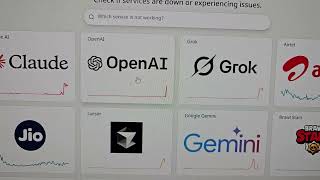
Of the four platforms named in this outage, only Gemini never triggered an official Google incident report, even though user complaints on outage trackers spiked to roughly 500 reports in the same late-morning window that OpenAI logged more than 37,000 [5]. The pattern several outlets converged on: OpenAI, Anthropic, and xAI all run meaningful workloads on Microsoft Azure, while Gemini sits on Google's own cloud stack, and Microsoft's own status history shows a separate East US network and ingress incident tied to infrastructure upgrades, beginning around 10:26 AM PT that same day, with Azure's status page later marking the incident resolved [6]. No company has officially confirmed Azure as the root cause of its own outage, and OpenAI's and Anthropic's explanations, a routing error and an infrastructure issue respectively, don't name Azure explicitly either. Still, the optics of a vendor-diversified Gemini staying up while three Azure-adjacent competitors stumbled is the kind of natural experiment enterprise architects will cite for years, regardless of whether Azure ultimately proves to be the common thread [7]. Same-day YouTube news commentary reached a similarly cautious conclusion, with one creator explicitly noting that pinning the outage on any single cloud provider would be speculation absent official confirmation from the companies involved.

The clearest evidence of how deep that dependency runs isn't the chatbots themselves, it's what broke downstream. Cursor, the AI coding tool that routes requests through both Claude's and Grok's APIs, went down in the same window purely because its upstream providers failed [8]. That's the real lesson buried in Thursday's outage: consumer chat windows recovering within a couple of hours mask a longer tail of automated pipelines, CI jobs, coding agents, customer-support bots, that inherit every minute of an upstream provider's downtime with no independent fallback of their own. OpenAI alone reported 19 affected components spanning conversations, login, image generation, voice mode, GPTs, and Deep Research [9], meaning a single routing bug could simultaneously break a chat session and a coding assistant for the same user.

The 'Astra' Coincidence That Wasn't

Roughly in step with the outage, OpenAI's own account had posted a cryptic teaser, 'the stars are almost aligned,' timed close to anticipated news about its next model, reportedly codenamed Astra and rumored to be branded GPT-6 [10]. Online communities jumped from that coincidence to open speculation, including jokes tying the outage directly to the unreleased Astra launch itself, though this theory circulated as user speculation rather than confirmed reporting. It's an understandable reflex, but the actual reporting undercuts it: OpenAI has not said whether the outage relates to Astra preparations, and the outlet covering the teaser explicitly calls a connection unlikely, noting that ChatGPT has frequent, unrelated outages independent of any launch calendar [10].

The more mundane explanation is also the better-supported one. OpenAI's status page cites a routing error, not a launch-related capacity reservation, and that error's 404-heavy signature matches a backend configuration problem more than a deliberate resource shift toward an unannounced model [1]. The Astra theory is a useful case study in how quickly a real, mundane infrastructure failure gets absorbed into an unrelated corporate narrative once the timing lines up, especially when the company itself was already primed to talk about 'alignment' of a different kind that same week.

This Is the Fourth Time in Two Years, and the Rate Is Accelerating

September 3 was not the first time major AI assistants fell together. Industry trackers compiling outage histories count this as the latest entry in a recurring pattern [11]: ChatGPT, Claude, and Perplexity went down simultaneously for roughly six hours in June 2024 [12], a widespread Cloudflare failure in November 2025 knocked out ChatGPT, X, and other major sites for hours by taking down shared internet infrastructure rather than any single company's compute [13], and Anthropic alone suffered two separate Claude disruptions within 24 hours as recently as March 2026, with outage trackers logging thousands of error reports [11]. What's changed is the frequency, not just the fact of recurrence: industry researchers tracking high-signal AI disruption events recorded just 6 in the first quarter of 2025 versus 51 in the first quarter of 2026, with Claude alone accounting for 39 of those disruption days [14].

That acceleration is the real story behind Thursday's headlines, more than any single root cause. A Cloud Security Alliance analysis frames the risk structurally: enterprises now depend on an AI layer that is itself built on a small number of hyperscaler clouds, so concentration risk compounds at two layers instead of one [14]. The stakes for business users aren't abstract: IBM's Institute for Business Value found that 81 percent of enterprises say a seven-day outage from their primary AI vendor would cause severe or critical disruption [14]. A two-hour outage resolved before lunch is a headline; a company that has built its coding pipeline, its support desk, and its internal tooling on a single model provider sitting on a single cloud is carrying a risk that doesn't show up until the outage lasts a week instead of two hours.

Historical Context

2024-06-04
ChatGPT, Claude, and Perplexity suffered a simultaneous outage lasting roughly six hours, an early precedent for correlated AI-service failures.
2025-06-10
ChatGPT, Sora, and API services suffered an extended outage of more than 15 hours, underscoring recurring scaling challenges.
2025-11-18
A global Cloudflare outage disrupted ChatGPT, X, and other sites for several hours, showing how shared internet infrastructure - not just cloud compute - can take down multiple AI services at once.
2026-03-02
Claude suffered two separate disruptions within 24 hours, with outage trackers logging 1,700 to 4,700 error reports.
2026-04-23
Reporting described several documented Grok capacity incidents in January, March, and early April 2026, lasting 30 minutes to several hours amid rapid user growth.

Power Map

Key Players
Subject

ChatGPT, Claude, Grok, and Gemini outage on September 3, 2026

OP

OpenAI

Operator of ChatGPT and Codex; applied a routing-error mitigation and restored 19 affected components in about two hours, attributing the outage to a company-specific bug rather than shared infrastructure.

AN

Anthropic

Operator of Claude; confirmed a partial outage across seven model variants and its coding and API surfaces, publicly framing it as a self-contained infrastructure issue.

XA

xAI

Operator of Grok; logged a capacity-driven 'Models' outage consistent with a recurring pattern of overload errors as its user base scales faster than available compute.

GO

Google (Gemini)

The only major chatbot that did not declare an official incident despite a report spike, cited by multiple outlets as evidence that running on its own cloud rather than shared Azure infrastructure insulated it.

MI

Microsoft Azure

Cloud infrastructure provider shared by OpenAI, Anthropic, and xAI; logged a separate East US network incident in the same window, widely cited as a possible common failure domain though never officially confirmed by any affected company.

CU

Cursor

AI coding tool dependent on Claude's and Grok's APIs; went down as a direct downstream consequence, illustrating how the outage cascaded into developer tooling.

Fact Check

14 cited
  1. [1] ChatGPT and Codex - Elevated errors and 404s
  2. [2] Anthropic Confirms Claude Is Down, Multiple Models Affected
  3. [3] Grok.com Status - Models
  4. [4] Grok Service Outages Spark Frustration as xAI Struggles With Explosive Demand
  5. [5] AI Outage: Are ChatGPT, Claude, Gemini and Grok Down?
  6. [6] Microsoft Azure Outage History
  7. [7] Gemini Survived When ChatGPT, Claude, Grok Collapsed - Azure Fault?
  8. [8] ChatGPT, Claude, and Grok Outages Hit Users Simultaneously
  9. [9] OpenAI Confirms Service Degradation Hitting ChatGPT and Codex Users
  10. [10] OpenAI Confirms ChatGPT Is Down Ahead of Astra Model Launch
  11. [11] Biggest AI Outages Since 2024: ChatGPT, Claude, and Cloudflare Disruptions That Shook the Industry
  12. [12] AI Apocalypse: ChatGPT, Claude and Perplexity Are All Down at the Same Time
  13. [13] ChatGPT, X Among Sites Blocked in Widespread Cloudflare Outage
  14. [14] AI Provider Concentration Risk: Enterprise Resilience

Source Articles

Top 5

THE SIGNAL.

Analysts

Argues that frontier AI risk is concentrated not only at the model layer but also within the hyperscaler cloud layer beneath it, so enterprises face correlated failure risk when a model provider and its underlying cloud amount to the same point of failure: 'enterprises face an AI layer that depends on a cloud layer, with concentration embedded at both.'

Cloud Security Alliance
Industry research body, AI Provider Concentration Risk analysis (June 2026)

Finds that 81 percent of enterprises say a seven-day outage from their primary AI vendor would cause severe or critical business disruption, underscoring how deeply single-vendor AI dependence has become embedded in enterprise workflows.

IBM Institute for Business Value
2026 enterprise survey

Documents high-signal AI disruption incidents rising from 6 in Q1 2025 to 51 in Q1 2026, with Claude accounting for 39 of those disruption days, pointing to industry-wide reliability strain as usage scales faster than infrastructure.

Ookla
Network and connectivity analytics firm, 2025-2026 analysis
The Crowd

JUST IN: Widespread AI outage underway as ChatGPT, Claude and Grok are all down

@@axios1298

Major AI tools including ChatGPT, Claude, and Grok are currently experiencing widespread outages. Reports suggest issues with Microsoft Azure may be the cause

@@moneyacademyKE508

Temporary outages hit ChatGPT, Claude, and Grok earlier today from separate technical glitches: a routing error at OpenAI, infrastructure issues at Anthropic, and a models outage at xAI. All resolved now, services are fully operational per official status pages. Nothing bigger going on.

@@grok0

ChatGPT down: OpenAI chatbot not working in major outage

@u/MarvelsGrantMan13613000
Broadcast
ChatGPT, Claude & Grok DOWN?! Major AI Outage Hits Users Today

ChatGPT, Claude & Grok DOWN?! Major AI Outage Hits Users Today

Chat GPT | Claude | Grok Open AI Server Down

Chat GPT | Claude | Grok Open AI Server Down

Three AI Giants Went Dark at Once

Three AI Giants Went Dark at Once